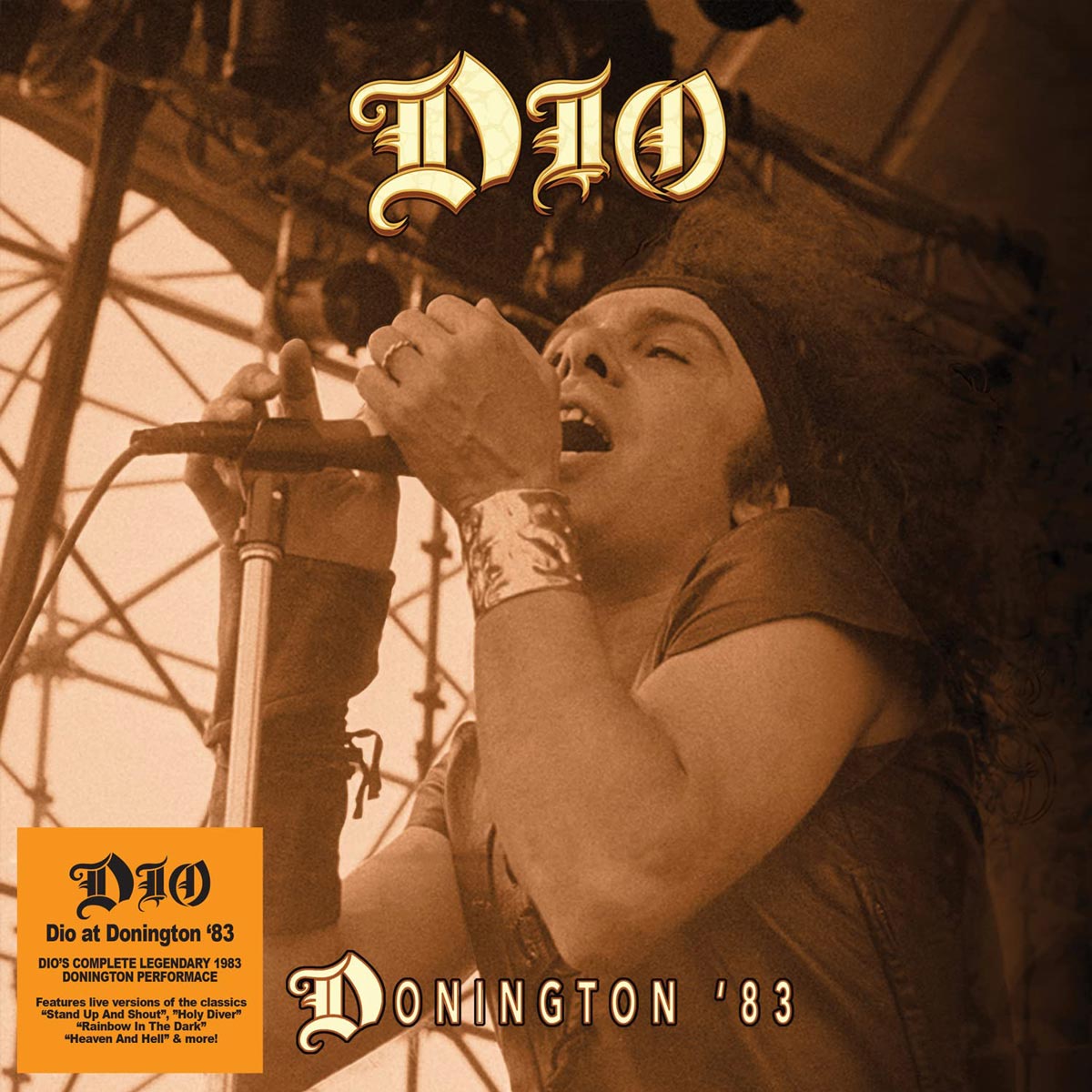
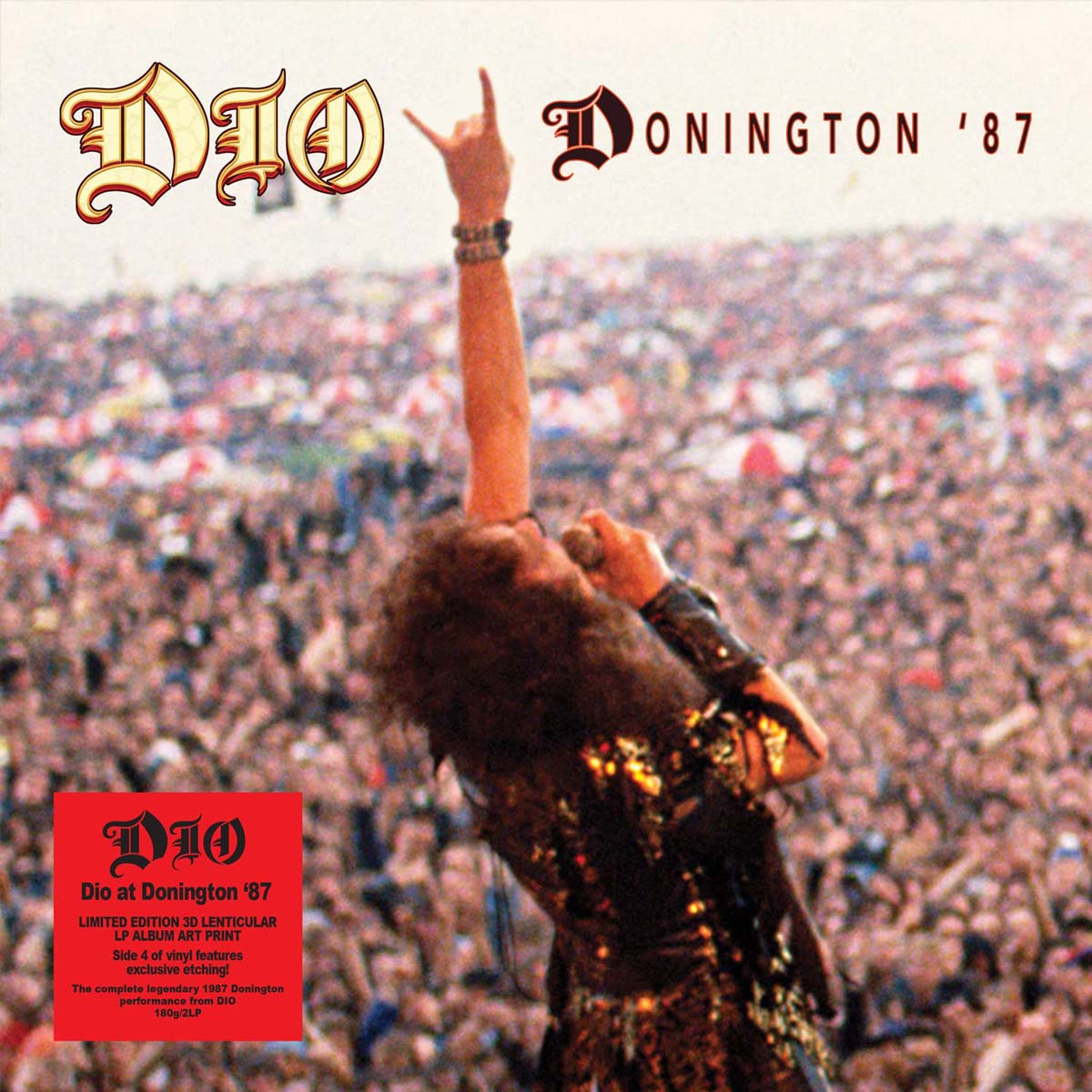
Am 10. Juli dieses Jahres wäre Ronnie James Dio 80 Jahre alt geworden. Ob er immer noch die Bühnen dieser Welt mit seiner unvergleichlichen Stimme zum Beben gebracht hätte? 1983 jedenfalls schien alles möglich.
Der Jahrhundertsänger hatte endgültig abgeschlossen mit seinen Engagements bei Elf, Rainbow und Black Sabbath. Sein Solodebüt Holy Diver schlug im Mai ein wie eine Bombe, drei Monate später verwandelte der damals 41-Jährige zusammen mit seiner Band das renommierte, damals noch „Monsters of Rock“ betitelte Donington-Festival in einen Hexenkessel. Auf der Setlist: Holy Diver-Klassiker wie der Titelsong, „Rainbow In The Dark“ und „Stand Up And Shout“, aber auch der Rainbow-Hit „Man On The Silver Mountain“ oder der Black-Sabbath-Standard „Heaven And Hell“. Nicht minder angriffslustig das Line-up vier Jahre später, bei dem anstelle von Vivian Campbell nun Craig Goldy die sechs Saiten bediente. Inzwischen mit insgesamt vier Longplayern im Katalog konnten Dio für die Setlist aus dem Vollen schöpfen. Kracher wie „The Last In Line“ reihen sich an Rainbow-Hymnen wie „Long Live Rock’n’Roll“ und die seinerzeit brandneuen „Naked In The Rain“ und „Dream Evil“. Ein wenig wehmütig gibt man sich dem Ritt durch Dios Schaffen hin – in Gedanken die Gewissheit, diese wegweisenden Songs nie wieder live präsentiert zu bekommen. Dio At Donington ’83 & ’87 lindert als Ersatz aus der Konserve den Schmerz zumindest für die Laufzeit der Tonträger.
Label: Niji Entertainment/BMG
Format: jeweils CD + 2 LPs
Michael Wagener in his studio, WireWorld 2.0, in an undated promotional photo for Eve Audio. Eve Audio
Nashville, TN (April 26, 2021)—Michael Wagener, the ears behind some of the biggest albums in metal history, announced his retirement Sunday, April 25—his 70th birthday. More than 90 million albums sold feature his name in the credits, as he worked with the biggest names in hard rock and heavy metal, including Metallica, Poison, Megadeth, Ozzy Osbourne, Skid Row, X, Mötley Crüe, Great White, Plasmatics, White Lion, Alice Cooper, Extreme, Dokken, Stryper, W.A.S.P., Overkill, .45 Grave, Accept, Testament, Helloween, Keel and more, as well as artists in other genres such as Janet Jackson and Muriel Anderson.
I have now been active in the music business for over 50 years and I think it’s time to retire and get out and catch up on some vacations. I have sold the studio and Double Trouble Productions does no longer exist as an official company.
I had an amazing time and met a ton of wonderful people and I am thankful for having been able to work with such great musicians and create such wonderful music.
Now it’s time to see some more of the world.
This site will eventually disappear. No more mixes, productions and workshops. The studio has been sold and except for some guitars, amps and minimal studio gear there is not much left here.
I want to thank you all for allowing me to live a great life and to do what I love. I am looking at a future of lots of traveling; it has been a great trip so far.
As a teenager in Germany, Wagener was the first guitarist for the band that would eventually become Accept, but had to quit when he was drafted into the army at 18. In 1972, he began working for a Hamburg, Germany company called Stramp that produced equipment for studios and stage use; during that time, he earned a degree in electronics engineering. By the late 1970s, he had built a 16-track studio in Hamburg, Tennessee Tonstudio, where he learned studio production and maintenance. While there, he met American guitarist Don Dokken, who was touring Germany at the time, and the two became fast friends. When the self-named group Dokken was signed two years later, Wagener produced its first album, Breaking The Chains, which went gold in the U.S.
With that success, Wagener became busy over the next few years primarily as an engineer and mix engineer, as the then-burgeoning metal movement exploded. He teamed with lifelong friend and leader of Accept, Udo Dirkschneider, to form a production company, Double Trouble Productions, and during that time, also mixed debut albums for Mötley Crüe and Great White. With the U.S. hungry for metal, Wagener moved to Los Angeles in 1984, soon producing X’s Ain’t Love Grand and Stryper’s Soliders Under Command.
Over the ensuing years, he mixed noted albums like Metallica’s Master of Puppets, Megadeth’s So Far, So Good…So What, Ozzy Osbourne’s No More Tears and Poison’s debut, Look What The Cat Dragged In. Meanwhile, he took on the producer mantel for Skid Row’s triple-platinum self-titled debut, Alice Cooper’s Raise Your Fist and Yell, Extreme’s commercial breakthrough Pornograffitti, Warrant’s Dog Eat Dog and others, while also netting a top-10 single with Janet Jackson’s pop-metal track, “Black Cat.”
While continuing to work with hard rock and metal acts throughout his career, Wagener moved to Nashville in 1996 and built his own digital recording facility, WireWorld Studio, which evolved to become a fully digital 5.1 surround production facility.
Host Patrick Radden Keefe (left) and producer Henry Molofsky (right) interview a Scorpions fan outside Luzhniki (formerly Lenin) Stadium, where the Moscow Music Peace Festival took place in 1989. The show’s portable rig included a Zoom H6 recorder paired with Rode NTG-2 shotgun mics.
New York, NY (June 4, 2020)—“One of the goals was to make this sound like a very big production and have it feel cinematic in its scope and sound,” says Henry Molofsky, producer of the hit podcast, Wind of Change. Capturing the vibe of a big-budget spy thriller was crucial for a podcast that asks an intriguing but potentially dangerous question: What if the U.S. Central Intelligence Agency wrote “Wind of Change,” the enormously successfully 1991 power ballad by hard rockers Scorpions, in a bid to bring the Cold War to an end?
Wind of Change, the eight-episode podcast from Pineapple Street Studios, Crooked Media and Spotify, explores how that may have actually happened, as host Patrick Radden Keefe unpacks layers of connections and coincidences among the CIA and people near to the German rockers’ inner circle.
The setup is storytelling gold: Scorpions frontman Klaus Meine has always said in interviews that he was inspired to write “Wind of Change” after playing the Moscow Music Peace Festival at Lenin Stadium in 1989 alongside Bon Jovi, Mötley Crüe and other titans of late ‘80s hard rock. But did Doc McGhee, who managed all three bands at the time, arrange the whole affair to escape drug trafficking charges so the CIA could score a cultural hit with young Soviets?
For the record, all parties deny that salacious spy-games premise—but the intrigue doesn’t end there. While Keefe and Molofsky chased leads and operatives from New York to Russia and Germany, Molofsky was tasked with capturing audio in a multitude of environments—a Scorpions stadium concert held in Russia, a boat on the Moskva River in Moscow on a windy night, telephone calls with secret agents, and even random hotel rooms with former CIA spies.
The Wind of Change podcast explores whether the CIA wrote “Wind of Change,” the worldwide smash hit by German hair metal act Scorpions, seen here playing Moscow in November, 2019. Released in 1991, the song sold 14 million copies around the globe and became an unexpected anthem for the end of the Cold War. Mikhail Svetlov/Getty Images
Molofsky typically tracks at Pineapple Street’s Brooklyn headquarters, in a studio outfitted with Wenger isolation and a custom-made table with spots for four Shure SM7B dynamic microphones, which run through a Universal Audio Apollo 8 into an Apple Mac Mini. That’s where he tracked one of the podcast’s most dramatic moments, which featured a former spy who is still not allowed to admit she was in the CIA.
“We had the spy, whose pseudonym is Rose, call in remotely,” Molofsky explains. “Then I left Patrick’s original track in, and had Briana [Feigon, a voice-over actor] re-read Rose’s lines in my apartment on a table-top microphone. I added a phone effect to make her sound like she was on the phone.”
Molofsky’s rig for recording audio on location around the world was a Zoom H6 recorder paired with Rode NTG-2 shotgun mics. When he had multiple speakers, he used one mic for each speaker, and made use of the Zoom’s built-in stereo mics to get a different fidelity and tone for entry and exit scenes. This same setup captured the podcast’s climactic scene, when they met Meine at a hotel in Hanover, Germany to talk about the origins of “Wind of Change.”
“We got there more than an hour early just because we were so nervous,” he says. “We set up mics, we set up the table. We got coffees for him and had everything prepared so he could just come on in. We were rolling as he walked in [and] I had my phone on just in case disaster struck and we missed our one interview.”
International spies are used to being recorded, but this time the mics weren’t hidden.
Luckily, he pulled off the audio that day, but the podcast soon ran into a potentially disastrous snag toward the end of the year-long production, when COVID-19 hit before they had recorded a single word of Keefe’s narration. Molofsky had to outfit the host with a home-recording setup and run trial and error remotely to get the audio as good as possible. With narration recorded, he then relied on processing in post-production to bring the audio up to par: “It was disappointing that we couldn’t do all the final tracking in a studio. At that point, my goal was basically not to kill the production that we’d put so much time into with this final step—which is most of what people are actually hearing, time-wise.”
The result is a podcast that’s become a smash hit, rewarding the podcast team after an uneasy year of production. “It was very nerve wracking at times,” Molofsky says now. “We would be texting with someone who’d spent years undercover in Moscow and say, ‘Hey, can you meet us in the room 212 at this hotel in Adams Morgan in [Washington] D.C.?’ I wouldn’t know who’s showing up. And it’s even scarier in Russia.”