Tag Archives: Harman International

Harman Kardon factory tour: Pure to the art of sound

Some of the Harman and competitor headphones that we’ve recently tested.

Giving Harman R&D lab tours and presentations to customers and audio journalists is a part of my job. Recently, we played host to some automotive journalists in town attending the Los Angeles Auto show.

Automotive audio journalist Shawn Molnar wrote this great article about his visit to our R&D labs that you can read in his popular BMWBlog.

Shawn gives an overview of  his visit to our labs where we showed the journalists our R&D facilities used for testing and evaluating Harman loudspeakers, headphones and automotive audio systems.  Most people I meet know Harman for its JBL and Harman Kardon consumer and professional products. They are surprised to lean that 75% of our sales are from Harman branded (JBL, Harman Kardon, Infinity, Lexicon, Mark Levinson) automotive audio and infotainment systems.

Research by CEA has found that consumers now spend almost as  much time listening to music in their cars as they do in their homes.  Moreover, the audio experiences in the car are increasingly more sonically satisfying than those experienced in the home. Branded audio systems in premium cars typically provide 7-channel surround sound through 16+ loudspeakers that deliver a full-range, balanced, enveloping sound stage that can reach concert sound pressure levels. Compare this to the tinny, spatially bereft stereo speakers in your MacBook Pro or flat panel TV, and you begin to understand why people are listening to music through headphones when they’re not listening in their cars.

So, why don’t automotive journalists spend more time writing about audio / infotainment systems in cars given that consumers tell us it’s an important factor in their overall satisfaction rating of the car?  When reading reviews of new cars, wouldn’t it be nice to hear more about the quality of the audio system than how many heated cup holders it has?

The Science and Marketing of Sound Quality

To my surprise, this morning an audio friend tweeted a link to an article I recently wrote for our company’s  internal newsletter  entitled, “The Science and Marketing of Sound Quality.”  My article can be found on a new Harman Innovation website  launched today that features articles on current and future disruptive technology that will impact consumers’ infotainment experiences. Check it out.

My article focuses on a longstanding pet peeve of mine (first mentioned in this blog posting): The lack of  perceptually meaningful loudspeaker and headphone specifications in our industry.  While consumer surveys repeatedly report sound quality to be a driving factor in their audio equipment purchases, consumers lack the necessary tools and information to identify the good sounding products from the duds.

This is particularly true for loudspeakers and headphones where the typical throw-away “10 Hz to 40 kHz” specification provided by the manufacturer is utterly useless. This specification only guarantees that the product makes sound, with no guarantee that the sound is good.  While the science exists today to accurately quantify and predict the perceived the sound quality of  loudspeakers (and hopefully, soon headphones), the audio industry continues to drag its heels into the 21st century,  and not routinely provide this information to consumers.

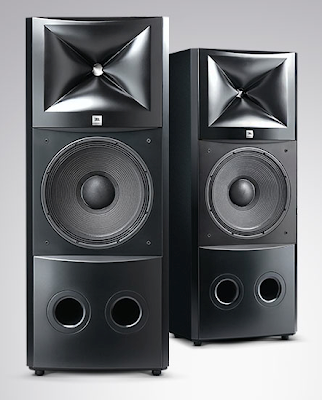
A rare exception is JBL Professional who provides comprehensive detailed measurements on studio/broadcast monitors like the new JBL M2 Master Reference shown below. Inspecting the measured frequency response curves shown  below, you can easily recognize the loudspeaker sounds exceptionally neutral and accurate based on the shape (flat, smooth, and extended)  Based on this set of measurements, we can predict how a listener would rate the sound quality of the loudspeaker in a controlled listening test, with 86% accuracy. The only pertinent information not shown in this graph is how loud the loudspeaker will play before producing audible distortion (trust me, this loudspeaker will play very loud! )

Perceptually meaningful loudspeaker specifications like these have been available for almost 30 years! Yet,  these specifications are currently not part of any professional and consumer loudspeaker standard. Such a standard would go a long way towards improving the quality and consistency of recorded and reproduced sound. Audio consumers want to hear the truth. We need to provide better information and audio specifications so they can find it.

JBL M2 Master Reference Monitor provides true reference sound quality that is clearly indicated by its technical measurements shown below. 
The spatially-averaged frequency response curves of the JBL M2  (from top to bottom) for the listening window (green), the first reflections (red), and the total radiated sound power.  At the bottom are shown directivity indices of the sound power (dotted blue) and first reflections (dotted red). These measurements tell us that the quality of the direct and reflected sounds produced by the loudspeaker will be very accurate and neutral over a relatively wide listening area.

Harman Researchers Make Important Headway in Understanding Headphone Response

Todd Welti, Sean Olive and Elisabeth McMullin are shown above with their custom binaural mannequin, “Sidney” wearing a pair of AKG K1000’s. No fit or leakage issues with these headphones.

Tyll Hertsens, Chief Editor at Innerfidelity recently visited our research labs in Northridge, and wrote a nice story in his blog about our headphone research and visit to Harman. You can read the entire story here.

In his story, Tyll summarizes three of our recent AES papers on headphones, the first one of which I already wrote about in this blog. I hope to write summaries of the other two papers in the upcoming weeks when I can find some free time.

Behind Harman’s Testing Lab

This past week I had an enjoyable time meeting well-known technology writer Robert Scoble who was visiting our Harman facilities in Northridge, CA along with his geek-in-command Sam Levine. As part of the tour, I showed  them our Reference Listening Room and Multichannel Listening Lab where we do product research and double-blind evaluations of loudspeakers. We discussed the science and philosophy behind how we design and measure the sound quality of our products.

One of the topics of discussion was my recent research that explores whether high school and college students from USA and Japan have different tastes and preferences in the quality of reproduced sound compared to older trained listeners.  We talked about differences in the tastes and performances of trained versus untrained listeners, and how Harman is able to accurately predict  subjective preference ratings of loudspeakers based on a predictive model that analyzes a set of comprehensive anechoic measurements.

After running Robert and Sam through a few trials of listener training using  our software “How to Listen”, I decided to put them through a couple of double-blind listening test trials to see if they had the right stuff. They compared four different brands of floor-standing loudspeakers located  behind an acoustically transparent, visually opaque curtain where each loudspeaker is shuffled into the same position via an automated speaker shuffler. All of our tests are conducted double-blind because we have found that even trained listeners are influenced by nuisance variables such as brand, price, size, etc.

 In these tests Robert and Sam heard the same four loudspeakers that have been evaluated previously by hundreds of untrained listeners including young, old, American, Asian, and European listeners, whose preferences and performances were compared to those of our panel of trained listeners. From these tests, we have found evidence that most listeners prefer the most accurate, neutral loudspeaker regardless of age, culture or listening experience.

When the listening trials were done, the curtain went up, and Robert and Sam were surprised to discover their favorite choice was the most accurate loudspeaker which was the least expensive. The science works.  One of the speakers Robert didn’t like was a model that he actually owned: it had excessive amounts of treble and upper bass, which I’m told is mandated by the manufacturer’s marketing department who believe that “boom and tizz” are what their customers want. Luckily, I haven’t met many of their customers, yet. Robert, then surprised me by turning on his camera doing an impromptu interview, which hopefully you’ll enjoy. If you want to learn more about the engineering process and tools behind designing a speaker, check out the interview with one of our speaker engineering stars, Charles Sprinkle.

In my next blog posting I hope to discuss some of the exciting research we’ve been doing on the relationship between the perception and measurement of headphone sound quality. The goal is to develop the same science for measuring and predicting the sound quality of headphones that we’ve found useful for designing good sounding loudspeakers.  Stay tuned!

More Evidence that Kids (American and Japanese) Prefer Accurate Sound Reproduction


Geoffrey Morrison, an audio writer at CNET and Sound & Vision has posted a nice summary  of my latest AES paper “Some New Evidence that Teenager and College Students May Prefer Accurate Sound Reproduction” presented at the recent  132nd AES Convention in Budapest, Hungary.


The paper is available for download here at the  AES E-library, and I have provided a YouTube video and a PDF of my presentation slides that summarize the main points of the research.


 The abstract of the paper reads as follows:


A group of 58  high school and college students with different expertise in sound evaluation participated in two separate controlled listening tests that measured their preference choices between music reproduced in (1) MP3 (128 kbp/s) and lossless CD-quality file formats, and (2) music reproduced through four different consumer loudspeakers. As a group, the students preferred the CD-quality reproduction in 70% of the trials and preferred music reproduced through the most accurate, neutral loudspeaker. Critical listening experience was a significant factor in the listeners’ performance and preferences. Together, these tests provide some new evidence that both teenagers and college students can discern and appreciate a better quality of reproduced sound when given the opportunity to directly compare it against lower quality options. 


The effects of culture and trained versus untrained listeners on loudspeaker preference are topics that have been discussed in previous postings on Audio Musings. To further shed some light on this topic, I also ran 149  native speaking Japanese college students through the same loudspeaker preference test along with 12 Harman trained listeners.  The graph below shows the mean loudspeaker preference ratings for these two groups of listeners along with the four different groups of high school and college students from Los Angeles.  


Not surprising, (at least to me) I found that the Japanese college students on average preferred the same accurate loudspeaker (A) as did the 58  Los Angeles students, and the trained Harman listening panel. The main differences among the different listening groups  were related to the effect of prior critical listening experience:  the more trained listeners simply rated the loudspeakers lower on the preference scale, and were more discriminating and consistent in their responses. This result is consistent with previous studies. The least preferred and least accurate loudspeaker (Loudspeaker D) generated the most variance in ratings among the different listening groups. This  was explained by its highly directional behavior combined with its inconsistent frequency response as you move from on-axis to off-axis seating positions. This meant that listeners sitting off-axis heard a much different (and apparently better quality) sound than those listeners  sitting on-axis.


 While the small sample size of listeners doesn’t allow us to make generalizations to larger populations, nonetheless it is reassuring  to find that  both the American and Japanese students, regardless of their critical listening experience, recognized good sound when they heard it, and preferred it to the lower quality options.


It would appear that the reason kids don’t own better sounding audio solutions has nothing to do with their supposed “deviant”  tastes in sound quality, but more do with  other factors  (e.g. price, convenience, portability, marketing, fashion) that have nothing to do with sound quality.  Music and audio companies should take notice that kids can indeed discriminate between good and bad sound, and prefer accurate sound, despite what the media has been falsely reporting for the last few years. With that out of the way, we should focus on figuring out how to sell sound quality to kids at affordable prices and form factors  they desire to own.


The research suggests that if we cannot figure out how to sell better sound to kids, we have no one to blame but ourselves. 

Topics Related to Perception and Measurement of Reproduced Sound

On Tuesday, April 26th 2011, I will be giving a presentation at the meeting of the Los Angeles AES Chapter on several topics related to recent audio research at Harman International. The topics include:

I’ve briefly discussed these topics in Audio Musings over the past few months, and you can find summaries of them by clicking on the links above. I’ll be giving an update on new findings, and briefly touch on topics not mentioned above. As a door prize, Harman will donate a free copy of Dr. Floyd Toole’s book Sound Reproduction (shown on the right side bar) autographed by the author of the book.

AES members and nonmember guests are welcome to attend. The meeting will be held at the Sportmen’s Lodge in Studio City. More details can be found at the Los Angeles AES website.

The Danger From Headphones

Below is an English translation of a recent article “Gefahr aus dem Kopfhörer“ (The Danger From Headphones) written by Matthias Hohensee over at Valley Talk. His article refers to my recent investigations into whether younger generations prefer lossy MP over higher quality music file formats. The preliminary results of that study were reported in the article I recently posted called, “Some New Evidence that Generation Y May Prefer Accurate Sound Reproduction”.
Matthias makes a good point about listener preference for MP3 becoming a moot issue with higher quality file formats becoming the standard, as bandwidth and music storage costs drop. I only briefly mentioned this in my slide presentation (see slide 7), but it deserves repeating. The days of low quality music downloads are numbered, I hope. Then, the main sound quality issue will become the recordings themselves, and the quality of the headphones and loudspeakers through which the recordings are heard. What are your thoughts on this matter?

The Danger from Headphones
by Matthias Hohensee
from Valley Talk 6.30.2010
Can the Germans be really proud of MP3 or has the digital stroke of genius desensitized the hearing of a complete generation?

When Angela Merkel recently visited the prestigious Stanford University in Silicon Valley and enumerated German technology services, she also mentioned the data compression method MP3. The technology that was largely developed by scientists at the Fraunhofer Institute has changed the music industry, even though it’s mainly U.S. companies that profit from the MP3 player market.
But can the Germans be really proud of MP3? Or has the digital stroke of genius desensitized the hearing of a complete generation? At least the observations of Jonathan Berger suggest this. Over the years the Stanford professor of music has been asking his students if they are satisfied with compressed music files, or if they prefer the full Hi-Fi sound.
He came to a surprising result: For years, the number of those who preferred the sound of ‘packed’ music to the uncompressed audio spectrum seems to grow steadily. Berger concludes that the taste of sound has changed.
Good sound is measurable
Sean Olive, on the other hand, considers Berger’s insight as nonsense: “Good, accurately reproduced sound is not a question of taste, but scientifically measurable.” And this is the way he should see it. After all, Olive is the head of acoustic research at Harman International. The U.S. manufacturer is considered to be THE address for sophisticated sound systems.
Alarmed by Berger’s observations Olive recently invited Los Angeles high school students to the Harman studios for extensive tests. “Everyone could hear the difference between different compacted sound files – and preferred less compressed songs,” says the scientist relieved.
Danger from headphones
Now, Olive is not really unbiased, after all Harman sells nearly three billion dollars worth of high-end audio technology per year. But in fact, technical progress makes Olive’s worries already obsolete. In times of high-speed Internet, data compression does not play the same role as it did in the nineties when the music piracy supplier Napster made MP3 popular.
The songs that were exchanged back then were extremely compressed in order to distribute them via the still slow Internet connections – but also to spare the limited memory of computers and MP3 players. Today the vendors such as Apple and Amazon are selling songs which are formatted in such a way that only real audiophiles can hear the difference to music CDs.
And so the real dangers for the hearing of ‘generation iPod’ aren’t the highly compressed music files, but simply the volume adjustment of their headphones.

Acknowledgements: Thank you to the author Matthias Hohensee for permission to repost his article here, and to Alena Winterhoff for the English translation.