Tag Archives: telefunken

Mixing The Iron Maiden ‘Legacy Of The Beast’ Tour, Part 2

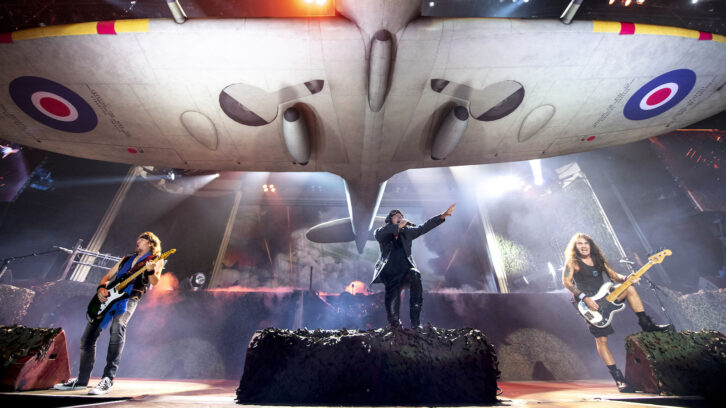
Pooch uses subtle panning to localize and help define each of the band’s three Fender-wielding guitarists in the house mix. Photo: John McMurtrie.
Pooch makes use of delicate panning to localize and assist outline every of the three Fender-wielding guitarists in Iron Maiden inside the home combine. Photo: John McMurtrie.

Concluding our protection of the four-year Iron Maiden ‘Legacy of the Beast’ tour, FOH engineer Ken “Pooch” Van Druten shares how he approaches every instrument within the combine, the band’s monitor system, what’s in retailer for the upcoming Future Past tour and extra. Don’t miss Part 1, the place he discusses key plug-ins, outboard gear, combine suggestions and extra!

Bringing all that gear to bear on the combination meant Pooch might focus in on the small print of the songs. “They’re super-nuanced, and that’s what makes this band sound nice, so I take advantage of the digital console with all its snapshot know-how to get into these moments,” he says. “For occasion, one of many powerful components about mixing them is that there’s three guitar gamers that each one play Fenders via Marshalls, so there’s considerably related tones and so they’re actually in the identical frequency vary; discovering house so that you could choose them out individually within the combine is troublesome. My answer was to place them in their very own panning areas primarily based on the place they’re on stage. Dave Murray is on stage proper, so he’s panned stage proper—not panned onerous all the best way, however he’s over there—whereas Adrian Smith is close to the middle, and Janick Gers is on stage left. It’s huge, extensive, unfold out, and you’ll select each single guitar—however then I additionally needed to construct snapshots in order that each time one of many guitarists solos, it snaps to the middle, they play it, after which the subsequent snapshot will get them again to their spot. It’s these sorts of nuances that make a distinction.”

To seize these guitar sounds, every guitar participant had three inputs, comprised of usual-suspect microphones like Shure 57s and a Palmer PDI-09 Junction Guitar Direct field, which captured sound after the consequences and preamps, plus it picked up the heat of the guitar amp itself.

FOH engineer Ken “Pooch” Van Druten is ready to rock behind his DiGiCo Quantum7 desk in Charlotte, North Carolina.
FOH engineer Ken “Pooch” Van Druten is able to rock behind his DiGiCo Quantum7 desk in Charlotte, North Carolina.

Of course, as Iron Maiden followers will notice, there was one other essential guitar sound that needed to be extraordinarily current within the combine: the bass of Steve Harris. “His bass tone may be very completely different than anyone else on the market; it’s nearly like a fourth guitar, as a result of it doesn’t have an entire lot of low finish in it,” Pooch concedes. “If you hearken to any Iron Maiden file, vocals are the loudest aspect, and the subsequent loudest factor is the bass guitar. He has a signature sound you could’t seize with a DI; we use an SM7 on his cupboard, and that’s the sound of Steve Harris.”

Meanwhile, Nicko McBrain’s drum sound was captured with a slew of mics, beginning with a Randall May system contained in the kick drum, used to assist each a Shure Beta51 and a SM91 boundary mic to get a few of the shell sound. Nearby, the snare was heard through a Shure SM57 on backside and a Telefunken M80-SH on prime, chosen partly for its bump within the high-end to higher seize the crack of the snare. The hi-hat cymbal sported a DPA 2011C, whereas the trip cymbal acquired a Mojave Audio MA-201fetVG LDC; that very same mannequin was used for overheads as nicely.
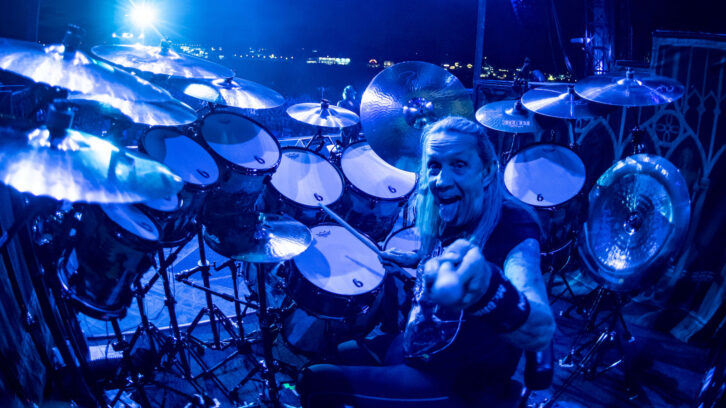
Iron Maiden drummer Nicko McBrain. Photo: John McMurtrie.
Nicko McBrain’s drum equipment is captured by Shure, Telefunken, DPA and Mojave Audio mics. Photo: John McMurtrie.

Nonetheless, a lot of the drum equipment actual property was taken up by at least 9 toms, every with its personal DPA d:vote 4099 CORE mic, apart from the 6-inch and 8-inch which shared one. Faced with so many open microphones on the toms, Pooch notes, “I’m triggering gates, however fairly than the gate getting its threshold data from the audio sign, it comes from a set off that’s affixed on the aspect of every drum shell.”

Over within the Iron Maiden Monitorworld sat a pair of DiGiCo SD desks; there, longtime monitor engineer Steve “Gonzo” Smith taken care of Harris’ combine, whereas the remainder of the band was underneath the watchful eye of Kevin “Tater” McCarthy. While all three guitarists sported in-ear screens, there was nonetheless loads of sound overlaying the stage—McBrain had his personal large, customized wedge and sub for monitoring, whereas each Dickinson and Harris most popular to get their mixes from an enormous assortment of audio system. Intriguingly, there have been two units of aspect fills, with one operated by every monitor engineer; Harris’ sidefills have been old-school Turbosound TMS3s, supplemented downstage by three units of the band’s personal customized wedges, relationship again to the Eighties. Meanwhile, Dickinson most popular his personal L-Acoustics sidefills additional upstage nearer to the drum equipment, and likewise heard upward of two-dozen d&b audiotechnik M2 and M4 wedges across the stage.
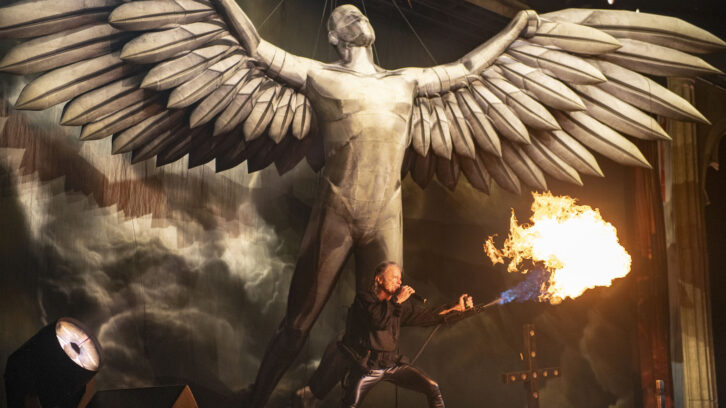
Iron Maiden vocalist Bruce Dickinson belts into a Shure Beta 58 while brandishing a flamethrower and its 30-pound backpack. Photo: John McMurtrie.
Iron Maiden vocalist Bruce Dickinson belts right into a Shure Beta 58 whereas brandishing a flamethrower and its 30-pound backpack. Photo: John McMurtrie.

With the four-year Legacy of the Beast trek now over, one would possibly anticipate Iron Maiden to take it simple for a couple of minutes, however the band will get again on the street in May; the 2023-24 Future Past tour will function the correct introduction to the brand new Senjutsu album whereas additionally shining a highlight on the often-underplayed Somewhere in Time from 1986. Already wanting ahead to it’s Pooch, who continues to be one of the vital current additions to a crew the place most personnel have logged a long time working for the group. “I’m the brand new child on the block, having been right here for 5 years,” he laughed. “They are a tremendous band to work for; I’ll keep right here for so long as they’ll have me.”

Capturing Chris Young’s Live Sound On Tour

Country star Chris Young kicked off the year with a sold-out run that included the 10,000-seat Mohegan Sun Arena in Uncasville, Conn. PHOTO: Paris Visone
Country star Chris Young kicked off the 12 months with a sold-out run that included the ten,000-seat Mohegan Sun Arena in Uncasville, Conn. PHOTO: Paris Visone.

Nashville, TN (March 20, 2023)—Chris Young has by no means been one to take a seat nonetheless; since bursting onto the charts in 2006, the singer/songwriter has amassed a truckload of number-one Country singles and a fervid following that catches him each time he goes on tour. In January this 12 months, the Grand Ole Opry member dropped two new singles, “Looking For You” and “All Dogs Go To Heaven,” to tease his upcoming ninth album, and to underline their launch, he headed out on the highway for 4 exhibits as properly—a preamble to a giant 12 months forward that may embrace a string of spring dates, festivals over the summer season after which a full-on enviornment tour within the fall.

The concert events additionally served as a chance to shake issues up a bit bit. While the nation star and his band nonetheless knocked out the hits, in addition they road-tested a brand new setlist, the brand new songs—and a brand new home engineer, too, with Erik Rogers taking up the FOH combine place. While Rogers spent the previous couple of years mixing heavy acts like Godsmack, Avatar, Breaking Benjamin and Falling in Reverse, he welcomed the possibility to dive into nation once more: “I blended a rustic artist, Dustin Lynch, for fairly some time, and again in 2017, one of many acts we opened for was Chris Young. The tour supervisor, Bill Cracknell, remembered me; we had a cellphone name a number of weeks in the past and right here I’m.”

The quick Winter run of sold-out on line casino arenas gave everybody on and off-stage time to work collectively and guarantee the whole lot was on-target earlier than the larger treks later within the 12 months. “The band has been collectively for a very long time, but it surely’s a predominantly new crew,” Rogers defined. “Everybody is aware of what they’re doing, however now we now have to do it collectively and current it to a roomful of strangers each night time as if we’ve been doing it collectively for 20 years! We did every week of rehearsals in Nashville, had 4 exhibits to dial it in and we’re already a well-oiled machine.”

The exhibits weren’t a warm-up, nevertheless—they ran pink sizzling from the beginning, with each the artist and audiences leaning into it. “Even the brand new songs that had been simply launched, the viewers already is aware of each phrase,” Rogers marveled, “after which you’ve the massive hits the place not solely do they know each phrase, however they scream them! It’s cool to have an viewers that engaged.”

While some mixers may pound the amount to get the combination over the group, Rogers prefers to maintain the SPLs civil. “I let the followers get it out of their system,” he chuckled. “Our present stays proper round 100 dBA averaged over 90 minutes. Of course, there are louder and quieter spots, they usually contribute to that—I measured the viewers the opposite day at 106!”

Hitting the road with Chris Young, FOH engineer Erik Rogers has been mixing on a Yamaha Rivage PM10 console for the first time. PHOTO: Paris Visone
Hitting the highway with Chris Young, FOH engineer Erik Rogers has been mixing on a Yamaha Rivage PM10 console for the primary time. PHOTO: Paris Visone.

Both the home and monitor positions are centered round Yamaha Rivage PM10 consoles, supplied by Young’s longtime audio firm of alternative, Sound Image Nashville. Rogers and John Weaver—Young’s monitor engineer since March, 2020—every get 56 inputs coming from the stage; whereas the 2 PM10s are impartial methods, they’re additionally networked along with one taking the opposite’s outputs, and all talkback and chat loops run by means of fiber solely.

Joining the Chris Young camp marks the primary time Rogers has labored with a Rivage desk, barring one night time filling in on a Bush tour 5 years in the past. “While there’s a studying curve, that’s the case with any console,” he identified. “My expertise thus far is that it sounds nice, operates properly, and when you wrap your head round the way you patch, assign DSP for plug-ins and issues like that, it’s identical to some other desk, besides that it sounds actually, actually good. I do know colleagues that take the Rivage out with Shinedown, Luke Bryan and Garth Brooks, they usually all swear by these desks; after utilizing it for 4 exhibits, I can see why.

“One factor I’ve discovered concerning the Yamaha is to belief the desk,” Rogers added. “I attempted to make use of some outboard plug-ins, they usually don’t sound nearly as good. To me, time-aligning the whole lot to exit of the console and again in wasn’t definitely worth the work to make it sound correct, as a result of the whole lot on the desk—the Rupert Neve Designs SILK processing, the Portico plug-ins and the opposite Yamaha options in there? You can’t beat ’em. They sound actually good, so I’m simply utilizing the desk.”

That mentioned, there have been a handful of Waves plug-ins used for combine buss processing, hosted externally on a Mac Studio operating Audioström Live Professor software program and Audinate’s Dante Virtual Soundcard. “The cool factor about Live Professor is that it could run any plug-in native with out a server,” he defined, “so you’ll be able to have Sonnox, Brainworx, Waves, all of those a number of producers’ plug-ins on the identical platform.”

Cover Story: Kenny Chesney—Taking Here and Now to Another Level

With the crew altering however the band staying the identical, the miking for the seven musicians onstage and their guitars’ ISO cupboards has remained the identical as properly. “Chris owns all of his mics, and it’s a smorgasbord—Beyerdynamic, Telefunken, Sennheiser; there’s a bit one thing off the buffet for everyone up there proper now,” mentioned Rogers. “I’ve began engaged on mic placement and doing a little fine-tuning, however I’m conserving in thoughts that these guys are very pleased with their in-ear mixes. Any adjustments should be achieved in live performance with John, our monitor engineer, as a result of issues that I would transfer for nuance at front-of-house might trigger drastic adjustments for in-ears and make life very tough for the folks onstage.”

In the previous, the band’s monitor mixes had been dealt with with a mixture of sidefills and JH Audio JH11 in-ear screens, however that’s altering for 2023, mentioned Weaver: “Chris Young is transferring from utilizing sidefills and just one in-ear monitor, to utilizing each in-ears all by means of the present, with no sidefills in sight. The Rivage PM10’s EQ and the Portico 5043 compressor with the dynamic EQ actually helped with getting the readability we would have liked of their in-ears to attain this large change.”

While the autumn tour will carry full manufacturing, the fast on line casino enviornment run picked up native stacks and racks, so audiences had been handled to line arrays from L-Acoustics, Meyer Sound, RCF and Electro-Voice. Regardless of the P.A., at each cease, followers heard Young and his band clean up his setlist staples whereas additionally including some new soon-to-be favorites, leading to concert events that stored issues feeling new but additionally acquainted. With that in thoughts, Rogers stored the mixes true to what was coming off the stage—not replicating the report, however not heading into the nice unknown both.

“In dialog with the artist and administration, they needed one thing that felt stay and uncooked,” mentioned Rogers, “however once you’re mixing an artist that’s bought dozens of plaques on their wall for large hits, you’ve bought to maintain the tonality of the track comparatively near the unique intent, so that each one these hits sound like what folks have been listening to for 17 years. When you’ve a fan base that loyal, you don’t wish to instantly change the whole lot. There are parts and melodies which can be essential, and we take note of these issues. But then there’s additionally the massive nearer, ‘Aw Naw,’ which begins off as a rustic track and finally ends up with a giant rock’n’roll jam for the tip of the night time. That’s nowhere on the report—that’s the sound of a band having a whole lot of enjoyable!”

Paul “Willie Green” Womack Tours Telefunken

Independent hip-hop and R&B producer Paul "Willie Green" Womack at the controls.
Independent hip-hop and R&B producer Paul “Willie Green” Womack at the controls.

South Windsor, CT (January 29, 2021)—Independent hip-hop and R&B producer Paul “Willie Green” Womack recently returned from filming a video at Telefunken’s headquarters and has also been putting his new Telefunken TF11 microphone through its paces at his Brooklyn recording studio.

Green with his new Telefunken TF11 microphone.

Green was at Telefunken’s headquarters in Connecticut to produce and film 30 minutes in the company’s recording studio and sound stage for the 2021 NAMM Believe in Music Week: “By visiting their manufacturing center, I could see firsthand how their mics are put together so meticulously.”

Green, whose production credits include Wiz Khalifa, Donnie McClurkin, The Roots, Billy Woods, Elucid and others, continues, “My first impression is that the new TF11 sounds very polished, and it sounds like a modern microphone. Telefunken has such a long history of so many great mics, but this one has a progressive, refined sound, which is what I was looking for, especially for the hip-hop and R&B I do.

“The top end is bright and not hyped, and it’s open and airy, the way you want, especially for modern R&B. You want that top end on there, but for things I would usually do for an R&B or a pop record, like boosting EQ to brighten it up — I don’t need to do that with the TF11. It just sounds that way right out of the box, which makes the whole process easier for tracking, and then of course, all the way through mixing. I’m having to work less to get the right sound.”

Telefunken Launches TF11 Microphone

Womack  investigated the lower frequency response of the TF11, he says. “When you work with some of these mics that have all of that bottom in there, I wind up trying to clear out some of that low end and low mid, especially if I’m doing a pop thing and I’m stacking a lot of vocals. If I want to warm it up, that’s what a tube pre-amp or a tube compressor would be for. This TF11 has a nice, full low end, but without so much that when I’m stacking vocals, it starts to bloom too much. It really is nice and balanced down there.”

Telefunken Elektroakustik • www.telefunken-elektroakustik.com

Pro Sound News’ Gear of the Year 2020

Gear of the Year logo 20202020 will be remembered as the year we’d like to forget, but when 2021 is recalled one day as the year everything bounced back, much of that will be due to groundwork laid down in the preceding 12 months. That includes the pro-audio industry—next year, when live events and concerts return, new hits rule the airwaves and the latest must-hear podcasts land in your listening queue, many of them will be created using pro-audio equipment that was introduced over the last 12 months. With that in mind, here’s the Gear of the Year for 2020.

So what was the Gear of the Year? That’s not an easy thing to determine, so rather than weigh a hot new plug-in against an arena-filling P.A. or an audio console years in development, we decided to let our readers show the way.

Product announcements have always been among the most popular stories on prosoundnetwork.com, so we dug through our Google Analytics (readership statistics), sifting through all the “new product” stories we ran 2020 (well into the triple digits!) to determine which ones were the most popular with PSN readers. With that in mind, here’s the Gear of the Year that YOU unknowingly picked—a true Top-20 for 2020.

YAMAHA RIVAGE PM5
YAMAHA RIVAGE PM5

1. YAMAHA RIVAGE PM3 AND PM5 DIGITAL MIXING SYSTEMS
This dual product launch in May was far and away the most popular product announcement of 2020 with our readers. Yamaha introduced two consoles—the PM5 and PM3—as well as a pair of DSP engines—DSPRX and DSP-RX-EX—and version 4 firmware that provides features to new and legacy Rivage systems.

Both of the new consoles feature large capacitive touchscreens that allow users to use multi-finger gestures, with the PM5 sporting three screens and the PM3 getting one. As with their predecessors, the PM5 and PM3 sport 38 faders—three bays of 12, with two masters—but each of the new control surfaces is laid out with an eye toward increased efficiency.


2. SOLID STATE LOGIC 2 AND 2+ USB AUDIO INTERFACES
Solid State Logic unveiled its first personal studio-market products—the USB-powered SSL 2 (2-in/2-out) and SSL 2+ (2-in/4-out) audio interfaces—at the Winter NAMM Show. The 2+ in particular caught our readers’ eyes, with a 4K analog enhancement mode “inspired by classic SSL consoles,” monitoring and an SSL Production Pack software bundle. Offering expanded I/O for musicians collaborating, it includes two analog mic preamps, 24-bit/192 kHz AD/DA AKM converters, multiple headphone outputs with independent monitor mix, MIDI I/O, and additional unbalanced outputs for DJ mixers.

JBL 4349 STUDIO MONITOR

3. JBL 4349 STUDIO MONITOR
The JBL 4349 studio monitor is a compact, high-performance monitor loudspeaker built around the JBL D2415K dual 1.5-inch compression driver mated to a large format, High-Definition Imaging (HDI) horn, paired with a 12-inch cast-frame and pure-pulp cone woofer. The JBL D2415K compression driver features a pair of lightweight polymer annular diaphragms with reduced diaphragm mass, while the V-shaped geometry of the annular diaphragm reduces breakup modes, eliminates time smear and reduces distortion, according to JBL.


APPLE LOGIC PRO X 10.54. APPLE LOGIC PRO X 10.5
Apple updated Logic Pro X with a “professional” version of Live Loops, new sampling features and new and revamped beatmaking tools. Live Loops lets users arrange loops, samples and recordings on a grid to build musical ideas, which can then be further developed on Logic’s timeline. Remix FX brings effects to Live Loops that can be used in real time, while the updated Sampler augments the EXS24 plug-in with new sound shaping controls. Other new tools include Quick Sampler, Step Sequencer, Drum Synth and Drum Machine Designer.


 AMS NEVE 8424 CONSOLE5. AMS NEVE 8424 CONSOLE
The AMS Neve 8424 is a small-format desk based on the 80-series console range. Intended for hybrid studios, the desk provides a center point between analog outboard gear, synths and the like, and the digital world of DAW workflows, software plug-ins and session recall. As an analog mixing platform, the 8424 offers 24 DAW returns across 24 channel faders or, for larger DAW sessions, a 48-Mix mode that allows a total of 48 mono inputs with individual level and pan controls to be mixed through the stereo mix bus.


MILLENNIA MEDIA HV-316 MIC PREAMP6. MILLENNIA MEDIA HV-316 MIC PREAMP
Millennia Media bowed its fully remote-controllable microphone preamplifier, the HV-316. Offering 12V battery operation, the HV-316 is housed in a 10-pound, 1U aluminum chassis housing 16 channels of Millennia HV-3 microphone preamplifiers with simultaneous analog and Dante 32-bit/192 kHz Ethernet outputs. Other digital audio output options are planned, including USB and MADI. The unit is designed for high-temperature continuous operation (up to 150° F), is powered by both 12V DC and worldwide 80–264V AC, and features “pi filter” shielding on audio and digital feeds to prevent interference.


Gear of the Year - SHURE SLX-D DIGITAL WIRELESS SYSTEM7. SHURE SLX-D DIGITAL WIRELESS SYSTEM
The Shure SLX-D, offered in single- and dual-channel models, provides operation of up to 32 channels per frequency band. Transmitters run on standard AA batteries or an optional lithium-ion rechargeable battery solution with a dual-docking charging station. For less technically inclined users, it offers Guided Frequency Setup and a Group Scan feature that sets up multiple channels by assigning frequencies to all receivers automatically via Ethernet connections, allowing a 30-plus channel system can be set up via Group Scan within a few seconds.


MEYER SOUND SPACEMAP GO8. MEYER SOUND SPACEMAP GO
The Meyer Sound Spacemap Go is a free Apple iPad app for spatial sound design and mixing. Working with the company’s Galaxy Network Platform, Spacemap Go can control Galaxy processors using a single or multiple iPads as long as the units have current firmware and Compass control software. Spacemap Go is compatible with various sound design/show control programs such as QLab, so designs assembled using them can be implemented into a multichannel spatial mix using Spacemap Go’s templates for common multichannel configurations.


D&B AUDIOTECHNIK 44S LOUDSPEAKER9. D&B AUDIOTECHNIK 44S LOUDSPEAKER
Housed in a flush-mountable cabinet, the d&b audiotechnik 44S is a two-way passive, point source installation loudspeaker with 2 x 4.5-inch neodymium LF drivers and 2 x 1.25-inch HF dome tweeters, delivering a frequency response of 90 Hz–17 kHz. The 44S features a waveguide and baffle design intended to provide horizontal dispersion down to the lower frequencies while being focused vertically, providing a 90° x 30° dispersion pattern to direct sound to specific spaces.


BEYERDYNAMIC TG D70 AND TG 151 MICS10. BEYERDYNAMIC TG D70 AND TG 151 MICS
Beyerdynamic made two additions to its Touring Gear (TG) series. The second-generation TG D70 dynamic kickdrum mic is meant for capturing the impact of bass drums and similar low-frequency-intensive instruments, while the TG 151 instrument mic is a lean microphone with a short shaft that can be used on everything from snares and toms to brass instruments and guitar amplifiers.


New Studio Microphone Wrap-Up : Fall 2020


Gear of the Year -QSC Q-SYS CORE PROCESSORS11. QSC Q-SYS CORE PROCESSORS
QSC’s Q-SYS Core 8 Flex and Nano audio, video and control processors provide scalable DSP processing, video routing and bridging for web conferencing, as well as third-party endpoint integration without the need for separate dedicated control processors. The 8 Flex includes onboard analog audio I/O and GPIO plus network I/O, while Nano offers network-only audio I/O processing and control.


TELEFUNKEN TF11 MICROPHONE12. TELEFUNKEN TF11 MICROPHONE
Telefunken‘s TF11 is the company’s first phantom-powered large-diaphragm condenser mic. The CK12-style edge-terminated capsule is a single-membrane version of the capsule featured in the TF51, and the amplifier is a proprietary take on the FET mic amplifier similar to the M60, coupled with a custom large-format nickel-iron core transformer.


L-ACOUSTICS K3 LOUDSPEAKER13. L-ACOUSTICS K3 LOUDSPEAKER
K3 is a compact loudspeaker from L-Acoustics that is intended as a main system to cover up to 10,000 people, or for use as outfills or delays for K1 or K2 systems. Designed as a full-range line source, K3 integrates 12-inch transducers for large-format system performance in the form factor of a 10-inch design.


CLEAR-COM HEADSET SANITIZATION KITS14. CLEAR-COM HEADSET SANITIZATION KITS
Clear-Com has sanitization kits for its CC-300, CC-400, CC-110, CC-220 and CC-26K headsets. They include replacement ear pads, pop filters, sanitizing wipes, ear sock covers and temple pads in a cloth bag. Items for each kit vary depending on the headset, and can also be purchased separately.


ZOOM PODTRAK P8 PODCAST STUDIO15. ZOOM PODTRAK P8 PODCAST STUDIO
The Zoom PodTrak P8 provides recording, editing and mixing capabilities all in one unit. Six mics, a smartphone and PC can be recorded simultaneously, each with its own fader and preamp with 70 dB of gain. A touchscreen controls monitoring, adjusting, onboard editing and more.


Pro Sound News‘ Gear of the Year, 2019


WAVES SHIPS KALEIDOSCOPES PLUG-IN16. WAVES SHIPS KALEIDOSCOPES PLUG-IN
Waves’ Kaleidoscopes plug-in creates classic analog studio effects such as 1960s phasing and tape flanging, 1970s stadium tremolo-guitar vibes and 1980s chorus sounds.


Gear of the Year - OUTLINE STADIA 28 LINE ARRAY SYSTEM17. OUTLINE STADIA 28 LINE ARRAY SYSTEM
The Outline Stadia 28 is a medium-throw system intended for use in permanent outdoor installations. A single enclosure weighs 46.2 pounds and can reportedly reach 139 dB SPL.


LAB.GRUPPEN FA SERIES AMPLIFIERS18. LAB.GRUPPEN FA SERIES AMPLIFIERS
Lab.gruppen‘s FA Series Energy Star-certified amplifiers are intended for commercial and industrial applications, and are offered in 2 x 60W, 2 x 120W and 2 x 240W.


D.W. FEARN VT-2 PREAMPLIFIER19. D.W. FEARN VT-2 PREAMPLIFIER
The updated D.W. Fearn VT-2 Dual-Channel Vacuum Tube Microphone Preamplifier now features an integrated, switchable 43 dB pad, aiding patching into a master bus.


KEF LS50 META SPEAKER20. KEF LS50 META SPEAKER
Our Gear of the Year list concludes with the LS50, featuring KEF’s Metamaterial Absorption Technology driver array, a cone neck decoupler, offset flexible bass port, low-diffraction curved baffle and more.

New Studio Microphone Wrap-Up : Fall 2020

Studio Microphone Wrap-Up, Fall 2020
Sift through our Studio Microphone Wrap-Up, Fall 2020, to see the latest offerings for recordists of all levels.

Recording microphones have been flying off the shelves at retail all year, but that hasn’t stopped pro-audio manufacturers from introducing a new studio microphone every few weeks this Fall. Some are high-end products aimed at the upper echelons of the recording world, while others are intended for down-and-dirty use in home studios, but they’re all worth finding out about, because every new mic is a potential new tonal flavor for your sonic stew. Sift through our ICYMI rundown of new mics from the last six months and see what’s new!


Aston Element Microphone

Aston Element
Aston Element

Aston Microphones has clearly had a blast this year developing its new Aston Element by having potential users vote on sound samples to determine the way the microphone would ultimately sound. The Element incorporates new capsule technology, a new chassis design, a magnetic pop filter and custom shock mount, and a backlit-LED logo 48V phantom power indicator. According to Aston, the studio microphone has been rated by NTi Audio as the world’s quietest mic and the frequency response, which extends far below 20Hz and above 20kHz, as the widest of any electromagnetic microphone.

Aston Microphones • www.astonmics.com


Audio-Technica Limited-Edition AT2020 Mics

Audio-Technica Limited-Edition AT2020 Mics

Audio-Technica has released new limited-edition AT2020 Series microphones—the AT2020V (standard) and the AT2020USB+V (USB model), each featuring a reflective silver finish. The side-address condensers are equipped with low-mass diaphragms custom-engineered for extended frequency response and transient response. The mics’ cardioid polar pattern reduces pickup of sounds from the sides and rear, improving isolation of desired sound source. All models in the AT2020 mic line are aimed to provide a wide dynamic range and handle high SPLs. Both of the limited-edition V models come with AT8458a shock mounts to attenuate noise, shock, or vibration transmitted through a mic stand, boom or mount.

Audio-Technica • www.audio-technica.com


Avantone Pro Kick Drum Mic

Avantone Pro Kick Drum Mic

Aiming to help drummers capture the ultra-low end of their sound, Avantone Pro has introduced Kick, a sub-frequency kick drum microphone that aims to capture the subsonic signature by using a low-frequency driver. The AV-10 MLF sports a single continuous press-formed cone, and in the Kick’s case, the 18 cm cone acts as a microphone element. The microphone itself is of a moving coil dynamic type, with a 50 Hz to 2 kHz frequency response, 6.3 Ω output impedance and figure-eight pattern, plus a male XLR connector.

Avantone • http://www.avantonepro.com


Beyerdynamic TG D70 and TG 151 Mics

Beyerdynamic TG D70 and TG 151 Mics
Beyerdynamic TG D70 (left) and TG 151 Mics

Beyerdynamic has introduced two new additions to its TG series. The second-generation TG D70 dynamic kickdrum mic is meant for capturing the impact of bass drums and similar low-frequency intensive instruments, while the TG 151 instrument mic is a lean microphone with a short shaft that can be used on everything from snares and toms to brass instruments and guitar amplifiers.

Beyerdynamic • www.beyerdynamic.com


IsoVox IsoMic Studio Microphone

 IsoVox IsoMic Studio Microphone
IsoVox IsoMic Studio Microphone

Swedish audio manufacturer IsoVox has introduced IsoMic, a new studio microphone created in conjunction with fellow Swedish company Research Electronics AB, owners of the Ehrlund Microphones brand. The new microphone is based around a triangular capsule with a 7 Hz to 87 kHz frequency range. The IsoMic itself features an aluminum body with glass bead-blasting finish. Its triangular capsule reportedly has a SNR (Signal-to-Noise Ratio) of 87 dBA, DR (Dynamic Range) of 115 dB, and a maximum SPL (Sound Pressure Level) peak performance of 0.5% THD (Total Harmonic Distortion) at 116 dB or 1% THD at 122 dB.

IsoVox • www.isovoxbooth.com


MXL Microphones Revelation Mini FET

MXL Microphones Revelation Mini FET

Hot on the heels of introducing its Revelation II studio microphone in the Spring, MXL Microphones has launched its new Revelation Mini FET, aiming to provide intimacy and warmth of a tube mic, but built around a FET circuit with a smaller footprint. MXL’s Revelation Mini FET utilizes a 32 mm center terminating, gold-sputtered capsule combined with a low noise circuit. The mic focuses on the midrange and lower frequencies, resulting in recordings with less hum and more music. Additionally, the inclusion of a three-stage pad (0, -10 dB, -20 dB) is intended to provide the flexibility needed for recording high SPL sources, such as horns and kickdrums. The mic features black chrome accents as well as hand-selected FET and capacitors

MXL • www.mxlmics.com

Sanken CUX-100K Microphone

Sanken CUX-100K Microphone

First announced earlier in the year, Sanken Microphones is now shipping its new CUX-100K Cardioid or Omnidirectional super wide range professional microphone. The new microphone builds on the history of the company’s Chromatic omni-mode CO-100K, adding the ability to change modes with three settings: Cardioid (Far), Cardioid (Near) and Omni modes. The CUX-100K is intended for a variety of high-resolution, high-sample rate recordings, both in spatial or close-miking applications.

Sanken • www.sankenchromatic.com

How To Choose Your Next Studio Microphone – The Complete Guide

Scope Labs Periscope Microphone

Scope Labs Periscope Microphone

Scope Labs, a new pro-audio manufacturer based in Finland and operating globally, has introduced its first mic, the Periscope Microphone — an omni-condenser microphone with a built-in compressor that gives the mic a unique character. The Periscope is based around an omni capsule followed by a compression circuit intended to highlight textural nuances that the mic captures, with the aim of providing a hyper-realistic sound. The Periscope is manufactured in-house at Scope Labs Ltd. in Finland.

Scope Labs • www.scopelabs.eu


Sennheiser MD 435 and MD 445 Vocal Microphones

Sennheiser MD 435 and MD 445 Vocal Microphones
Sennheiser MD 435, MD 445

Sennheiser has introduced two new vocal microphones—the MD 435 large-diaphragm microphone, bringing the company’s dynamic MD 9235 capsule to a wired vocal microphone for the first time; and the MD 445, an LDC with a tight super-cardioid pick pattern. Ostensibly intended for live sound use, they reportedly hold their own in the studio as well. The MD 435’s lightweight aluminum-copper voice coil is intended to provide fast transient response, according to Sennheiser, in an effort to provide detailed, transparent sound. The large-diaphragm microphone features dynamics of 146 dB(A) and can handle sound pressure levels of up to 163 dB/1 kHz. The MD 445 is designed with a high-rejection, super-cardioid pick-up pattern, it reportedly offers uses considerable gain before feedback. Dynamics are wide at 146 dB(A) and the microphone is said to be able to handle sound pressure levels of up to 163 dB/1 kHz.

Sennheiser • www.sennheiser.com


Telefunken TF11 Microphone

Telefunken TF11 Microphone
Telefunken TF11 Microphone NICHOLAS SONSINI

The TF11 is the company’s first large diaphragm phantom-powered condenser mic. The CK12-style edge-terminated capsule is a single membrane version of the capsule featured in the TF51, and the amplifier is a proprietary take on the FET mic amplifier similar to the M60, coupled with a custom large format nickel-iron core transformer by OEP/Carnhill made in the UK. The mic’s through-hole components include UK-made polystyrene film capacitors, Nichicon Fine Gold electrolytic capacitors, and a high-performance, ultra-low-noise JFET amplifier.

Telefunken Elektroakustik • www.telefunken-elektroakustik.com


Podcast Audio Compression—How and Why with ‘Eric Krasno Plus One’

Eric Krasno, a studio-savvy professional musician, talks shop with artists and producers like Don Was, Dave Matthews and John Mayer on his music podcast.
Eric Krasno, GRAMMY-winning producer/songwriter and member of funk/jazz trio Soulive, talks shop with artists and producers like Don Was, Dave Matthews and John Mayer on his music podcast.

When producer Matt Dwyer sits down to mix and master an episode of the podcast Eric Krasno Plus One (Osiris Media), his ears are searching for the sweet, compressed sounds he heard on the airwaves in the 1980s.

“I grew up in the era of great FM radio,” he says, “so I have in my head these amazing-sounding FM radio voices from the Eighties, really smooth-talking people without much variation [that] come through loud and clear wherever you are.”

Achieving that aesthetic can be a challenge, he says, especially considering the variety of input sources he encounters on the podcast. Krasno, a GRAMMY-winning producer/songwriter who talks shop with artists and producers like Don Was, Dave Matthews and John Mayer on his music podcast, tracks with a Telefunken AK-47 mic and a Universal Audio LA-610 preamp. But his guests’ audio can be a wild card.

“Primarily, we’re doing [interviews] over FaceTime,” says Dwyer, “and then he’ll feed the audio back into Ableton. We’re trying to get guests to record themselves locally and then send the track to us, [but] we try to make do with the remote audio the best we can.”

Reverse Engineering: Song Exploder Podcast Puts the Pieces Back Together
How the Office Ladies Podcast Brought The Office Home

Passing the files over the internet adds some initial compression, but Dwyer doubles down to tighten them up before sending the tracks through a limiter and boosting the gain. “It’s a lot different than producing music, because you want a really steady sound from the voice with very, very little dynamics,” he says. “People are listening to these things in their car, in the gym, and you want to serve the conversation rather than focus on an audiophile experience.”

Dwyer has a reliable formula for equalizing the tracks, and there’s a night-and-day difference between how he handles the audio sources. The audio files he gets from Krasno and his guests are often adjusted in opposite directions.

“Eric has a nice, deep voice, so I’m doing a lot of rolling off of the low end, maybe around 200 Hz, to take a little bit off the low end so it’s not so boomy,” he says. “To the contrary, if I’m looking at a FaceTime recording or something like that, I’m probably boosting a little bit more in the mid-range, maybe like the 400-800 Hz range, because you don’t get as much of that coming into those recordings.”

"You want serve the conversation rather than focus on an audiophile experience,” says producer Matt Dwyer.
“You want to serve the conversation rather than focus on an audiophile experience,” says producer Matt Dwyer.

Dwyer doesn’t impose a heavy hand in the mastering stage, he says. His primary concern is to bring out an overall frequency shape if he didn’t get it in the mix, and to work on loudness.

“When you’re talking about podcasts, especially when you’re going to get into a platform that serves up dynamic ads, you’ve got to be very conscious about your loudness measurement. For example, with the platform we’re on, all the ads are served up at -16 LUFS. I try to master for an average of -16 LUFS, and do kind of a QA inspection of the overall file.”

How Podcasters Fight Windy Extremes to Get Audio
Building the Epic Audio Narrative of Wind of Change

As a confessed music fanatic, Dwyer can be hyper-critical of albums that come out with “squashed and poor dynamic range,” he says. Podcasts, he recognizes, are a different beast.

“The unfortunate nature of the podcast space,” he says, “is that the end result is going to be a 128 Kb MP3 that people are going to get served up. You have to keep that in mind, particularly in the mastering stage, and make sure that it’s going to sound varied to somebody streaming it to their phone coming through their earbuds. It’s a lot about problematic frequencies and making sure that the loudness is intact and where we want it to be.”

Eric Krasno Plus One • https://www.osirispod.com/podcasts/eric-krasno-plus-one

Telefunken Launches TF11 Microphone

Telefunken TF11 Microphone
Telefunken TF11 Microphone NICHOLAS SONSINI

South Windsor, CT (September 23, 2020)—Telefunken Elektroakustik has added to its ongoing Alchemy Series of microphones with the introduction of its new TF11, the company’s first large diaphragm phantom-powered condenser microphone.

The TF11 microphone’s sound reportedly draws inspiration from a number of notable mics in the past, with mic designers aiming to provide a voicing similar to an AKG C12 mixed with modern FET performance. According to the company, the TF11 provides quick, accurate transient response, high SPL handling, and low self-noise.

The Gear of Damian Lillard’s Mini-Studio Inside the NBA Bubble; Hear His Tracks

Drawing from circuit elements employed in other Telefunken models, the CK12-style edge-terminated capsule is a single membrane version of the capsule featured in the TF51. Meanwhile, the amplifier is a proprietary take on the FET mic amplifier similar to the M60, coupled with a custom large format nickel-iron core transformer by OEP/Carnhill made in the UK. The mic’s through-hole components include UK-made polystyrene film capacitors, Nichicon Fine Gold electrolytic capacitors, and a high-performance, ultra-low-noise JFET amplifier.

Intended for use in the studio or in a live-sound setting, the TF11 is hand-assembled and tested in the U.S., and is available as a single mic (MSRP $895.00), or in matched stereo sets.

Telefunken Elektroakustik • www.telefunken-elektroakustik.com

Peek at All-Star Damian Lillard’s Mini-Studio Inside the NBA Bubble

Five-time NBA All-Star, Portland Trailblazers point guard Damian Lillard has a second career as rapper Dame D.O.L.L.A.
Portland Trailblazers point guard Damian Lillard has a second career as rapper Dame D.O.L.L.A. Frenchieinportland/Creative Commons

The NBA is back in action despite the COVID-19 pandemic, with 22 teams living and playing within ‘The Bubble’ of Disney’s Wide World of Sports Complex as they complete their season. Living in lockdown has left some with little to do other than play, but five-time NBA all-star Damian Lillard has been putting his downtime to good use, recording in his hotel. Waxing lyrical is not a new passion for the Portland Trailblazers point guard, who has recorded as rapper Dame D.O.L.L.A. for some time.

Now, having posted a photo of his mobile recording set up on Instagram, we can take a look at what he’s using to capture those tracks inside The Bubble.

View this post on Instagram

Live from the Bub… #JustTurned30

A post shared by Damian Lillard (@damianlillard) on

Capturing Lillard’s flow is a Telefunken-Elektroakustik ELA M 251E large-diaphragm tube condenser mic—not an impulse purchase at $9,495 list price, but given that he’s expected to make just shy of $30 million this year, he can probably afford it. That mic is perched atop a Gator FrameWorks GFW-MIC-0821 compact base bass drum and amp mic stand.

Next stop is the Universal Audio Apollo x4 Thunderbolt 3 audio interface, which in turn is sending everything to Avid Pro Tools on an Apple MacBook Pro. Keeping that laptop connected to something via a Cat 5 cable—let’s guess it’s hotel internet—is a J5Create JCD383 USB-C multi adapter.

Last and realistically least, the hard-to-see headphones leaning against the Apollo x4 aren’t high-end cans but rather a Sony PlayStation platinum wireless headset—which means Lillard is probably games for fun when he’s not, you know, playing games for a living. On the other hand, it’s always a good idea to hear your tracks the same way the eventual listener is going to, so having a set of down-to-earth consumer ‘phones around isn’t a bad idea actually.

Those headphones are crucial, however, as he pointed out to the Associated Press, noting, “I saw people saying that there would be complaints of him recording music, but I don’t have any speakers. Everything is in the headphone speakers. I’m rapping out loud, but not screaming to the top of my lungs. Nobody is going to hear me rapping.”

Peek Inside Green Day’s Old Home Studio

Damian Lillard's latest singlePerhaps neighbors won’t hear him rapping in his hotel, but more and more people are hearing him in the outside world. Hip-hop is more than just a hobby for Lillard, who aspires to have dual careers in basketball and music, much as actor Donald Glover has a separate occupation as Grammy-winning rapper Childish Gambino. June saw Lillard drop two tracks—“Goat Spirit” with Raphael Saadiq, and “Blacklist”—while July found him releasing “Home Team.” He’s also worked with the likes of 2 Chainz and Lil Wayne in the past, the latter of whom he performed with during this year’s NBA All-Star weekend. With NBA players not allowed outside The Bubble until their season ends, who knows how many tracks Dame D.O.L.L.A. may leave Disney with?

Doshi Audio EVO Series Tape Head Preamplifier | Review

I had a fantastic time putting the most excellent Doshi Audio Tape Head Preamplifier through its paces. This latest version, labeled the EVO series, has some improvements over the previous Tape Head Preamplifier 3.0 series, but permit me to reminisce a bit first… A Long Time Ago In A Recording Studio Far, Far Away Sitting behind an enormous API console as I peered through the glass to watch the musicians in the tracking room, I heard the last bit of decay from the final chord and cymbal crash fade to silence. I hit stop, then the rewind button on the MCI JH-110 2” 24 track machine. I mashed the talkback button and asked the band to come in and hear the take. When all were gathered in the control room, I hit play. It was a big sonic letdown. In different situations, the disappointment was sometimes extreme, sometimes minimal and on a few very special occasions, I felt the playback actually had an enhanced quality. But it was NEVER the same as the input. Sure, the music and performances were many times excellent and captivating, but why wouldn’t the tape deck serve up all that goodness that I heard going to the […]