Tag Archives: Tonearms

Kuzma SAFIR 9

There are some audio manufacturers which are the epitome of an ‘in a single day success’; they hit the audio world seemingly from out of nowhere with a product that takes everybody unexpectedly. And often, that’s it; they vanish nearly as quick as they appeared. Kuzma isn’t that type of firm. Instead, Kuzma’s success is the results of years honing and perfecting extraordinarily good merchandise. The SAFIR 9 is the final word results of this on-going quest for perfection, constructing because it does on the strengths of present Kuzma designs and taking them to the final word in efficiency.

Let’s back-track just a little: 40 or so years in the past, Franc Kuzma give up his common job and, as the toughest of hardcore audio and music fans, delivered his very first design devoted to playback of the very best sounding analogue sound provider we name ‘LP’. It was a belt-driven turntable referred to as `Stabi’; its plinth and mud cowl body have been made out of stable oak, suspended subchassis out of mutilayered MDF, had a heavy aluminium platter/subplatter meeting, conventional bearing and the (then) notorious Philips/Impex AC motor as a primary driver. Main emblems of the design have been stability (therefore Stabi), freedom of reasonance, general structural and mechanical rigidity and good isolation and decoupling from airborne and different suggestions and interference.

Back to as we speak!

Guess what? In 2022, Kuzma has lengthy been one of many very main world producers of turntables, tonearms and something and all the things else associated to the LP analogue playback, his turntables nonetheless carry the title Stabi and – exact same design targets and rules will be attributed to each single considered one of his creations, albeit cooked to a significantly increased diploma of perfection with a lot expertise, data and pragmatic knowledge accrued ever since!

Kuzma neither designs nor releases new merchandise for the sake of historic alignment or regularity. Ever. But, when he does launch a product, the imposed (and achieved) aim shifts the constraints of the hitherto attainable into one other dimension. Time and once more this was verified and confirmed with overwhelming majority of Kuzma merchandise. But, what we have now right here and now’s all that and… a hell of much more.

Even earlier than contemplating and dwelling on the particulars of the design, development and execution, earlier than a single phrase about sonic efficiency – earlier than something – the brand new Kuzma SAFIR 9 tonearm, the principle and solely matter of this story, has, with no shade of doubt, shifted the identified boundaries and interested by tonearms normally. Why? One single phrase reply to the query in its entirety – Sapphire. A treasured stone with unsurpassed basic resillience and general diploma of rigidity; one that may be grown artificially into nearly any form.

Five years

It took greater than 5 years of laborious analysis and improvement to convey analogue LP playback to succeed in this stage. Numerous pre-production prototypes have been frequenting Kuzma’s personal reference audio system for over three years with fixed refinements and enhancements in each possible facet of a tonearm design. A really particular, customized made, tapered arm tube out of sapphire has been designed and put into actuality. Why sapphire? We all know it isn’t the lightest materials on the earth, so what may very well be so useful to outweigh some theoretical hindrances? Sapphire’s pure properties (learn: with out having to make it behave as required) are an nearly splendid inertia and insensitivity to a really excessive share of undesirable resonance mode and vibrations which, when noticed by the broad frequency response and pure harmonic construction of the music, find yourself with lots of distortion and different artifacts. In quick: components which noticeably cut back the flexibility of a tonearm to help a given phono cartridge to extract the nth diploma of musical data saved in grooves of a document; extracted accurately and with out lack of data.

Once the sapphire arm tube has been accomplished at each ends it’s fitted into a considerable ensemble of stable aluminium and brass blocks, including much more to the rigidity of the general construction and mechanically very quiet help to the arm and the carried out bearings.

Ah, sure, – bearings! As with all different Kuzma tonearms, the SAFIR 9 comes with the most recent and even additional improved proprietary multi-point bearing answer. A whole in-house design, they consist of 4 unbelievably sharp spikes machined to absolute perfection and resting in, equally so precisely made cups that are – shock, shock! – made out of sapphire! Friction-free lateral and vertical motion assured.

Rounding off the conceptual a part of the SAFIR 9 design, allow us to point out a twin part brass counterweight with lock mechanism which precisely and effectively balances the tonearm and any of the perfect phono cartridges to a desired vertical monitoring power.

Needless to say, VTA (vertical monitoring angle) is totally adjustable with the assistance of a particular software supplied with the arm. Azimuth can be very simple to regulate for the optimum channel steadiness and stereo separation with clear markings on the arm tube and primary meeting for repetitive settings.

In it’s customary specification, SAFIR 9 is equipped with a high-quality, 1.5m lengthy, single piece (from headshell cartridge pins to the interface with the phono enter) cable answer. The coronary heart of this association is a high-quality silver inside wire. As with all different Kuzma tonearms, different inside wiring and interfaces can be found as choices.

In spite of its comparatively excessive mass of 1250gms, Kuzma’s SAFIR 9 is conveniently appropriate with quite a few as we speak’s best possible decks; together with fairly a number of from the corporate’s personal vary of turntables. Its considerably increased than common efficient mass is of no (adverse) consequence for a complete synergy with any of essentially the most succesful moving-coil cartridges of as we speak and even yesteryear. If something, a accurately carried out efficient mass of a tonearm additional improves working situations and setting for a superb cartridge.

Only the very best

For this overview, the Kuzma SAFIR 9 tonearm has been put in to the Kuzma Stabi XL AIR turntable and the CAR60, flagship of the Kuzma MC cartridge vary has been used. Fitting, set up and setup has been easy and simple. Not solely does the SAFIR 9 retain the usual Kuzma arm base fitment, however arm tower for the XL AIR permits vertical adjustment itself which, on this occasion, additional assisted a superb vary for VTA changes.

I don’t wish to make it look like the Kuzma SAFIR 9 solely works within the context of Kuzma turntables and cartridges, nevertheless. Nevertheless, we have now seen one thing of a development in turntable design of late. In the time when it was simply ‘vinyl’ and never a ‘vinyl revival’, folks often used to pick a turntable from one model, and arm from one other and a cartridge from a 3rd. While the selection of cartridge continues to be very open, it appears many individuals as we speak go for utilizing the identical model for deck and arm.

Resetting the degrees

The unusual a part of the SAFIR 9’s efficiency is that it doesn’t sound such as you’d anticipate it to in any manner. It doesn’t pull collectively all the nice factors of previous masters, it doesn’t sound like an improved model of the very best tonearm in its class, and it doesn’t do an impression of one other model of arm (like a unipivot that ‘thinks’ it’s a parallel tracker). Instead, what it does is set up a brand new benchmark; limiting the impression and ingress of the tonearm like by no means earlier than.

Part of the rationale for the SAFIR 9’s success could be as a result of the efficient mass of the arm is 60g. Most trendy shifting coil cartridges have a compliance according to an arm weight about one-fifth of that determine. The result’s excellent bass efficiency, though it suggests a level of rigidity elsewhere; placing this arm on a turntable sitting on a wobbly flooring might be not a good suggestion!

However, in the fitting setting it delivers bass like no different tonearm; not ‘large’ or ‘bassy’ however exceptionally well-controlled but tuneful proper all the way down to the bottom notes. And from there, the SAFIR 9 reaches up the frequency band with the identical precision and musical integrity. This isn’t any small change, and arguably bass is without doubt one of the few locations the place digital audio exceeds the efficiency of analogue. The SAFIR 9 evens the rating; delving into the synth bass of ‘The Word Girl’ from Cupid & Psyche 85 by Scritti Politti [Virgin] provides a depth and readability to these deep, digital beats that’s often the stuff of CDs and downloads. Similarly ‘Wake Up and Make Love With Me’ by Ian Dury and the Blockheads from New Boots and Panties [Stiff] completely bought into the groove laid down by these excellent pre-punk pub-rock stars. Often with this album, when performed on vinyl, you appear to have a selection of ‘depth’ or ‘funkiness’; the SAFIR 9 is uncommon in that it affords each.

Good bass alone wouldn’t make the SAFIR 9 so profitable. But the muse stone of fine efficiency on the low finish units the arm up for excellent efficiency the additional up the frequency vary. Even in comparison with the very best, the SAFIR 9 is unexpectedly good. It has a cutting-edge sense of musical freedom and midband readability, all of the whereas delivering a sound with authority and extension. This is necessary as a result of in each different arm on the market, these components act in some type of dynamic steadiness; you commerce one off in opposition to the others. But not with the SAFIR 9, since you efficiently attain all factors of the compass directly!

Curiously, this sonic revelation isn’t one thing from which you drink deep, a minimum of at first. You end up listening to 2 or three records very well, then retiring to no matter Fortress of Solitude you like to consider what simply went on musically. Then, you come for an additional session. It’s as in case you can solely educate your self one or two albums at a time. Naturally, this fades and what’s left after the scrutiny classes is essentially the most great sense of musical order; abruptly they’re taking part in all the fitting notes and this time in the fitting order, Mr Preview! And then the orgy of music begins; you wish to hear each LP that ever moved you, that ever made you assume or faucet your ft, since you wish to hear what it actually appeared like, and normally, you’ll be impressed. Whether it’s a well-worn traditional like Moondance [Van Morrisson, WB], an outdated audio favorite like Making Music [Zakir Hussain, et al, ECM] or a long-forgotten again of the pile monitor like ‘Constant Craving’ by okay.d. lang [Ingénue, Sire], it’s like listening for the primary time, and re-evaluating all the things directly.

Taking it gradual

That final would possibly clarify the necessity to go gradual at first. Listening to tracks you’ve heard repeatedly (even ones you heard and saved within the assortment) is commonly simple if the adjustments are small, however when they’re as profound because the adjustments caused by the SAFIR 9, the training curve is as steep as it’s well-worth climbing. In fact, I’m at a little bit of a loss to explain these adjustments, as they’re profound and wholesale; it’s a bit like document taking part in simply bought an entire lot nearer to the studio, however with out the clichés that means. Everything is simply extra ‘proper’ than it has been earlier than. I performed largely jazz and rock as a result of most of my LPs are in these genres, however listening deeper to any type of music, the identical highly effective new fact utilized. This is resetting what is feasible in high-performance vinyl and that’s a heady wine!

I’m undecided the place to go after listening to the Kuzma SAFIR 9. It kind of destroys all you assume about turntables and turntable hierachy. Granted, the high-mass turntable and an immovable object of an tools stand are obligatory necessities for this tonearm, and people situations alone will show a turn-off for a lot of high-enders. But if these situations are in your vinyl purview, there’s nothing that comes shut. And given the present view of the turntable world (14” arm beats 9” arm, air bearing beats gimballed tonearm), the SAFIR 9 is disruptive know-how of the very best order. But all of that pales into insignificance while you sit down and simply pay attention. That’s while you realise this actually is the very best arm ever.

Technical specs

  • Type gimballed tonearm with artificial sapphire armtube
  • Effective Length 229mm (9 inch)
  • Mounting Distance (spindle to centre of rotation) 212mm
  • Offset Angle 23 levels
  • Effective Mass 60 grams
  • VTA Adjustment Yes
  • Azimuth Adjustment Yes
  • Bias Compensation/Adjustment Yes
  • Internal Wiring Silver Alloy
  • Overall Mass (Weight) 1250 grams
  • Price £20,000

Manufactured by

Kuzma

www.kuzma.si

UK Distributor

Definitive Audio

www.definitiveaudio.co.uk

+44(0)115 973 3222

Back to Reviews

The put up Kuzma SAFIR 9 appeared first on Hi-Fi+.

EAT Fortissimo

The Forte is likely one of the hottest and recognisable turntables within the EAT (European Audio Team) model’s line-up. It has been in that catalogue for greater than a dozen years and for a superb purpose, the turntable delivers the products at a really eager worth. So, when hi-fi+ acquired an opportunity at trying on the new Fortissimo, which is successfully the already substantial Forte writ massive, we jumped. Well, perhaps ‘jumped’ isn’t the proper phrase; ‘braced for affect’ is nearer. In its crate, the Fortissimo weighs in at a hefty 86kg or 190lbs. Put one other method; this turntable weighs as a lot as undefeated Post War heavyweight boxing champion Rocky Marciano did all through a lot of his profession. The temptation to say the Fortissimo ‘pulls no punches’ is simply too nice.

The Forte and Fortissimo fashions permit the person to go for an EAT-designed tonearm or provide their very own – 12” – arm. In the case of the Fortissimo, it got here equipped with the brand new F-Note tonearm and the corporate’s Jo No 8 cartridge as a whole package deal. Like the Forte line, there may be additionally a smaller Fortissimo S, which strikes the ability provide and motor into the principle chassis. You might name this a ‘smaller’ design, in the best way Saturn is a ‘smaller’ planet to Jupiter; in different phrases, the ‘little’ Fortissimo S continues to be bloody large!

Heavyweight similarities

The Forte connection is value mentioning so much as a result of the similarities between the 2 heavyweight turntables are readily obvious. They are greater than household resemblances, particularly because the EAT household is each comparatively massive and various. The Fortissimo is plainly ‘impressed’ by the Forte. But that doesn’t imply that is merely a Forte with a bulkier price ticket. Similarly, EAT might have made the seemingly logical step to make the brand new Fortissimo both a modern and wispy factor or a grotesquely over-muscled super-high mass field, and the very fact it retains the substantial however not bloated traces of the Forte is a feather in EATs cap. In impact, the Forte confirmed the audio world that high-mass turntables needn’t look agricultural and the Fortissimo continues that idea though it strikes the ‘high-mass’ needle.

EAT Fortissimo

The outsized (16in, 400mm) platter is maybe essentially the most noticeable factor on each Forte and Fortissimo fashions and essentially the most placing distinction between the 2 are 12 brass inserts round its periphery. In truth, the platter additionally incorporates a central brass hub to the principle platter, which ups the whole mass to a powerful 22kg. The two-part platter is a mixture of more durable alloys within the outer half and a softer alloy for the interior part, with considered use of Sorbothane damping to maintain resonance at bay.

Girthy and floaty

Despite being a ‘girthy’ platter, it’s partly magnetically suspended, with a sequence of neodymium magnets alongside the underside half of the platter. This isn’t to ‘float’ the platter like a suspended design, however extra about offsetting the stress of all that platter mass on the inverted bearing, which suggests an order of magnitude much less rumble. And it’s the bearing the place the large modifications occur between Fortissimo and Forte; this time, the shaft floor is handled with Movic low-friction coating. Movic is a graphene-based materials developed by NASA, and it reduces friction ranges by an element of six over the earlier model. It nonetheless makes use of a ceramic ball tip with a Teflon plate as a bearing mirror/cup.

The relaxation may be very a lot in keeping with the present Forte mannequin, with its distinctive stand-alone, twin AC motor energy block, and two comparatively brief silicon string belts, designed to scale back wobble (not that wobble is far of a difficulty with a platter of this mass, and the substantial nature of the bearing block.

Not an F-bomb

You can use nearly any 12” arm on the Fortissimo, however EAT’s personal £6,998 F-Note is an ideal accomplice. Like the deck, it’s a high-mass design, with a low-friction bearing, however EAT has redesigned the four-point bearing system to beat the necessity for a extra ‘glacial’ bearing to wrangle the mass of the arm. VTF and VTA are each simply adjustable with out the necessity for extra instruments. This sits on its huge base, and the entire arm appears to be like cool in chrome. Finally the £2,998 Jo No 8 cartridge – with its nude Shibata stylus profile and boron cantilever, its TPE suspension and 8N pure copper wire –completes the package deal

There’s a temptation for producers to overstate the design standards of a turntable in its sonic presentation. In explicit, high-mass designs are sometimes ‘large’ and ‘stable’ sounding, usually to the detriment of the efficiency itself. EAT is totally different; it’s nearly understated by comparability, and that’s its largest power. It’s acquired all of the strengths of high-mass designs (wonderful velocity stability, sturdy, clearly outlined bass) with out the weaknesses (hard-sounding treble, barely constricted midrange, lack of rhythmic ‘bounce’) making for a turntable of nice poise and honesty. The solely sturdy character of high-mass that shines by means of is the sense of grace and poise it imparts to the music, which places it extra towards the normal expansive high-end sound than the sunshine and quick ‘Pace, Rhythm and Timing’ presentation that continues to be common in some circles.

Get funky

That’s to not say the turntable can’t get funky; I performed ‘Mr Wiggles’ from Motor Booty Affair by Parliament [Casablanca] and that funk-meets-disco proto-rap laid down a beat as infectious because it was exact and deep. However, even this album highlighted the scale and precision of the soundstage. This is a monitor that begins with a reverberant vocal however is then reduce to a good rhythm part enjoying between the audio system nearly as background music to the DJ. Here, that sound was bursting to get out from between the speaker cupboards. Having heard the Forte (admittedly a while in the past), the unique deck had the identical expansiveness of sound, however the Fortissimo brings better precision and snap to that staging. The Forte doesn’t make a imprecise picture, however the Fortissimo brings the sound to a fair sharper focus.

This turns into necessary when enjoying larger-scale classical works and extra complicated prog-rock items. I haven’t performed ‘Roundabout’ on Fragile by Yes [Atlantic] for years partly as a result of it’s so multi-layered that it may possibly sound complicated; lighter, faster-sounding turntables stress the delicate rhythms and greater decks simply go for the readability of instrument and voice. Few get the stability proper, and it’s a mark of the poise of the EAT Fortissimo that you may get pleasure from each the Squire/Wakeman/Bruford traditional backline and the refined noodling of Howe and Anderson, all in a cohesive, coherent complete.

Audiophile commonplace

‘Do Nothin’ Till You Hear From Me’ on This One’s for Blanton! by Duke Ellington and Ray Brown [Pablo] is one thing of an audiophile commonplace. Still, on the EAT Fortissimo, it’s not merely as a result of scale and imaging, however that it reveals the recording’s playful aspect fantastically. This was Ellington in his twilight years, however what his piano enjoying may lack in vitality, it greater than makes up for in sophistication and easy fills and vamps.

That document encapsulates what the EAT Fortissimo does so effectively; it does all of the audiophile stuff you anticipate of it, after which goes the additional mile by making the music gratifying, unforced and unfussy. This is a really approachable sound.

The Full Package

I’ve described the Fortissimo as a whole package deal and never damaged out the F-Note or Jo No 8 for a purpose; there’s no want to take action. Sure, you may swap out each to get the final scintilla of efficiency in case you throw cash on the entrance finish, however you’d be some huge cash to considerably enhance on this bundle. Especially as they dove-tail so effectively on the turntable; I’d battle to consider an arm that’s a greater match to the Fortissimo that isn’t a Graham Phantom Elite (which doubles the fee) or a cartridge that isn’t one thing that wasn’t within the £5,000-£9,000 worth bracket

I don’t like utilizing the B-word in audio. Officially, there aren’t any bargains in high-end audio by definition; high-end describes a set of merchandise which can be luxurious items and never the sort of stuff you may discover filed underneath ‘Middle of Lidl’. That all being stated, the EAT Fortissimo is a considerable flagship turntable in a market the place similarly-specified ‘flagships’ can price an order of magnitude extra. Couple that with the F-Note arm and Jo No 8 cartridge and you’ve got a package deal costing simply over £20,000 that can simply see off many turntable methods costing twice that… presumably extra. Put merely; it is a true reference grade, high-end flagship turntable with out the flagship worth.

Technical specs

  • Type two-box high-mass turntable
  • Electronic velocity change 33.3/45.11rpm
  • Speed variance ±0.09%
  • Wow & Flutter ±0.008%
  • Signal-to-noise ratio -73dB
  • Dimensions (W×H×D) 70 × 25 × 44cm
  • Weight 68kg
  • Finish Black, Makassar, Leather Black
  • Price from £10,500 (relying on end, arm, and cartridge mixture)

Manufacturer

EAT

www.europeanaudioteam.com

UK Distributor

Absolute Sounds

www.absolutesounds.com

+44(0)208 971 3909

Back to Reviews

The submit EAT Fortissimo appeared first on Hi-Fi+.

EAT Fortissimo

The Forte is likely one of the hottest and recognisable turntables within the EAT (European Audio Team) model’s line-up. It has been in that catalogue for greater than a dozen years and for a very good cause, the turntable delivers the products at a really eager value. So, when hi-fi+ received an opportunity at trying on the new Fortissimo, which is successfully the already substantial Forte writ giant, we jumped. Well, perhaps ‘jumped’ isn’t the correct phrase; ‘braced for impression’ is nearer. In its crate, the Fortissimo weighs in at a hefty 86kg or 190lbs. Put one other manner; this turntable weighs as a lot as undefeated Post War heavyweight boxing champion Rocky Marciano did all through a lot of his profession. The temptation to say the Fortissimo ‘pulls no punches’ is just too nice.

The Forte and Fortissimo fashions enable the person to go for an EAT-designed tonearm or provide their very own – 12” – arm. In the case of the Fortissimo, it got here equipped with the brand new F-Note tonearm and the corporate’s Jo No 8 cartridge as a whole bundle. Like the Forte line, there may be additionally a smaller Fortissimo S, which strikes the facility provide and motor into the primary chassis. You might name this a ‘smaller’ design, in the way in which Saturn is a ‘smaller’ planet to Jupiter; in different phrases, the ‘little’ Fortissimo S continues to be bloody huge!

Heavyweight similarities

The Forte connection is value mentioning lots as a result of the similarities between the 2 heavyweight turntables are readily obvious. They are greater than household resemblances, particularly because the EAT household is each comparatively giant and various. The Fortissimo is plainly ‘impressed’ by the Forte. But that doesn’t imply that is merely a Forte with a bulkier price ticket. Similarly, EAT might have made the seemingly logical step to make the brand new Fortissimo both a modern and wispy factor or a grotesquely over-muscled super-high mass field, and the actual fact it retains the substantial however not bloated strains of the Forte is a feather in EATs cap. In impact, the Forte confirmed the audio world that high-mass turntables needn’t look agricultural and the Fortissimo continues that idea though it strikes the ‘high-mass’ needle.

EAT Fortissimo

The outsized (16in, 400mm) platter is maybe essentially the most noticeable factor on each Forte and Fortissimo fashions and essentially the most putting distinction between the 2 are 12 brass inserts round its periphery. In reality, the platter additionally incorporates a central brass hub to the primary platter, which ups the full mass to a powerful 22kg. The two-part platter is a mixture of tougher alloys within the outer half and a softer alloy for the internal part, with even handed use of Sorbothane damping to maintain resonance at bay.

Girthy and floaty

Despite being a ‘girthy’ platter, it’s partly magnetically suspended, with a collection of neodymium magnets alongside the underside half of the platter. This isn’t to ‘float’ the platter like a suspended design, however extra about offsetting the strain of all that platter mass on the inverted bearing, which suggests an order of magnitude much less rumble. And it’s the bearing the place the large adjustments occur between Fortissimo and Forte; this time, the shaft floor is handled with Movic low-friction coating. Movic is a graphene-based materials developed by NASA, and it reduces friction ranges by an element of six over the earlier model. It nonetheless makes use of a ceramic ball tip with a Teflon plate as a bearing mirror/cup.

The relaxation may be very a lot consistent with the prevailing Forte mannequin, with its distinctive stand-alone, twin AC motor energy block, and two comparatively brief silicon string belts, designed to cut back wobble (not that wobble is far of a problem with a platter of this mass, and the substantial nature of the bearing block.

Not an F-bomb

You can use nearly any 12” arm on the Fortissimo, however EAT’s personal £6,998 F-Note is an ideal associate. Like the deck, it’s a high-mass design, with a low-friction bearing, however EAT has redesigned the four-point bearing system to beat the necessity for a extra ‘glacial’ bearing to wrangle the mass of the arm. VTF and VTA are each simply adjustable with out the necessity for added instruments. This sits on its large base, and the entire arm appears to be like cool in chrome. Finally the £2,998 Jo No 8 cartridge – with its nude Shibata stylus profile and boron cantilever, its TPE suspension and 8N pure copper wire –completes the bundle

There’s a temptation for producers to overstate the design standards of a turntable in its sonic presentation. In explicit, high-mass designs are sometimes ‘huge’ and ‘strong’ sounding, typically to the detriment of the efficiency itself. EAT is totally different; it’s nearly understated by comparability, and that’s its greatest power. It’s received all of the strengths of high-mass designs (glorious velocity stability, robust, clearly outlined bass) with out the weaknesses (hard-sounding treble, barely constricted midrange, lack of rhythmic ‘bounce’) making for a turntable of nice poise and honesty. The solely robust character of high-mass that shines by way of is the sense of grace and poise it imparts to the music, which places it extra towards the standard expansive high-end sound than the sunshine and quick ‘Pace, Rhythm and Timing’ presentation that is still standard in some circles.

Get funky

That’s to not say the turntable can’t get funky; I performed ‘Mr Wiggles’ from Motor Booty Affair by Parliament [Casablanca] and that funk-meets-disco proto-rap laid down a beat as infectious because it was exact and deep. However, even this album highlighted the scale and precision of the soundstage. This is a observe that begins with a reverberant vocal however is then in the reduction of to a good rhythm part enjoying between the audio system nearly as background music to the DJ. Here, that sound was bursting to get out from between the speaker cupboards. Having heard the Forte (admittedly a while in the past), the unique deck had the identical expansiveness of sound, however the Fortissimo brings better precision and snap to that staging. The Forte doesn’t make a obscure picture, however the Fortissimo brings the sound to a fair sharper focus.

This turns into vital when enjoying larger-scale classical works and extra complicated prog-rock items. I haven’t performed ‘Roundabout’ on Fragile by Yes [Atlantic] for years partly as a result of it’s so multi-layered that it may sound complicated; lighter, faster-sounding turntables stress the subtle rhythms and greater decks simply go for the readability of instrument and voice. Few get the stability proper, and it’s a mark of the poise of the EAT Fortissimo that you could take pleasure in each the Squire/Wakeman/Bruford basic backline and the refined noodling of Howe and Anderson, all in a cohesive, coherent complete.

Audiophile normal

‘Do Nothin’ Till You Hear From Me’ on This One’s for Blanton! by Duke Ellington and Ray Brown [Pablo] is one thing of an audiophile normal. Still, on the EAT Fortissimo, it’s not merely as a result of scale and imaging, however that it exhibits the recording’s playful facet fantastically. This was Ellington in his twilight years, however what his piano enjoying may lack in vitality, it greater than makes up for in sophistication and easy fills and vamps.

That document encapsulates what the EAT Fortissimo does so properly; it does all of the audiophile stuff you anticipate of it, after which goes the additional mile by making the music fulfilling, unforced and unfussy. This is a really approachable sound.

The Full Package

I’ve described the Fortissimo as a whole bundle and never damaged out the F-Note or Jo No 8 for a cause; there’s no want to take action. Sure, you may swap out each to get the final scintilla of efficiency if you happen to throw cash on the entrance finish, however you’d be taking a look at some huge cash to considerably enhance on this bundle. Especially as they dove-tail so properly on the turntable; I’d battle to think about an arm that’s a greater match to the Fortissimo that isn’t a Graham Phantom Elite (which doubles the associated fee) or a cartridge that isn’t one thing that wasn’t within the £5,000-£9,000 value bracket

I don’t like utilizing the B-word in audio. Officially, there aren’t any bargains in high-end audio by definition; high-end describes a set of merchandise which can be luxurious items and never the type of stuff you may discover filed below ‘Middle of Lidl’. That all being mentioned, the EAT Fortissimo is a considerable flagship turntable in a market the place similarly-specified ‘flagships’ can price an order of magnitude extra. Couple that with the F-Note arm and Jo No 8 cartridge and you’ve got a bundle costing simply over £20,000 that may simply see off many turntable methods costing twice that… presumably extra. Put merely; it is a true reference grade, high-end flagship turntable with out the flagship value.

Technical specs

  • Type two-box high-mass turntable
  • Electronic velocity change 33.3/45.11rpm
  • Speed variance ±0.09%
  • Wow & Flutter ±0.008%
  • Signal-to-noise ratio -73dB
  • Dimensions (W×H×D) 70 × 25 × 44cm
  • Weight 68kg
  • Finish Black, Makassar, Leather Black
  • Price from £10,500 (relying on end, arm, and cartridge mixture)

Manufacturer

EAT

www.europeanaudioteam.com

UK Distributor

Absolute Sounds

www.absolutesounds.com

+44(0)208 971 3909

Back to Reviews

The publish EAT Fortissimo appeared first on Hi-Fi+.

The NEW Kuzma SAFIR 9 Tonearm Preview | Michael Fremer Reports

From Michael:

“My full review of Franc Kuzma’s newest tonearm, the Safir 9 will appear in an upcoming issue of The Absolute Sound. This video offers a preview showing the tech behind both the original 4 Point arm—if you’re not familiar you’ll see exactly what those 4 points are and where they are— and the new arm as well.”

The post The NEW Kuzma SAFIR 9 Tonearm Preview | Michael Fremer Reports appeared first on The Absolute Sound.

SME Model 60 Turntable and VA Series Tonearm

SME could not have faced a more formidable challenge, nor could the stakes be greater: Design and build the first new, line-topping SME turntable since company founder Alastair Robertson-Aikman passed away in 2006—and be sure it outperforms the original by a considerable margin. Since Robertson-Aikman’s passing, the company has successfully filled in the lower end of its line. A new “statement” turntable is altogether something else.

When in 1989 Mr. Robertson-Aikman (known to friends and associates as AR-A) chose to design and manufacture a turntable, he was late to the game. By then CDs had eaten vinyl for lunch, both dollar and unit-wise, though the cassette had already inflicted lasting damage.

Vinyl’s fall was steep and for some shocking. Even record stores by then had mostly lost interest. In the mid 1980s, Tower Records’ flagship Los Angeles Sunset Strip store had mostly moved LPs out and “long box” CDs in. A depressing sight deep in the heart of the American record business. How many younger readers even know what a “long box” is? Or a CD for that matter? Vinyl’s demise would come but a few years later industry experts predicted. We all know how that turned out.

Mr. Robertson-Aikman figured that enough vinyl enthusiasts with large collections and bank accounts to match would be interested in installing its Model V arm on a turntable of equal quality. The V, introduced in 1986, was a mid-to-high-mass arm featuring a tapered, pressure-diecast, magnesium arm tube designed to better accommodate the low-compliance moving-coil cartridges that were then becoming popular.

As with the original 3009 introduced in 1959 and discontinued in 2004 after selling, according to SME, approximately a half-million units, SME billed the new Series V “the best pick-up arm in the world,” which, at the time, it surely was. But its relatively high mass proved problematic for spring-suspended turntables that either bottomed out or suffered from what became known as “porch glider effect,” as the added mass produced undesirable lateral sway exacerbated by eccentrically pressed records—probably another reason AR-A chose, as the sun set on the vinyl record, to introduce a costly new turntable.

Thus, was born the belt-drive SME Model 30—named for its introduction 30 years after the debut of the 3009 arm. In fewer than four months, the Model 30 went from a design concept to a fully operational prototype, with every part (other than the arm’s made-in-Chicago magnesium arm tube) down to nuts, bolts, and accessory tools designed and manufactured in-house, as SME still does today.

The Model 30 incorporated a carefully tuned, fluid-damped, “four-poster” suspension system that hangs the 35-pound subchassis on 48 specially made O-rings (12 per tower), totaling 96 strands, adjustably damped in each tower by a paddle in viscous fluid. The system eliminates “bouncy-bounce” “overshoot” with almost zero-Q recovery and lateral sway, providing both physical stability and effective isolation from both floor and airborne vibrations.

Though quickly developed, the Model 30 remains in production 32 years later more or less as originally designed (the “/2” designation refers to a power supply change). It was born a classic and remains so today. The 1990 introductory price of £9000 with arm (around £22,000 in today’s currency) put it well out of reach of most consumers, but the ones who could afford it got something mechanically and sonically special, though for some its machine-shop industrial look was off putting. Those original tables, unless destroyed in war, flood, or fire, no doubt still spin today.

SME later expanded its turntable lineup to include the smaller, less costly Model 20, followed by larger 30 and 20 models designed to accommodate 12″ arms. A series of more compact and less costly models followed, only one of which, the Model 15, incorporated an O-ring-based suspension. The discontinued Model 10, the current Model 12, and the integrated (with Nagra phono preamp) Synergy feature less sophisticated, elastomer-based suspensions. The Model 6—SME’s least costly turntable, introduced in 2020 and so named because it’s the company’s sixth all-new turntable design—does without a suspension altogether, relying instead on four elastomer feet. It also does without high-mass, thick aluminum plates, featuring instead a chassis CNC-machined from what the company says is a “unique polymer high-density resin material.” The Model 6 sells in America for $7995 about the same price in 2022 dollars as would the discontinued Model 10—around $9100 ($5995 in 2000). There’s something attractive and typically SME-precise about that symmetry.

Something Old, Something New, Nothing Borrowed, Something Blue

I’ve made four trips to SME’s Steyning headquarters, the first when Mr. Robertson-Aikman was still there to play records in his legendary listening space. A memorable experience! The last visit was for the SME 60’s debut, and it was equally memorable both for the new product roll-out and because it demonstrated that current owner Cadence Group’s Ajay Shirke has made major investments in SME’s future. He added to the already well-equipped shop several costly state-of-the-art CNC machines and other new production-enhancing apparatus including a state-of-the-art CMM tolerance-testing device, while leaving in place the many costly “done by hand” operations that helped define through the years SME quality and attention to the smallest details. As in the past, SME still produces specialty products for the medical, automotive, and aerospace industries, though the percentage dedicated to that has dropped as vinyl popularity surges.

Under CEO Stuart Mc-  Neilis, a licensed aircraft engineer with 34 years of experience in that industry whose appointment SME announced in November of 2016, the company has moved into modern materials like the aforementioned “unique polymer high-density resin” used for the Model 6 and now the Model 60 Series VA tonearm.

While the tonearm pictured on the 60 may appear to be the familiar “something old” Series V—it is a new arm designated as the Series VA tonearm, not made of die-cast magnesium but rather machined from a single piece of a “unique polymer high-density resin” (not to be confused with a “3D-printed arm”) that extends from the headshell to the counterweight stub. The new tonearm tube is a tri-lobe-profile shape, which provides strength and stability to the sonically inert polymer-resin material, enabling a low effective mass. The arm’s effective length is 233.15mm (9 inches). Internal wiring is Crystal Cable 0.1mm Mono X-Tal (Crystal Cable is another Cadence acquisition). The new arm retains the V’s familiar aluminum-alloy bearing housing with revised inner tungsten weight to achieve a cartridge balance range of 5g–18g.

Hard-wired RCA jacks fixed to a rear-chassis terminal block replace the Model V’s right-angled five-pin DIN-jack termination. This makes auditioning RCA-to-RCA phono cables easier (though SME includes a high-quality set from Crystal Cable). The new Series VA arm will be a Model 60 exclusive.

Mechanically and conceptually, though the 60 is a completely new design, it’s fair to describe it as a highly refined and upgraded Model 30. It shares both the 30’s oversized 13″-diameter, 17.6-pound platter with its diamond-turned, scrolled, isodamp top surface and world-renowned 6.75″-long, ¾”-diameter, sealed oil-bath housing, high-carbon, chrome-tooled-steel spindle bearing. SME says it couldn’t find a way to improve it, though in the 60 it’s hydraulically dampened with its lower extremity extending into a silicone fluid bath intended to control micro-resonances generated by the rotating mass.

The 60 retains the stable, “4 poster” concept introduced pre-1990 in VPI’s TNT and in the Basis Debut (which came first depends upon who you ask), along with the double aluminum alloy chassis, wherein the lower one holds the motor and the upper one, hung via a fully re-imagined, far more complex O-ring suspension system, the platter and arm-mount platform.

Four large-diameter, height-adjustable footers, each incorporating three silicone rubber cylinders that decouple the towers from whatever platform they’re placed upon, provide a strong foundation for the re-imagined suspension system. The new design inverts the O-ring system, now internally mounted, which, for greater stability, puts the wider end of the array at the top. An additional series of four horizontally placed O-rings produces lateral stability and additional damping sufficient to eliminate the four hydraulic dampers found in the 30’s towers. The suspended subchassis is damped on its underside, but with less of it covered than I recall there being on the 30.

A new, custom-made, bi-phase AC-synchronous motor, housed in a high-mass brass enclosure and isolated on height-adjustable points (as on the Model 30), drives the subplatter, controlled by a dedicated DSP engine that generates two independent sine waves that control frequency, phase relationship, and amplitude, tuned to the individual motor. The output driver stage is a dual-channel, Class AB, bi-polar, low-distortion design, directly relay-coupled to the motor. SME removes the transformer from the superbly machined-from-an-aluminum-billet motor-controller box, which can then be placed close to the turntable with no worries about induced hum. LEMO-terminated Siltech cables connect the transformer, speed controller, and turntable. The transformer in its own box goes wherever convenient. Speeds of 33⅓ and 45rpm can be independently pitch-adjusted if desired and stored in memory. SME also supplies a deluxe Siltech AC power cord.

So, what’s “blue”? One of the Model 60s cosmetic options—a major change for the “any color you want as long as its black” company ethos. The 60 is available in the standard finishes of Brushed Metal (black and silver anodized), and at extra cost Machined Honeycomb (black, blue, and silver anodized) and Diamond Finish (hand-polished bare metal). The 30 series is also now available in the cosmetically enhanced Diamond Finish.

Setup and Use

As with the Model 30, setup is relatively simple despite the design’s complexity. In about a half hour, using the supplied tools and gauges and an excellent instruction manual, an experienced turntable enthusiast should have the Model 60 spinning and in no need of further adjustments for years to come. Given the table’s cost, it’s likely a dealer will do the installation. Though, wider, deeper, and pleasingly squatter than the Model 30, the Model 60’s 105 pounds is but 13 pounds greater than the 30’s.

The Series VA arm sets up identically to the Series V, which means overhang is set by sliding the arm-mount sled fore and aft rather than in a slotted headshell. The advantages are that tracking force doesn’t change when you set overhang, and the cartridge mounts more securely into small round holes rather than into slots. The disadvantage is that you cannot rotate the cartridge in the headshell to adjust zenith angle, which, given today’s extreme stylus profiles and lax manufacturing tolerances, is becoming more of an issue—but that’s a discussion best left for another time.

Series V and VA do allow for easy VTA/SRA adjustment but not azimuth, which is critical for maximizing channel separation and balance. There’s a fix, however. WAM Engineering (wallyanalog.com) offers a cartridge inspection service. You send it your new or used cartridge, and WAM does the measurements and gives you a complete report, as well as a shim or shims that can correctly set SRA and azimuth without affecting cartridge/headshell integrity (if your arm does allow for zenith-angle adjustment, you can get a corrective set-up gauge). This process also makes cartridge setup quick, easy, and accurate, without your having to buy or use a digital microscope, an oscilloscope, or a Fozgometer. You’ll also learn if your new costly cartridge has been so poorly manufactured that it’s beyond set-up redemption, in which case you should return it for a satisfactory sample. This happens more often than you might think.

While the supplied Ortofon Windfeld Ti that came pre-installed on the arm (but does not come standard) sounded as smooth, graceful, and detailed as expected, I chose to review the Model 60 with both the Ortofon Anna D and the Lyra Atlas Lambda SL, two more costly, higher-performance but different-sounding cartridges that I think are more likely choices for $71,000 turntable buyers. Whatever the cartridge choice, owners will have to be careful because the arm lock found on the Series V (and a different one seen on the Model 60 last March) is not included in the final production arm—maybe because it mars the satiny finish? According to SME, “the Model 60/Series VA launched in March is the same as the final production version reviewed. The new type of arm rest is a U-shaped cup holder which retains the arm and protects against being accidentally knocked out of the rest. The old-style roller clamp holder was not retained as it can scuff the painted finish over time/use.”

Serenely Silky Sonics

When readers ask me about SME, most often I say my favorite is the Model 15. It has a lighter, freer, more graceful, and less damped sonic personality than do the bigger tables, though it lacks their scale, weight, and “slam,” which some prefer.

This is not meant to suggest the Series 30, 20, and the others reviewed over the decades are not extraordinary machines that have always offered “world-class” performance and build-quality, but for me they’ve always had a cool, austere sonic personality that elicited more respect than love.

Reviewing the Model 60 turntable and Series VA arm separately is obviously impossible. However, I’m thinking the silky, sweet, effortless presentation—a floating sensation so fundamentally different and more enticing than my sonic recollections of any of the many SME turntables I’ve positively reviewed in the past—must in great part be due to the new Series VA arm’s low to non-existent resonant character.

This may sound oxymoronic, but the arm is noticeably not there. Instead, it accurately delivered the sonic characteristics of both the Anna Diamond (intensely three-dimensional imaging and focus, über-detail, slightly aggressive attack, expansive soundstage, slight coolness in the midrange) and the Lyra Atlas Lambda SL (rich, well-textured mids, generous sustain and decay, less intense image three-dimensionality and focus, less aggressive attack), comparable to what the SAT CF1-09 manages, and that arm alone costs around $50,000!

Combine that floating sensation (which has nothing to do with it being a suspended table!) with as black a backdrop as I’ve heard from only the best vinyl record playback, with speed stability and rhythmic vitality that’s direct-drive-like (the somewhat more speed-precise and far more costly OMA K3 sits adjacent), and you have a formidable combination, more importantly one that elicits as much love as it does the usual SME respect.

The Nimbus direct-to-disc Beethoven Piano Sonatas Volume One (Nimbus DC901) performed by Bernard Roberts on a Steinway Model D concert grand and cut on a Neumann SX-74 using tube amplification is a great test of image solidity, attack precision, sustain generosity, and decay coherence. The recording also effectively captures the Steinway’s timbral colors from the bright, pure, bell-like upper register to the warmer, woody, but still clarified lower keys. Dynamics from pp to fortissimo are unrestrained, and so is Roberts’ playing. He’s not at all intimidated by the D2D process. It’s a remarkable recording and a fine performance by a notable pianist. When all correctly lines up and there’s no mistracking, you are attending an in-studio recital, with a heightened sense of “being there” aided by a coincident-pair microphone setup with no added artificial reverb.

The Model 60 delivered this recording as effectively as I’ve heard it, with the piano’s image solidly locked and unwavering between the speakers, with the modest studio reverb cleanly rendered in a space behind the piano, and with not a hint of the sound being from a vinyl record. When I added the DS Audio 001 Eccentricity Detection Stabilizer to correct minor groove eccentricity on a few of the very well pressed records, sustained notes were “wow free.”

For a “max audiophile quality,” musically satisfying vocal recording try Lori Lieberman’s latest, Truly (Drive On Records 115115 18), a live-in-the-studio set engineered by Bob Clearmountain. Lieberman is backed by the piano, guitar, bass, and drums quartet of Matt Rollings, Lyle Workman, David Piltch, and Victor Indrizzo—all familiar names to liner note readers and all recorded three-dimensionally in the studio space. Mic’d closely in front of a nowhere-to-hide dry backdrop, Lieberman delivers her most affecting vocals on record, mostly avoiding a distracting breathy affectation. Yes, she covers her composition “Killing Me Softly.” A superbly recorded and well-performed “songbook” album.

The table’s bass performance checked out well using Ron Carter’s All Blues (CTI 6037), a tightly sprung quartet record featuring Bill Cobham, Joe Henderson, and Roland Hanna. Speaking of “sprung,” sprung tables often relinquish bass weight, articulation, and control in exchange for effective isolation. The Model 60 provides outstanding isolation and equally live bottom octaves. I think Ron would like how his bass sounds on this record played on the Model 60, especially on the ballad “Light Blue,” where he shares center channel with Hanna’s piano. You hear strings not “bass.”

For a symphonic spin, I tried an original pressing of Jascha Horenstein’s Tchaikovsky Pathétique with the LSO (EMI ASD 2332). The conductor best known for his Mahler and Bruckner delivers a non-weepy, sober Sixth with Brucknerian overtones that’s not particularly well loved, but I like it, and the warm, three-dimensional, dynamic recording is an added attraction that the Model 60 delivered with timbral generosity and spatial solidity. An encore on the OMA K3 turntable produced a different presentation, somewhat drier and less harmonically splendiferous but with other virtues I’ll not elucidate to save space.

The recent Bernie Grundman AAA mastering of Little Feat’s Waiting For Columbus (Warner Music R1 3140), one of the finest live rock recordings ever, indicated two things: First, that the Model 60 from staid Steyning can rock out with the best non-sprung tables, and second that this mastering, while not quite as hyped up and muscular on bottom (which can be a pants-flapping treat) and glistening on top as the late Stan Ricker’s was for Mobile Fidelity, is a more honest accounting that highlights the outstanding vocals while not selling short the rhythm section or the juicy synth lines. From bottom to top the Model 60 does full justice to this spectacular concert recording.

Conclusion

Clearly, it was a big deal for SME to produce a brand-new turntable intended to better the company founder’s original, now-classic design. Challenge met. The new SME Model 60 with Series VA arm is an overwhelmingly successful upgrade to what was formerly the company’s flagship Model 30. It achieves new SME greatness without forsaking the vision of founder Alastair Robertson-Aikman, who would surely appreciate both this new turntable/arm combo and where his company is headed.

That said, if you want a table that allows you to swap arms or carry a pair of them, the Model 60 isn’t for you. Otherwise, if you’ve got $71,000 or a bit more for something blue or one of the other variants, you’d best check out the SME Model 60 before buying anything at or near the price point. The only remaining question is, who the hell really designed this thing?

Specs & Pricing

SME Model 60 turntable
Drive system: DSP controlled AC-synchronous motor, belt drive with speed control.
Speed range: 33.3 & 45
Dimensions: 557 x 212 x 417mm
Weight: 105 lbs.

Series VA tonearm
Effective length: 233.15mm
P2S distance: 215.35
Effective mass: 10g–11g
Cartridge balance range: 5g–18g
Connectors: RCA jacks
Price: $71,000, Model 60 and Series VA arm; (extra-cost finishes and colors available)

SME LIMITED
Mill Road
Steyning, West Sussex BN44 3GY
England
sme.co.uk

BLUEBIRD MUSIC LIMITED (U.S. Distributor)
bluebirdmusic.com

Associated Equipment
Loudpeaker: Wilson Audio Specialties Chronosonic XVX
Preamplifier: darTzeel NHB-18NS
Power amplifier: darTzeel NHB 468 monoblocks
Phono preamplifier: CH Precision P1/X1PSU, Ypsilon VPS100, MC-26LS SUT
Phono cartridges: Ortofon Anna Diamond & Lyra Atlas Lambda SL
Cable and interconnects: AudioQuest Dragon & TARA Labs The Zero Evolution & Analysis Plus Silver Apex & Stealth Sakra and Indra (interconnects). AudioQuest Dragon and Dynamic Design Neutron GS Digital (AC power cords)
Accessories: AudioQuest Niagara 7000 (powering line-level equipment), CAD Ground Controls; AudioQuest NRG Edison AC wall box and receptacles, ASC TubeTraps, RPG BAD, Sklyline, and Abffusor panels, Stillpoints Aperture II room panels, Stillpoints ESS and HRS Signature stands, HRS XVR turntable base, Thixar and Stillpoints amplifier stands, Audiodharma Cable Cooker, Furutech Record demagnetizer, Orb Disc Flattener, Audio Desk Systeme Vinyl Cleaner Pro X, Kirmuss Audio KA-RC-1 and Klaudio KD-CLN-LP200T record-cleaning machines, full suite WallyTools

The post SME Model 60 Turntable and VA Series Tonearm appeared first on The Absolute Sound.

Burmester 217

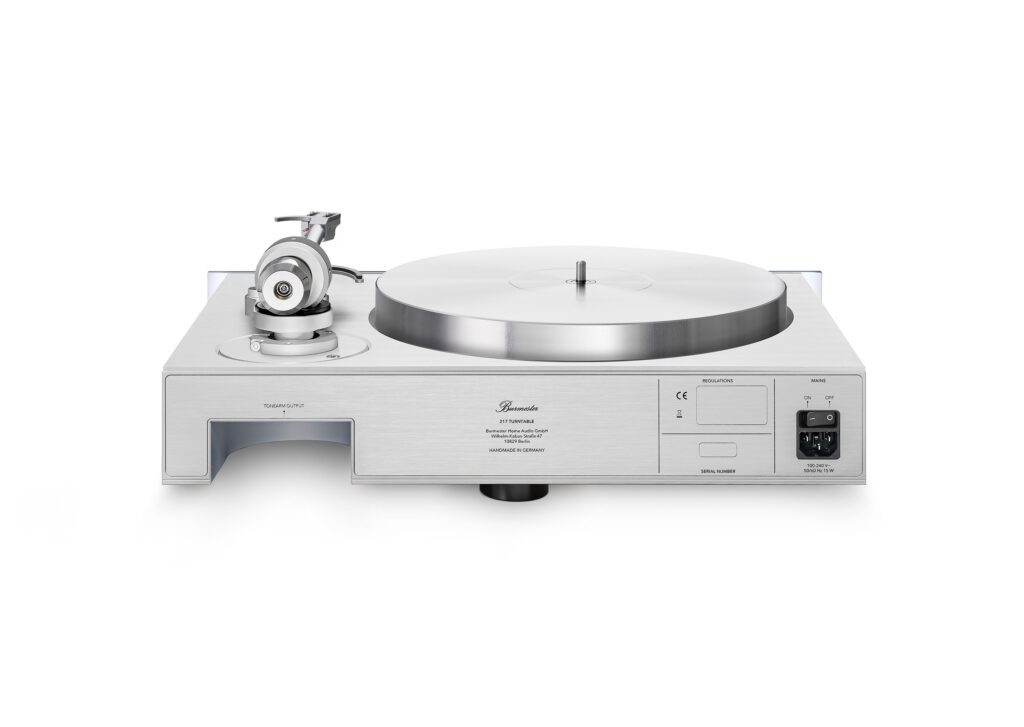
Given Burmester’s reputation as a manufacturer of complete audio systems, the 217 is only the company’s second turntable in the brand’s 45‑year history. That first turntable, the 175 from five years ago (reviewed here) is part of the company’s Reference Line and includes a built-in phono stage. The 217 – from Burmester’s Top Line – is the first product the company has ever made to take advantage of the awesome 100 Phono Preamp, that we reviewed way back in issue 77.

However, I want to extricate the review from a potential trap of its own making at the outset. The way I described the 217 makes it sound like it’s simply the record-spinning add-on to the Top Line electronics. The implication that it’s the turntable for Burmester completists rather than a good turntable in its own right. This is wrong. The 217 is a turntable, arm and cartridge combination designed as a turn-key vinyl ‘rig’ that works well at the head in many systems. The fact that I suspect it will be the turntable of choice for so many Burmester owners shouldn’t detract from its performance as a standalone package.

Easily fooled

As you unbox the 217, you would be forgiven for thinking it a direct-drive design. In fact, it features two belt-drive motors, the belts and pulleys of which are supplied pre-fitted. You can’t see them even in installation because the belts sit beneath the drive axle upon which the platter sits. It has one switch for power and two buttons for 33 and 45-rpm play. An indicator light flashes as it reaches the set speed and stays constant when it reaches that level. That’s the sum of its controls; no 78, no speed control, and no more extensive displays or strobes. That’s all you need.

This drive axle and motor arrangement are housed in a massive, low-resonance unibody housing of solid aluminium. This effectively makes the 217 a sealed unit, and even replacing the belts is beyond the listener’s scope. This is the Mercedes-Benz connection rubbing off on the brand (even putting coolant in the radiator is a service-level job today), but it does mean the product is functionally fuss-free once installed. The final links in the chain are the three adjustable feet the deck sits upon and a bituminised leather composite mat.

The turntable is matched with a straight, gimbal-mounted 9″ tonearm, which features an arm tube of ‘unidirectional fibre composite material’ (carbon fibre, to its friends) and an aluminium headshell and arm base. The cartridge is also housed in an aluminium body and is a moving coil design with a Shibata stylus profile. The arm exits to a standard five-pin SME tonearm cable connector, and a high-grade tonearm cable (exiting, in this case, to two XLRs for the 100 phono stage) is supplied, which fits in a recess on the back of the turntable.

Ready to roll

For such a high-grade turntable, it’s a remarkably ready-to-roll design. Burmester recommends professional installation, but much of that is more about lifting a relatively heavy turntable into place rather than a complex installation. Burmester sets up everything from speed control to cartridge alignment, even downforce and anti-skate are put in place in the Burmester factory. You plug and play.

While I said earlier that the Burmester 217 is not simply a front-end for the Top Line system, the company is not too forthcoming with resistive and capacitive load or the cartridge gain. This is not a problem for Burmester 100 owners because the system allows automatic set-up using the test LP provided with the phono stage. For the rest of the world… it’s guesswork time!

Build quality is off the charts. Normally, I’d preface that by saying, “Naturally, as a Burmester product…” but vinyl enthusiasts might not have had the same exposure to Burmester’s product line. They might assume it’s some shiny chrome bling thanks to that front panel. They would be assuming incorrectly. I’d say this is built like a tank, but that doesn’t go far enough. This is built to an uncompromising standard, putting the 217 among the shining stars of turntable construction like SME and Transrotor. It’s the consistency and attention to detail that will grab you; some of the best-loved and highest-end turntables have a ‘three-foot rule’; they look great from a metre or so away, but up close, there are some rough edges. You’d need to analyse every panel with an electron microscope to find a poorly finished edge. I guess when your products end up in the interior of a Maybach, ‘good enough’ isn’t in your vocabulary.

Seven Layer Army

That attention to detail extends to the packaging itself. Built across seven numbered layers, it allows you access to everything in a logical order, beginning with the manual, then the case candy with a pair of grey Burmester-logoed gloves and cleaning kit, then cables, then the platter and so on. I find it a little odd that the platter is the first part of the turntable out of the box (the other logical way is to place the platter underneath the main unit, so it comes out of the box and straight onto the installed turntable. However, the platter’s mass is such that if it is housed that close to the edges of the box, it could create undue stress on the packaging. Placing it in the middle of the unboxing (and to the left of the turntable) makes the load more evenly distributed and prevents any risk of an accident.

It might seem like a small touch, but Burmester has a clever way of installing the platter. It recommends installers use a double cup suction lifter, the sort of things glaziers have to move panes of glass around. Installers can place the heavy platter on the spindle and bearing housing. Given the only other way of placing this by hand involves either dropping the whole platter the last centimetre or so – or sacrificing a few fingertips to the Dark Gods of Vinyl – the use of a simple suction lifter is a neat trick. It’s absolutely going in my box of tricks for the next heavy platter lifting session. You could say I’m a sucker for this kind of thing.

Burmester 217 rear

There’s a commonality to Burmester source devices, be they CD players, music servers, or turntables. There is a clever combination of extraordinary refinement with a stentorian bass that takes the listener a little time to process. You are so overwhelmed by the information going on it takes two or three tracks to realise just how good the sound really is. Curiously enough, in finalising the review, I looked at my notes and compared them with the ones written for the 175 five years ago. Two things sprang out at me; my handwriting is worse than ever, and there were so many echoes between that review and this one. Yes, of course, the 175 is the bigger (and, especially, heavier) hitter and the process of re-educating your ears took a lot longer with the Reference Line turntable because there was so much more information to process. But the two are very much in lockstep sonically.

Shining naturalness

Back then, I wrote about ‘effortlessness’ and ‘naturalness’ to the 175’s sound, and those elements shine out in the 217 too. The deceptively simple lines of ‘Paper Tiger’ from Beck’s Sea Change [Mo Fi] require a turntable of both precision and absolute fidelity to get right, otherwise, it overstates the guitar sound or his close-mic’d vocals. Get it right (as happens here), and it’s at once fluid, morose, slightly creepy, and brilliant. Get it wrong, and it sounds like an out-take. That can only happen with a turntable with outstanding effortlessness and naturalness. Especially the latter; any hint of brightness is met badly.

The very natural sound of the 217 extends to its dynamic range, and it’s here where I think the newer model might even score over the 175 it’s clearly based upon. The Reference Line turntable is designed for similarly uncompromising systems. Its monumental sense of scale can be overpowering in some cases, and it’s in those cases where the 217 sounds right. That still means large full-range systems, but not those top-of-the-tree designs that require a barn of a room and leave you intellectually and emotionally drained after an hour or two of playing. In the 217, the ultra-dynamic recital by Alexander Toradze playing Prokofiev’s Piano Sonata No 7 in B flat [EMI/Angel] is portrayed with force and grace at once, but the same in a system befitting the 175 might make you run for cover.

Burmester 217 cartridge close up

Record playing through the 217 is both a voyage of rediscovery and a lithe and articulate performance, with the large-scale soundstage that’s a Burmester trait. Music is fully three-dimensional with excellent solidity of instrument images within that stage. Each of these instruments is right sized too. That ability scales well as you move from Dylan, a guitar and a harmonica through chimey PCM synthesisers that dominated 1980s recordings, back to well-recorded 1950s jazz and out to full-blown orchestral pieces. If each of these has its correct scale and shape, it’s clear the 217 is doing many right things, sonically.

Close harmony

Vocals are a strong point with the 217, whether they be the close harmonies of the Beatles singing ‘You Never Give Me Your Money’ [Abbey Road, EMI] or the truly beautiful folk voice of Nic Jones singing ‘Canadee-i-o’ [Penguin Eggs, Topic], the articulation and detail of the voices in both cases cut through the years.

Breaking down the sound of the Burmester 217 is ultimately self-defeating because it’s an extremely coherent sound. Going back to that Nic Jones album once more, his voice, guitar and fiddle playing demand a system that communicates music well, and that’s precisely what the 217 does so well. This album normally shows up a higher-mass turntable as being a bit ponderous and rhythmically challenged, but on the 217, it’s light, tight and beautifully ordered. Swap Nic Jones for Frank Sinatra singing ‘It Happened in Monterey’ [Songs For Swinging Lovers, Capitol] and the 217 nails it; both Nelson Riddle’s excellent scoring and Sinatra’s uncanny passing tones meld together exactly as you always knew they should.

My only real issue with the 217 is more ‘philosophical’ than ‘musical’. I’m still unsure if the high-end turntable market ‘gets’ the notion of a turn-key turntable like this. While there was a long hiatus when turntables were starting to be discussed in the past tense, audiophiles before and after the vinyl revival almost universally selected the turntable, arm, and cartridge from a selection rather than select them as a single entity. Even brands that provide all the links in the chain (Clearaudio, for example) don’t specify their high-end models as a turnkey solution.

All-in-one

However, I think the trend is more toward this kind of all-in-one solution, even if there is an implication of choice; Linn offers a range of decks, arms, and cartridges… but has them in three distinct packages that most listeners choose. In fact, I find this preset option to have great validity as it allows the manufacturer to make very nuanced decisions about the performance of all three turntable components as a complete unit. It also removes some of the difficulties of successful system matching and installation. Finally, it solves the ongoing problem of finding a demonstration facility willing to perform cartridge demonstrations.

Burmester 217 arm-base detail

The Burmester 217 is a formidable turntable like the 175 was before it. And yet, it is not a turntable that delivers a formidable sound. Instead, it makes the sort of sound that will keep you listening to vinyl for years and is built so well that it will still be doing the same for your great-grandchildren. In sound and build, it’s consistent and exacting. It’s the ideal partner for a Top Line Burmester system, and yet its standalone performance makes it a turn-key high-end turntable for almost any system. In short, it’s a stellar performer.

Technical specifications

  • Type Belt drive record player with arm and cartridge supplied and set
  • Speeds 33, 45 rpm
  • Motors Two AC motors with belts, no user access
  • Arm Aluminium and carbon fibre, 9”
  • Arm bearing system gimballed bearing
  • Cartridge type Moving coil
  • Stylus profile Shibata
  • Dimensions (W×H×D) 482 × 165 × 283mm
  • Weight 31.5kg
  • Price £18,700

Manufacturer

Burmester Audiosysteme GmbH

URL: burmester.de

Tel: +49 (0)30 78 79 68 0

Back to Reviews

The post Burmester 217 appeared first on Hi-Fi+.

2022 Golden Ear: Pear Audio Blue Odar Turntable with Cornet 3 Tonearm

Pear Audio Blue Odar Turntable with Cornet 3 Tonearm

$17,500

If you want to play records, this is the way to go in my view.  (If you are totally focused on correct pitch, you could look for a used Nakamichi disc-centering turntable; otherwise, this is the one.) All the Pear Audio designs of Peter Mezek aim at the same goals of silence, solidity, absence of micro-speed variations, and absence  of grit, grain, and resonance effects. In short, they are designed to reproduce what is actually on the record—and, of course, there are some definite things on it. One of the less expensive Pear Blue setups will likely get you close to the ultimate that the Odar/Cornet 3 combination represents. But if you want to go for the best, here it is. Typical analog playback reviews are usually “yes and then again no.” This one is all “yes.” The Blue Odar is different and better at a price that is lower than other super-tables. 

The post 2022 Golden Ear: Pear Audio Blue Odar Turntable with Cornet 3 Tonearm appeared first on The Absolute Sound.

Klaudio KD-ARM-AP12 Tangential Tonearm

This interesting tonearm is produced by the same Auburn, Washington, company that introduced vinyl fans to the KD-CLN-LP200 Ultrasonic Vinyl Record Cleaner. In development for several years, the KD-ARM combines two types of tonearm designs, linear-tracking and pivoted, in an attempt to provide the benefits of both. 

The Klaudio ’arm is supplied with an automatic ’arm lift that mechanically controls all up/down functions via a button added to a laser-light module. There is also a (user-adjustable) proximity sensor located at the edge of the automatic arm lift that detects when the tonearm reaches the end of a record’s runout groove and automatically raises the ’arm. Options include the choice of either standard nickel-plated or a gold-plated finishes and the selection of tonearm length, either 10.5″ or 12″ (equivalent pivot-to-spindle mounting distances). Regardless of which options you choose, the ’arm’s is price remains the same, $19,999. The model of KD-ARM under review is the KD-ARM-AP-12, with a nickel-plated finish and a 12″ equivalent length.

The KD-ARM arrives in a very well insulated flight-case with dual latches and a carrying handle. Opening the case reveals easily accessible foam cutouts filled with accessories and with the KD-ARM itself. There are two Klaudio detachable headshells (one long and one short) and an azimuth-tool. Also included is a mounting guide, tonearm-alignment tool, laser-tangency tool (and auto-arm-lift control), mounting sleeve with hardware, and tonearm counterweights. 

According to Klaudio, the KD-ARM-AP12 is a true tangential tonearm based on a mechanical design that doesn’t involve the complexity of air bearings. This is achieved via a pivoting base that also glides longitudinally on precise bearings to keep the cartridge stylus tangent along a linear track across the entire record (this tangency is confirmed by means of a laser-light projection device).

The core functional parts of the pivoted linear-tracking assembly are a combination of a dual carbon-fiber ’arm and the sliding ’arm base. This dual-’arm assembly is what keeps the headshell/cartridge/stylus perpendicular to the linear track along the record. However, the dual tonearm’s precise articulation alone is not enough to ensure true linear tracking, since the entire assembly, though perpendicular, still travels along an arc relative to the stylus tip. To keep the stylus tip moving along a linear track instead of in an arc, the KD-ARM has a bearing system at the tonearm base that actuates an inverse arc to counteract the natural arc of the pivoted ’arm, thereby nulling the effect. This combined approach of dual-arm and inverse-arc is the heart of the KD-ARM’s approach to tangential tracking. Based on observation and practical application, the system works very well and performs its function with precision.

Some of the other features of the KD-ARM include an azimuth adjustment for the headshell mount, an ’arm-base bubble-level, an ’arm-base stem-height adjustment, an on-the-fly VTA/SRA tower adjustment, and an integrated bubble-level for tonearm leveling. Because the KD-ARM is essentially a linear-tracking device, there is no anti-skate adjustment.

Klaudio offers a very easy to follow KD-ARM user manual, with text and useful images that step you through the set-up process in five chapters. The first chapter discusses the mounting of the tonearm base (pivot-to-spindle distance, mounting-hole size, mounting-screw locations, ’arm height adjustment, and tonearm handling). The second chapter covers orientation and coarse setting of the KD-ARM (cable attachment, tonearm alignment-tool usage). The third chapter covers stylus alignment and horizontal leveling. Chapter four covers counterweight adjustment, including determining whether add-on weights are needed. The final chapter covers miscellaneous items such as how to use the azimuth-tool test head to level/adjust azimuth, the reference VTA bubble level, ’arm lift platform adjustment, and an ’arm guide-pin repositioning procedure, if needed.

In addition to Klaudio’s user manual, there are a several official YouTube video links on Klaudio’s website that cover certain aspects of the KD-ARM setup, including a visual view of an active KD-ARM installation that is very useful, a cartridge/headshell change/replacement video, a tonearm-drift adjustment video, and a general video of the KD-ARM operation. These videos provide additional information to supplement the user manual.

For initial setup, the Klaudio KD-ARM used in this report was installed with the help of Klaudio President/Owner Peter Cheon. Before Peter arrived with the KD-ARM, we discussed which ’table I would be using and how the ’arm would be mounted. Peter was provided with the necessary information and parameters for the cantilevered armboard adapter that he attached to one of my Basis Debut Vacuum armboards (in this case, the one for a 9″ Graham standard mount was used). The armboard adapter extended the board to the length necessary for the 12″ KD-ARM and provided proper clearance for alignment and mounting. In the end, we used two different armboard adapters. Initially, an aluminum one was installed. Later, Peter sent me a stainless-steel version that allowed a little more VTA-adjustment range. The stainless-steel armboard adapter was the one I used exclusively after it arrived.

To determine which length KD-ARM (10″ or 12″) will mount to a particular turntable, the user should check the mounting template and distances required by Klaudio (and speak or correspond with the ’table manufacturer, if necessary). If the KD-ARM isn’t compatible with the armboard on the ’table, an alternative approach may be necessary. Klaudio manufactures a height-adjustable (3.1″ to 5.1″), freestanding tonearm base (KD-BAS-ARM01) that may allow the use of the KD-ARM in such circumstances. Additionally, Klaudio also makes a height-adjustable (2.4″ to 7.9″) freestanding base (KD-BAS-ARM02) for the laser-tangent tool. If your turntable lacks the space to accommodate the alignment laser (which also incorporates the motorized tonearm lift mechanism), Klaudio offers the KD-BAS-ARM02 ($549), an adjustable-height freestanding base that you position next to the turntable. 

Using the KD-ARM takes little effort beyond what is required for a pivoted ’arm. The big difference is that the headshell doesn’t travel across the record like it does with a standard pivoted tonearm. It travels exactly like a true linear-tracking ’arm. Setting stylus position above the record with the finger lift initially takes a little getting used to but quickly becomes a non-issue. With the auto-lift feature, the press of a button located on the laser-tangent tool lowers or lifts the armrest. When a user wants to stop playing the record before a side ends, the button is pressed again, raising the ’arm/stylus off the record. During the long period (12+ months) I spent evaluating the KD-ARM, the auto-lift feature worked flawlessly, including the end-of-record auto-lift.

Because of the design of the sliding base, it was possible to mount multiple cartridges on both Klaudio headshells and on two Ortofon LH-4000 headshells (the LH-4000 allows azimuth adjustment on the headshell for the cartridge installed). The act of changing a cartridge pre-mounted in its own headshell was a simple matter of removing the current cartridge/headshell, installing the desired cartridge/headshell, turning on the laser-tangent tool, sliding the ’arm base until the stylus was illuminated (verifying proper tangency), setting the tracking force, and adjusting height via the KD-ARM VTA/SRA tower. Since the cartridge was pre-aligned in the headshell during initial installation, the entire process took a couple of minutes to complete, making cartridge/headshell swaps quick, precise, and repeatable.

Usually, pivoted ’arms are said to have more solidity in the bass region. On the other hand, tangential trackers are more apt to trace the groove with less distortion and provide a more effortless and effervescent portrayal of the musical performance. (The reader should take note that these comments are generalities, not absolutes. In this writer’s experience, design and execution, as much as the type of tonearm used, tend to dictate where tonearms land vis-à-vis such generalizations.) 

With that being said, the KD-ARM does a very nice job of allowing cartridges to trace the grooves with ease and has a sonic openness that is quite attractive. On the bass side of the equation, the KD-ARM tends to supply healthier amounts of what’s on the record than the generalities mentioned above would suggest. The sound is very well integrated from top-to-bottom without any areas that stand out or seem to be missing. Each cartridge used during the evaluation (Lyra Atlas SL, Lyra Etna, Lyra Etna SL, van den Hul Colibri XGP, Hana SL, Hana ML) showed its recognizable sonic characteristics.

Let’s take Duke Ellington’s Jazz Violin Session for example. This album features Duke on piano, Svend Asmussen and Stephane Grappelli on violin, and Ray Nance on viola. The entire album fills the room and creates the sensation of a charged space from which the music emerges. The sonics are so captivating that one listens with joy and exuberance. The opening track, “Take the “A” Train” begins with Sam Woodyard filling the stage with cymbals before Duke’s piano gradually enters. With the addition of Grappelli, Smussen, and Nance’s strings, the number turns into a cornucopia of happiness. The timbre of each instrument just sounds so enjoyable (including Ernie Shepard’s bass/scat solo). On the KD-ARM with Atlas SL or Hana SL cartridges, the sound was excellent, and the music’s message of cheerfulness transferred effortlessly. 

The Blue Note Tone Poet Series release of Lou Donaldson’s Mr. Shing-A-Ling [BST 84271] is another very good sounding LP. When listening to “Ode to Billie Joe,” one can’t help but dive right into the music and mentally let go. The addictive groove of Leo Morris’ drums invites rhythmic head-swinging and is soon followed by the equally compelling sounds of Donaldson’s alto sax, Jimmy “Fats” Ponder’s guitar, and Lonnie Smith’s organ. All artists get to play groove-laced solos that add icing to the cake.

Through the KD-ARM with the same cartridges mentioned above, the performance came through with every bit of its soulful groove intact. While both cartridges played well in the KD-ARM, the Atlas was tighter in the bass and more ordered, while the Hana SL was somewhat fuller and looser around the edges. This observation is as expected and reveals that the KD-ARM lets cartridges show their unique qualities.

Shifting to Tracy Chapman’s self-titled album allowed a view into how the KD-ARM processed bass-heavy music. On “Talkin’ Bout A Revolution,” the KD-ARM kept the cartridge stable to the point where there was no audible breakup or congestion during thick instrumental interludes. Chapman’s raw vocals and guitar weaved their way into the music and presented a very nice and unique tone that was quite involving. The bass-heavy track “Fast Car” offered a powerfully dense and full bass line, while remaining delicate throughout the rest of the spectrum. The KD-ARM performed well, allowing the music to stay visceral and spacious, and maintaining excellent guitar separation.

It should be apparent that the albums mentioned in this report were delightful to listen to. The KD-ARM never subtracted from the pleasure of vinyl or hindered what one got out of the LPs. While it didn’t quite match the performance of my Basis SuperArm 9, the KD-ARM performed excellently. Couple its sterling performance with the ability to easily switch headshells (even SPU-type cartridges), and one has a tonearm that is versatile, unique, and very good sounding. If possible, it is surely worth a listen to find out if it fits your system and your needs.

Specs & Pricing

Type: Pivoted tangential-tracking tonearm
Length: 10″ or 12″
Price: $19,999 (10.5″ or 12″, nickel or gold finish)

KLAUDIO
2840 W Valley Hwy N
Auburn, WA 98001
(253) 249-7813
klaudio.com
[email protected]

Associated Equipment:
Analog tape: Otari MTR-10 Studio Mastering (¼” 2-track) tape deck with custom Flux Magnetic Mastering Series repro head and secondary custom tube output stage, Studer A820 Studio Mastering (¼” 2-track) tape deck, ReVox G-36 (¼” 4-track) tape deck
Analog vinyl: Basis Audio Debut Vacuum, Basis Audio 2800 Vacuum ‘tables; Basis Audio SuperArm 9, Basis Audio Vector IV (x2), Graham Phantom III, Klaudio 12″ Tangential tonearm; Lyra Atlas, Lyra Atlas SL, Lyra Etna, Lyra Etna SL, Lyra Titan-i, van den Hul Colibri XGP, Hana SL
Phonostage: The Raptor (Custom), Lamm LP2 Deluxe, Ayre P-5xe, Musical Surroundings Phonomena II+ w/Linear Power Supply
Preamp: Dual Placette Audio Active Linestage, Lamm L1.1 Signature, Lamm L2 Reference
Amp: Custom/Modified solid-state monoblocks
Speaker: Vandersteen Model 3a Signature with dual 2Wq subwoofers and dual SUB THREE subwoofers using M5-HPB high-pass filter, Joseph Audio Pearl 20/20 Graphene
Cables: Assortment of AudioQuest, Shunyata, Tara Labs, Acoustic Research, Cardas, and custom cables
Racks/Accessories: Minus-K BM-1, Neuance shelf, Maple wood shelf, Symposium Ultra, Aurios Pro, Pneuance Audio, Walker Audio, Klaudio RCM, Kirmuss RCM, VPI RCM, Clearaudio Double Matrix Pro RCM
Room: 18′ x 8′ x 43′

The post Klaudio KD-ARM-AP12 Tangential Tonearm appeared first on The Absolute Sound.

Editors’ Choice: Tonearms Under $2000

VPI JMW-9 Signature

$1000

Compared to the standard JMW-9, the Signature version offers worthwhile upgrades such as a stainless-steel bearing assembly, Nordost Valhalla wiring, variable fluid-damping, mechanical anti-skate control, and higher effective-mass design. HP praised the Super Scoutmaster Signature package for its “considerable dynamic jump” and “musical authenticity.” 

Kuzma Stogi S

$1550 (w/Cardas copper wire)

The Stogi S is a hydraulically damped unipivot with a simple string-and-weight anti-skating mechanism, dual underslung counterweights, and provisions for making both coarse and fine azimuth adjustments. In our reviewer’s system, this ’arm enabled a Shelter 90X cartridge to produce almost shockingly three-dimensional sound with rock-solid bass.

Origin Live Encounter Mk III

$1650

In the Encounter, PS’ reference Ortofon Windfeld displayed its peerless neutrality and near-peerless tracking, with outstanding bass and a rich and involving midrange. Highs, though smooth and extended, evinced a very subtle lack of detail or focus. The Encounter also allowed the Dynavector Karat Mk III to strut its stuff with virtually no cramping of its high-kicking style. It says volumes for the excellence of this ’arm that it could put two such different pickups through their paces so even-handedly. 

Ortofon TA-110

$1679

Ortofon’s flagship tonearm combines parts of a Jelco tonearm with Ortofon’s highest-quality bearings and 6N high-purity copper tonearm interconnect. The ’arm’s highly effective vibration control, derived from Ortofon R&D, keeps it from smearing low-level details and produces a wonderfully open, engaging sound. While super-arms costing three times more offer some ergonomic improvements—particularly repeatable, minute VTA adjustments—the Ortofon offers remarkable transparency, low coloration, and precise, natural soundstaging. 

The post Editors’ Choice: Tonearms Under $2000 appeared first on The Absolute Sound.