
World News
March 2023 Classical Record Reviews
Rimsky-Korsakov: Scheherazade
Curtis Symphony Orchestra/Osmo Vänskä
Curtis Studio (24/96 WAV obtain). Drew Schlegel, prod. and eng.
Performance ****
Sonics ****
The greatest American conservatory gamers can match totally fledged professionals in musicality and polish, so it is no shock that the Curtis Institute has launched its personal label. Kicking off with a showpiece like Scheherazade might need been of venture, however not with Osmo Vänskä, lately of the Minnesota Orchestra, on the helm.
Once previous the self-conscious opening gestures, the conductor limns an unusually pictorial first motion: The straightforward, rocking rhythm evokes the ocean; the horn evokes a name from afar. Despite a barely opaque climax—tuttis total are much less distinctive than all the pieces else—I used to be startled to search out my longstanding allegiance to Ansermet (Decca) challenged. Vänskä, logically, strikes attacca into the subsequent motion; I’m shocked nobody’s tried that earlier than. I significantly favored the lilt of the second, dancing theme. The ultimate tutti brings emphatic, marked accents.
The sluggish motion begins daringly slowly. Vänskä shapes the lengthy theme absolutely, bringing better impulse to the height. The motion flows; the little dance part right here begins quietly. The finale’s tarantella—not Rimsky’s time period—has a propulsive raise, shifting much more shortly with the brass fanfares. The crashing shipwreck is fairly commonplace. The ultimate fade is peaceable.
The conductor is extra serious about vitality than precision: The first motion’s wind-down briefly come unstuck; the finale’s first tutti triplets are slapdash and smudgy. But these passing flaws, which may occur even within the massive leagues, are balanced by fantastic enjoying elsewhere: the liquid clarinet, with simply the fitting rubato within the thrives; the fragile oboe; the clear, plaintive horn; the tight, exact string tremolos. The lighter passages are splendidly textured and spacious; tuttis are much less particular. I’m wanting ahead to extra from this new label.—Stephen Francis Vasta
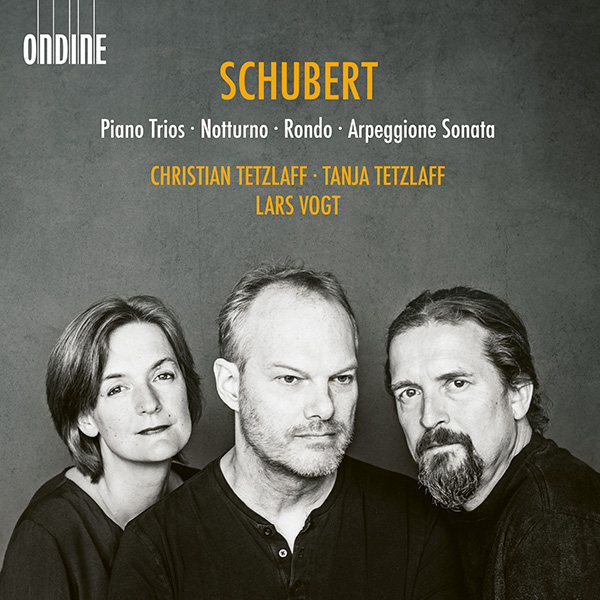
Schubert: Piano Trios • Notturno • Rondo • Arpeggione Sonata
Christian Tetzlaff, violin; Tanja Tetzlaff, cello; Lars Vogt, piano
Ondine 1394 (reviewed as 24/96 WAV). 2023. Christoph Franke, prod. and ed.
Performance *****
Sonics ****
No recording of Franz Schubert’s chamber music has moved me as a lot as this one. First, there’s the consummate artistry of three very good musicians who bend tempos and plumb dynamic extremes with unusual freedom in service of nice music written within the final 5 of Schubert’s 31 years. Listen, for instance, to the tender and heartbreaking second motion of Piano Trio No.1 because it weeps sweetly and to the delights of its ultimate motion.
This is the final chamber music recording that pianist Lars Vogt made together with his frequent trio companions earlier than succumbing to most cancers of the throat and liver. Vogt was already experiencing horrible belly ache throughout the first recording session, which passed off February 21–25, 2021. By the time the trio recorded the Piano Trio No.1, on June 10–11, 2021, he had acquired his prognosis and begun chemotherapy. Death got here solely 15 months later, three days in need of his 52nd birthday.
As a lot as each nice artist performs as if their life is determined by it, everybody performed with full consciousness that these is likely to be their final recording classes collectively. Who can fail to be moved by the intense sensitivity of three artists feeling and respiratory as one? Who can hear with out recalling that Schubert himself, conscious that he would die of syphilis a lot too quickly, poured his coronary heart and soul into each considered one of these works?
Schubert’s extraordinary skill to create magnificence and pleasure amidst struggling—to transcend impending tragedy by tapping right into a seemingly inexhaustible fount of melody—is mirrored right here by the very good, dedicated enjoying of Vogt and the Tetzlaff siblings. I urge you to partake of the innumerable riches on this indispensable recording.—Jason Victor Serinus
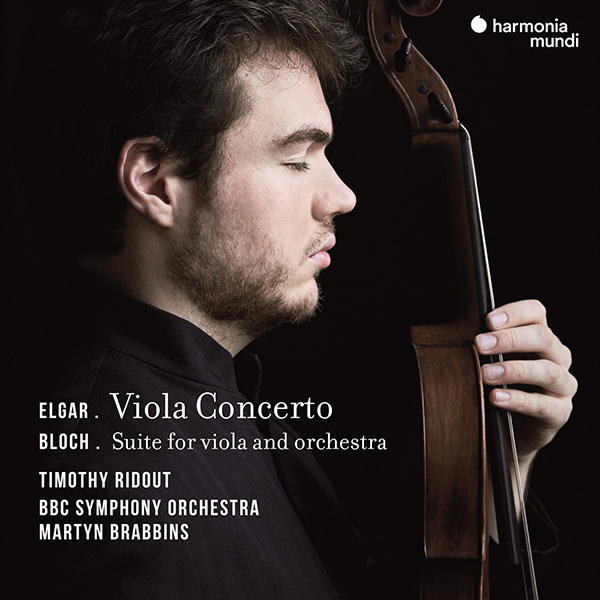
Elgar: Viola Concerto
Bloch: Suite for Viola & Orchestra
Timothy Ridout, viola; BBC Symphony, Martyn Brabbins
Harmonia Mundi HMM902618 (CD). 2023. Andrew Keener, prod.; Dave Rowell, eng.
Performance ****
Sonics ***½
Elgar by no means wrote a Viola Concerto. Violist Lionel Tertis organized this model for his personal use from the Cello Concerto, with the composer’s approval. The threat, in fact, is that the transfer to the higher-pitched instrument will sacrifice the music’s shade and energy.
No concern: Timothy Ridout assaults the opening name to consideration with an incisive authority that compensates for any lowered resonance. He’s a perceptive interpreter, discovering the fitting looking out or fervent have an effect on as wanted within the lyric phrases and minimizing vibrato in excessive, tender phrases. He realizes the Adagio‘s cautious affirmation and the finale’s occasional plaintive inflections, sustaining pressure and curiosity in that discursive motion.
The unstable harmonies and sparer textures of Bloch’s Sonata jerk us abruptly into comparative modernity. Disturbing “sci-fi” orchestral gestures—assume Twilight Zone, not Star Wars—alternate with the viola’s makes an attempt at lyricism. The music then segues right into a folkloric type of passage. Such themes, alone and in canon, dominate the subsequent two actions, one angular and scherzo-ish, the opposite mysterious and looking out.
All this falls on the ear neatly sufficient, however solely within the bright-eyed, propulsive finale does all the pieces totally come to life. Throughout this rating, Ridout’s low tones handle to sound each dusky and edgy, which is totally acceptable.
Brabbins conducts sensibly, with tender landings, reserving energy for the most important climaxes. Quiet strings may be grainy, however the reeds—particularly the clarinet, which is distinguished within the Bloch—sound good-looking. The sonic body recesses the orchestra barely, however the interaction with the soloist nonetheless registers. At what appeared a superb playback stage, the tuttis within the Elgar have been fierce.—Stephen Francis Vasta

Johann Sebastian Bach: The Well-Tempered Consort—III
Phantasm
Linn CDK708. CD (reviewed as 24/96 WAV). 2022. Philip Hobbs, prod. & eng.
Performance *****
Sonics ****
For the third and ultimate launch in its marvelous collection The Well-Tempered Consort, England’s Phantasm, a consort of 5 viols led by treble viol participant Laurence Dreyfus, presents 27 chamber preparations of Bach works initially supposed for keyboard and organ.
By conveying polyphonic complexity by means of 5 clearly delineated string traces, Phantasm enhances the emotional impression of Bach’s harmonic relationships. If your system can current 5 in another way pitched viol traces with readability and heat, you’ll find your self relishing the wealth of magnificence and invention that Bach compacted into quick works, a lot of which final lower than two minutes.
Phantasm skillfully weaves excerpts from Bach’s Inventions and Sinfonias, Organ Book III, and The Well-Tempered Clavier Books 1 and 2 right into a coherent complete. The quick introduction to the 65-minute set, the Sinfonia No.1 in C Major BWV 787, is pure delight. The timbres are a pleasure, and the miking clear sufficient to disclose the sound of hairs brushing throughout intestine strings.
It’s tough to learn Dreyfus’s liner notes with a straight face. Writing in a method designed to elicit insider smiles from teachers and the early-music fraternity, he intersperses such gems as “Consider the topic … with its rhetorical distinction between the cryptic decree trailed by a scornful staccato and answered by thrives of aristocratic frippery” amongst invaluable insights into Bach’s genius.
Best to focus as a substitute on the ingenious profundity of the “Prelude No.18 in G-sharp minor BWV 863,” the stunning succession of sorrowful dissonances in “Fuga tremendous: Jesus Christus unser Heiland BWV 689,” the fun of “Fughetta tremendous: ‘Allein Gott in der Höh’ sei Ehr BWV 677,” and the transcendent concord of the ultimate “Fantasia in G Major BWV 572.”—Jason Victor Serinus
-
Product on sale
 Audiophile Vinyl Records Cleaning BundleOriginal price was: €69.90.€59.90Current price is: €59.90. incl. VAT
-
Product on saleEasy Start Vinyl Records Cleaning KitOriginal price was: €69.90.€59.90Current price is: €59.90. incl. VAT
-
Vinyl Records Cleaner Easy Groove Concentrate€34.95 incl. VAT
-
Easy Groove Super Set€199.00 incl. VAT
-
Easy Groove Enzycaster – vinyl records prewash cleaner€34.95 incl. VAT
-
Easy Groove Extreme MK. II- vinyl records prewash cleaner€45.00 incl. VAT
-
Vinyl Records Cleaner – Easy Groove Virgin Concentrate€35.00 incl. VAT
-
Easy Groove Spray&Wipe vinyl records cleaner€34.95 incl. VAT


