
World News
Primare PRE35 Prisma streaming preamplifier
Hygge won’t be the primary phrase that involves thoughts when considering the Primare PRE35 Prisma preamplifier, however in Limhamn, Sweden, that’s how Primare likes to explain their merchandise. It means “cozy,” and it is an important idea within the Nordic nations, nearly a lifestyle. Another time period that seems in Primare’s product descriptions is lagom, which loosely interprets as “not too little, not an excessive amount of—excellent.”
For me, none of that is misplaced in translation. I’m all for folksy adjectives for high-tech gear. After spending hygge time with the brand new PRE35 Prisma preamplifier, I’ve come to equate hygge with “not digital-sounding” and lagom with the magnificence of its bodily and digital design: not too little, not an excessive amount of.
By trendy hi-fi requirements, Primare has been in enterprise for some time. Founded in Sweden in 1985 by Bo Christensen and Bent Nielsen, Primare takes a group strategy to analysis and improvement: Specialists work on completely different technical points of their designs, then Nielsen, Primare’s chief engineer, pulls every little thing collectively. Primare was an early adopter of class-D amplification; my colleagues Kal Rubinson and Herb Reichert have each explored this facet in current critiques of Primare amplifiers (footnote 1). Primare can be identified for being forward of the sport in exploring digital audio storage and streaming know-how, capabilities totally carried out within the PRE35 Prisma.
In current years, with an ever-increasing selection and high quality of built-in parts in the marketplace, and the rising price of interconnects, even die-hard “separatists” are giving them a glance. Primare’s lineup consists of 21 parts, most with a point of integration. The introduction of ancillary modules has rendered the notion—and worth—of stand-alone parts considerably fluid: The PRE35 Prisma preamplifier lists for $3900. Adding the subtle DM35 DAC module will increase the value to $4400. Include the SM35 Prisma community module, the value turns into $5000, and you’ve got the Primare PRE35 Prisma.
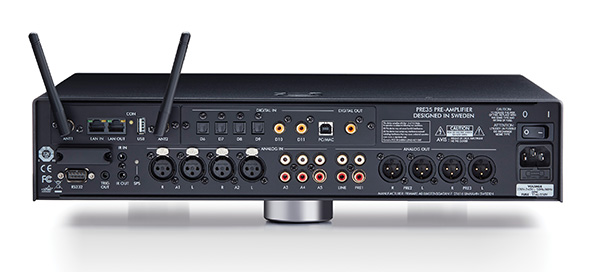
Jacks and knobs and circuit boards
Without turning this evaluation right into a person handbook, this is a quick abstract of the out there inputs and outputs: 5 analog inputs (two pair balanced), 9 digital inputs (4 TosLink, two S/PDIF on RCA, one USB-A, one USB-B, one LAN/Ethernet), Wi-Fi and Bluetooth antennae, two balanced and two unbalanced outputs (together with one line pass-through on RCA), one digital output (S/PDIF on RCA), and a LAN output. Also onboard are the same old set off connections and an RS-232 for integration. Oddly, given the surfeit of connection choices, there is no such thing as a AES3 digital enter, which I wish to have for my CD transport, and no headphone jack. On the analog aspect, balanced alerts run totally balanced—and totally analog—from enter to output.
The PRE35 Prisma is a basic one-shelf unit, standing 4.2″tall on three high-quality, twist-to-level ft. The PRE35 Prisma runs cool and may be stacked with different parts. The entrance panel is spare, with two giant multifunction knobs and 4 diminutive buttons; front-panel features are duplicated on the included distant. A comparatively small show supplies primary standing data. If my instinct has been proper all these years and the texture of the knobs on an audio part is a clue to its high quality, then the PRE35 is of the best high quality: Its hefty steel chassis is complemented by sturdy, strong knobs. Primare could also be manufactured in China, but it surely is designed in Sweden.

To get a fuller image of the PRE35 Prisma than I may from the handbook and web site, I turned to Terry Medalen, Primare’s advertising and marketing supervisor. He advised me that the linear energy provide of the PRE35 Prisma makes use of a custom-wound R-core transformer and is in a swap mode for standby solely; it switches to the linear provide. Primare places a lot give attention to their energy provides: “Thoroughly carried out energy provide designs” is the primary merchandise listed within the “Design Brief” for the PRE35 Prisma.
This is a preamplifier, so the amount management issues. The one right here, Medalen defined, is a “2 × 4 channel balanced mode IC chosen for optimum channel stability and low listening stage efficiency—the IC is totally out of the sign path.” It works in increments of 1dB between 21 and 54 (on the front-panel read-out) and in 0.5dB steps from 55 by way of 99. Finer management at louder ranges makes good sense.
The quantity management, inner DACs, and community electronics can create noise points; the PRE35 Prisma addresses this with brief circuit paths, cautious circuit implementation, and the usage of four-layer circuit boards (one layer serving as floor), and surface-mount parts, which act as antennas lower than bigger, typical parts do.
The PRE35 DAC is predicated on a flagship AKM DAC chip, the AK4497EQ. This chip is alleged to be “able to reaching 128dB (stereo) S/N and –116dB THD+N, whereas supporting as much as 768kHz PCM and 22.4MHz DSD. This potential to deal with larger decision file codecs will enable for the potential of future software program upgrades,” in accordance with the design transient. The AK4497EQ additionally consists of “a newly developed switched capacitor filter ‘OSR Doubler’ that enormously reduces sound degradation from noise shaping, reaching a flat noise flooring as much as 200kHz.”

Forming connections
Both customers and designers of high-quality audio gear face a brand new set of challenges resulting from the truth that, for higher and worse, {hardware} and software program have turn out to be bedmates demanding reciprocal consideration. Audio corporations should now make use of or collaborate with software program designers, and we should study to work with the merchandise of those collaborations, together with app integration and an ever-developing function set. During my evaluation of the PRE35 Prisma, a lot of these {hardware}/software program marriages have been nonetheless in progress and had not but been consummated. Terry Medalen up to date me about a few of Primare’s engagements, present and future. Software is updatable on-line by way of the community connection. •
• The PRE35 Prisma is designed to be managed by the multiroom Primare Prisma app, which is obtainable for iOS and Android. Currently, the app facilitates part setup, integrates web radio, permits entry to music information saved in your native community, and supplies hyperlinks permitting you to entry native streaming providers by way of Chromecast, AirPlay, Bluetooth, and Spotify Connect connections—however see under.
• In the approaching months, Qobuz and Tidal shall be built-in into the Prisma app, permitting gapless playback with each providers. Once that occurs, Qobuz will present gapless playback as much as 24/192 and Tidal will assist gapless playback and MQA decoding to the primary full unfold at 48, 88.2 or 96kHz.
• At the time of testing, Roon relied on AirPlay or Chromecast to connect with the PRE35, limiting decision to 16/44.1 (AirPlay) or 24/96 (Chromecast). But a firmware replace scheduled for March—across the time you are studying this—will implement RaaT, Roon’s industrial-strength streaming protocol, which goals to assist “all related audio codecs, now and sooner or later,” each wired and wirelessly. At that time, the PRE35 shall be licensed “Roon Ready.”
• Once Tidal is totally built-in with the Prisma app (and in addition with Roon), Tidal Connect and the forthcoming Qobuz Connect shall be superfluous, so they will not be supported.
• Primare’s strategy to Bluetooth is uncommon. Recognizing the constraints of all present Bluetooth implementations, they make the most of an older model (Bluetooth 4.1 and its primary SBC codec) in a configuration optimized for informal listening. Want higher sound? Choose a greater connection.
• In an fascinating little bit of future-proofing, the PRE35 helps WiSA for connection to wi-fi audio system. WiSA facilitates connections at as much as 24/96 with near-zero latency and speaker synchronization as much as a microsecond. According to analysis, that is effectively under the brink for human discrimination.
Initially, I relied on my laptop computer’s connection to Wi-Fi and used a USB cable to connect with the PRE35 Prisma. Later, I related the router on to the Primare with an Ethernet cable. I additionally tried the Wi-Fi connection, and it labored positive, however I used the Ethernet connection for all my severe listening.
For setup, I sat shut, with my studying glasses on, as a result of the show on the PRE35 Prisma, as I discussed, is kind of small. Settings are configurable in 5 classes—normal, enter, audio, streaming, and community—and embrace customizing standby habits, quantity at startup, most quantity, and enter acquire. Even Mute is adjustable: from 0 as much as any setting you select.
Footnote 1: See Herb Reichert’s April 2020 evaluation of Primare’s A35.2 energy amplifier right here and Kalman Rubinson’s November 2022 evaluation of the A35.8 energy amplifier right here.
-
Product on sale
 Audiophile Vinyl Records Cleaning BundleOriginal price was: €69.90.€59.90Current price is: €59.90. incl. VAT
-
Product on saleEasy Start Vinyl Records Cleaning KitOriginal price was: €69.90.€59.90Current price is: €59.90. incl. VAT
-
Vinyl Records Cleaner Easy Groove Concentrate€34.95 incl. VAT
-
Easy Groove Super Set€199.00 incl. VAT
-
Easy Groove Enzycaster – vinyl records prewash cleaner€34.95 incl. VAT
-
Easy Groove Extreme MK. II- vinyl records prewash cleaner€45.00 incl. VAT
-
Vinyl Records Cleaner – Easy Groove Virgin Concentrate€35.00 incl. VAT
-
Easy Groove Spray&Wipe vinyl records cleaner€34.95 incl. VAT







