
World News
Dual CS 5000 Turntable
Dual CS 5000 Turntable
 Surprisingly superior but appealingly reasonably priced, this semi-automatic flagship deck from 1985 sought to unseat Rega’s market-leader. How does it sound at this time?
Vinyl followers within the early ’80s have been effectively catered for when it got here to reasonably priced turntables. If your finances was tight, the succesful NAD 5120 made a effective start line. But in the event you may stretch your funds a bit of additional then there was just one alternative: the Dual CS 505 [HFN Feb ’13]. First launched in 1981, it proved to be a strong and dependable performer at its discount worth of £75.
Just a few years later got here an improve to this deck within the type of the CS 505-2, however by this time, Dual had determined it was time to convey the struggle to the following stage of the turntable market, which meant taking over the mighty Rega Planar 3. The design the corporate got here up with with a purpose to mount this problem was the CS 5000 seen right here.
Feet First
The CS 5000 was greeted by a number of raised eyebrows when it appeared in 1985, being excess of a CS 505-2 given a fast spit and polish. Rather, it was surprisingly technologically superior for what was nonetheless a comparatively reasonably priced turntable at round £200. It was based mostly round a stable picket plinth completed in both an actual walnut veneer or the compulsory Nineteen Eighties black ash. The plastic subchassis inside this plinth was suspended, however not like the CS 505, which used 4 springs for this, right here the suspension was achieved through 4 adjustable shock-absorbing toes. The underside the place these have been mounted was bolstered with a metallic plate, so as to add mass and rigidity.
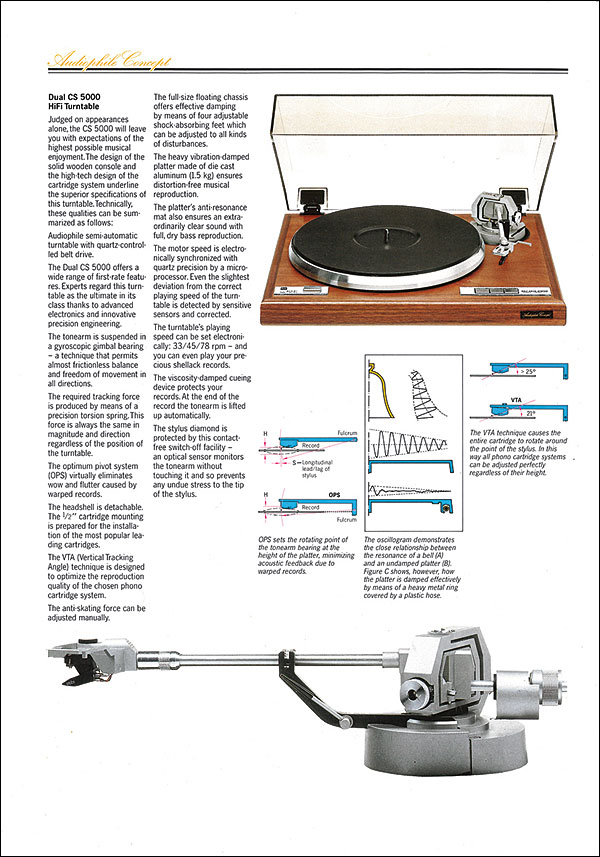
A 1.5kg diecast aluminium platter was on the coronary heart of the deck and the underside of this featured a recess round its periphery. Inside was fitted a metallic ring, lined in plastic in a bid to damp undesirable platter vibrations, notably on the periphery. Finally, the platter was topped by a rubber mat and spun on a stainless-steel bearing with a brass sleeve that was mounted to the turntable’s plastic subchassis.
The CS 5000 was belt drive however, fairly than use the synchronous AC motor of the CS 505 with its easy however extremely efficient ‘orange phase’ pulley for velocity adjustment, Dual went extra high-tech for its new flagship deck. The EDS 5000 motor used was a DC servo sort, pushed by a devoted circuit quartz-referenced to every velocity utilizing a microprocessor. Speed adjustment was not provided, however Dual took the weird step of including a 78rpm velocity choice to the standard 33rpm and 45rpm settings. Meanwhile, the motor was mounted to the plastic subchassis utilizing three resilient rubber mounts.
Pivots ‘N’ Platters
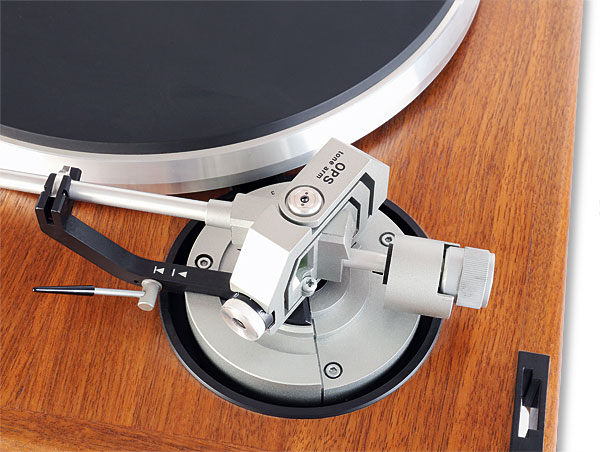
The tonearm that got here with the CS 5000 was additionally new. It pivoted on a gyroscopic gimbal bearing with each monitoring pressure and anti-skate compensation utilized through springs. The arm additionally made use of Dual’s Optimum Pivot System, or OPS, whereby the vertical pivot level of the arm was set on the peak of the platter floor, fairly than being above it, as can be the norm. Dual claimed that this lowered acoustic suggestions from warped records. More importantly, it lowered the efficient size of the trail the stylus would take when monitoring a ‘bump’, with a concurrent drop within the obvious velocity variation that resulted.
Cartridge Couture
A removable headshell was used and the deck got here provided with an Ortofon OMB 20 E cartridge pre-fitted. This was one other essential step up from the CS 505, which needed to make do with an Ortofon OMB 10. Meanwhile, a particular stylus was accessible for the enjoying of 78rpm shellac records. Additionally, over the lifetime of the CS 5000, three completely different headshell kinds have been provided. The first was an extended, normal sort that was silver in color, although later in manufacturing this modified to a black plastic mannequin similar to that used on the CS 505-2. However, the CS 5000’s is longer so the 2 usually are not interchangeable.
The actually intriguing headshell possibility was the third one, the highest of which sported a round VTA adjustment knob. Rotation of the knob would range the angle of the cartridge-mounting plate beneath by as much as 5° in both path. This was a intelligent manner of circumventing the tonearm’s lack of peak adjustment, and a particular VTA guide provided with the turntable gave really useful settings for most of the fashionable cartridges of the day.
One of essentially the most satisfying issues in regards to the CS 5000 was the way in which by which it operated. Dual caught with semi-automatic operation for the deck which meant an automatic stop-and-lift on the finish of a report, fairly than a totally automated arm return. Most importantly, this was all carried out silently and sweetly utilizing electronics versus the efficient, however fairly clunky, mechanical strategies employed within the CS 505. No flailing cueing levers on the finish of the report right here!
To begin, the turntable can be powered up and 33rpm can be chosen robotically. The velocity was modified if the consumer desired, then the arm (which was cued ‘up’ at energy on), can be manually moved over the floor of the report to a selected monitor. At this level, the velocity indicator LED would flash till the platter was on top of things and the quartz regulation locked in. Then the LED would illuminate steadily and the arm would robotically decrease. Should any undue velocity variations within the drive system happen (or certainly, if there was an influence reduce mid-LP), the arm would robotically carry.
A separate cueing lever was additionally fitted to permit the arm to be lifted and moved throughout play, however this appears superfluous as urgent the chosen speed-change button would additionally carry the arm to permit it to be manually re-positioned. Once moved, urgent the identical button would return the stylus to the report. At the tip of the LP, the arm lifted and the platter stopped.
Going For Gold
Despite its elegant styling and ease of use, the CS 5000 by no means actually achieved the cult standing of the CS 505. In 1987 it was outmoded as Dual’s flagship by the CS 7000 Golden One, which was largely related in design to the CS 5000 however featured a gloss black plinth and a few considered gold plating of the platter and numerous arm elements. It additionally swapped the dual-purpose velocity/cueing buttons for a rotary management. A simplified mannequin, the CS 750, additionally appeared across the similar time because the CS 7000 Golden One. The design’s ultimate fling got here in 1991 because the Golden Stone, which noticed the CS 7000’s black-and-gold tonearm and gold platter housed in a synthetic stone plinth.
 Adam Listens
It does not take too lengthy when listening to the CS 5000 to grasp that it truly is a cultured performer. While the CS 505 is a effective deck in its personal proper it could actually sound a bit of tough across the edges, however ‘tough’ is the final phrase to spring to thoughts right here. The CS 5000 presents up a stunning sense of ambiance and a wealthy, partaking midband that makes it a straightforward and compelling hear, irrespective of the music being performed.
HI-FI News
through Hi-Fi News https://ift.tt/JfNCqVc
November 18, 2023 at 01:16AM
-
Product on sale
 Audiophile Vinyl Records Cleaning BundleOriginal price was: €69.90.€59.90Current price is: €59.90. incl. VAT
-
Product on saleEasy Start Vinyl Records Cleaning KitOriginal price was: €69.90.€59.90Current price is: €59.90. incl. VAT
-
Vinyl Records Cleaner Easy Groove Concentrate€34.95 incl. VAT
-
Easy Groove Super Set€199.00 incl. VAT
-
Easy Groove Enzycaster – vinyl records prewash cleaner€34.95 incl. VAT
-
Easy Groove Extreme MK. II- vinyl records prewash cleaner€45.00 incl. VAT
-
Vinyl Records Cleaner – Easy Groove Virgin Concentrate€35.00 incl. VAT
-
Easy Groove Spray&Wipe vinyl records cleaner€34.95 incl. VAT







