
World News
Estelon AURA loudspeaker
Estelon AURA loudspeaker
I’ve been watching Estelon since they got here in the marketplace within the US. Their hanging look grabs the attention, however, preoccupied with different manufacturers and critiques, I used to be capable of deny them severe consideration till now.
I had my causesparticularly value. The costs of these earlier Estelons have been a poor match for my funds. I used to be additionally troubled by the truth that, regardless of rhetoric about driver and element selection, superior cupboard supplies and building, and fastidious engineering, Estelon has been stingy with particulars and specsnot a whole disqualifier however moderately a missed alternative to attraction to objectivist proclivities.
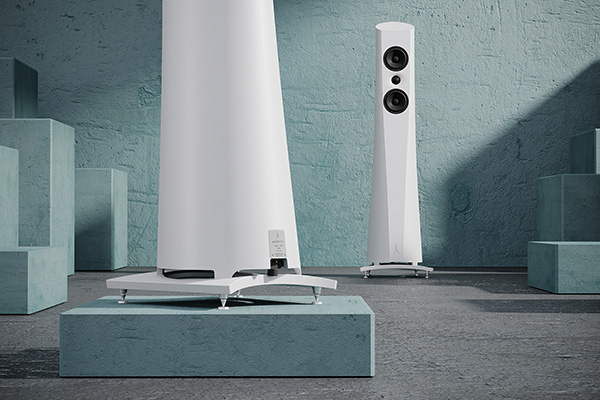
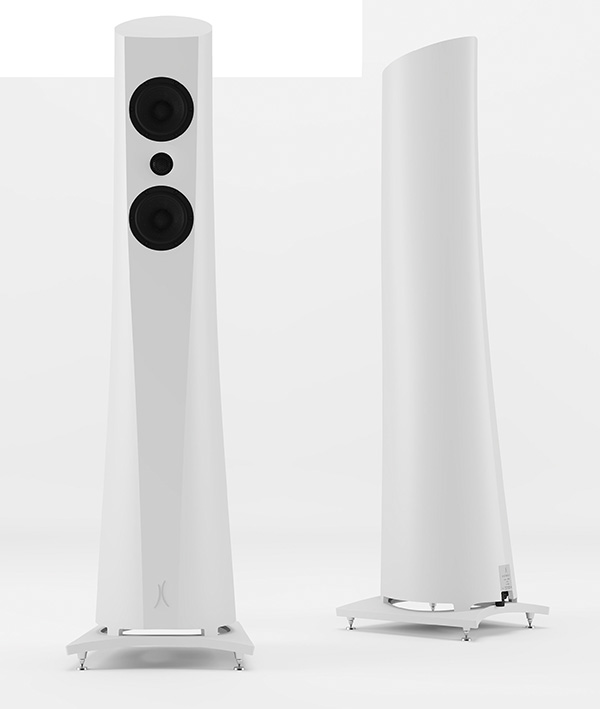
What modified my thoughts? First, whereas Estelon is deservedly recognized for the class of its designs, the AURA is, to me, the cleanest design the corporate has but achieved. The black grille tapers from high to backside in clear counterpoint to the clear, curved white physique, which widens high to backside and appears to levitate simply barely off the ground. The impact is unfussy and swish. Had I been requested my selection of colours, I might need ordered blackthe one different shade, apart from white, that the AURA is available inhowever black fails to make the daring trend assertion the white speaker does.
Second, at $19,900/pair, the AURA is far cheaper than these earlier fashions, together with the Forza reviewed by Michael Fremer and the XB Diamond Mk.2 reviewed by Jim Austin (footnote 1). $20,000 continues to be some huge cash for nearly anyone, and any declare that $20,000 is reasonably priced for a pair of audio system would doubtless be ridiculed by non-audiophiles in addition to many audiophiles. Still, it’s in vary to many extra potential consumers than Estelon’s different choices.
Estelon stays stingy with technical data. For instance, whereas they state a frequency vary, they don’t specify a deviation envelope, plus or minus what number of dB. When I requested Estelon for added information, I realized crossover factors (77Hz, woofermidwoofers; 2.1kHz, midwooferstweeter) however not slopes or orders of the crossovers. Still, I used to be so taken with the design and look of the AURA that I went again and browse these earlier Estelon critiques. Both provided restricted technical specs, however the audio system have been praised by the reviewers (MF and JA2), and each measured effectively (JA1). That’s ok for me.
Arrival and setup
The AURAs arrived packed in particular person, foam-braced corrugated bins enclosed by a stronger field with an built-in wooden pallet. The take a look at pair got here from Estonia, after all, and was "damaged in" as a store demo at a US AURA supplier earlier than being shipped to the native supplier (Stereo Exchange), who delivered and unpacked them. The audio system and packaging have been pristine on arrival, testifying to the competence of the packaging design and execution. Included with the audio system have been eight adjustable spikes, eight matching floor-protector discs, two pairs of cotton gloves, a sprucing fabric, and a consumer guide.
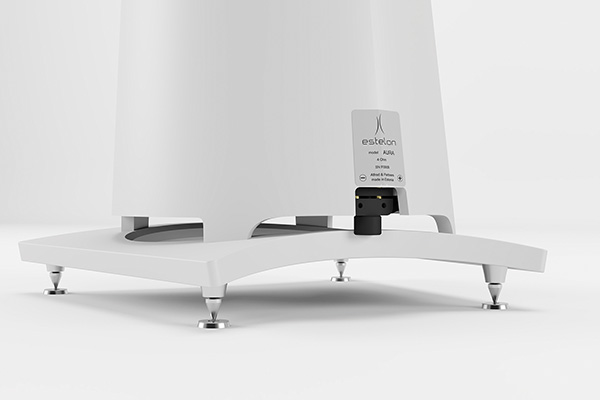
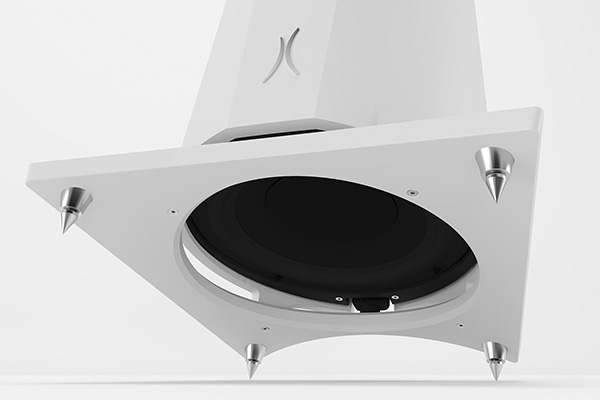
Placed within the standard "candy spots" on the far corners of the carpet and lifted ever so barely by the small spikes, the AURAs have been eye sweet, as anticipated; their swish simplicity would swimsuit virtually any room. Fit and end of the proprietary, mineral-filled cupboard and drivers was flawless. The uncommon form and angled high keep away from parallel inner surfaces. With the grille in place, the one notable exterior options are the gently arched base plate, which is separated from the principle cupboard by a 2cm hole to permit for the output of the downward dealing with 10" woofer and the speaker terminals, that are virtually hidden below the underside rear of the principle cupboard. The AURAs’ look advantages from the accent supplied by the grille, and I’m happy to say that I most popular to take heed to them with the grilles in place. If that may be a consequence of a visible bias, so be it.
With the grille eliminated, one sees a vertical M-T-M association, the 1" Scan-Speak tweeter flanked by a pair of 5" midwoofers close to the highest of the speaker. The crossover between the tweeter and the midwoofers is at 2.1kHz; the tight spacing ends in a midwoofer-midwoofer spacing of a few wavelength at that frequency, the tweeter-midwoofer spacing half that. Such an association might trigger beaming interference, however in a vertical array, it could solely be a difficulty above or under a traditional seated place.
Estelon calls these drivers midwoofers not midrange drivers as a result of their vary extends all the way down to a low 77Hz, the place the down-facing woofer begins to take over. The middle of the M-T-M trio is a few meter above the woofer, a small fraction of a wavelength (roughly 4.5 meters) on the crossover, so there must be no points there. Estelon emphasizes the care lavished on mentioned crossover, which makes use of:
Mundorf Supreme and Classic resistors
Mundorf air-core coils (inductors) for midwoofers and tweeter
Mundorf resin-impregnated coils for bass
Kubala-Sosna inner wiring.
I linked the AURAs to a single NAD C 298 stereo amplifier, and later to a pair of monoblock Benchmark AHB2 amplifiers, through spade-terminated AudioQuest Granite cables; the AURA terminals additionally settle for banana-plug terminations. My experiments with placement ended up with the audio system about 7.5′ aside, 5′ from the entrance wall, and about 3′ from the sidewalls. They have been toed in just a bit, near the factory-recommended 7°.
Hello, stunning
From the primary noteseffectively earlier than I finalized place and toe-inI discovered that the AURAs’ magnificence was not superficial. They sounded open and detailed and, as soon as correctly positioned, well-balanced. I like to make use of solo piano recordings to start out a evaluation as a result of the piano is a single acoustical instrument with extensive ranges in frequency and dynamics. The problem for any element, together with the AURAs, is to convey all of the notes, singly and in chords, with presence, tonal stability, and readability whereas additionally making clear that the supply of all that sound is a single massive instrument in an actual acoustic house.

The AURAs achieved all that with a pair of recent recordings of Liszt’s Transcendental Etudes carried out by Francesco Piemontesi (Pentatone 5187052) and by Haochen Zhang (BIS-2681). Both play Steinways, and each recordings have been auditioned through 24/96 FLAC information downloaded from the labels’ web sites. The devices and their aural environments are remarkably comparable to one another, however I detect a bit extra focus within the BIS recording. And, though Zhang was recorded in a movie/recording studio in Munich and Piemontesi in a small, fashionable live performance corridor in Lugano, neither recording provided a lot details about the acoustics of the recording websites. The distinction is within the taking part in. Zhang clearly relishes articulating particular person notes, which he does with virtually superhuman precision. Piemontesi leans towards a extra legato expression, though the Estelons nonetheless let me hear every of the notes once I attended to them. Zhang’s delineations have been thrilling within the "massive" items, comparable to No.4, "Mazeppa," and No.8, "Wilde Jagd," but in addition surprisingly touching within the extra delicate No.7, "Vision"; he saved me hanging on each be aware, with bated breath. Strangely, Piemontesi’s extra fluid taking part in achieved extra momentum within the massive items and supplied a much-appreciated grace within the delicate items. I listened to each performances a number of occasions through the AURAs. The expertise was informative, fulfilling, and completely nonfatiguing.

I lately stumbled on a recording of chamber wind items by György Ligetia brand new launch from Harmonia Mundi (CD, HMM905370) recorded in 2016 and remastered and reissued solely this yr. The earlier concern (Musicales Actes Sud ASM 26) was criticized for its sound high quality, however Harmonia Mundi’s 2023 launch, which I downloaded in 24/96 FLAC, is spectacular. Via the AURAs, the devices within the opening Six Bagatelles for Wind Quintet popped like a poster-painted posy, every clearly delineated, richly coloured, and arrayed on a soundstage that extends laterally past the audio system. The closest wind devices sounded as shut because the audio system, the ensemble extending to a couple ft behind, and there was a powerful phantasm of performers in my room. Quite thrilling, after all, however I missed any sense of the recording-site acoustics. Fortuitously, the foremost work on this recording, Ligeti’s Chamber Concerto, with François-Xavier Roth conducting Les Siècles, a bigger ensemble, was recorded in a bigger house, which endows the ensemble’s sound with a richer atmosphere (footnote 2). This was appreciated, particularly when the AURAs’ low-frequency efficiency delivered tight and detailed bass. In the motoric third motion, the pacing and percussion simulate artificial music; it’s reproduced right here with surgical precision. The fourth motion is mellow and flowing save for one manic outburst; I used to be engrossed all through by the music because the AURAs conjured a vivid phantasm of a reside efficiency.
Footnote 1: Estelon Forza ($149,000$163,000/pair) reviewed by Michael Fremer in November 2021. Estelon XB Diamond Mk.2 ($58,000$65,200/pair) reviewed by Jim Austin in October 2022.
Footnote 2: The album notes determine each recording websites, the Méjan Chapel in Arles and the Cité de la musique in Soissons, however don’t affiliate particular person works with the websites. From the photographs I see on the web and from what I hear, I think that the Concerto was recorded in Soissons and the 2 items for quintet in Arles.
HI-FI News
through InnerFidelity https://ift.tt/g6NCsdz
November 24, 2023 at 02:58PM
-
Product on sale
 Audiophile Vinyl Records Cleaning BundleOriginal price was: €69.90.€59.90Current price is: €59.90. incl. VAT
-
Product on saleEasy Start Vinyl Records Cleaning KitOriginal price was: €69.90.€59.90Current price is: €59.90. incl. VAT
-
Vinyl Records Cleaner Easy Groove Concentrate€34.95 incl. VAT
-
Easy Groove Super Set€199.00 incl. VAT
-
Easy Groove Enzycaster – vinyl records prewash cleaner€34.95 incl. VAT
-
Easy Groove Extreme MK. II- vinyl records prewash cleaner€45.00 incl. VAT
-
Vinyl Records Cleaner – Easy Groove Virgin Concentrate€35.00 incl. VAT
-
Easy Groove Spray&Wipe vinyl records cleaner€34.95 incl. VAT


