
World News
Q Acoustics 5040 loudspeaker
Q Acoustics 5040 loudspeaker
When I reviewed the Concept 50 loudspeaker from the UK’s Q Acoustics in August 2022, I concluded that the Concept 50 lowers the candy worth spot for inexpensive tower audio system to $3000/pair. Now I’ve one other pair of Q Acoustics loudspeakers in the home for evaluate. Like the sooner speaker, the 5040 is a slim, elegant-looking tower with a vertical D’Appolito drive-unit array comprising a 0.9" fabric-dome tweeter positioned between the 2 5" plastic-cone woofers. But the worth is half that of the Concept 50: $1499/pair. Will this be a brand new candy spot? We shall see.
The 5040
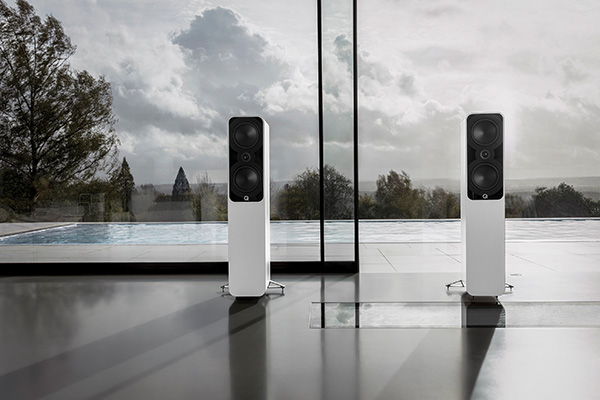
Superficially, the 5040 seems similar to the Concept 50, with twin height-adjustable spikes on the entrance and stabilizing aluminum outriggers on the rear. But it’s barely shorter and lacks the sooner speaker’s sprung base. The three drive items are mounted on the prime of the High-Density Fiberboard baffle on a panel completed in black acrylic and remoted from the enclosure with a layer of butyl rubber. The enclosure is made out of 18mm MDF and, as with the Concept 50, Q Acoustics has paid a number of consideration to the cupboard’s vibrational conduct. Strategically positioned Point-2-Point (P2P) inner bracing stiffens the cupboard to attenuate low-frequency vibrations, whereas two tubes, referred to as Helmholtz Pressure Equalisers (HPE), are stated to cut back the consequences of inner standing waves.
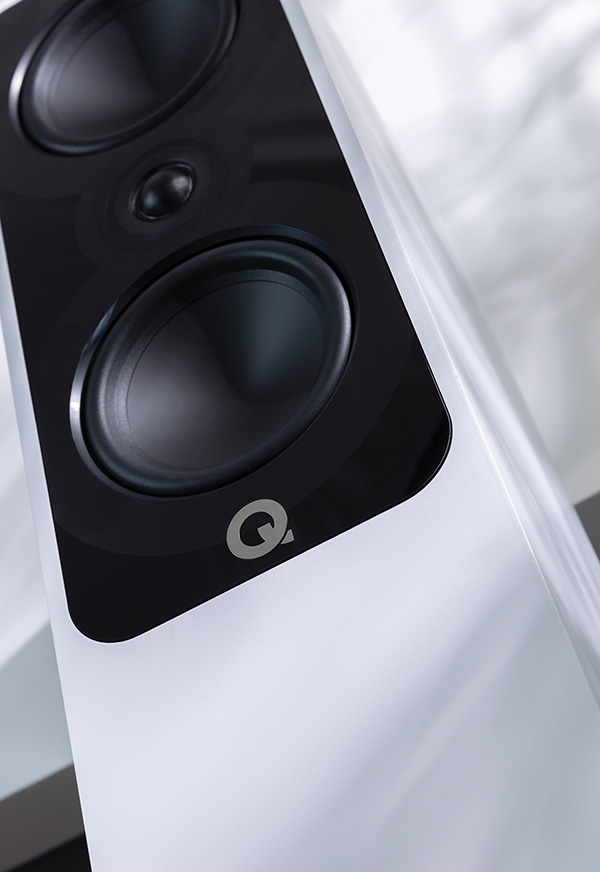
The proprietary drive items had been developed for Q Acoustics’s 5000-series fashions. The woofers’ plastic cones are terminated with a considerable half-roll encompass and have what Q Acoustics calls a "Continuous Curve Cone" profile (footnote 1), which does not have a standard mud cap. This cone was developed utilizing Finite Element Analysis (FEA) and is claimed to mix the bass-performance advantages of a standard straight conical cone with the midrange frequency management of a flared cone whereas lowering harmonic distortion. The dispersion and what’s described as "a well-controlled frequency response" ought to allow a easy integration with the tweeter. The woofer’s motor makes use of a considerable magnet with a close to totally saturated pole piece and an aluminum ring mounted beneath the pole plate to cut back inductance-induced modulation distortion. The 30.5mm voice-coil is wound from low-mass copper-clad aluminum wire (CCAW) over a glass fiber former.
The woofers are reflex-loaded with a port 11" from the ground on the speaker’s rear and cross over to the tweeter at 2.5kHz. This unit was developed from the Concept sequence tweeter. It is hermetically sealed to forestall modulation by inner stress variations and mechanically remoted from the entrance baffle. The material diaphragm has a slim concave roll encompass and is loaded with a shallow waveguide.
Setting up
I used my Roon Nucleus+ to feed audio information over my community to an MBL N31 CD participant/DAC, which was related first to the Musical Fidelity Nu-Vista 800.2 built-in amplifier I reviewed within the December 2023 challenge, then, later, to the Audio Research I/50 built-in amplifier I reviewed in September 2023. Finally, I hooked it as much as my NAD M10 built-in amplifier. The Q Acoustics 5040 has a single pair of binding posts on the backside of the rear panel. I single-wired every speaker with AudioQuest Robin Hood cable.
With the 5040s sitting on their spikes and outriggersprotecting spike covers are supplied for many who have wood flooringthe tweeters had been 30" from the ground, which is a number of inches under my ear top. However, a D’Appolito driver array optimizes the vertical dispersion in order that the tweeter-axis response is maintained a number of levels above and under that axis whereas flooring and ceiling reflections are diminished in degree. Listening to the dual-mono pink noise observe on my Editor’s Choice CD (Stereophile STPH016-2; not out there), I did not hear any important change in tonal steadiness if I slouched or sat up straight. The sound began to sound a little bit hole if I rose to the purpose the place I might see the highest of the enclosure.
The handbook recommends that the 5040s be positioned a minimum of 0.2m (8") from the wall behind them, 0.5m (19.7") from the sidewalls, and a pair of4m (78.7"157") aside. As with the Concept 50s, the 5040s wanted to be nearer to the wall behind them than was doable in my room. (This is because of a brief flight of stairs behind the right-hand speaker that runs as much as the vestibule.) I due to this fact experimented with the speaker positions to offer essentially the most even midbass and upper-bass steadiness. The 5040’s entrance baffles ended up 72" from the wall behind the audio system, which had been 103" aside and 47" from the closest sidewalls, although this distance was diminished at locations by bookcases and file cupboards.
The handbook additionally says that "turning the loudspeakers barely inwards will sharpen the stereo picture on the expense of a narrower sound stage." As I’m a stereo imaging fanatic (footnote 2), I toed every speaker in to the listening place. I left off the vestigial grilles for my auditioning.
Listening
With their ports open, the 5040s reproduced the 1/3-octave warble tones on the Editor’s Choice CD cleanly right down to the 40Hz band, with the 50Hz warble a little bit decrease in degree. The 32Hz tone was bolstered by the bottom room mode, however the 25Hz and 20Hz tones had been inaudible. The warble tones sounded very clear, with no "doubling" (including second-harmonic distortion). The half-stepspaced tonebursts on Editor’s Choice spoke cleanly right down to 60Hz, with these decrease in frequency suppressed a little bit and people between 2kHz and 4kHz barely accentuated. Listening to the enclosure’s partitions with a stethoscope whereas the tonebursts performed, I might hear a slim band of liveliness between 250Hz and 300Hz on the rear panel. The facet panels and entrance baffle had been higher behaved on this regard.
Though the 5040s had been positioned farther out in my room than Q Acoustics recommends, the low frequencies had adequate bass weight. The softly struck bass drum that punctuates Peter Gabriel’s "My Body Is a Cage," from Scratch My Back (Special Edition) (24/48 MQA, Real World Productions/Tidal), was delivered into the room in what sounded to be full measure.
Footnote 1: A white paper on the know-how featured in Q Acoustics’ 5000-series loudspeakers will be downloaded from tinyurl.com/3c4m9du8.
Footnote 2: See my 1981 article on stereo imaging right here.
HI-FI News
through InteriorFidelity https://ift.tt/U9uHhZ1
December 29, 2023 at 03:48PM
-
Product on sale
 Audiophile Vinyl Records Cleaning BundleOriginal price was: €69.90.€59.90Current price is: €59.90. incl. VAT
-
Product on saleEasy Start Vinyl Records Cleaning KitOriginal price was: €69.90.€59.90Current price is: €59.90. incl. VAT
-
Vinyl Records Cleaner Easy Groove Concentrate€34.95 incl. VAT
-
Easy Groove Super Set€199.00 incl. VAT
-
Easy Groove Enzycaster – vinyl records prewash cleaner€34.95 incl. VAT
-
Easy Groove Extreme MK. II- vinyl records prewash cleaner€45.00 incl. VAT
-
Vinyl Records Cleaner – Easy Groove Virgin Concentrate€35.00 incl. VAT
-
Easy Groove Spray&Wipe vinyl records cleaner€34.95 incl. VAT


