
World News
February 2024 Classical Record Reviews
February 2024 Classical Record Reviews
Reinbert de Leeuw: Der nächtliche Wanderer / Abschied
Netherlands Radio Philharmonic Orchestra, Reinbert de Leeuw & Edo de Waart
Challenge Classics CC72957 (CD, reviewed as DSD). 2023. Anita Wijnen, prod.; Jan Stellingwerff, Frank Mathijssen, engs. Abschied eng.
Performance ****½
Sonics *****
The music of composer/conductor/pianist Reinbert de Leeuw (19382020) is as astounding as something I’ve heard. His ultimate two orchestral works, each recorded dwell, might have been composed 40 years aside, however each are complicated, layered, and crammed with darkish, aggressive, and soul-shakingly violent vitality.
When de Leeuw wrote his Abschied (Farewell) in 1973, he felt he had stated all he might presumably say by means of composition. He went out with an emphatic bang, with an nearly 23-minute piece with an air of emphatic finality that feels like universes colliding repeatedly till every little thing collapses, solely to renew colliding as soon as once more. Thanks to extraordinary digital restoration by Bert van der Wolf and Oude Avenhuis of Northstar Recording Services, the 2017 dwell recording, performed by Edo de Waart, is assured to blow you away, assuming your system can deal with it.
Despite writing a couple of subsequent works, de Leeuw eschewed composition for full orchestra till 2013, when he created and performed the world premiere of his 46-minute, single-movement Der nächtliche Wanderer (The Night Wanderer) for orchestra and taped accompaniment. (The tape contains accordionist Bart Lelivelt, and actor Steven Scharf reciting, in German, the poem on which the symphony relies.) After the remarkably practical sound of a canine barking within the night time, the dwell recording unfolds softly and slowly. Silence and texture are central to haunted passages ultimately punctuated by super percussive jolts and violent threats. The horror and terror of the music grows and accelerates till Hölderlin’s chilling poem about concern, strangling, and demise reaches our ears. The ending is as unforgettable as all that precedes it.Jason Victor Serinus
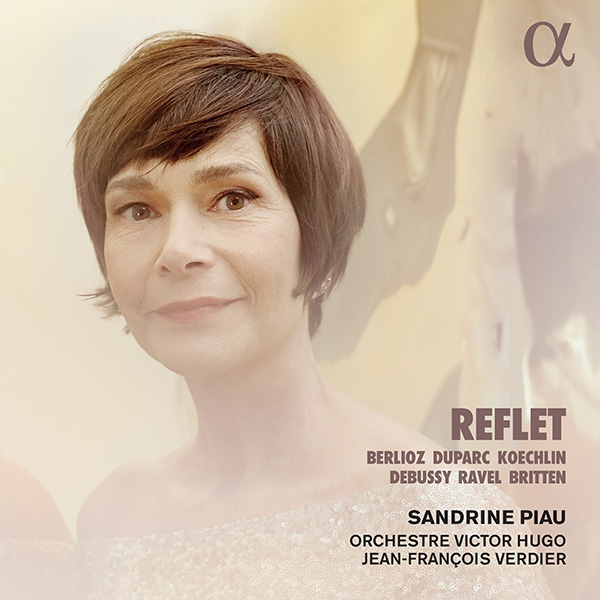
Sandrine Piau: Reflet
Sandrine Piau, soprano; Orchestre Victor Hugo, Jean-François Verdier
Alpha1019, CD (reviewed as 24/96). 2023. Vincent Mons, Laure Casenave, engs.
Performance *****
Sonics *****
Sandrine Piau is one thing of a miracle. Fifty-seven on the time of this recording, she sounds nearly as recent and freed from voice as she did in her late 20s. Her interpretations have grown deeper with the passage of time, however she retains an understated simplicity that transport us with sincerity quite than a surfeit of phrase portray.
Reflet consists completely of French songs about mild, illusions, and "the land of luminous transparency." Setting poetry by Baudelaire, Leconte de Lisle, Hugo, Verlaine, and others, it begins with the oldest tune on this system, Hector Berlioz’s "Le spectre de la rose" from Les Nuits d’Été. Although Piau voices the best notes with much less quantity than these instantly under them, her voice is so lovely, the sound so chic, the tune’s thriller so completely conveyed that the rendition convinces. Then come two of Henri Duparc’s greatest recognized songs, "Chanson triste" and "L’invitation au voyage." No one can substitute Maggie Teyte’s haunting slowdowns and idiosyncratic emphases, however Piau’s magnificence is profound, the magic of Duparc’s orchestrations absolutely realized.
Scattered between gloriously performed interludes by Debussy"Claire de lune" from Suite Bergamasque, orchestrated by André Caplet and "Pour remercier la pluie au matin," orchestrated by Ernest Ansermetcome Ravel’s Trois Poèmes de Stéphane Mallarmé, Britten’s Quatre Chansons Françaises, and Koechlin’s much less well-known Quatre Poèmes d’Edmond Haraucourt. Whether the temper be of sensual abandon amidst the dual pulls of affection and demise (Ravel’s "Soupir"), the intoxicating mixture of daytime scents and nighttime wonders (Britten’s "Nuits de juin"), or sheer fantasy (Koechlin’s "Aux temps des fées"), Piau lives every tune as if composed for her. This is a fabulous recital.Jason Victor Serinus

Prokofiev: Symphony 5
London Symphony Orchestra, Gianandrea Noseda
LSO Live LSO0379 (CD). 2023. Nicholas Parker, prod.; Neil Hutchinson, ed.
Performance *****
Sonics *****
From the beginning, when the winds venture the opening theme with a stately dignity, Noseda lays out the Fifth with a gratifying readability and a strong sense of route. The agency, lyrical circulation, removed from undercutting the grinding interjections, render their intrusions extra ominous. The second theme is conspicuously sooner; the forthright improvement underlines the obsessive-compulsive high quality of some accompaniment motifs. Throughout the motion, the broad, highly effective climaxes construct with out straining, and the sonorities, even at their loudest, stay clear.
In the Allegro marcato, the perky clarinet and different melodic parts, punctuated by lean, slashing accents, stand in sharp aid in opposition to the tick-tock accompaniments. The arrival on the Meno mosso is full-throated; the passage builds affirmatively, and its return is extra reflective. The accented basses present ample tonal weight to deliver off the flowing Adagio; the music slides nearly unnoticed into and out of extra dissonant, menacing episodes. At the climax, the brass triplets are clear and pillowy, not heavy and portentous; the excessive violins ease easily into the opening theme’s ultimate recap. After a ruminative opening, the propulsive closing Allegro giocoso chugs alongside properly; the whirling themes give strategy to relaxed, lyrical inflections within the second group.
The LSO, as urged, contributes posh, delicate taking part inkudos to the principal reeds, particularly the clarinet, who retains busy. The wide-ranging engineering, with out a hint of stridency on the peaks, is equally fantastic. All advised, that is actually one of the best new Fifth I’ve come throughout in a protracted whereas, one which steers an professional center course between the gentle grandiloquence of the usual studying and the brisk, terse approaches of Szell and Jansons.Stephen Francis Vasta
Tchaikovsky: Symphony No.4
Cleveland Orchestra, Franz Welser-Möst
The Cleveland Orchestra TCO0009 (16/44.1 WAV). 2023. Elaine Martone, prod.; Gintas Norvila, eng.
Performance ***½
Sonics *****
If you are on the lookout for a resplendent Fourth, right here it’s. The massive, deep brass copy within the opening fanfares; the clear woodwind definition inside a pure acoustic; the wealthy, resonant bass help because the textures developall this makes for essentially the most "current," vividly coloured manufacturing ever.
Musically, we’re on barely shakier floor. In the primary motion, Welser-Möst avoids marking off sections within the customary method, taking part in it "all of a chunk." In the method, nonetheless, he can push ahead breathlessly. The horns shave time without work the longer notes of their opening fanfare; the Moderato bumps unceremoniously by means of its first main cadence; and the motto theme’s returns are hecticit is like a run-on sentence. Even when the conductor permits the clarinet to calm down, he does not belief it, shifting issues alongside shortly thereafter. In the primary massive climax, the dominant strings push forward of the woodwind countertheme (discreetly obscured by the engineers).
The center actions go effectively. The oboe sings merely within the Andantino, which makes a smooth touchdown on the central part; the pizzicato Scherzo, on this context, is surprisingly average. The Finale suffers bouts of instability, the woodwind runs areeffectivelyrunny, the return of the motto hurries up, undercutting its ominous energy. Still, it is bright-eyed and joyous, with good delicacy within the second group.
The taking part in is first-rate. The strings are silky and mysterious on the Moderato‘s beginalthough the bows typically sit unnecessarily lengthyand the Finale‘s forte runs are spanking clear. The reeds are delicate, the brass agency and forthright. The textures are clear, even at full throttle with the percussion going; quiet passages are all a notch above the indicated dynamics however retain a delicate demeanor.
So a lot excellence; I want it have been persistently maintained.Stephen Francis Vasta
Robert Schumann: Piano Quartet & Quintet
Isabelle Faust, Anne Katharina Schreiber, Antoine Tamestit, Jean-Guihen Queyras, Alexander Melnikov
Harmonia Mundi 902695, CD (reviewed as 24/192). 2023. Stephan Cahen, prod. and eng.
Performance *****
Sonics ****
This dream of a recording unites 5 of our most interesting interval instrument soloists in two of Schumann’s best chamber works. Composed in 1842 only a few weeks aside, these superb compositions for piano and strings share with the songs of 1841 a love of magnificence and life tempered by high-Romantic sorrows and dramas.
The quartet begins deceptively in a mournful mode earlier than the clouds elevate and lyricism abounds. Even so, amidst the music’s romantic flights, pleasure can by no means be assumed. The second motion scherzo scurries about restlessly earlier than ending on a hopeful observe, on the very finish. Song is on the coronary heart of the following motion; the melody is beautiful and tender. Only within the spirited finale does Schumann lastly appear to say that he is writing music like this as a result of he can, so let’s drop our guard, rejoice, and benefit from the chase.
I have never listened to Schumann’s chamber music for a few years. I used to be delighted to search out myself greeting the opening bars of the Piano Quintet with the thought, "Oh, it is this one!" Once you hear the music, chances are you’ll really feel equally, as a result of the opening melody and wild tumble that observe are unforgettable. The distinction with the second motion’s funeral march is intense. Its melody, too, has such a profound impact on listeners that it is no surprise that it surfaced in Bergman’s movie Fanny and Alexander and in much less chic style in Buffy the Vampire Slayer. The third motion scherzo is one other wild chase, up and down, culminating in delightfully energetic style. Romance reigns within the ultimate fugue, which leads among the most marvelous music to ever finish a quintet.
Sonically, the intestine strings often sound a mite grainy in fortes, however usually the genuine sonorities of the interval devices seduce.Jason Victor Serinus
HI-FI News
by way of InnerFidelity https://ift.tt/6JtrnHl
February 9, 2024 at 05:38PM
-
Product on sale
 Audiophile Vinyl Records Cleaning BundleOriginal price was: €69.90.€59.90Current price is: €59.90. incl. VAT
-
Product on saleEasy Start Vinyl Records Cleaning KitOriginal price was: €69.90.€59.90Current price is: €59.90. incl. VAT
-
Vinyl Records Cleaner Easy Groove Concentrate€34.95 incl. VAT
-
Easy Groove Super Set€199.00 incl. VAT
-
Easy Groove Enzycaster – vinyl records prewash cleaner€34.95 incl. VAT
-
Easy Groove Extreme MK. II- vinyl records prewash cleaner€45.00 incl. VAT
-
Vinyl Records Cleaner – Easy Groove Virgin Concentrate€35.00 incl. VAT
-
Easy Groove Spray&Wipe vinyl records cleaner€34.95 incl. VAT


