
World News
T+A Solitaire S 530 loudspeaker
T+A Solitaire S 530 loudspeaker
I jumped on the probability to evaluate T+A’s $47,900/pair Solitaire S 530 loudspeaker for just a few causes (footnote 1). First, as a result of T+A is a well-established firm with an method I like and respect: They make hi-fi tools of the best high quality however with costs that, although substantial, are consistent with their expertise and execution. Their stuff could be very good-looking with spectacular industrial design, however T+A would not do audio jewellery. What’s extra, although T+A is aggressive in R&Dtheir "Company" webpage says, "Actually, we’re scientists …"however they’re selective in the usage of new expertise. The third cause I used to be curious about reviewing a product from T+A is that their costs and technical stage place them in a market section I do know effectively.
What I did not know till not too long ago is that T+A makes loudspeakers, and so they’re fairly completely different from the loudspeakers different corporations make. I solely realized this once I began listening to concerning the S 530 and its bigger sibling, the S 540, from associatesassociates whose ears I belief.
For the final 15 years, I’ve been listening to comparatively typical, multi-point-source audio system, which emit overlapping, roughly spherical wavefronts from drivers that often are spherical. This group consists of most not too long ago the wonderful Wilson Sasha DAW, which I nonetheless personal. Before that string of audio system, I’d been an enormous proponent of line sources and planar dipoles: Genesis IIs and Magnepans, for instance. Most of these loudspeakers had shortcomingslimitations in final dynamics, affect, element, generally bass extensionhowever I at all times discovered one thing inherently proper concerning the sound, particularly the way in which they recreated house, which greater than made up for these shortcomings.
Which results in the fourth and remaining cause I wished to listen to these audio system. When my very first audiophile buddythe one I’ve recognized the longestadvised me about them, he stated, "I believe you’d actually like them. They’re a line supply." That sealed the deal.
The T+A Solitaire S 530
The design of the Solitaire S 530 is uncommon: When was the final time you noticed a speaker that makes use of seven midrange drivers? Or, even weirder, a tweeter that is nearly 3′ lengthy?
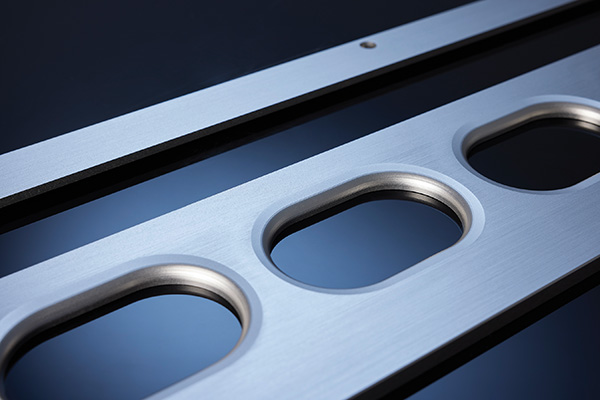
Actually, the S 530 is comparatively typical in comparison with different line-array loudspeakers; contemplate The Note from Laufer Teknik, which stands possibly 10′ tall and has 50+ tiny drivers (footnote 2). The S 530 is a 4′-tall tower in a conventional-looking cupboard that is deeper than it’s broad however impressively stout and, primarily based on a knuckle rap, considerably inert. You begin to discover how uncommon it’s once you have a look at the entrance baffle, consisting completely of a single thick slab of aluminum with drivers recessed into fluidly formed, tapered recesses. The "Organic" baffle, as T+A calls it, is a waveguide that shapes the dispersion patterns of the person drivers into "a really perfect line supply." The quote is from the corporate web site. Apparently a loudspeaker would not must be 10′ tall to be a correct line supply.
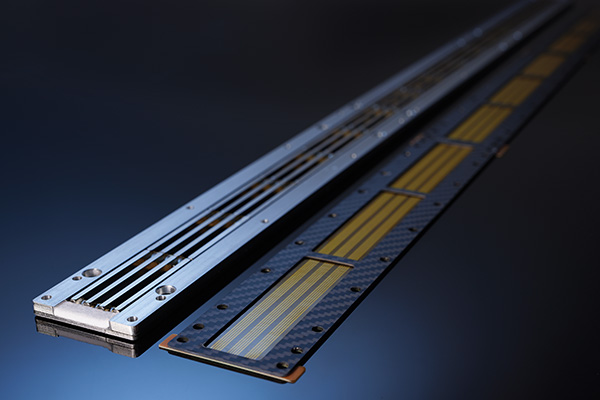
And these drivers! The S 530’s entrance baffle doesn’t maintain, as extra typical loudspeakers do, a vertical array of spherical drivers in numerous sizes. On the left are seven ovals. On the suitable is one prolonged … what precisely?
The electrostatic tweeter was one of many first applied sciences developed by Siegfried Amft when he began T+A in 1978, and so they’ve been part of the corporate’s DNA ever since. So, I used to be stunned to be taught that the tall factor on the baffle of the S 530 is not an electrostatic tweeter however a 33.5" lengthy, 1.65" broad magnetostatic, or planar magnetic, tweeter. It was developed in-house by T+A’s R&D division, which, the corporate says, employs 15 engineers. Specifically, the tweeter consists of a Kapton membrane lower than 10µm thick onto which a posh array of aluminum patterns has been spray-deposited (footnote 3). Five parallel aluminum traces run down the middle of the membrane, linked in sequence to type a single conductor greater than 10m lengthy. The outer parts of the membrane, which are not a part of the middle conductor, are lined nearly utterly with aluminum in a sample of carefully spaced hexagons, meant to create a extra uniform magnetic discipline throughout the membrane. Behind the membrane are 4 columns of 64 "Toblerone-shaped" magnets, their slender ends pointed towards the membrane, positioned halfway between the traces. The outcome, T+A says, is a magnetic discipline that adjustments to oppose curvature within the membrane floor because it deflects, protecting its actions fixed over its floor. The results of all that is, to repeat, a tweeter that is nearly 3′ lengthy.
The change from electrostatic to magnetostatic, I realized, was pushed by the previous’s susceptibility to arcing in heat, humid climates. The expertise behind the brand new driver grew out of the event of the TPM 3100 headphone transducer, a venture that was itself a by-product of earlier loudspeaker R&D.
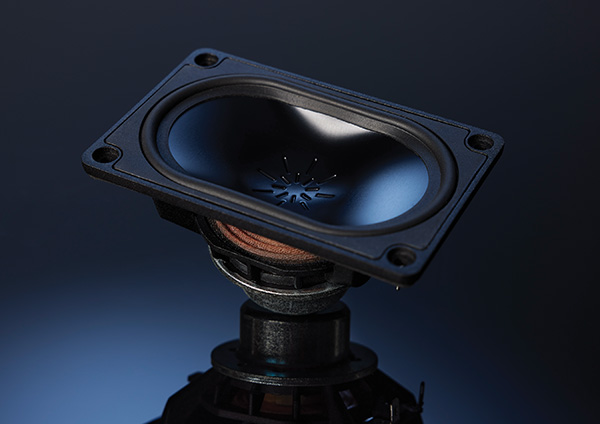
So, what concerning the seven ovals on the opposite aspect of the entrance baffle? Those are midrange drivers. It’s the primary time T+A has used oval driverswith aluminum cones as an alternative of their typical fiber/carbon combine. The oval form produces a tall, slender dispersion sample that extra successfully combines to type the S 530’s line array, and for a given floor space, permits their acoustical facilities to be nearer to the elongated tweeter’s.
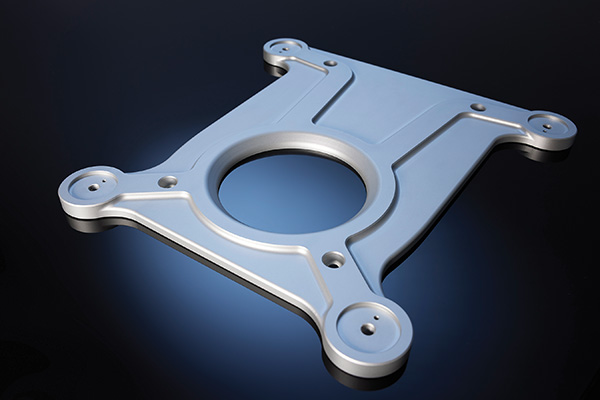
What concerning the bass? The bass models are on the aspect within the type of a brand new, spherical, 8.75"-diameter aluminum-cone woofer, which replaces the 8.25" and eight.75" fiber/carbon ones that T+A used beforehand. The two woofers are side-firing and mounted halfway up the cupboard. They at the moment are in a ported (bass-reflex) chamber and in-phase, whereas in earlier T+A fashions, the chamber was sealed and the drivers in every pair operated out of part. The level of all that is to create a loudspeaker that energizes a room in a essentially completely different manner than typical audio system.
Conventional round-driver audio system generate a soundwave with a (very roughly) spherical wavefront; consider every driver as on the middle of an increasing sphere of sound, at the very least within the ahead course. What reaches the ear in such audio system is an overlapping mixture of spherical wavefronts, every radiating from a special middle.
In distinction, a line supply is greatest envisionedthat is the idealized abstractionas sound emanating from an infinitely lengthy vertical line. It’s clear from symmetry (if you consider it) that at the very least towards the center of that vertical line, sound can solely propagate outward, not up or down. The consequence is that the sound emitted propagates out like a cylinder moderately than a sphere.
An actual-world line-source loudspeaker is not infinitely lengthy, so that is all solely a tough approximation. What’s extra, the room has a ceiling and a groundprime and backside boundaries that constrain the soundwaves. The result’s that the sound depth falls off quick on the prime and backside. The wavefront rising from a real-world line supply is extra like a can of Coke (or, very roughly, half a can) than an infinite cylinder. For a speaker just like the S 530, you will wish to be sitting right down to hear, the audio system aimed precisely on the listening seat. Stand up, and the sonic presentation adjustments drasticallyrather more than with a extra typical loudspeaker.
Another massive distinction between a standard, point-source loudspeaker and a line-source loudspeaker is how shortly the music’s depthits quantitydrops as you progress away from it. With some extent supply, the wavefront is an increasing sphere, the floor space of which will increase because the sq. of the radius, so the depth will get smaller because the inverse sq. of the space from the supply. In distinction, the floor space of a cylinder will increase in direct proportion to the radius, so the depth of sound rising from a line supply speaker will get smaller as 1/r. With a line supply speaker, the music quantity stays louder farther out into the room. If you are used to standard designs, this could be a little disconcerting.
This reality additionally has implications for a way the sound interacts with surfaces within the room. There’s much less interplay with the ceiling and ground, however what concerning the sidewalls? It’s exhausting to say, as a result of a loudspeaker can name itself a line supply whereas nonetheless having a reasonably slender horizontal dispersion sample; the quantity of interplay with the sidewalls relies on the small print.
Setup
My listening room is 24′ lengthy, so I began out placing the audio system 1/3 of the space (8′) out from the entrance wall and my listening chair two-thirds of the way in which (16′) out. I began with the Solitaires about 4′ from the sidewalls (to the center of the noncentered tweeter) and my chair in the midst of the room, forming a tough equilateral triangle. The S 530 has three ±1.5dB rocker switches, one every for Bass, Midrange, and Treble; I left these within the "LIN" (flat) place.
After the audio system had been burned in for a couple of week, I sat down and cued up the primary album. The distinction from what I used to be used to was so astonishing that my preliminary response was that one thing was impropernot a lot that the audio system have been damaged however that actuality was out of kilter. For an on the spot, my thoughts flashed to a picture burned into my mind at an early age, of furnishings and different issues suspended within the vortex of a twister. (Think Wizard of Oz.) The performers have been stable, three-dimensional objects suspended in three-dimensional house in a manner my mind could not fairly settle for. The subsequent on the spot, that psychological picture was gone, the left aspect of my mind kicked again in, and I began to course of what I used to be listening to. Over the course of some minutes, I went from considering one thing was improper to recognizing that it wasn’t improper, simply completely different. Not lengthy after that, throughout a spherical of transferring the audio system to search out their optimum positions, I began to suppose that what the Solitaires have been doing wasn’t simply completely differentit was proper.
Footnote 1: Shorthand for T+A Electroakustic, GmbH & C. KG, which loosely interprets to "Technology and Application within the Field of Electroacoustics, LLC."
Footnote 2: Or had, since they are not made anymore. You can see photographs right here.
Footnote 3: See the dialogue of this expertise in Julie Mullins’s evaluate of the Audeze LCD-5 headphone. There’s no connection between the 2 corporations besides that they are utilizing related expertise.
HI-FI News
through Stereophile.com https://ift.tt/di5rnXS
April 26, 2024 at 03:40PM
-
Product on sale
 Audiophile Vinyl Records Cleaning BundleOriginal price was: €69.90.€59.90Current price is: €59.90. incl. VAT
-
Product on saleEasy Start Vinyl Records Cleaning KitOriginal price was: €69.90.€59.90Current price is: €59.90. incl. VAT
-
Vinyl Records Cleaner Easy Groove Concentrate€34.95 incl. VAT
-
Easy Groove Super Set€199.00 incl. VAT
-
Easy Groove Enzycaster – vinyl records prewash cleaner€34.95 incl. VAT
-
Easy Groove Extreme MK. II- vinyl records prewash cleaner€45.00 incl. VAT
-
Vinyl Records Cleaner – Easy Groove Virgin Concentrate€35.00 incl. VAT
-
Easy Groove Spray&Wipe vinyl records cleaner€34.95 incl. VAT


