
World News
TAD Grand Evolution One loudspeaker
TAD Grand Evolution One loudspeaker
Review samples of some new high-end audio merchandise don’t develop on bushes. They are extra like dray horses trouping from one vacation spot to a different. After the US premiere of the Technical Audio Devices (TAD) Grand Evolution One (TAD-GE1), a floorstanding speaker from TAD’s Evolution sequence, on the 2023 Capital Audio Fest, the overview pair got here to stick with me in Upstate New York for a few months earlier than touring on to the 2024 Florida Audio Expo for one more public look. After that, they returned to John Atkinson for measuringthen off once more on one other journey.
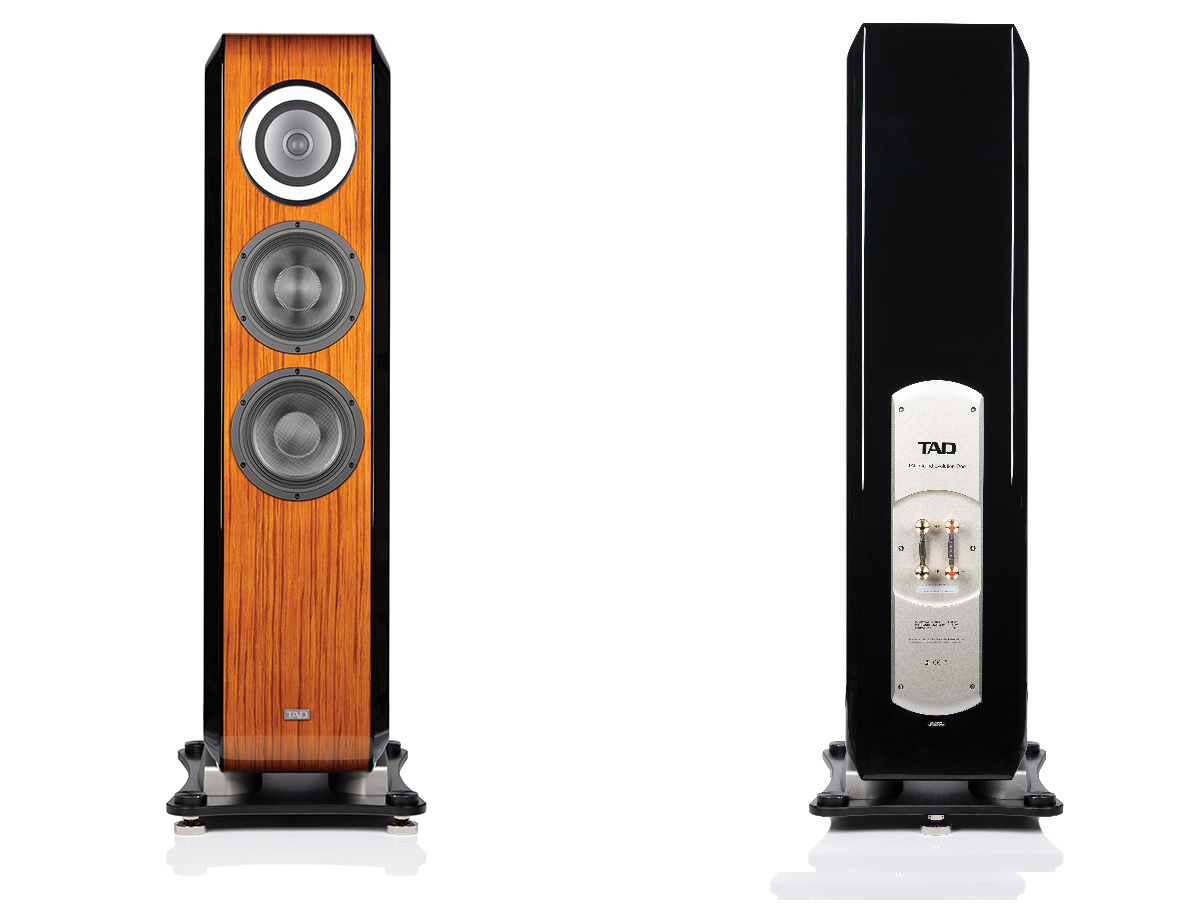
The TAD Labs GE1 is a three-way, three-driver design. Up high is TAD’s proprietary Coherent Source Transducer (CST), a 5½" coaxial tweeter/midrange driver. Two matched 7" woofers fill out the center of the entrance panel. On the again are two pairs of speaker faucets related (in the intervening time) with high-quality jumper cables; those that biwire or biamp are cared for. The GE1 is a bass-reflex speaker; its port fires down. The footers are the same old spiked cones; a set of steel discs is thoughtfully included for many who want to defend their hardwood flooring.
The cupboard stands simply shy of 49" tall, constructed out of 40mm-thick MDF panels and 18mm birch plywood bracing. The visible aesthetic is much like that of a effective grand piano: sides and again completed in shiny black lacquer, the entrance kitted out in very good-looking, glossy-finished olive wooden, much like the within rims of some high-end pianos. The cupboard edges are easily contoured. The cupboards sit atop an hooked up combo port/plate (extra on this in a second). Including this platform, every speaker weighs 140lb. This shouldn’t be a compact speaker, however it’s hardly overwhelming in scale. The Grand Evolution One is good-looking, with shot at a Best of Breed ribbon for its shiny coat alone. The bodily look and bespoke construct high quality would improve any inside decor.
The new TAD GE1 clearly shares know-how genes with earlier TAD audio system Stereophile has reviewed, together with the CE1TX standmount opinions lately, the Compact Reference in 2012, and two earlier members of the Evolution household, the and the . The TAD Labs Grand Evolution One is priced at $65,000/pair.
From management rooms to dwelling rooms
There’s a dialectic at work within the audio world, one among a number of, or many. Some firms primarily design for, and promote to, the pro-audio market, together with monitoring gear for studios. Others conceptualize, manufacture, and market wares solely for residence audio. A number of producers, from boutique storage outfits to massive worldwide companies, stroll on either side of the road. Pioneer Electronics in Japan is an instance of the latter: In 1978, Pioneer, which had lengthy been related to inexpensive hi-fi merchandise, spun off Technical Audio Devices Laboratories (TAD Labs), which centered initially on loudspeakers and drivers meant to be used in studios; TAD merchandise had been (and proceed to be) in-built Japan. CEO Shinji Tarutani and Head of Design Toru Nagatani have been with each firms for a few years.
TAD’s mission expanded when Pioneer employed loudspeaker designer Andrew Jones, who beforehand labored with KEF, to design merchandise meant for shoppers. The first mannequin Jones designed for TAD, in collaboration with Nagatani, was the large Model One. That mannequin featured a coaxial midrange/beryllium tweeter driver. Although Jones has since moved on, present TAD loudspeakers are variations on this theme. The present US distributor for TAD Labs is Pro Audio Design (therefore "TAD through PAD"), headed by Dave Malekpour. Dave has an extended historical past in pro-side design together with Augspurger studio screens, which have utilized TAD drivers.
During an extended Zoom dialog, Malekpour shared his views concerning the forwards and backwards between client and professional audio. "What we wish in a studio monitor may be very completely different than what we wish in a playback monitor. In a studio monitor, we wish one thing that’s going to point out us all of the warts, particularly within the midrange the place the vocals are. In a hi-fi speaker, we usually need one thing a little bit softer within the midrange: We need to showcase the music. For instance, the Yamaha NS-10 screens are nonetheless broadly revered by engineers, however they are not one thing you hearken to for pleasure. The design temporary for the GE1 was to make a beautiful loudspeakerbeautiful trying and beautiful sounding."
Coincidences
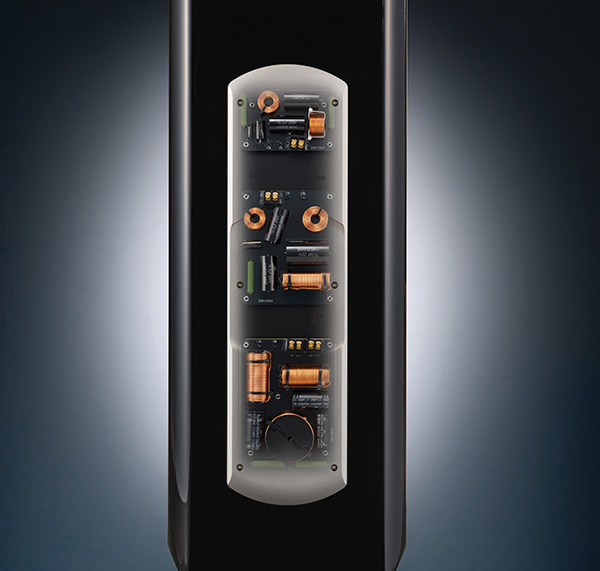
One of probably the most outstanding technical options of TAD loudspeakers is the usage of their very own "coincident" drivers. "Coincident" refers back to the particular manner TAD designs work; the tweeter is nestled snugly throughout the bigger midrange such that the tweeter would not block the middle space of the midrange cone. TAD didn’t invent this strategy; that historical past stretches again to the Nineteen Forties, to the event of the Altec Lansing Duplex, which dominated the studio-monitor market within the US. Tannoy’s "Dual Concentric" drivers performed the same function in Europe. When correctly engineered, concentric drivers can generate extremely coherent, in-phase sound originating from a single level in area, over an prolonged frequency vary.
For the GE1’s Coherent Source Transducer, a proprietary vapor-deposition approach was used to manufacture the beryllium tweeter diaphragm, which is nestled within the middle of that 5½" magnesium midrange cone. According to TAD’s specs, this twin driver, which is remoted in its personal cupboard chamber, covers frequencies from the higher bass to the ultrasonic, 250Hz100kHz.
"The CST driver, being a point-source, has extra managed dispersion than with a domed tweeter," Malekpour mentioned. "When you hearken to the speaker, regardless of the place you place it, you’re feeling prefer it’s aimed toward you. The section response may be very even. For the listener, what which means is: clean. No frequency holes. The massive difficulty with a dual-concentrickind driver is the positioning. The two parts, the midrange and the tweeter, are timed by their positioning. The response is exceptionally linear."
Apart from Tannoy, which nonetheless makes concentric-driver audio system, just a few different consumer-focused firms take the same strategy. Probably probably the most outstanding is KEF, with its Uni-Q driver array. France’s Cabasse is one other; the Cabasse La Sphère loudspeaker makes use of a four-way concentric driver. And then there’s Fyne, which was based by a number of Tannoy veterans.
Considering these sonic advantages, notably in soundstage and picture element, why do not all loudspeakers use concentric drivers? Because there are tradeoffs. With coincident drivers, the principle problem is modulation distortion. Diffraction and undesirable reflections are additionally issues, particularly at excessive SPLs, and magnetic discipline interactions within the motor can even trigger issues. TAD’s CST driver offers with the magnetic interactions by using a nonferrous conductive ring to cancel the affect of the magnetic flux from one driver on the opposite. It offers with the acoustical points by placing the tweeter behind the midrange, time-aligning them to reduce interactions, and setting the crossover level to the lower-frequency driver in order that such "modulation distortion" stays beneath the brink of detection.
Appealing to the bass
Speaking of crossover factors: The specified crossover frequencies for the GE1’s are 250Hz and 1.8kHz. Below 250Hz, that matched pair of seven" woofers kicks in. TAD, which appears to get pleasure from creating acronyms and initialisms for his or her design parts, calls this driver the MACS II (Multi-layered Aramid Composite Shell Second Generation) diaphragm woofer (footnote 1).
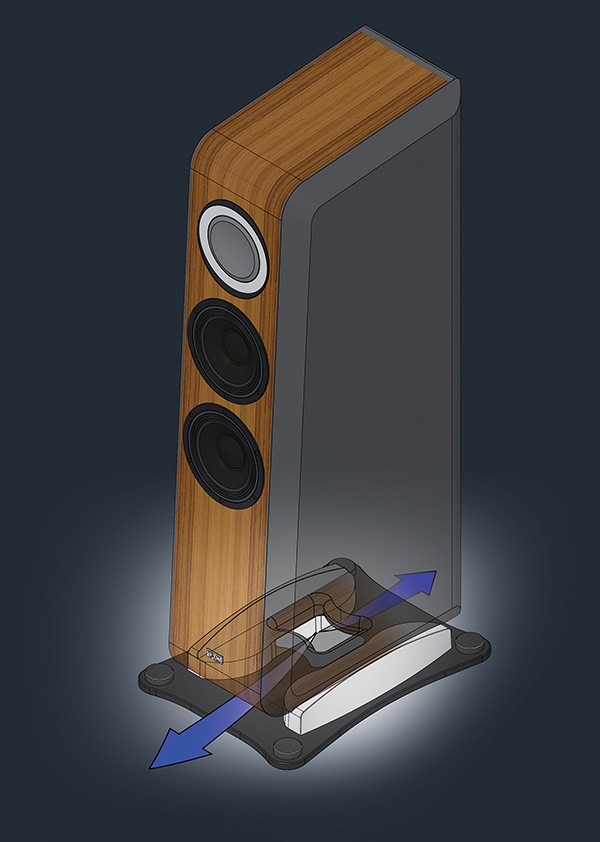
The GE1’s bass efficiency is augmented by acoustic tubing directed all the way down to the reflex port that exits to the ground platform. TAD has a time period for this as effectively: AFAST (Acoustic Filter Assisted System Tuning). In technical notes, TAD describes it this fashion: "Multiple acoustic tubes with acoustic resistance added to their finish surfaces are buried contained in the enclosure to successfully suppress standing waves." When the audio wave exits the cupboard through the port, it encounters two hefty chunks of diecast aluminum, which TAD phrases Bidirectional Aero-Dynamic Port (or ADP). These flared steel blocks, that are mounted on a 15mm-thick aluminum base plate, drive the port’s output to the entrance and the rear, blocking it to the perimeters.
What do these two options accomplish? "It’s not a transmission line, however what is going on there may be they take the vitality inside the cupboard and push it into the port," Malekpour mentioned. "It’s nearly a funneling system from compression right into a horn-loaded port. This filters out a few of the potential for noise and offers you a really linear low-frequency exit. The bi-directional motion of vitality reduces cupboard movement, and it’s also possible to get the speaker nearer to a wall than with a rear-firing solely port design." TAD’s low-end frequency response specification for the GE1 is 27Hz. I notice my colleague Ken Micallef ‘s remark when he heard this very pair of GE1’s on the 2023 Capital Audiofest. He known as it "the deepest, most prolonged, room-filling and brain-frying low-end I’ve heard outdoors a recording studio."
Is this spectacular bundle simple to drive? The revealed sensitivity is a middling 88dB/2.83V/m, with a nominal impedance of 4 ohms. "They do like energy," Malekpour mentioned. "They aren’t a extremely delicate, superefficient speaker. I prefer it when the amplifiers have some headroom." In my auditions, I used my VPI analog entrance finish, Bricasti digital, and McIntosh amplification, all acquainted from everday listening and a number of other earlier opinions.
Rooms of 1’s personal
Both TAD Grand Evolution Ones arrived strapped to a single wood pallet, packed in two single-layer cardboard packing containers. When I requested concerning the light-weight packaging, I used to be advised that these packing containers had been meant for one-time use and that extra critical crating was within the works. TAD, apparently, is catching up with growing demand for his or her merchandise as their distribution within the US expands after a fallow interval.
I trundled the audio system of their packing containers into the entrance corridor of our home and unpacked them there earlier than hauling them to the big Victorian double parlor that holds my Downstairs System. I wished to listen to how a considerable three-way floorstander would carry out there, changing the smaller, two-way standmount Harbeths usually positioned on both facet of a hearth.
Footnote 1: You can consider aramid as generic Kevlar.
HI-FI News
through Stereophile.com https://ift.tt/Z1RKHU5
May 1, 2024 at 07:10PM
-
Product on sale
 Audiophile Vinyl Records Cleaning BundleOriginal price was: €69.90.€59.90Current price is: €59.90. incl. VAT
-
Product on saleEasy Start Vinyl Records Cleaning KitOriginal price was: €69.90.€59.90Current price is: €59.90. incl. VAT
-
Vinyl Records Cleaner Easy Groove Concentrate€34.95 incl. VAT
-
Easy Groove Super Set€199.00 incl. VAT
-
Easy Groove Enzycaster – vinyl records prewash cleaner€34.95 incl. VAT
-
Easy Groove Extreme MK. II- vinyl records prewash cleaner€45.00 incl. VAT
-
Vinyl Records Cleaner – Easy Groove Virgin Concentrate€35.00 incl. VAT
-
Easy Groove Spray&Wipe vinyl records cleaner€34.95 incl. VAT







