
World News
T+A R 2500 R multisource receiver
T+A R 2500 R multisource receiver
The hi-fi receiver has been many alternative issues. Early examples, just like the Harman Kardon "Stereo Festival" TA-230 from 1958 (stated by modern-day Harman/Samsung to be the primary stereo receiver; footnote 1), featured separate FM and AM monophonic tuners that might assign a speaker to every should you wished to take heed to what was then a fad: stereo broadcasts over two stations (left channel over FM, proper over AM, as an example). Standardized FM stereo broadcasting started in 1961, and by then, receivers had developed into massive, advanced, almost full stereo methods; an instance of that was the Fisher 800 (footnote 2).
By the Nineteen Seventies, the main focus of receiver growth and manufacturing had shifted to Japan. The period of features-laden "Silverface" receivers peaked with the huge Technics SA-1000 (footnote 3). That behemoth was simply over 2′ extensive, almost 2′ deep, about 7.5" tall, and weighed 87lb. It was able to 330Wpc into both 4 or 8 ohms, and its linear energy provide sported 4 specifically made 18,000µF filter capacitors. Among its many progressive options have been LED stage meters (the most recent factor in 1977) and a parametric midrange management. Technics claimed a frequency vary of 5Hz to 91kHz and a sign/noise ratio of 115dB, A-weighted. In brief, the SA-1000 was the king of the Silverface mountain.
The level of a receiver has all the time been to mix as many music-listening sources in a single chassis as doablewith preamp features and amplification. Back in analog days, that meant on-board FM and often AM; a phono preamp (typically two); sometimes a tape-head preamp; full enter switching, quantity management, and tone controls, akin to what you’d discover in a standalone preamplifier; and an influence amplifier, typically with outputs for 2 units of audio system. Back then, patrons introduced a "report participant" (turntable, tonearm, and cartridgetypically a record-wrecking changer) and possibly a tape machine to the occasion, plus audio system. All different sources and features have been within the receiver.
We of a sure classic bear in mind how necessary FM radio was within the days earlier than it was conglomeratized, genericized, automated, and ruined. In current years, streaming has changed a whole lot of radio listening. (In truth, we will stream lots of the world’s remaining radio stations through the interwebs, now not slave to conglomerate possession of the native airwaves or the vagaries of antennas and contours of sight to towers.) In place of a group of records, one might need a network-attached server (NAS) with a digital library, or a conveyable SSD or thumb driveor merely a playlist arrange on one of many main music-streaming companies. It may be good if the receiver can connect with a contemporary TV, which may have both TosLink or HDMI-ARC output, or each. For these of us who nonetheless personal a bunch of CDs, we’d as effectively embody a sturdy DACand possibly even a built-in CD transport.
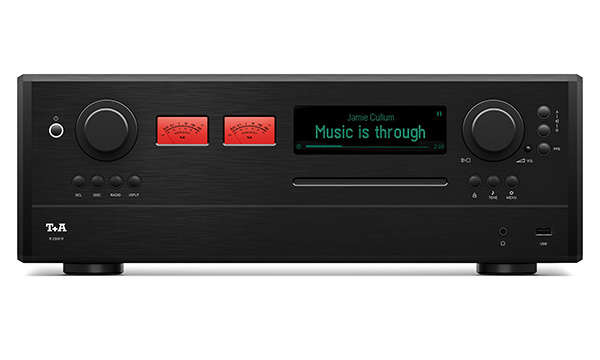
The R 2500 R
Throw in FM analog and digital tuners, and voilà, you have got the R 2500 R, the "twenty first Century Receiver" from T+A Elektroakustik of Herford, Germany, southwest of Hanover. T+A (footnote 4) is a full-line firm with some 100 staff and annual gross sales of 1520 million, in line with American press-relations man Jim Shannon. T+A makes every little thing from turntables to headphones and loudspeakers and all of the electronics in between together with amplifiers, disc gamers, turntables, streamers, and DACs. As the title implies, the R 2500 R is within the R Series, which sits slightly below the top-line HV Series.
Interesting apart: Shannon advised me his father’s Fisher 800B receiver was his gateway right into a lifetime of loving music and hi-fi gear. The R 2500 R machine has a dense function set, a posh wi-fi distant management, and a sturdy cellphone/pill app. It might take a purchaser weeks or months to take a look at every little thing it does and each method to tweak the output sound. If you haven’t any vinyl, the R 2500 R is all you wantsimply add audio system, and make them full-range and high-fidelity as a result of (although I’m getting forward of myself ) the R 2500 R excels in all its audio duties. It will set you again $18,880; with an non-compulsory phono preamp (both MM or MC), make it $19,800 (footnote 5).
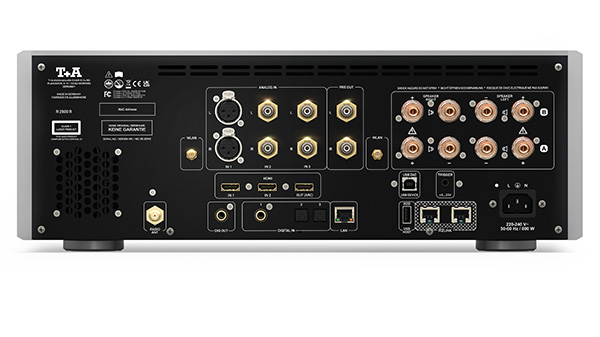
To summarize, right here is every little thing you may take heed to utilizing the R 2500 R: radio (FM, digital FM, internet-streaming), CDs (by means of the slot-loading built-in participant), laptop audio (by means of the built-in USB DAC), streaming companies (through hard-wired Ethernet or Wi-Fi), TV sound (optical or HDMI-ARC digital by means of the DAC or by means of one of many three analog inputs), digital recordsdata from a thumb drive or exhausting drive (linked through USB), or vinyl (utilizing an exterior preamp into one of many analog inputs or with the non-compulsory MM or MC phono preamp, not included within the overview unit). You can use it as a pc "soundcard" through a USB connection and T+A’s software program driver (not essential on Apple gadgets). Analog parts like exterior phono preamps or tape machines can plug in balanced or single-ended. The R 2500 R is managed (considerably, with a whole lot of menu scrolling) by the entrance panel, or by its sturdy steel many-buttoned distant, or, maybe optimally, through the T+A Navigator G3 cellphone/pill app. With so many modes, sound sources, and choices, the cellphone’s touchscreen is the best person interface.
Visually, it is a smart-looking aluminum-cased part with front-panel power-level meters and a show that reveals which enter and what music is enjoying (artist and song-title data for streaming from web companies or NAS-based or USB-drive recordsdata). The rear-panel connections are clearly labeled and simply accessible. The prime panel has a round glass "portal" to see a portion of the interior circuitry. The two "mini site visitors cone"-shaped Wi-Fi/Bluetooth antennas could be positioned on prime of the R 2500 R or on a shelf above; they embody a foot or so of wire to permit some flexibility. Included within the field is a T-shaped FM antenna and an adapter for the 75 ohm socket on the again of the unit. Also within the field is an entire printed guide.
One function not accessible on the time of overview was Roon certification. The guide and web site state that the unit is "Roon Ready," however pull-down textual content on the web site signifies, "As the Roon certification course of is just not but full, the R 2500 R can’t be operated through your Roon system for the time being." Roon management can be useful to no less than some potential patrons, as a result of the T+A app is not made up of essentially the most user-friendly code ever written (extra on that later).
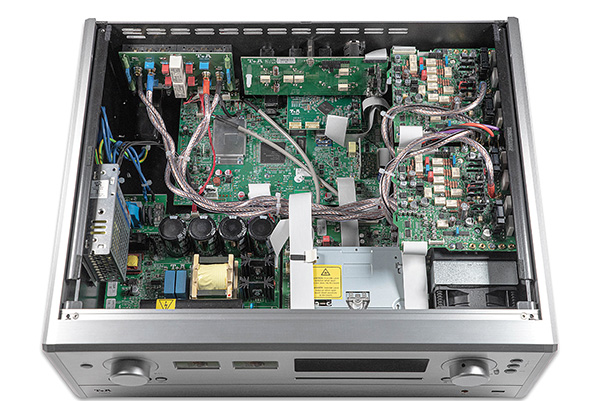
Controls and circuits
In the analog area, there are bass and treble controls, accessed from menus through the entrance panel or distant and included within the app. Both are broad-spectrum (low-Q). The bass management is centered at 300Hz, treble at 3kHz. Their vary (6dB to +8dB) is reasonable in comparison with some tone-control schemes (footnote 6).
The quantity management is an analog, stepped resistor/relay design with uniform 1dB steps from 0 (no sign) to 85 (most output stage). There is an analog low-pass filter on the output, switchable between 60kHz and 120kHz. I admit not listening to any variations between the 2 filters. Shannon really useful 120kHz, in order that’s the place I saved it.
The digital circuitry is generally T+A designed and constructed. The DACs for PCM and DSD bitstreams are unbiased. The DSD DAC is T+A designed and made. Shannon described the PCM DAC like this: "[It] makes use of a twin/quadruple set of Burr Brown delta sigma processors however bypasses a lot of the features, aside from the true digital conversion. After working with the Burr Brown engineering group for almost 30 years, we’ve got realized to make use of the Burr Brown chips’ Operation Mode, conversion solely, which permits us to carry out all high-speed upsampling, filtering, and enter dealing with in our application-specific sign processing structure. This processor is the middle of the digital system and takes the info from the assorted exterior and inside digital sources and both passes it on unprocessed as a local DSD bitstream to the True One Bit converter or passes PCM knowledge on to the Quadruple Converter after processing by our proprietary oversampling algorithms."
The R 2500 R gives six digital-filter choices for PCM and two for DSD, all designed and applied by T+A. JA’s testing will illustrate some or all of them. I discovered the "Bezier" oversampling filter finest for PCM; it is described within the guide as "providing excellent ‘timing’ and dynamics." With DSD streaming, each filters sounded about the identical, with possibly a slight edge to "DSD2," which is described as "two shorter filters operat(ing) in parallel," which "produce even decrease distortion than DSD1 mode." Switching between filters could be completed through menus utilizing the distant management and front-panel show, or with much less effort utilizing the app.
As I referred to the guide to reap filter descriptions, I used to be reminded once more what number of controls and options the R 2500 R contains. This is reward; a receiver of any period needs to be almost or totally a full-featured audio system in a well-built single part. There is just not sufficient area on this overview to enter each nook and cranny of the R 2500 R’s capabilities, so I strongly urge would-be patrons to discover the web site and obtain the person guide (hyperlink on the webpage; tinyurl.com/3fmmhhc4).
The energy amplifier within the R 2500 R is class-AB. Shannon’s description: "Our R collection is now over 25 years previous, and that is essentially the most just lately refined iteration of a completely discrete (no op-amps), very extensive bandwidth (linear to over 100kHz), twin mono, totally balanced, temperature compensated (utilizing thermal sensors to boost and decrease bias voltage to maintain every little thing in essentially the most linear, low distortion portion of the circuit’s efficiency) amplifier. The amp is powered by a T+A-designed totally discrete switching energy provide. We really feel that we will get greater present and energy (into) a comparatively small chassis utilizing a switching provide, however the accessible OEM provides are all designed for laptop use and much too noisy for audio functions. We spent a number of years growing a discrete switching circuit that develops very excessive present with very low noise and gives steady power-factor correction for glorious efficiency in almost any AC grid."
Unpacking and establishing: a course of
So far in my younger profession as a Stereophile reviewer, this unboxing and setup was essentially the most advanced I’ve skilled. The R 2500 R is double-boxed, with a number of items of packing materials between the interior field lid and the considerably massive and heavy receiver, which is in a material bag. It was awkward for one individual to take away and unbag it with out tipping it over. Then there is a sub-box stuffed with equipment: the 2 Wi-Fi/Bluetooth antennas; distant management and batteries; heavy-gauge energy cable; and FM T-antenna (the guide clearly states that should you’re critical about FM, you may need a greater antenna, however this can get you began).
Once freed from its packaging, the all-metal, all-black field virtually screamed "solidly constructed!" The match and end are refined and look modern-functional. The entrance panel’s buttons and knobs really feel and act like they will maintain as much as a lifetime of use. The rear panel connectors are topnotch.
Footnote 1: See tinyurl.com/2p9drpur and tinyurl.com/3t8d7cc3.
Footnote 2: The Fisher 800C, from 1962, included a lot of the options that got here to be related to top-line stereo receivers for many years to return. See tinyurl.com/7ws4wefz.
Footnote 3: See tinyurl.com/2db3aymx.
Footnote 4: That’s a plus signal and never, please discover, an and; the corporate is usually a little sensitive about that, and who might blame them?
Footnote 5: If that looks as if an enormous quantity, take into account that in in the present day’s {dollars}, adjusted for inflation, when it was new, the Technics SA-1000 price roughly half as a lot because the T+A does.
Footnote 6: See tinyurl.com/237h5pm6. The PDF on the hyperlink reveals the connection between audio frequencies, devices, and tone bands (bass, midrange, treble, and so on.).
HI-FI News
through Stereophile.com https://ift.tt/0YMS9NB
July 19, 2024 at 04:05PM
-
Product on sale
 Audiophile Vinyl Records Cleaning BundleOriginal price was: €69.90.€59.90Current price is: €59.90. incl. VAT
-
Product on saleEasy Start Vinyl Records Cleaning KitOriginal price was: €69.90.€59.90Current price is: €59.90. incl. VAT
-
Vinyl Records Cleaner Easy Groove Concentrate€34.95 incl. VAT
-
Easy Groove Super Set€199.00 incl. VAT
-
Easy Groove Enzycaster – vinyl records prewash cleaner€34.95 incl. VAT
-
Easy Groove Extreme MK. II- vinyl records prewash cleaner€45.00 incl. VAT
-
Vinyl Records Cleaner – Easy Groove Virgin Concentrate€35.00 incl. VAT
-
Easy Groove Spray&Wipe vinyl records cleaner€34.95 incl. VAT


