
World News
Hegel H400 streaming built-in amplifier
Hegel H400 streaming built-in amplifier
The Internet of Things has arrived on the stereo rack (footnote 1). Many hi-fi techniques are actually linked to the broader world, managed by telephones and tablets. Complex entrance panels with many switches and buttons have virtually vanished; these nonetheless round are retro items or model statements. Little front-panel touchscreens with advanced menu timber have been rendered vestigial or not less than redundant. Designers of receivers, built-in amplifiers, and DACs should now not less than think about incorporating a streaming module and a device-control app. In sure element classes and sure value brackets, a built-in app-controlled streamer is now a key a part of the worth proposition, a lot as a tuner was again within the days of terrestrial radio.
The strongest and versatile management interfaces are actually cellphone/pill apps. The fashionable hi-fi element, if it has something to do with streaming, is tightly built-in with an app, receiving instructions over house networks or by Bluetooth whereas interacting with streaming providers over the interwebs. Because a smartphone or touch-screen pill is a high-resolution visible paletteand since you maintain it in your handit is a extra handy and versatile (if generally buggier) approach of controlling a tool, providing way more choices than these front-panel knobs and switches and even probably the most advanced and complicated pushbutton distant management. What’s extra, the characteristic set may be reshuffled or expanded from afar with an replace to the app and/or the system’s firmware.
"From afar" is a key phrase: One want solely be on the identical communitynot in the identical room or in shut proximityto manage the system. With acceptable web protection (by Ethernet or Wi-Fi), you may be enjoying music by the pool from a streamer/amplifier inside the home, operating the present out of your cellphone anyplace throughout the community’s vary. There’s each indication that the normal line-of-sight infrared distant will quickly be as quaint as a file changer dropping 45s onto a pile on a file participant’s platter as a hard-riding stylus gouges the grooves (footnote 2).
There is a stark division between nostalgia-based analog hi-fi rooted within the Fifties andeffectivelythe long run. It’s a courageous new world for producers, who now should provide experience in app-coding, {hardware} interfacing, and generally even community troubleshooting, since prospects are inclined to blame gadgets for native community failures.
From Norway, an web factor
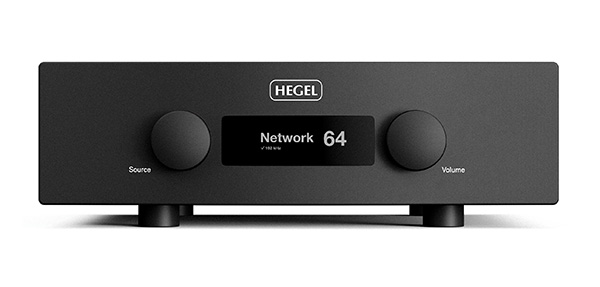
The Hegel H400 combines the capabilities of an built-in amplifier, DAC, and streamer. Designed in Oslo, Norway, and assembled in China, it connects to the broader world by wired Ethernet. It retains a foot planted in pre-streaming hi-fi with loads of different wired connections, digital and analog. It features a line amp (supply choice, a quantity management) and a strong class-AB amplifier. It can comfortably exchange a previous-era built-in amp or receiver, missing solely a phono preamp and tuner to be fullhowever who wants a tuner within the age of the web radio? Hegel’s app supplies entry to a whole bunch (maybe hundreds) of radio selections. That class-AB amplifier is specified to offer as much as 250Wpc into 8 ohms. Hegel says it may possibly drive impedance masses as little as 2 ohms nominal, with a damping issue of 4000 (!). That ought to be enough to boss even the unruliest speaker.
The H400 replaces the H390, including an enhanced streaming platform, app-based management, a brand new DAC chip, a nicer case with rounded corners and higher air flow, new quantity and input-selection knobs "with higher really feel," and pushbuttons to enter and use the settings menu, additionally accessible from the all-metal wi-fi distant.
Inside is just a little laptop (Amlogic A113X "system on a chip," which makes use of an ARM CPU), managed by the Hegel Setup app; Hegel says the app shall be renamed Hegel Control in a future replace. The DAC relies on an ESS Sabre ES9038Q2M chip and that firm’s Hyperstream II structure, with built-in jitter correction. On the rear panel is a typical RJ45 Ethernet jackno antennas. Hegel Vice-President of Sales and Marketing Anders Ertzeid stated the choice to maintain wi-fi networking out of the amplifier chassis was made "for the sake of sound efficiency. The antenna will suck in a complete lot of high-frequency noise into the circuits." Some corporations forgo the comfort of Wi-Fi not less than partly for the superior reliability of wired Ethernet; Roon, for instance, strongly encourages a wired connection. As of mid-2024, that Amlogic all-in-one supported Spotify and Tidal Connect and will entry a networked native music assortment by way of the UPnP protocol. Apple AirPlay and Google Chromecast had been supported, however there was no Wi-Fi or Bluetooth connectivity. Just earlier than press time, the H400 was licensed Roon Ready.
Also on the time of testing, the Hegel app couldn’t management Qobuz from throughout the app (in distinction to Roon and extra mature apps from dCS, T+A, Cambridge, and WiiM). Qobuz Connect integration is coming, permitting you to pick out the H400 because the "speaker" from throughout the native streaming apps, however not till Qobuz provides "Connect" functionality; Qobuz hasn’t but set a launch date past "quickly."
Ertzeid identified that Qobuz works nice over Apple AirPlayit does, however this limits streaming decision to 16/44.1 and provides a layer of complexity, as a result of the cellphone or pill is not simply controlling playback; it is interfacing with Qobuz’s servers, grabbing the stream, changing it to CD decision on the fly, after which streaming it by Wi-Fi to the native community, after which it’s delivered by Ethernet to the H400. This complexity will increase the percentages of dropouts.
Hegel has an answer, or not less than another: the JPLAY app (footnote 3). If you are not conversant in JPLAY, consider it as a less expensive (149 for a lifetime license), lite equal of Roon, minus the flexibility to go looking native and networked native server or laptop recordsdata and streaming providers (Qobuz and Tidal) all on the similar time. JPLAY is device-agnostic, so there isn’t any certification concerned. JPLAY allowed me to manage Qobuz from my cellphone however routed instantly from the Qobuz servers to the H400 by way of its wired connection. Finally, I used to be in HD streaming nirvana. Streaming hi-rez music from Qobuz, the H400’s front-panel sample-rate readout confirmed that I used to be streaming in full hi-rez. This will all be moot now that Roon has licensed the H400 as Roon Ready.
Connections, connectionsand controls
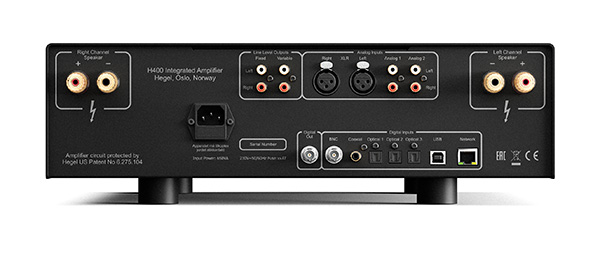
In addition to streaming, the DAC can obtain and convert bits and bytes from native sources by way of three optical TosLink and two coaxial S/PDIF connections, one on RCA and one on BNC. A USB Type B socket permits connection to a pc by way of a typical USB cable. An unusual characteristic is a BNC "DAC Loop" digital output jack, which the person handbook says "makes it potential to improve the digital inputs of the amplifier with an exterior high-end DAC" by connecting it to the "jitter-reduced" digital output and connecting the exterior DAC’s analog output to the XLR inputs on the H400. (So select an exterior DAC with balanced outputs.) This sign looping is enabled utilizing the monochrome front-panel display and menu timber activated utilizing the Source knob’s pushbutton or with buttons on the wi-fi distant management. Hopefully, a future replace will permit issues like this to be set by finger-tapping a cellphone or pill display.
A closing DAC element: Although the ESS chips provide varied antialiasing filter choices, Ertzeid stated Hegel’s designers "have pre chosen what we predict sounds greatest: an apodizing filter with out pre ringing."
On the analog aspect, along with that single pair of balanced XLR inputs, the H400 affords two unbalanced inputs on RCA. For outputs, there are two at line-level, each on RCA, one topic to the H400’s quantity management (a real "preamp out"); the opposite mounted (a "house theater pass-through"; inputs will also be configured at a set degree in order that quantity may be managed by the supply).
The primary outputs are a single set of multiway binding posts that help naked wire, spade, and banana connections. There isn’t any headphone output, and there isn’t any provision for an inside phono preamp.
The circuit chargeable for quantity attenuation "shares loads with what you discover within the P30A and H600, though not fairly to the usual of these," Ertzeid wrote in an electronic mail. The P30A makes use of a management system to route the sign to the suitable resistors, decided by the setting of the management knob. "Exactly what it’s, we hold secret, however they’re very exact circuits initially developed for high-frequency measurement tools. It continues to be a totally analog quantity attenuator, so there isn’t any compression. The profit of those circuits is that they’re extraordinarily low noise. … The circuits used within the H600 and P30A are much more silent than the implementation we might afford within the H400, however the precept continues to be the identical."
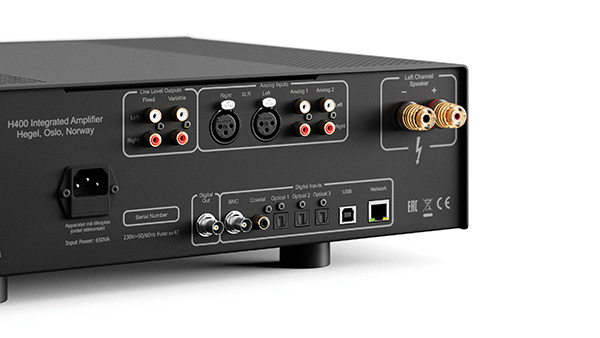
The back-panel connectors are all high-quality. The H400 appears solidly constructed, apparently constructed to final. The entrance panel is traditional Norwegian streamlined simplicity: a quantity knob, a source-selector knobeach additionally pushbuttons for menu activation and choiceand a monochrome show. The show signifies what supply is enjoying, the amount degree (0100), and for digital and streaming sources, the sampling charge. Underneath the entrance panel is an influence on/off swap, mirrored by a button on the distant management. The all-metal distant incorporates play/pause and former monitor/subsequent monitor controls for the streamer.
Footnote 1: See wikipedia.org/wiki/internet_of_things.
Footnote 2: I’ve many fond recollections of simply such a file changer and a pile of Nineteen Seventies pop, rock, and nation singles collected by my brothers, cousins, and me, consistently spinning at my grandparents’ home in Texas. I harbor no fond recollections of a pile of infrared remotes on tables and between couch cushions, hardly ever in attain once you want them.
Footnote 3: See jplay.app. My because of JPLAY’s Marcin Ostapowicz for offering a complimentary account and answering some questions on his well-designed, lower-priced, feature-light Roon different.
HI-FI News
by way of InnerFidelity https://ift.tt/X63omNf
October 10, 2024 at 04:30PM
-
Product on sale
 Audiophile Vinyl Records Cleaning BundleOriginal price was: €69.90.€59.90Current price is: €59.90. incl. VAT
-
Product on saleEasy Start Vinyl Records Cleaning KitOriginal price was: €69.90.€59.90Current price is: €59.90. incl. VAT
-
Vinyl Records Cleaner Easy Groove Concentrate€34.95 incl. VAT
-
Easy Groove Super Set€199.00 incl. VAT
-
Easy Groove Enzycaster – vinyl records prewash cleaner€34.95 incl. VAT
-
Easy Groove Extreme MK. II- vinyl records prewash cleaner€45.00 incl. VAT
-
Vinyl Records Cleaner – Easy Groove Virgin Concentrate€35.00 incl. VAT
-
Easy Groove Spray&Wipe vinyl records cleaner€34.95 incl. VAT


