
World News
NAD M66 streaming preamplifier
NAD M66 streaming preamplifier
In my early years in audio, I witnessed the rise and fall of the AM-FM receiver, first in vacuum tube mono and later in stable state stereo. Some of them grew to be behemoths, supporting a number of inputs, equalizers, twin speaker zones, and highly effective amplifiers. When radio sources receded in reputation and with the rise of CDs, cable TV, and DVD, radio receivers had been changed by A/V receivers within the mainstream market.
Today, the ascension of streaming because the conduit for each audio and video content material has nudged these, too, from the middle stage. One can stream content material from the bewildering number of merchandise with web entry together with cell telephones, good TVs, nearly any pc, and naturally, devoted streaming units from the cheap-and-cheerful to significantly audiophile. If your music is on the internet or on a NAS, many of those will allow you to browse for it, discover it, and play it.
Like the M33 built-in amplifier, the NAD M66 is, as is the results of that evolutionary sample, or a variant of it, integrating subtle streaming choices with a contemporary, a number of enter/output preamplifier full with D/A (and A/D) conversion, DSP, bass administration, and room correction, to not point out MM/MC phono inputs. It differs from these traditional AM-FM receivers, althoughand from its predecessor the M33in offloading amplification to a devoted amplifier. It additionally expands the array of inputs, outputs, and options relative to its fast predecessor (the M33) and its evolutionary forebears.
NAD calls the M66 a DAC-Preamplifier. The DAC portion is carried out with ESS’s present flagship DAC chip, the Sabre Pro ES9038PRO, an eight-channel machine able to changing PCM as much as 32/768kHz and DSD as much as DSD256. In the M66, all eight channels are used for the principle L and R stereo, which function at 24/192 PCM; DSD needn’t apply. Two extra unitsTexas Instruments PCM5122 stereo DAC chipsare employed for the 4 subwoofer outputs. Other important M66 options embody a exact resistor-ladder quantity management for analog alerts and full-spectrum Dirac Live room correction with Bass Control. NAD has additionally included what they name Dynamic Digital Headroom (DDH). When enabled throughout D/A conversion, it’s stated to eradicate distortion resulting from digital intersample peak clipping ("intersample overs") that may happen with oversampling and sudden high-frequency, high-level transients. This has the potential to render percussion devices specifically extra realistically.
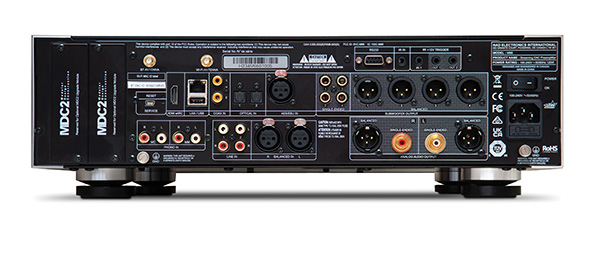
The M66’s again panel exhibits off the vary of the M66 as preamplifier/controller. Scanning the connectors from left to proper and beginning with the digital inputs throughout the highest, we see first two wi-fi inputs (Bluetooth and Wi-Fi antennas), then HDMI/eARC, LAN, USB, two RCA and two optical (TosLink) S/PDIF, and a single AES3. Below these are the analog inputs: MM Phono and MC Phono on RCA, two pairs of single-ended line inputs on RCA, and one pair of balanced line inputs on XLR. On the suitable facet there are three tiers. The prime tier has an RS232 management interface, an IR enter, two 12V set off inputs, and a single 12V set off output; all of the triggers are 1/8" miniplugs. The center tier has RCA and XLR outputs for 4 subwoofers. The backside tier has a pair of RCA and a pair of XLR line-out connectors. To the acute proper is an influence block with On/Off swap, an IEC socket, a line fuse, and a grounding submit. There are two growth slots on the acute left, though it is arduous to think about a urgent want for them.
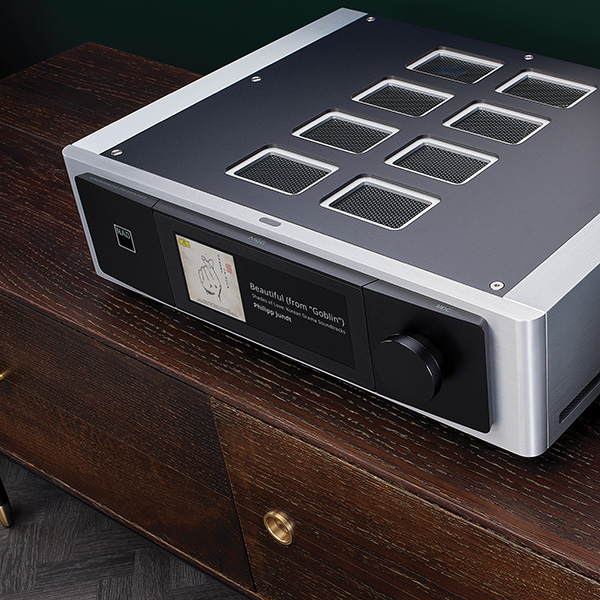
The entrance view of the M66 could be very cleardeceptively so for a tool with a lot occurring. At the entrance heart of the highest panel is the On/Standby button; an illuminated NAD badge on the left facet of the entrance panel turns from amber to white when the ability is on. Directly beneath that may be a ¼" headphone jack. On the suitable is a big, easy, barely overdamped quantity/management knob. Center stage is a 7" full-color touchscreen that shows album artwork, observe/album info, and quantity stage, and facilitates fundamental playback controls (Play, Pause, Forward, Back). The giant touchscreen additionally lets you choose an enter and entry the playback queue and settings menus.
This works nice if you happen to sit inside arm’s attain. Fortunately, there are handy options, together with a distant management (footnote 1), although probably the most sensible and complete is the BluOS app, which may run on a pc or any iOS or Android machine. The app readily loaded and performed my native library and accessed a fairly big selection of streaming websites. However, it ignored my DSD/DFF tracks (footnote 2).
I didn’t have time to turn out to be totally snug with the BluOS system, however aside from the DSD glitch, it appeared to work wonderful for music playback. My desire for taking part in music was Roon, nevertheless it was straightforward to make use of it together with BluOS for settings. With each loaded on all my unitsmy essential PC/Server, iPhone, and iPadI may use whichever machine was at hand.
I started utilizing the M66 by connecting its line outputs by way of balanced (XLR) cables to my Benchmark AHB2 amps, which drove my KEF Blade Two Meta loudspeakers. Later, I added a pair of KEF KC92 subwoofers by way of two of the RCA sub outputs. In addition to the wired LAN, Wi-Fi, and Bluetooth hyperlinks, I utilized my PC server, which runs each Roon and JRiver, by way of my Merging Hapi II to make extra direct bodily connections with each the AES3 digital enter and the balanced analog inputs of the M66. For the uncommon events after I wanted to spin a silver disc, I plugged my Oppo 103 into the RCA or TosLink inputs. Over the course of the evaluation interval, I used to be in a position to strive many however not all the M66’s bodily and community connections.
Straight stereo
Before working Dirac or turning on the subwoofers, I turned on the amps and the M66 and ran by way of a dozen or so acquainted recordings simply to get a really feel for a way issues labored and to see (or, moderately, hear) if there have been any audible surprises. I did this in 3 ways, working the M66 as a Roon Ready endpoint (by way of a wired community connection), utilizing Roon to manage the music and the Hapi for digital conversion, sending the Hapi’s analog output to the M66’s balanced analog enter, and, lastly, by utilizing Roon to ship output from the Hapi’s AES3 output to the M66’s AES3 enter.

There had been no surprises. When I listened to acquainted stuff like Ligeti’s Six Bagatelles for Wind Quartet (Harmonia Mundi, 905370DI, 24/96 obtain) and "Tambourine" from Sol & Pat (Alpha Classics Alpha 757, 16/44.1 PCM obtain), the devices, their total steadiness, and the soundstage was what I heard when working the D/A output of my Merging Hapi direct to the ability amps. The sound was clear with notable delineation of devices and a pleasant sense of house applicable to every recording. This tells me that the DAC within the M66 is great, and the analog path by way of the M66 is clear.
This high quality of copy was greatest characterised by a current recording of Dutillieux’s Tout un monde lointain… for cello and orchestra (Victor Julien-LaFerriere, Orch. National de France, David Robertson. 16/44.1 PCM obtain, Alpha Classics Alpha 886). This is a stunning, vigorous efficiency served by an equally beautiful recording by which the solo cello is up entrance and only a bit left of heart stage, whereas the orchestra is unfold large and distinctly farther again. The refined starting, by which the cellist rubs the strings flippantly, is barely audible (correctly) (footnote 3). Within seconds, its presence turns into fairly clear. As the orchestra are available in to fill the stage, the excellence between cello and orchestra stays, as clear as it could be from, say, Row G.

I don’t assume I’ve beforehand had an expertise just like the one I had with the M66, by which three fairly totally different modes of sign transmission and processing proved equally satisfying. It is vital to notice that, whereas the M66 does possess an Analog Direct mode, by default that is defeated and the analog enter is digitized at 24/96. In Analog Direct, the sign stays analog from enter to output.
You may assume it affordable to make Analog Direct (footnote 4) the default setting, however doing so thwarts all DSP capabilities for the analog inputs. With Analog Direct chosen, you can’t use tone controls, bass administration, or Dirac Live with these analog inputs. It additionally eliminates the L/R steadiness management.
I anticipated, fairly I believe, that the lack of such capabilities could be offset by removing of an audible veil or two ensuing from redundant A/D/A conversion (footnote 5), however that expectation wasn’t met: Exhaustive A/B comparisons did not crown a winner. I had the constant impression that the Analog Direct pathway was somewhat extra relaxed and open, however I couldn’t persistently decide whether or not it was engaged with out a direct A/B comparability. Perhaps it issues that every one my sources are digital; if you happen to use analog sources, you might have a unique expertise.
Some of the capabilities misplaced with Analog Direct enabled are important. I do not care about tone controls or Balance, however the lack of Diracwhich, for one factor, is by far one of the best ways to combine subwoofersis regrettable.
Turning to the digital inputs: DDH seems to be a winner. Clipping resulting from intersample overs will not be a brand new discovery; its trigger and its options are properly documented (footnote 6). It can coarsen treble particulars with, eg, cymbals or high-brass partials.
Footnote 1: I’ve little to say in regards to the distant management. Yes, it could management quantity, the brightness of the NAD icon, energy on/standby, and mute. It can even pause/resume play and advance observe ahead or again. There is a doubtlessly helpful button which, with every push, steps by way of the 5 accessible Dirac filters and Dirac OFF, however there isn’t any show on the RC or the entrance panel to point the present standing. (Great for blind assessments!) There are 10 programmable buttons for presets, however there isn’t any means, till programmed, for it to pick inputs or to remind the person what every button does.
Footnote 2: BluOS doesn’t play DSD/DFF as downloaded or as ripped from SACDs. Its solely possibility is to create, off line, PCM recordsdata for playback. I attempted it as soon as and it does work.
Footnote 3: At the time I wrote this evaluation, I had not seemed on the rating and incorrectly recognized the "barely audible" opening sounds. After consulting the rating, I discovered that the sound is made by the very mild brushing of a cymbal and a snare drum and relistening at a really excessive stage clearly confirmed my error. I additionally checked out a number of different recordings and, on most, the brushing was both inaudible, unidentifiable or clear however simply too loud! The greatest had been this one and one other by Xavier Phillips (cello) and the Seattle Symphony led by Ludovic Morlot (SSM1001, 24/96 5.1 obtain).
Footnote 4: Analog Direct is individually selectable with phono MM, phono MC, line 1, line 2, and balanced inputs.
Footnote 5: When not in Analog Direct, the enter is presently digitized to 24/96 by an ESS Sabre ES9822Pro, a two-channel ADC with spectacular specs: DNR of 124dB and 117dB of THD+N!
Footnote 6: See benchmarkmedia.com/blogs/application_notes/intersample-overs-in-cd-recordings.
HI-FI News
by way of InnerFidelity https://ift.tt/Fu0cNLn
November 1, 2024 at 03:12PM
-
Product on sale
 Audiophile Vinyl Records Cleaning BundleOriginal price was: €69.90.€59.90Current price is: €59.90. incl. VAT
-
Product on saleEasy Start Vinyl Records Cleaning KitOriginal price was: €69.90.€59.90Current price is: €59.90. incl. VAT
-
Vinyl Records Cleaner Easy Groove Concentrate€34.95 incl. VAT
-
Easy Groove Super Set€199.00 incl. VAT
-
Easy Groove Enzycaster – vinyl records prewash cleaner€34.95 incl. VAT
-
Easy Groove Extreme MK. II- vinyl records prewash cleaner€45.00 incl. VAT
-
Vinyl Records Cleaner – Easy Groove Virgin Concentrate€35.00 incl. VAT
-
Easy Groove Spray&Wipe vinyl records cleaner€34.95 incl. VAT







