
World News
Chord Electronics Ultima Integrated
Chord Electronics Ultima Integrated
A yr in the past, once I was visiting my native hi-fi seller, he advised me relatively excitedly a couple of new built-in amplifier he had heard an early pre-production pattern of. He was so enthusiastic that I made a psychological notice to pay money for one for evaluate. That amplifier was the Ultima built-in amplifier from Chord Electronics.
It made its world debut on the Munich High-End Show final May however was solely unveiled within the UK on the Bristol Hi-Fi Show in February.
It has an attention-grabbing backstory as a result of, on this mannequin, we see the Ultima know-how Chord Electronics launched 5 years in the past in its high-end amplifiers trickling right down to an built-in amplifier for the primary time.
Chord Electronics began producing amplifiers for customers {and professional} recording studio environments such because the BBC and Abbey Road. Since then, it has expanded into streamers, DACs, and phono levels.
Avionics background
John Franks, who based the corporate in 1989, had a background within the avionics trade with the likes of Raytheon, AT&T, and Marconi Avionics. This expertise, he advised me, formed the best way he approaches design.

I used to be inquisitive about studying extra in regards to the Ultima and the way it happened, so I went to speak to him on the Chord Electronics manufacturing unit. Asked to summarise his design philosophy, Franks stated: “Being ready to go so far as you’ll want to go to make the easiest factor that the know-how of the time can do. And know-how is at all times enhancing. In avionics, you can not short-change and compromise a design as a result of, for those who do, planes can depart from correct flight. You should be ready to push the envelope, and I feel I’ve introduced that philosophy over from avionics. It’s no compromise. It’s what I at all times wished to do, and it’s been a helluva trip.”
The applied sciences which have trickled right down to the brand new Ultima built-in are Chord Electronics’ twin feed-forward error correction and ultra-high frequency, switching energy provides.
Dual feed-forward
The twin feed-forward know-how relies on a paper by the legendary Malcolm Hawksford at Essex University. It was then taken up and refined by Bob Cordell of Bell Labs earlier than being additional developed by Chord Electronics’ John Franks. Franks progressed Cordell’s twin feed-forward error correction topology and integrated his personal ideas in ultra-high-frequency energy provides which have underpinned Chord’s amplifier vary since 1989.
As many regard the ability provide because the beating coronary heart of an amplifier, let’s have a look at that first. In a nutshell, the Chord Electronics change mode energy provide runs at 80kHz, which Chord says means it doesn’t intrude with any audio alerts. The incoming energy is filtered and rectified after which chopped utilizing high-voltage MOSFETs. It is then handed on to a particular ceramic-cored high-frequency transformer, rectified once more and is then fed to Chord’s Dynamic Coupling system.

This {couples} the amp’s optimistic and detrimental rails with a robust magnetic flux to assist deal with any excessive demand. Running the ability provide at 80kHz additionally means the transformer might be a lot smaller.
Such energy provides have been initially developed to be used within the aerospace, telecommunications, and knowledge processing industries the place they wanted excessive energy in a space-efficient format. However, early variants used within the audio trade have been usually criticised for electrical noise, poor reliability, excessive engineering prices and producing electromagnetic interference.
Ten years after
In his white paper on his amplifier designs, Franks admits that it took him 10 years of “perseverance and modern engineering” to beat these issues, however he’s adamant that this was the suitable strategy.
He advised me: “It is about controlling a drive unit quickly and a few of these 15in drivers are massive and perhaps have a compliant mass of 100g. It takes quite a bit to cease and begin them inside microseconds and also you’ve received to attract down vitality out of your energy provide in a short time. High-frequency switching energy provides can do this, whereas analogue provides wrestle.

“Smaller capacitors are sooner to reply and likewise the recharge time on a high-frequency energy provide is a lot sooner. People suppose they at all times have RF noise, however there isn’t in the event that they’re designed proper. Analogue provides are passing something that’s on the mains, and that may very well be something, and loads of it may very well be RF. So it’s a complete false impression.”
For these causes, Franks has stopped utilizing large storage capacitors in his energy provides and opted for a number of, smaller ones. He believes smaller capacitors reply sooner to charging and discharging calls for than bigger ones. The Ultima boasts 4 high-power line enter phase-corrected energy provides designed to ship wonderful transient response.
Sliding bias
The amplifier operates as a Class AB sliding bias design, which implies it operates in Class A more often than not, with Class B operation solely coming into play in probably the most demanding conditions. The output levels use Chord’s personal metal-on-silicon MOSFET units, made for them in an aerospace-sector fabrication home. They are a dual-die design, which implies they’re thermally coupled in manufacturing to match one another completely.
Franks’s improvement of Hawksford and Cordell’s authentic twin feed-forward know-how is the opposite thrilling a part of the amplifier circuit topology. The Ultima has two extra amplifier circuits that monitor and proper the distinction between the output of the reference enter, each inputs fed to the MOSFETs, and the output of the ability MOSFETs. If this detects a discrepancy, the circuit will add a ‘distinction sign’ to the enter of the MOSFETs to appropriate it and supply an correct output. This corrected output is then fed again as a part of the amplifier’s total world suggestions.
Franks says that Class AB and B amplifiers have an Achilles heel. While extra environment friendly than Class A designs, the N channel units that deal with the highest half of the music waveform hand over to the P channel units that cope with the detrimental a part of the waveform, which is the place crossover distortion is generated. The twin feed-forward circuitry is designed to minimise this.
Unboxing
As I unpacked and dealt with the Ultima, it exuded high quality. It shares the identical 28mm thick strong aluminium entrance panel with the not too long ago launched Ultima PRE 3 preamp. All of its casework is created from precision-machined, strong aircraft-grade aluminium.
It is a surprising piece of recent industrial design, and its reassuring solidity is complemented by the customary Chord Electronics gentle present equipped by an inside ring of LEDs. Although primarily beauty, Franks hinted once we spoke that any spurious RF might be dissipated inside LEDs.
The amplifier is minimalist in its styling, with simply two giant rotary knobs on the entrance panel to the left and proper of the spherical on/off change, which glows purple when in standby mode and cycles from inexperienced to cyan to point it is able to use.
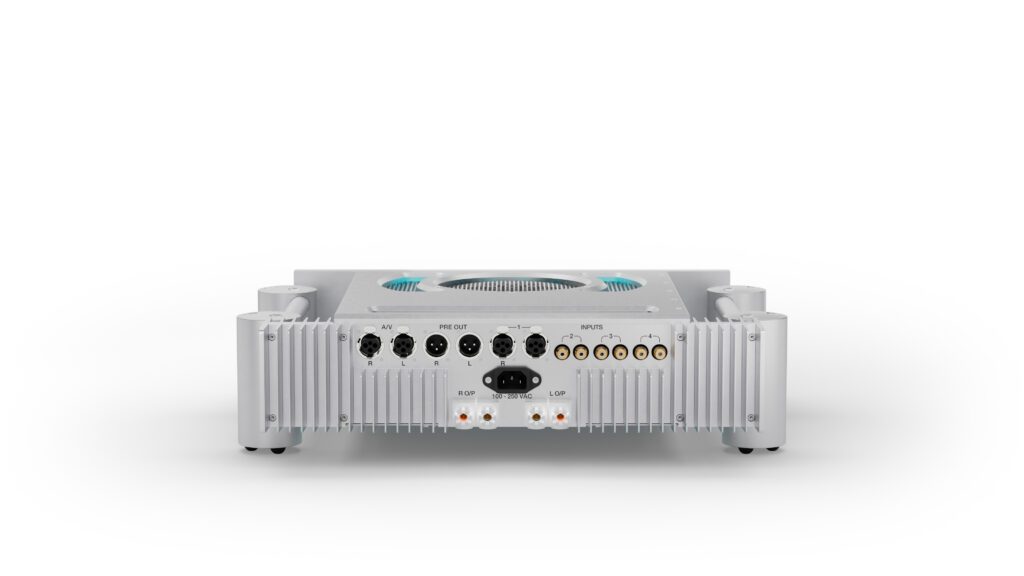
The left-hand knob controls the amount and, when pressed, permits enter choice. It has a light-weight circling that modifications color to indicate the chosen enter. Input 1 is a balanced XLR whereas the opposite three RCA line inputs are unbalanced. It additionally has an XLR AV bypass and a balanced XLR preamp output on the rear panel. The right-hand knob controls steadiness and AV bypass.
You have chosen, correctly
To consider the Ultima built-in I linked it to a pair of Russell Okay Red 120Se audio system, that are a favorite of mine. The Ultima, with its 125 watts of energy, would drive them properly.
My music supply was an Audio Note CDT-Five CD transport and DAC 5 Special, which supplied a super-high-quality enter. I didn’t use the balanced enter, however anybody who has supply parts that present a balanced output is properly suggested to take action.
Setting the Ultima up was little one’s play. Controls are minimal, so you possibly can’t go fallacious. Inputs are clearly marked, and polarity is simple to discern, and with the colored gentle that surrounds the amount/enter selector knob simple to see even from a distance; after getting memorised which color denotes which enter, you have to be prepared for motion.
The distant management supplied can also be simple to make use of and responsive, so I used it all through my listening. There is, after all, no phono enter on the Ultima, however that’s not uncommon lately. Chord Electronics has its personal to supply with the Huei MM phono stage and the Symphony if in case you have a transferring coil cartridge.
Warmed to
I’m happy to say that the Ultima was a type of merchandise that I warmed to from the very begin. Straight in with a favorite monitor from guitarist Peter White, his model of the Johnny Nash traditional ‘I Can See Clearly Now’, the Ultima impressed with its simple, detailed, layered, and dynamic presentation, portraying every participant of this beautiful instrumental of their correct place inside the music. It was free from random fireworks or pitching parts at me that did nothing to boost my appreciation of the music. No, the entire monitor hung collectively properly, with nice perception into how White performed every notice. The bass line was tight, tuneful and the Ultima conveyed its twists and turns superbly. Drums and percussion have been managed and syncopated and the accordion half, usually misplaced within the combine on poorer merchandise, was properly conveyed and separated.
Switching to the stunning ballad ‘Lo Siento Mi Vida’ from Linda Ronstadt’s Hasten Down the Wind album, the Ultima brilliantly conveyed the 2 guitars on the intro. It allowed you to listen to the variations between them, whereas Ronstadt’s vocals got here throughout as highly effective but sensual. The stroll and growl of the bass line have been properly dealt with, and on the drumkit, you might hear numerous strikes of differing energy and delicacy on snare or cymbals. And all of it flowed superbly with that dreamlike really feel this monitor has.
Grabbing the Saxophonic album by sax ace Dave Koz, I used to be eager to play the monitor ‘All I See Is You’. The Ultima didn’t disappoint, conveying the physique and ‘raunch’ of Koz’s tenor sax that provides it that typical high quality you possibly can solely describe as ‘horny’, and right here it had all of that. The electrical bass line that actually drives the monitor alongside was conveyed with nice tempo and every thing was as a replacement musically, enjoying its correct function within the appreciation of the monitor.
Ben Sidran is a favorite jazz singer/songwriter/pianist of mine and following up for me was ‘Sunny Side of the Street’ from his Enivré d’Amour CD. I do know his voice properly from seeing him reside on many events and I can say the Ultima did justice to his model and sound. His vocals have been expressive and characterful, whereas his Yamaha DX7 synth had the top-end sparkle and liveliness it ought to have. The wonderful, raunchy bass line was tight and tuneful, whereas the saxophone was properly voiced and articulated. The monitor moved and flowed properly, and its staccato, lilting rhythm was conveyed properly.
Mood change
Changing the temper, I reached for George Benson’s wonderful 20/20 album and performed the monitor ‘No One Emotion’. This monitor flies alongside at a breakneck tempo and is unbelievably tight concerning the musicianship and association, and the Ultima took it in its stride. Pacey, detailed, tuneful, dynamic, and managed, it captured Benson’s immaculate vocals very properly whereas that relentless synth bass line drove the monitor alongside at breathtaking pace. I might additionally savour Michael Sembello’s scorching guitar solo, which the Ultima pitched with simply the suitable mixture of raunch and poise.
Whether it was delicate guitar work from Larry Carlton or Earl Klugh, scorching sax from Dave Koz or David Sanborn, heartfelt vocals from Linda Ronstadt, or hardcore rocking from ZZ Top, the Ultima dealt with all of it with management, element rendition, and dynamics whereas holding all of it collectively as a musical entire.
The built-in amp market has heated up lately, and patrons are spoilt for alternative for good-sounding amps. Thanks to the Ultima, issues simply received even hotter. If you might be available in the market at this worth level, you must think about the Chord Electronics Ultima.
Technical specs
- Type: Sliding Class A/AB, 2-channel built-in amplifier
- Analogue inputs Four line inputs. Three unbalanced (RCA) one balanced (XLR). One AV bypass (XLR)
- Digital inputs: None
- Analogue outputs: One balanced pre out (XLR)
- Input impedance 100k ohms
- Power output 125Wpc @ 8 ohms
- Frequency response 10Hz-200 kHz ±3dB
- Distortion THD 0.01 % (20Hz-20kHz)
- Signal-to-noise ratio 90dB on all inputs
- Dimensions (WxHxD) with Integra legs 480mm x 130mm x 380mm
- Weight: 14.75 kg
- Price: £8,500, $11,250
Manufacturer
Chord Electronics
+44 (0) 1622 721444
The publish Chord Electronics Ultima Integrated appeared first on hi-fi+.
HI-FI News,Audio
through Articles Archive – hi-fi+ https://ift.tt/ZmUM3N9
December 17, 2024 at 04:43PM
-
Product on sale
 Audiophile Vinyl Records Cleaning BundleOriginal price was: €69.90.€59.90Current price is: €59.90. incl. VAT
-
Product on saleEasy Start Vinyl Records Cleaning KitOriginal price was: €69.90.€59.90Current price is: €59.90. incl. VAT
-
Vinyl Records Cleaner Easy Groove Concentrate€34.95 incl. VAT
-
Easy Groove Super Set€199.00 incl. VAT
-
Easy Groove Enzycaster – vinyl records prewash cleaner€34.95 incl. VAT
-
Easy Groove Extreme MK. II- vinyl records prewash cleaner€45.00 incl. VAT
-
Vinyl Records Cleaner – Easy Groove Virgin Concentrate€35.00 incl. VAT
-
Easy Groove Spray&Wipe vinyl records cleaner€34.95 incl. VAT







