
World News
MoFi Electronics SourcePoint 888 loudspeaker
MoFi Electronics SourcePoint 888 loudspeaker
A current excessive level in my profession as a reviewer was writing in regards to the MoFi Electronics SourcePoint 10 standmount loudspeaker for the February 2023 problem of Stereophile. Priced at $2999/pair, the two-way SourcePoint 10 featured an progressive 10" coaxial (HF/LF) drive unit and impressed me with its clear, fantastically well-defined low frequencies, natural-sounding midrange, and the flexibility to play loudly with out pressure.
The SourcePoint 10 was the primary MoFi speaker to be designed by Andrew Jones, whose earlier designs for KEF, Infinity, Pioneer, TAD, and ELAC had all taken up residence in Stereophile‘s Recommended Components listings over time. The second of Andrew’s designs for MoFi was the SourcePoint 8, which was favorably reviewed by Kalman Rubinson in September 2023. Priced at a aggressive $1999/pair, the SourcePoint 8 additionally used a coaxial drive unit, however because the identify suggests, the woofer diameter was 8" quite than 10". KR was additionally impressed by what he heard, writing that the SourcePoint 8 was a balanced, wide-range speaker that demonstrated how satisfying a small, comparatively inexpensive loudspeaker will be.
Now we’ve Andrew Jones’s third design for MoFi, the floorstanding SourcePoint 888, which prices $4999/pair.
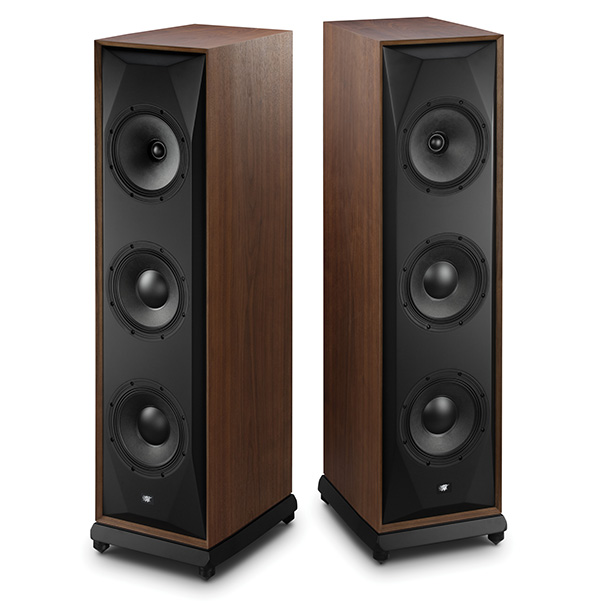
The SourcePoint 888 …
… makes use of an 8" coaxial driver for the midrange and treble, just like that used within the SourcePoint 8. This driver is mounted close to the highest of the sculpted entrance baffle, accompanied farther down by two 8" woofers. The woofers use a paper cone and are reflex-loaded with two 3"-wide ports on the rear panel. The midrange and woofer cones are terminated with a corrugated encompass quite than the standard half-roll rubber encompass. With the midrange cone, the obstruction of the half-roll encompass would disrupt the tweeter’s radiated wavefront.
The crossover between the midrange and woofers is ready to 130Hz; that between the midrange and the coaxially mounted 1.25" soft-dome tweeter is at 1.6kHz. The tweeter subsequently operates over a wider passband than regular. When I interviewed Andrew Jones for my SourcePoint 10 evaluation, he defined that the coaxial unit’s lower-frequency cone acts as a waveguide for the tweeter. The waveguide reduces the tweeter’s tour requirement, so it may be operated right down to a decrease frequency than could be attainable if it lacked a waveguide. With a waveguide, "the advance in effectivity or sensitivity and the discount in tour greater than make up for the truth that you are crossing over at 1.6k. It allows you to get an excellent progressive, constant off-axis efficiency," Jones instructed me, including that utilizing a dome with a barely bigger diameter, 1.25" quite than the standard 1", with a large roll encompass, supplies further dynamic vary functionality on the decrease frequencies.
The 888’s internally braced enclosure stands simply over 42" excessive on its base and ftcone ft for carpeted flooring and flat-bottomed ft for picket flooring are each suppliedand is constituted of thick MDF. Other than the grey base and the matte-black entrance baffle, the panels are completed in a Satin Walnut or Black Ash wooden veneer. Electrical connection is by way of two pairs of binding posts near the bottom of the rear panel.

Setting up
The principal supply of music was my Roon Nucleus+ server feeding audio knowledge over my community to a Roon Ready MBL N31 CD participant/DAC, which was linked on to a pair of Parasound JCA100 Tribute monoblock amplifiers. Though the audio system will be biwired, I single-wired them with AudioQuest Robin Hood cable. I did not use the MoFi SourcePoint 888s’ magnetically hooked up grilles, and the evaluation pair arrived with solely the flat ft; the cones really useful for carpeted flooring like mine had been lacking. (The evaluation samples had beforehand been reviewed by one other author, who should have forgotten to pack the cones within the containers; footnote 1.) Nevertheless, with a speaker weighing 96lb, coupling the enclosure to the ground shouldn’t be a problem.
The SourcePoint 888’s guide recommends that the consumer begin by putting the audio system roughly 13′ away from the room boundaries. After a lot experimentation, I ended up with the SourcePoint 888s a lot farther away than that, in an effort to optimally stability the higher bass with the decrease midrange. In their remaining configuration, the speaker’s entrance baffles had been 83" from the wall behind the audio system, the best speaker’s woofers had been 47" from the books that line that speaker’s closest sidewall, and the left speaker’s woofers had been 35" from the LPs that line that speaker’s sidewall.
Listening to the 1/3-octave warble tones on my Editor’s Choice CD (STPH016-2; not out there), the SourcePoint 888s in these positions cleanly reproduced the tones with full weight right down to the 40Hz band. However, the 32Hz tone was a lot greater in stage than these on both facet. As you may learn within the Measurements sidebar, the MoFi speaker’s port-tuning frequency coincides with that of my room’s lowest mode. While this bass increase added some magnificence to orchestral recordings, it was a lot an excessive amount of with rock and jazz. I ended up blocking the 2 audio system’ backside ports with foam plugs. I saved them blocked for many of my listening. I saved the highest ports open besides as famous within the Listening part.
With the decrease ports plugged, the warble tones sounded even right down to 32Hz, the 25Hz tone was simply audible, and I could not hear the 20Hz tone at my regular listening stage. The half-stepspaced tonebursts on Editor’s Choice spoke cleanly and evenly right down to 32Hz. I heard no wind noise from the open ports with the lowest-frequency tones and the tonebursts, and warble tones sounded clear, with no "doubling" (second-harmonic distortion).

Listening
With the MoFi audio system toed-in to the listening place and the coaxially mounted tweeters stage with the peak of my ears at 36" from the ground, the dual-mono pink noise monitor on Editor’s Choice was reproduced as a steady central picture. The excessive frequencies sounded easy and the midrange uncolored whether or not I sat up straight or slouched. I additionally heard little or no "vertical Venetian blind" impact, or comb filtering, as I moved my head back and forth. A contact of emphasis was audible round 3kHz with pink noise, however this was solely noticeable with overly vibrant rock recordings.
With all of the SourcePoint 888s’ ports open, the hammer-blow drums at first of Aaron Copland’s Fanfare for the Common Man, carried out by the Atlanta Symphony Orchestra carried out by Louis Lane (16/44.1 FLAC, Telarc/Qobuz), nearly knocked me out of my chair. With the underside ports blocked, the notorious Telarc bass drum was tamed however nonetheless had wonderful weight and definitionthe rolls on the drum on the finish of the Fanfare had been cleanly articulated.
Footnote 1: When I packed the audio system to be returned to MoFi Electronics, I discovered the small containers with the cones hidden within the foam packaging. Mea culpa.
HI-FI News
by way of Stereophile.com https://ift.tt/hSlTyej
February 21, 2025 at 03:44PM
-
Product on sale
 Audiophile Vinyl Records Cleaning BundleOriginal price was: €69.90.€59.90Current price is: €59.90. incl. VAT
-
Product on saleEasy Start Vinyl Records Cleaning KitOriginal price was: €69.90.€59.90Current price is: €59.90. incl. VAT
-
Vinyl Records Cleaner Easy Groove Concentrate€34.95 incl. VAT
-
Easy Groove Super Set€199.00 incl. VAT
-
Easy Groove Enzycaster – vinyl records prewash cleaner€34.95 incl. VAT
-
Easy Groove Extreme MK. II- vinyl records prewash cleaner€45.00 incl. VAT
-
Vinyl Records Cleaner – Easy Groove Virgin Concentrate€35.00 incl. VAT
-
Easy Groove Spray&Wipe vinyl records cleaner€34.95 incl. VAT







