
World News
A Swedish ‘Requiem’
A Swedish ‘Requiem’
2xHD Presents Mozart’s Monumental ‘Requiem Mass’ In a New Light
It was just some quick weeks in the past that our personal Mark Ward reviewed the upcoming DG Original Source reissue of Karl Bohm’s 1971 outing of W.A. Mozart’s Requiem. If you prefer to a primer on the work, and likewise on separating your understanding of Mozart from the entertaining, however fictionalized story introduced within the movie Amadeus, I might extremely suggest studying Mark’s article right here.
The core repertoire of the classical cannon is wealthy with completely different recordings and interpretations, and Mozart’s last work, a excessive level of the classical interval model, has been recorded kind of to dying. The work has proven up in movie scores, commercials, YouTube video essays, and all the things in between. If you’re procuring on vinyl, you’ve a wealth of recordings normally simply sitting within the Mozart part of your favourite used file retailer. However, in contrast to some items within the repertoire, there’s no “one” recording that jumps to my thoughts after I take into consideration this work.
For the old-school collectors, I’m positive the Karl Bohm studying is one that can resonate with you. It has these mid-Twentieth century heavy tempos and thick instrumentation. A “Romantic” Requiem in the event you could. However, one thing occurred to recorded classical music beginning within the Nineteen Seventies: a renewed curiosity in analysis on “early music,” usually known as “Historically Informed Performance”, or abbreviated as ‘HIP’. This motion introduced music analysis and dwell efficiency collectively to raised perceive and recreate what 18th century music would have appeared like again in its day.
Well, HIP is an ongoing endeavor and my outdated graduate seminar at McGill University on this subject can attest to the truth that the arguments about what’s and isn’t “genuine” are countless. Generally, we will perceive a number of core ideas about music from earlier than the nineteenth century, and that’s that ensemble sizes had been a lot smaller (music was performed in smaller, usually semi-private royal settings), and the devices of the time sounded fairly completely different. If you ever get the possibility to see or hear a baroque oboe or related early music instrument (replica or unique), you’ll comment that it sounds softer, has a a lot lighter timbre, with a a lot mellower sound high quality. Similar issues will be mentioned about flutes which had been made solely out of wooden and had no keys, or violins/violas/cellos which used intestine strings and thus sound a lot rounder and softer.
Much of the evolution of musical devices within the nineteenth century relies across the evolving idea of the symphony orchestra. Over time, increasingly more musicians had been added to the stage, to entertain a larger dimension of viewers, as live shows had been now for the center courses as a lot because the aristocracy. The bores of the woodwinds bought smaller as a way to undertaking higher, metallic keywork started for use to play in a greater diversity of keys, and the valve was invented to permit brass devices to play chromatically, and thus be utilized in extra music. There was this nice interplay between the brand new music being written and the brand new modifications taking place to the instrumental households that labored in tandem. This was after all nice for the brand new works and new venues of the day. The uncomfortable side effects of this evolution solely arose within the Twentieth century, when performers started to look again to the older music of Bach, Handel, Vivaldi, and naturally Mozart, which had been now being performed by 60+ musicians on an enormous stage stocked with trendy romantic devices.
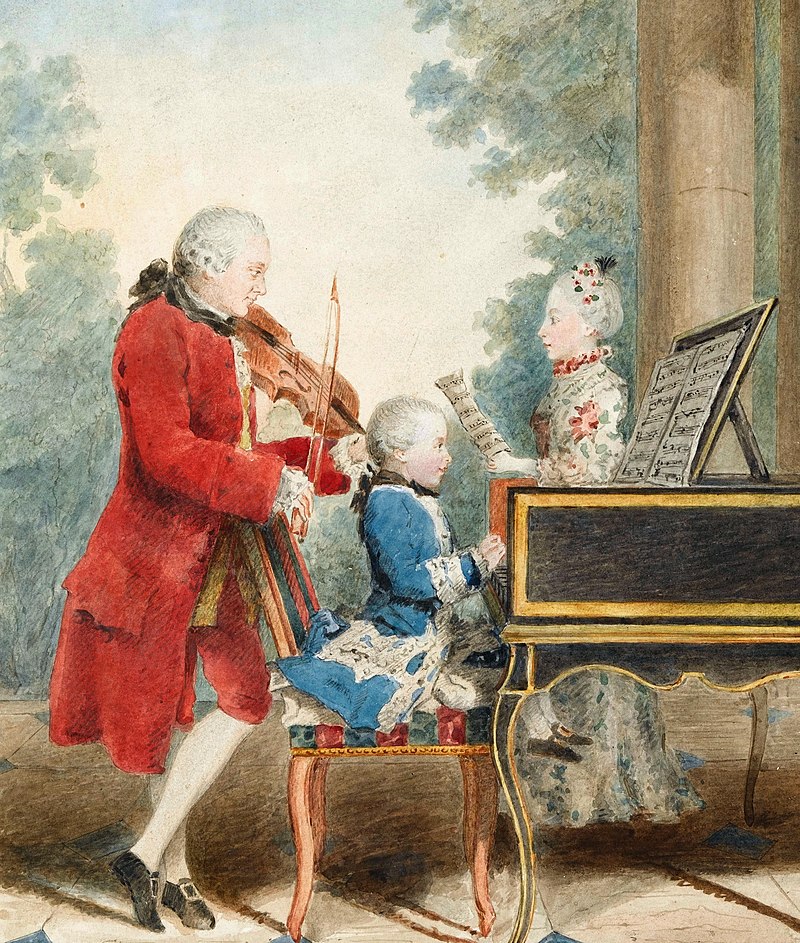 The Mozart household within the composer’s youth. Note the distinction in bow between a contemporary violin and the one pictured, this, plus intestine strings contributed to a vastly distinction sound than that of as we speak’s devices
The HIP motion sought to deal with this dilemma by fusing what we knew on the time about how this music was initially performed, and what we may feasibly do in efficiency now to get nearer to that “authenticity”. The affect of this motion grew over time, and actually reached an apex when labels like Harmonia Mundi and Telefunken started releasing recordings of Bach and Handel by conductors like Nikolaus Harnencourt and John Eliot Gardiner, carried out by musicians taking part in on interval replica devices.
The new recognition of HIP recordings and live shows didn’t exist in a vacuum, and the standard labels, conductors and orchestras did reply by adopting some however not the entire trappings of the HIP motion. This is why as soon as the 70s roll round, you start to see recordings of Bach, Handel, Mozart, and Haydn, with lighter instrumentation, faster tempos, and extra spritely taking part in. One explicit recording I’ve listened to for quite a few years is Sir Neville Marriner’s 1977 model with the Academy of St. Martin within the Fields on UK Argo (ZRG 876) which on the time adopted lots of the musical impacts of the historic efficiency motion (dimension, lightness of taking part in) whereas sustaining trendy devices. And as enjoyable as a number of the interval historic instrument performances can get, these are the kinds of recordings I discover myself gravitating again to, as a result of they join the previous with the current by means of sensible compromise. And whereas the Marriner doesn’t essentially characteristic a number of the high flight vocal soloists of the sooner “romantic” variations, it’s musical interpretation is one I can get behind.
When I noticed earlier this yr that Canadian audiophile label 2xHD records was reissuing a reasonably obscure 1979 recording of the Requiem on vinyl, I used to be curious as to what sort of Requiem efficiency this may be, and what made it benefit the eye of this reissue label. The recording in query was by Swedish choral conductor Stefan Sköld main the orchestra he based, the Choir of St. Jacob, alongside an orchestra of school and college students from the Stockholm Conservatory. Issued on the Swedish label Proprius (PROP 7815), I’m undecided anybody would have ever caught this efficiency on their radar, however that’s the fantastic thing about these smaller specialty reissue labels, they carry to mild obscure gems usually buried beneath extra commercially profitable releases. A home Swedish launch of one of many most-recorded works by one of many most-recorded composers? Probably barely made a dent in 1979 (older audiophiles know the label for excellent recorded sound on classics like "Cantate Domino" and "Jazz on the Pawnshop" so it is attainable this one was additionally higher recognized then_ed.). In 2025 nevertheless, when a label like 2xHD -run by veteran engineer René Laflamme and producer André Perry- releases a file, you are likely to take discover.
Fortunately, this explicit Requiem efficiency was a pleasure to take heed to and uncover, because it is without doubt one of the most thought of recordings I’ve heard from the pre-digital period. While Sköld and his orchestra use trendy devices and a comparatively massive (however not big) refrain, the taking part in is energetic, and the instrumentation is paired down to provide the piece a way more versatile really feel. Soloists too, whereas not family names, do an admirable job, notably within the low voice division. The ‘Tuba Mirum’ featured dynamic and colourful solos from bass-baritone Magnus Linden and tenor Brian Burrows (the one title on this album some may acknowledge).
The tempos and taking part in model actually assist set this recording aside from its friends. The well-known ‘Dies Irae’ actually strikes and flows, and by outcome it clocks in considerably faster than virtually all different recordings from the time at 1:45. Compare that to Marriner’s 1:53 or Karl Bohm’s reasonably lugubrious 2:00 minutes.
But it’s not simply the tempos that provide the sense of liveliness on this recording. Listen to the opening cello solo in ‘Recordare’ and listen to the refined and lightweight musical tone produced. What vibrato is there doesn’t form the phrase like in a romantic line, however provides coloration and texture to the sound solely. Meanwhile, the solo voices weave in between each other with out the overwhelming “mass” of sound (see what I did there?) from the operatic interpretations of the previous.
So, I’ve made the case that this can be a stand-out Requiem recording from a musical standpoint, so what concerning the sound? Well, this recording was made at St. Jacobs church in Stockholm, the house of this choir. This has its advantages and downsides: for one; clearly Stefan Sköld knew how one can place his musicians within the area for max impact. The choir sound is expansive and pictures spectacularly. The texture of the orchestra can also be first charge, and each instrument has a stable, tangible, and three dimensional picture that delicately balances the directness of the sound with the interplay with the church. There are a number of downsides, although. There is a noticeable lack of bass on this recording, which tends to occur while you swap the wooden of a live performance corridor stage with the stone of a church. However, there’s not a lot bass in Mozart’s Requiem anyway, with what little bass there’s coming from a two-drum timpani and what seems like a single double bass.
 The St. Jacob Church in Stockholm
The lack of bass is greater than made up for within the readability of the devices, with a slight emphasis on the higher midrange and decrease treble. The very high of the frequency spectrum generally will get misplaced within the sound throughout extra dominant sections, however then reemerges within the delicate moments such because the epic ‘Confutatis’ or the dynamic ‘Domine Jesu’ the place the sopranos sound as if they’re a ray of sunshine shining by means of the musical texture.
The scaled down orchestra and thoughtful taking part in additionally enable top-of-the-line strengths of this recording to return by means of, microdynamics, that are current in all the things from the trombone solo to the vocal options. The dynamic vary will be highly effective when naturally known as for, however the Mozart Requiem is simply not a chunk that’s going to overwhelm you with slam and bombast. It is an intimate choral work with complicated textures and thru this new vinyl remastering by 2xHD, all these qualities shine by means of. Instrumental coloration is vivid and sophisticated, whereas all the things interacts naturally with the acoustic area round it. If you need to hear real looking vocal or instrumental texture, this recording will captivate you.
2xHD engineer René Laflamme mastered this launch from the unique analog masters at present held by Naxos on the corporate’s 2xHD Fusion Mastering System which incorporates amongst different devices, a Nagra-T tape recorder wired with OCC silver cabling. The chopping was carried out by Chris Bellman at Bernie Grundman Mastering on their all-tube chopping chain. My urgent, achieved by Le Vinylist in Quebec metropolis (I imagine that is solely my second expertise with this plant) with plating by Mastercraft, was pretty quiet, even when the file floor didn’t appear like it might be. The listening expertise was solely sometimes marred by a little bit of tape hiss, fully acceptable for a recording of this age and with a comparatively low cutting-level most probably to protect the dynamics of the recording.
2xHD picked a gem with this Mozart recording, and whether or not you’re new to the piece, or have a devoted part for it in your file shelf, this recording will be a superb place to begin to perceive Mozart’s vocal and orchestral writing in unburdened readability.
HI-FI News
by way of Tracking Angle https://ift.tt/eXoCvRV
February 28, 2025 at 10:10PM
-
Product on sale
 Audiophile Vinyl Records Cleaning BundleOriginal price was: €69.90.€59.90Current price is: €59.90. incl. VAT
-
Product on saleEasy Start Vinyl Records Cleaning KitOriginal price was: €69.90.€59.90Current price is: €59.90. incl. VAT
-
Vinyl Records Cleaner Easy Groove Concentrate€34.95 incl. VAT
-
Easy Groove Super Set€199.00 incl. VAT
-
Easy Groove Enzycaster – vinyl records prewash cleaner€34.95 incl. VAT
-
Easy Groove Extreme MK. II- vinyl records prewash cleaner€45.00 incl. VAT
-
Vinyl Records Cleaner – Easy Groove Virgin Concentrate€35.00 incl. VAT
-
Easy Groove Spray&Wipe vinyl records cleaner€34.95 incl. VAT







