
World News
HiFi Rose RD160 USB DAC
HiFi Rose RD160 USB DAC
Designed to accomplice the RS130 network-attached streamer and RD180 built-in amp, the flagship RD160 DAC combines state-of-the-art silicon with a raft of customized DSP
Sean Kim, the Marketing/Sales Executive Director at HiFi Rose, has acknowledged that the model needs to ‘enliven the hi-fi market and have it embrace new know-how quicker’. That’s fairly an ambition, and, to be honest, the South Korean firm has already confirmed itself to be a profitable disruptor – a working example being the excitement generated by its ‘steampunk’ RA180 amplifier [HFN Jul ’22], and its community streamers sporting huge, customisable touchscreens [HFN Jun ’21 and Mar ’22].
So, right here’s the RD160, its first standalone DAC. Abandoning the ESS chipset utilized in its earlier streamer/DAC fashions, it packs the brand new flagship Velvet Sound Verita resolution from AKM [see PM’s Welcome, HFN May ’24]. Currently, that is the highest-level DAC that AKM affords, consisting of a two-chip bundle, with the AK4191 noise-shaper/upsampler/digital filter handing over to the AK4499EX for the precise D-to-A conversion. No fewer than two pairs are used within the RD160, one set per channel, along with HiFi Rose’s personal ‘I2S alignment’ regime operating on a Cortex-A7 ARM-processor.
Unseen display
But earlier than anybody will get to speaking about what’s taking place beneath the RD160’s hood, it will likely be this DAC’s look that will get tongues wagging. Causing a stir is de rigueur for this model, and the RD160 unveils yet one more design aesthetic right here. When not in use, the DAC’s ten small metallic buttons on the left of its entrance panel flank a bigger house that is still utterly clean. But change it on, and a show (truly two separate OLED panels) lights up, and since it’s mounted behind translucent – quite than clear – plastic, its white textual content and graphics have an uncommon really feel to them, nearly paying homage to e-paper. Off to the proper, a bigger dial is surrounded by a dimmable white LED ring shouting on your consideration.
This fascia offers the RD160 its distinctive look, however look previous it and also you’ll discover its different parts are ‘typical HiFi Rose’. The thick high plate with the milled emblem is one acquainted aesthetic gadget, as are the cooling fins on the aspect of the chassis. I’ve no complaints in regards to the construct high quality both, because the aluminium case has a stunning end and, with black or silver colourways obtainable, some partial matching of this DAC is feasible with different HiFi Rose parts.
Charting the best way
There’s extra to this gadget than a elaborate industrial design, although. In protecting with its want to be a power for change [see boxout], the RD160 presents the D/A course of in its personal specific means. In default mode, you’ll see a flowchart seem on the display, highlighting the chosen enter, filter, upsampling and output – the route the sign takes by way of the RD160. If you’re keen on diagrams, the arc sample that signifies quantity – when utilized in variable output mode – will tickle your fancy much more. This ‘schematic’ show is weird, unique… and I actually loved utilizing it.
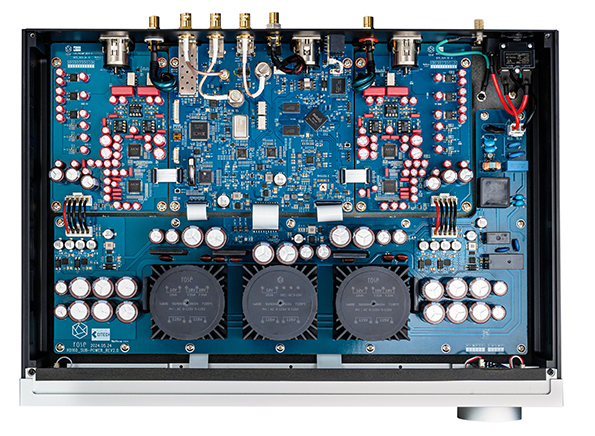
Above: Three linear PSUs [bottom] feed the digital and analogue sections of each left and proper channels. The former utilises an RK3128 Quad core Cortex-A7 CPU [centre right], the latter with AK4191EQ/AK4499EXEQ upsampler/ DAC chips and J-FET outputs [top left and right]
While legibility isn’t nice from a distance of three metres or so, it’s positively extra enjoyable than boring textual content or a small LED telling you which ones filter you’ve chosen. Also, in comparison with the button- and LED-infested Musical Fidelity M6x DAC [HFN Jul ’22] I sometimes use for testing, I discovered the RD160’s show extra informative when exploring all the pieces the DAC affords. A pure (massive) textual content show is accessible in case you desire, and as soon as music playback will get underway, all is changed by two waveforms. These seem sluggishly and lack sharp focus as a result of barely frosted show, however this lends them an oddly ‘analogue’ really feel – once more, enjoyable!
Generally, the remotes that accompany HiFi Rose’s separates are minimalistic within the excessive. That’s not the case right here because the RD160’s distant is full of buttons, making this one of many firm’s few merchandise you’ll be able to utterly management whereas sitting on the couch. I discovered this handset to be far more intuitive to make use of than the buttons on the unit itself.
Flower energy
Setting the RD160 aside from a slew of entry-level AK4191/AK4499EX-based DACs from challengers together with SMSL, Topping and Eversolo, HiFi Rose has added extra to the combo to justify the value. Three customized linear toroidal energy provides lay the muse, powering the digital stage and the left and proper analogue output phases independently. A number of effort has been put into protecting the core digital and analogue phases aside [see inside picture, p66], the designers describing this structure as ‘Rose CIM’ (Completely Isolated Modules).
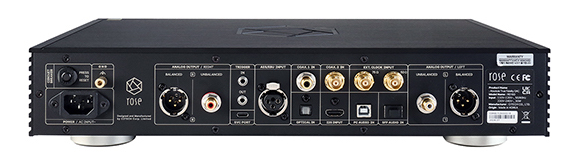
Above: Digital inputs span optical (192kHz/DSD64 DoP), two coaxial and AES/EBU (384kHz/DSD128 DoP), HDMI/I2S (768kHz/DSD512), USB-B and SFP (768kHz/DSD512). Two clock ins are included, plus balanced (XLR) and single-ended (RCA) analogue outs
The DAC and balanced analogue output phases, the latter using low-noise J-FET op-amps, are separated onto two mono PCBs for the left and proper channels. All the digital processing, together with the varied PCM/DSD formatting, digital filter and upsampling choices, in addition to its channelling to I2S, is completed on the central PCB. The OCXO clock relies right here too (that is the large-ish metallic can within the centre), although HiFi Rose does provide the ability for an exterior clock to be hooked up.
 Flexible buddy
The function set and connections of the RD160 enable for loads of alternative when becoming it right into a wider system, together with pre-out ranges starting from 1V to 9V, which could be adjusted on the fly utilizing the big dial on its entrance panel. This could be helpful in case you have been to attach the RD160 immediately into an influence amplifier, however I opted to make use of it with an built-in amp: HiFi Rose’s EISA Award-winning RA280 [HFN Apr ’24]. In this set-up, the RD160 appeared so as to add little when it comes to colouration and appeared fairly clear. It resolved a number of element, particularly by way of the analytically minded Focal Sopra No2 floorstanders [HFN Sep ’15] I used, however traces of harshness or artificiality have been absent.
Playing the Akademie für Alte Musik Berlin’s Bach Brandenburg Concerto recordings [B0991J76PS; Harmonia Mundi; 192kHz/24-bit], by way of Roon and an Eversolo DMP-A8 [HFN May ’24], drafted into digital streamer duties over I2S, ‘II.Adagio’ from Concerto No.1 in F Major was introduced in a pleasantly flowing method. The oboe main the best way sounded very pure, segueing into finely portrayed baroque strings, and the size of the recording was appropriately conveyed. With eyes closed, I used to be nearly satisfied I used to be listening to the dwell efficiency on the Jesus-Christus-Kirche within the German capital.
Open extensive
That stated, when ‘zooming’ in on particular person devices I missed having the ability to place them with confidence on the stage. Of course, that is by no means straightforward with orchestral items recorded in nice halls, however when I’ve listened to this album prior to now by way of the identical loudspeakers and a T+A DAC200 [HFN May ’22], there was a heightened sense of accuracy. But I wouldn’t wish to overstate this: the efficiency actually didn’t come throughout as being smeared, quite a extra spread-out picture basically, and this didn’t make the listening expertise unrewarding. HiFi Rose’s debut standalone DAC hit the spot on a number of fronts and delivered convincing immersion when ‘IV. Menuet – Trio I – Polonaise – Trio II’ got here round.
And not each recording includes a huge, dwell sound. There was a fantastically spacious really feel to the RD160’s portrayal of ‘Yok Haddi Yok Hesabı’, an 11-minute monitor from Turkish psychedelic rock band BaBa ZuLa [Istanbul Sokakaları; Glitterbeat GBCD163; 48kHz/24-bit], significantly in its dealing with of the numerous scattered percussion, which incorporates the tinkle of falling cash. The HiFi Rose DAC was in its factor with this layered, centered piece, sustaining the sensation of its hypnotic build-up whereas nonetheless neatly exposing the attribute twangs of the stringed saz – a Turkish/Middle Eastern instrument the band amplifies to get a sound that sits someplace in between people and metallic.
Switching to a Pro-Ject CD Box RS2 T CD transport [HFN Sep ’19], related by way of AES/EBU, I spun Gustav Mahler’s Symphony No.1 and the unfinished Symphony No.10, discovered on Disc 1 of the Leonard Bernstein Conducts Mahler field set [Sony Classical; 19439708562]. The change of supply didn’t yield a change within the RD160’s manner – the grand orchestral dynamics on ‘II. Kräftig Bewegt’ discovered the house to specific themselves, similtaneously softer passages supplied delicate, gentle detailing that invited me to ‘lean into’ the recording. Again, the impression was that of listening to a live performance efficiency in its totality, which isn’t a draw back when coping with Mahler.
Striking a stability
The virtuoso enjoying of Anne-Sophie Mutter throughout John Williams’ Violin Concerto No.2 [Deutsche Grammophon 00289 480 2012 8; 96kHz/24-bit] was on the cusp of being not fairly pronounced sufficient, but this can rely a bit on private style – in case you desire particular person devices to be accentuated, above getting a extra built-in view of an association, the RD160 may not tickle your fancy. On the opposite hand, I did typically benefit from the stability struck, which HiFi Rose’s Sean Kim states knowledgeable the choice of this DAC’s dual-chip AKM bundle.
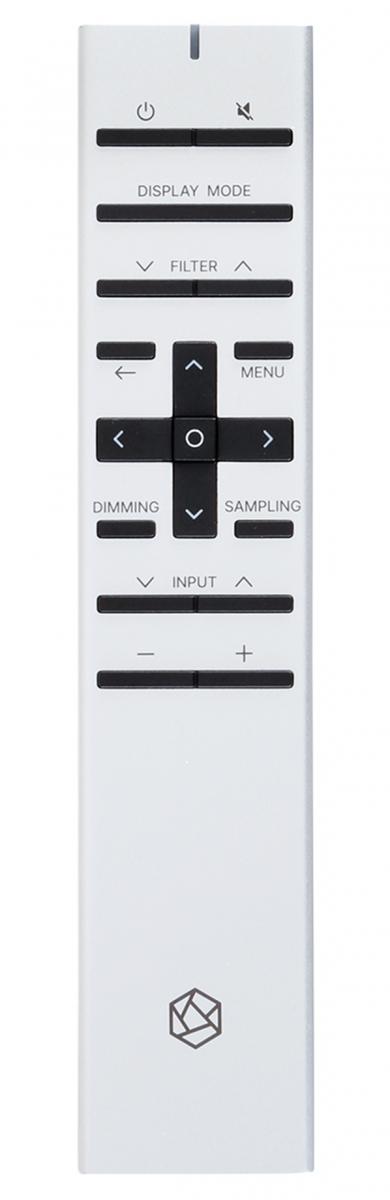
Above: PThe RD160 has a ‘devoted distant management’ providing entry to enter, mute, quantity, sampling and filter modes, show look and menu navigation
An factor of the attraction of this flagship unit is the handy means in which you’ll mess around with its digital filters and upsampling. Yes, most DACs provide related capabilities, however the attention-grabbing factor in regards to the RD160 is that you realize precisely what you’re doing, because of its OLED show. You’ll be enticed to experiment, even when that’s not your nature.
Season to style
During testing, I felt the best optimistic affect on efficiency was achieved by instigating the unit’s PCM upsampling to the utmost price (768kHz or 705.6kHz, relying on supply). As typically with AKM chipsets, conversion to DSD introduced with it a touch of a smoothing impact – a lesser sense of decision however a extra fluid sound – as evidenced when listening to Feist’s Multitudes album [Polydor 4873183; 88.2kHz/24-bit], however you do must take into consideration the drop in degree throughout comparability to PCM modes. Furthermore, because it’s straightforward to experiment with, I assume RD160 homeowners will exit and uncover what they like. For some, enjoying round with these variables will likely be an finish unto itself.
Hi-Fi News Verdict
With the promise impressed by the implementation of a pair of AKM’s flagship DAC options, the RD160 is clearly no run-of-the-mill product. In observe it delivers the products, providing a clean, detailed sound albeit favouring broad soundstaging over pin-sharp positioning. Otherwise, the distinctive design not solely attracts visually, but in addition provides a component of enjoyable and exploration in use. And there’s nothing flawed with that!
Sound Quality: 82%
HI-FI News
by way of Hi-Fi News https://ift.tt/9A6ldI3
March 12, 2025 at 03:32PM
-
Product on sale
 Audiophile Vinyl Records Cleaning BundleOriginal price was: €69.90.€59.90Current price is: €59.90. incl. VAT
-
Product on saleEasy Start Vinyl Records Cleaning KitOriginal price was: €69.90.€59.90Current price is: €59.90. incl. VAT
-
Vinyl Records Cleaner Easy Groove Concentrate€34.95 incl. VAT
-
Easy Groove Super Set€199.00 incl. VAT
-
Easy Groove Enzycaster – vinyl records prewash cleaner€34.95 incl. VAT
-
Easy Groove Extreme MK. II- vinyl records prewash cleaner€45.00 incl. VAT
-
Vinyl Records Cleaner – Easy Groove Virgin Concentrate€35.00 incl. VAT
-
Easy Groove Spray&Wipe vinyl records cleaner€34.95 incl. VAT


