
World News
Too younger for Brahms
Too younger for Brahms
A pair of prestigious piano competitors finals has Peter Quantrill questioning if specific items and composers are greatest left on the shelf, ready for a musician’s life to meet up with their capability
Can a musician be ‘too younger’ for sure repertoire? It may be coincidence, however I’m inclined to assume so after listening to two younger pianists win main competitions. Over a single weekend in late September 2024, the finals of each the Leeds International and George Enescu competitions occurred. I attended the latter, in Bucharest, and noticed the 31-year-old Ukrainian pianist Roman Lopatynskyi win over the jurors (or a majority of them, anyway) with a efficiency of Brahms’ Second Piano Concerto which, whereas assured and big-boned, hardly reached base camp when it comes to scaling the expressive calls for of the piece. You can decide for your self on YouTube, simply as you’ll be able to the efficiency of Jaeden Izik-Djurko, the 24-year-old Canadian pianist who joined a distinguished record of Leeds laureates with the exact same Brahms Second.
Long participant
We can all play decide and jury in these circumstances. In the character of contemporary televised competitions, we’re inspired to take action. Izik-Djurko’s Brahms, like Lopatynskyi’s, felt constrained by the epic scale of the concerto, which is after all of the longest in the usual repertoire. Second prize on the Enescu remaining was taken by a Russian pianist, Tatiana Dorokhova, with a extra delicate account of Brahms’s First Concerto, albeit one nonetheless frozen in a stylistic period relationship again to the Sixties and ’70s, inflated to Mahlerian dimensions.
As it occurs, Alexander Kantorow triumphed on the Moscow Tchaikovsky competitors in 2019, taking part in Brahms’ Second, and with preternatural maturity and lightness of contact (this, too, might be checked out on YouTube). But general, mischievously, I want to suggest a moratorium on Brahms concertos at competitions (violin ones too). Partly for the sensible purpose that the concertos are so lengthy in comparison with the preparation time out there for the contestants with orchestra. These are symphonic works, demanding a degree of dialogue between soloist and orchestra that can’t be faked inside a quick rehearsal.
Perhaps it appears pretentious to say that younger musicians are ‘too younger’ for Brahms. But the pianist Beatrice Rana instructed me lately that she has solely simply begun to current his solo music in public. She has been taking part in the First Concerto for some years, however solely now, in her early 30s, does she really feel she has the life expertise to start grappling with the sonatas. This could appear ironic, provided that Brahms was in his early 20s when he wrote them. Nevertheless, some music calls for not simply years of conservatoire coaching, however commencement from the varsity of exhausting knocks. Around the identical time because the competitions, I noticed Kirill Petrenko conduct Bruckner’s Fifth Symphony, and Sakari Oramo conduct Mahler’s Sixth. In each circumstances they have been doing so for the primary time – certainly Petrenko had by no means performed any Bruckner earlier than. Yet you’ll hardly comprehend it.
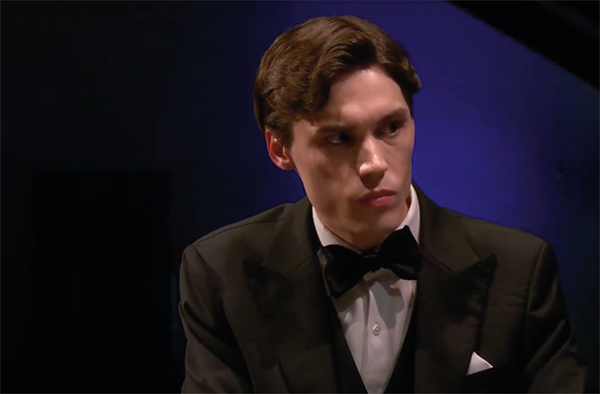
Youth and maturity – Canadian pianist Jaeden Izik-Djurko performs Brahms on the Leeds competitors whereas [above] Kirill Petrenko conducts Bruckner on the BBC Prom
Both Oramo and Petrenko have been bringing many years of expertise – in life and music – to bear on a recent encounter with a peak of the symphonic repertoire. Of course, in contrast to solo pianists, that they had the benefit of first-class orchestras to again them up (this is usually a two-edged sword!). In each items there’s a wealthy, typically ambiguous and even contradictory internal narrative that, like Brahms’s Second Concerto, can’t be reached via diligent examine and technical finesse.
Better with age
Brendel has at all times been notoriously dismissive of his early recordings, made in Vienna within the Fifties for American labels comparable to Vox. Karajan suggested Rattle to ‘throw away your first 100 Beethoven Fifths’ (when Rattle nonetheless had 95 to go!). That famous Brucknerian Günter Wand solely felt outfitted to start tackling the Fifth in his late 50s. These are ruefully retrospective reflections, whereas Izik-Djurko and Lopatynskyi are entitled to reside within the second. With their triumphs in Leeds and Bucharest, they’ve a profession in entrance of them. But maybe they need to give Brahms a relaxation, for now.
HI-FI News
by way of Hi-Fi News https://ift.tt/jKe1kUq
March 13, 2025 at 04:08PM
-
Product on sale
 Audiophile Vinyl Records Cleaning BundleOriginal price was: €69.90.€59.90Current price is: €59.90. incl. VAT
-
Product on saleEasy Start Vinyl Records Cleaning KitOriginal price was: €69.90.€59.90Current price is: €59.90. incl. VAT
-
Vinyl Records Cleaner Easy Groove Concentrate€34.95 incl. VAT
-
Easy Groove Super Set€199.00 incl. VAT
-
Easy Groove Enzycaster – vinyl records prewash cleaner€34.95 incl. VAT
-
Easy Groove Extreme MK. II- vinyl records prewash cleaner€45.00 incl. VAT
-
Vinyl Records Cleaner – Easy Groove Virgin Concentrate€35.00 incl. VAT
-
Easy Groove Spray&Wipe vinyl records cleaner€34.95 incl. VAT







