
World News
Nightingale Point 5
Nightingale Point 5
 British firm steps up with a three-way reflex-loaded loudspeaker with a twist, however will its sound have Trevor Attewell head over heels in love?
The Point 5 from Nightingale Acoustics is a really uncommon loudspeaker, which could be stated to put on its coronary heart on its head. Starting on the different finish, its physique is a mainly rectangular cupboard manufactured from 19mm particle board with an integral entrance panel that’s stepped inwards by 24mm excessive 180mm, the 2 ranges being joined by a slope.
In the decrease, principal part are the bass driver, nearly central on the entrance, with the reflex port (75mm in diameter and 167mm lengthy) under it. The port is a considerable tube 3½mm thick. Meanwhile, the midrange driver is on the inset portion of the panel.
Foam and performance
The inside of the enclosure is lined with foam, the thicknesses various from 25-50mm, and a considerable lateral brace is fitted alongside the again, between the facet partitions, roughly a 3rd of the way in which up the enclosure. The cupboard is veneered solely on the edges, all the opposite faces being fleck-painted. A contoured foam grille completes the entrance, and that is mounted in place by adhesive. It is formed to fill within the stepped a part of the panel, presenting a vertical entrance floor. The traditional recessed plastic connecting panel is fitted close to the highest of the cupboard, and this presents the person a selection of 4mm sockets or male two-pin DIN.
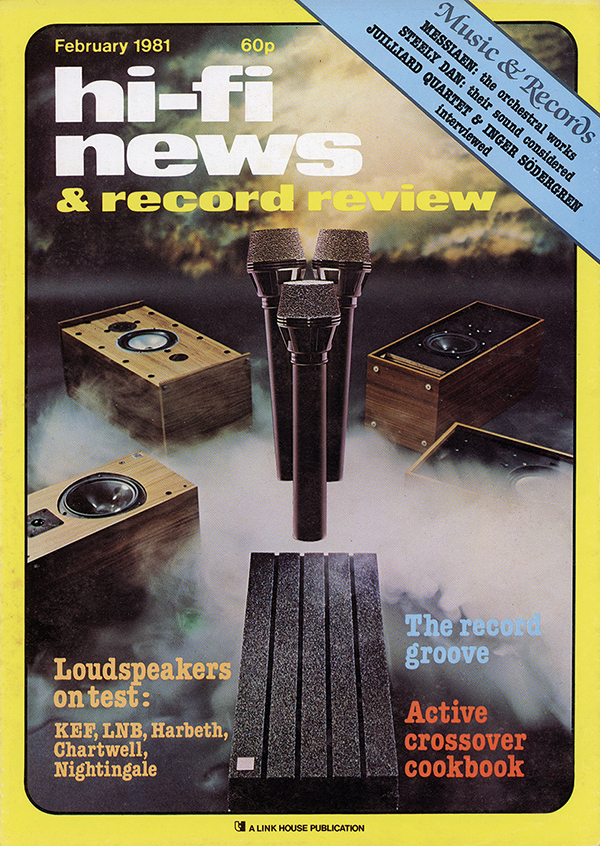
Cover of HFN Feb ’81
Something lacking? Oh sure, the pinnacle! Sitting atop the cupboard is a foam cowl, rectangular, with a chamfered high entrance edge – it’s held solely by two adhesive strips. Under it sits the tweeter, mounted considerably offset from the centre line, above the midrange unit the truth is, on a vertical steel bracket. Because of the offset, which helps to scale back any mixture of diffraction results from the facet edges, the speaker must be equipped in handed pairs if stereo imaging is to not be worsened. Also beneath the lid is the crossover, which is an 11-element affair on a PCB, screwed to the highest.
Tweeter tact
Some care in dealing with the speaker is required, because the cowl just isn’t bolstered in any method, and the tweeter and crossover may very well be susceptible to acts of savagery, equivalent to standing it the other way up. It shouldn’t occur, in fact, however all of us have our moments of aberration. Needless to say, the explanation for stepping the motive force fronts is to provide time-delay compensation. The complete construction is well-made, feels stable, and it’s a reduction to see a loudspeaker that’s satisfyingly totally different.
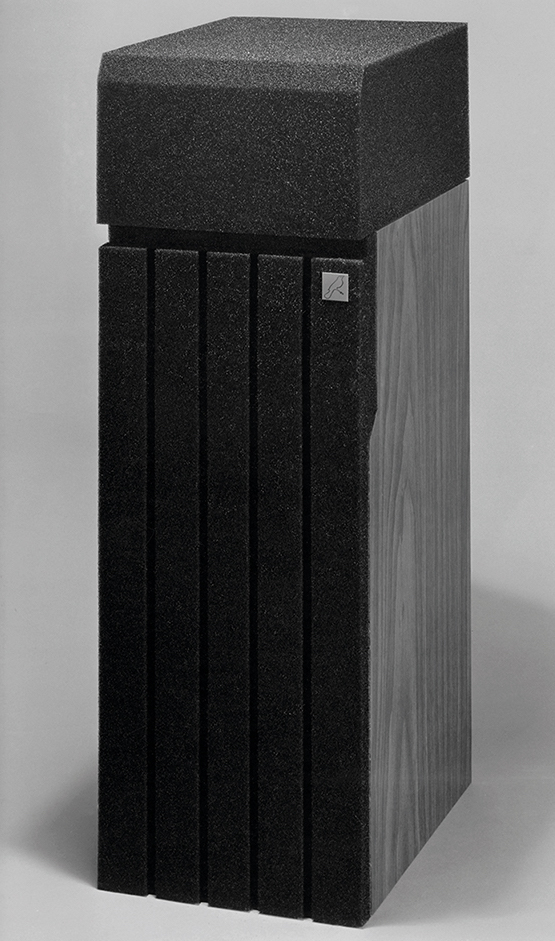
The NM Point 5’s very purposeful cupboard design was hid behind a foam grille and hood, all held in place with traces of sticky tape
Although it appears to be like large enough for floor-mounting, stands are beneficial, the instructed one being the 8in AVF stand, with out castors. These weren’t accessible for our checks, however others of comparable top have been employed, the audio system being about 1½m from the top wall and three⁄4m from the facet partitions.
 Wiring woes
First impressions weren’t good – the tonal steadiness appeared removed from flat, and one thing appeared very flawed on the high finish. It was subsequently determined to measure the efficiency of the speaker earlier than any in-depth listening was executed. The sinewave response confirmed a severe and spiky suck-out between 2kHz and 4kHz, and the response of these current was unanimous – the tweeters have been out of part. Lifting its hat and its brains confirmed that the wiring was appropriate in keeping with the board markings, however we determined to function anyway, and reversed the part of the tweeter. The ‘EEG’ promptly returned to regular, and the maker subsequently confirmed that ‘appropriate’ was certainly ‘incorrect’, because of using a typical board with non-applicable markings. This might be rectified in manufacturing.
Fresh listening checks confirmed a marked enchancment, the principle feedback on normal, prolonged listening being that the highest was barely ‘fizzy’ and exhausting, there was some ‘presence’ carry that tended to scale back the efficient bass content material, and a few mid colouration was seen. It is unlucky that the measurements had been seen earlier than these checks, however the graphs have been saved out of sight throughout, and for some days earlier than the listening, and there’s little likelihood I may have remembered any particulars.
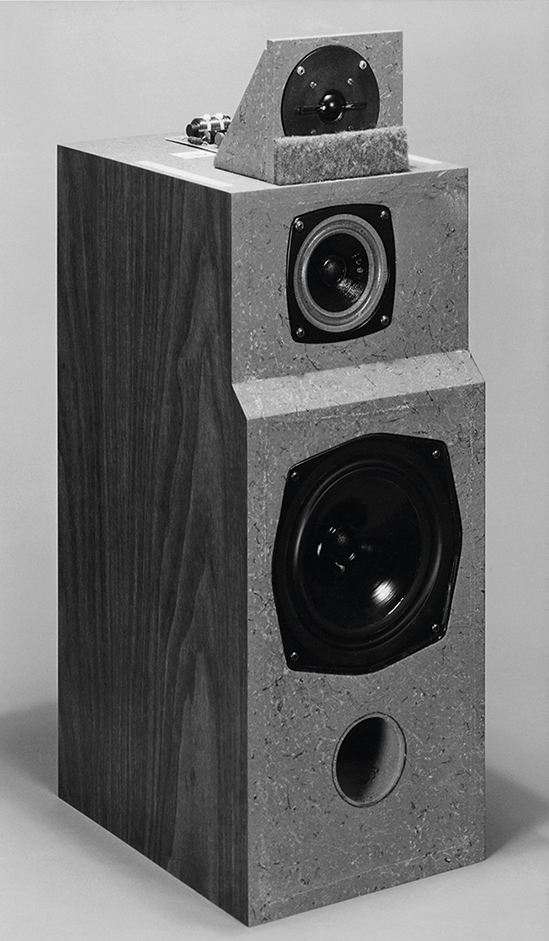
The early ‘mk1’ NM Point 5 audio system as reviewed in Hi-Fi News displaying crossover mounted to the highest of the cupboard and offset mid/treble drivers
Strings have been additionally thinner, the cellos being barely recessed, with an general improve in ‘chestiness’. Organs confirmed much less 4’ output, the reeds have been extra irregular and sharper, however reasonably thinner, and mixtures extra strident. Triangles and bells have been additionally sharper, most percussion devices being extra emphatic, and extra hole. Organ pedal, bass drum and double basses indicated much less bass extension, although not considerably so. Harpsichords have been duller within the mid, with much less sweetness within the high.
Hats off
When it got here to imaging, with good stereo inputs this was typically thought-about to be good, with ample lateral accuracy however some vertical patterning, and the angle depth, although affordable, was not excellent. Trying the loudspeaker with out its hat merely elevated the tweeter output and was not favored. The look additionally suffers, in fact, if that could be a consideration.
The most obtainable stage was very appreciable and definitely way over most customers may stand for lengthy. There is not any safety – some samples might have a fuseholder close to the enter socket, however there is no such thing as a fuse in it! However, a superb spell considerably above the beneficial 100W peak produced no issues. Some slight distortion was heard, however it was nothing to fret about, notably in these excessive situations.
Frequency funnies
Examining the measurements taken does present a gradual upward slope over the band. This was slight, however most likely important, with a dip round 500Hz, and a considerably spiky high. If I say that these options can account for a few of the audible results, a few of our sceptical readers might merely fall about laughing, remembering the circumstances of the measurement. Well, please yourselves!
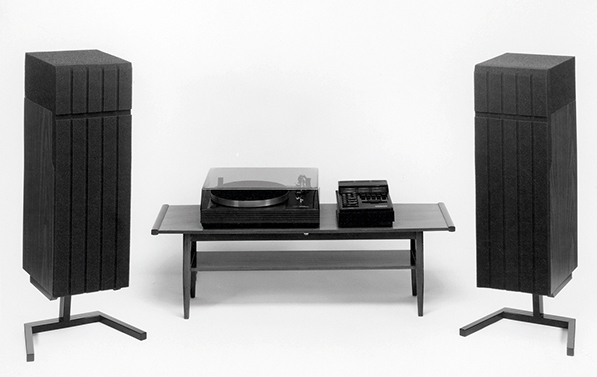
The Nightingale Point 5 audio system pictured in a typical system with Linn LP12 turntable and Nytech CTA252XD built-in amp [HFN Jun ’17]
The impedance modulus curve is typical, displaying a well-controlled impedance, the minimal modulus being 5ohm at about 100-200Hz, a superbly respectable worth, with a mean very near nominal. The sensitivity within the measuring room was 93dB SPL of pink noise at 1m for 10½V enter, which is once more a really affordable determine. Although some response options have been mildly criticised, the essential design is an effective one, and my feeling is that a bit of consideration to the midband/bass crossover and to the tweeter may make this an excellent performer, if costing issues allow.
Conclusion
As this design at present stands, I might hesitate to make a agency general advice, however would counsel audition, particularly by those that want a brightish sound.
HI-FI News
by way of Hi-Fi News https://ift.tt/2BMsi5c
April 9, 2025 at 02:58PM
-
Product on sale
 Audiophile Vinyl Records Cleaning BundleOriginal price was: €69.90.€59.90Current price is: €59.90. incl. VAT
-
Product on saleEasy Start Vinyl Records Cleaning KitOriginal price was: €69.90.€59.90Current price is: €59.90. incl. VAT
-
Vinyl Records Cleaner Easy Groove Concentrate€34.95 incl. VAT
-
Easy Groove Super Set€199.00 incl. VAT
-
Easy Groove Enzycaster – vinyl records prewash cleaner€34.95 incl. VAT
-
Easy Groove Extreme MK. II- vinyl records prewash cleaner€45.00 incl. VAT
-
Vinyl Records Cleaner – Easy Groove Virgin Concentrate€35.00 incl. VAT
-
Easy Groove Spray&Wipe vinyl records cleaner€34.95 incl. VAT







