
World News
Rotel Michi Q5 CD participant/DAC
Rotel Michi Q5 CD participant/DAC
 Styled to match its amplifier siblings, the newest member of Rotel’s flagship Michi household combines a custom-made top-loading CD transport with USB enter and DAC stage
Rotel has topped its new Michi Q5 a ‘Transport DAC’, which strikes us as a considerably imprecise description of what’s, before everything, a CD participant. Yes, it has digital inputs to make wider use of its onboard DAC, plus digital outputs, however only one look on the Q5’s distinctive top-loading drive mechanism – plus the actual fact it resides below the ‘CD participant’ tab on Rotel’s web site – tells you it is a unit primarily aimed toward silver disc lovers.
Priced £5499, and due to this fact proper in keeping with different Michi fashions together with the P5 S2 preamp [HFN May ’24] and X3 S2 [HFN Jan ’24] and X5 S2 built-in amplifiers, the Q5 is, we’re informed, the forty seventh CD participant to return out of Rotel, a run that began with the RCD-850 in 1985. And whereas it is the one CD participant within the Michi household, Rotel’s wider catalogue presently consists of 4 different disc gamers, together with the Diamond Series DT-6000 [HFN Aug ’22]. The Japanese marque additionally says it’s dedicated to the format sooner or later, noting CD’s ‘ongoing strong world demand’.
Classy chassis
As the latest member of the Michi household, the Q5 will get the full-width chassis design and high-quality match and end of its siblings. It’s additionally pretty weighty at 23.5kg, a lot of that coming from a pair of {custom} toroidal PSU transformers and substantial black alloy ‘Michi’ casework with side-mounted heatsinks carried over from the Michi amps.
A flush, glass entrance panel carries a full-colour TFT show that hosts album art work and monitor data. For CD playback it means a community hyperlink is required to dig up the imagery from a web-based database, so the Q5 has a wired Ethernet connection (however no Wi-Fi). This is not allied to any onboard streaming module, although, simply because the built-in amps and DAC/preamp of the Michi collection are non-networked designs. The purpose for this, says Rotel, is that ‘streaming know-how evolves quickly, so it is extremely possible that the Q5 will outlast any particular streaming module’.
The producer additionally teases {that a} devoted Michi streamer is on the horizon. Until then, although, third-party digital sources can hook up with the Q5 by way of its USB-B, coaxial and optical inputs, the primary of these dealing with music information as much as 384kHz/32-bit PCM and quad DSD. Digital alerts feed right into a DAC stage primarily based on the one developed for the P5 S2 preamplifier albeit with a ‘sound tuning’ of its personal [see PM’s Lab Report]. This remains to be a balanced analogue stage, nevertheless, feeding XLR in addition to single-ended RCA outputs.
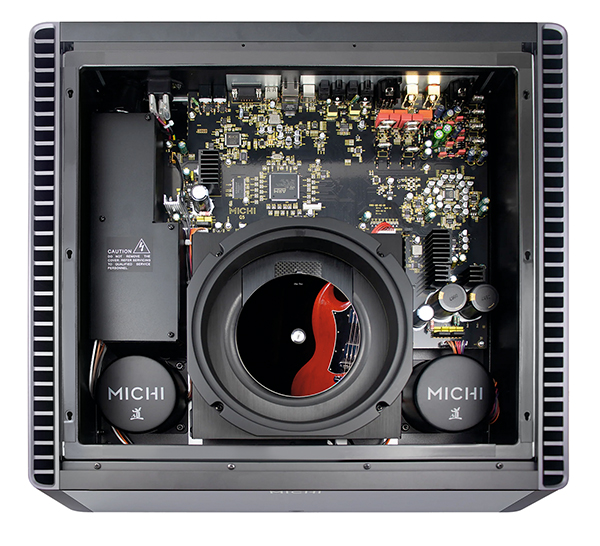
Above: Dual screened transformers [bottom left and right] feed separate PSUs for the XMOS USB enter [top left], ARM processor-based DSP [centre], CD transport [bottom] and ESS DAC-based analogue output stage [top right]
Digital outputs are included too, however the Q5’s capability to function as an outboard DAC means there’s some blurring of the boundaries between it and the opposite Michi elements it is destined to be partnered with. For this mannequin, Rotel makes use of a single DAC chip, whereas the P5 S2 preamp runs a pair of ES9028PROs in a dual-mono configuration – the producer says homeowners of each preamp and participant ought to experiment to discover a choice. Those utilizing its X3 and X5 amplifiers are suggested to attach digital sources to the Q5.
Glow and behold
Back to the principle occasion, and for this new participant Rotel has engineered a top-loading disc mechanism [see PM’s Lab Report] that it believes provides the act of taking part in a CD (SACD is not on the menu right here) some vinyl-esque ‘tactile enjoyment’. That’s as possibly, however I used to be much more enamoured of the white LED ring across the perimeter of the CD mechanism inside that lights up while you elevate the Q5’s CD cowl. This could be turned off by disabling ‘Top LED Mode’ within the menus, however who’d need to try this?
Other menu choices, accessed and navigated by way of buttons on the Q5’s distant management [see p49] embrace supply/enter renaming; community troubleshooting; firmware standing; switching between two ‘PC-USB Decoding’ modes (one extending PCM dealing with from 24-bit to 32-bit on the expense of DSD and MQA compatibility); and adjusting the brightness and timeout of the principle entrance show.
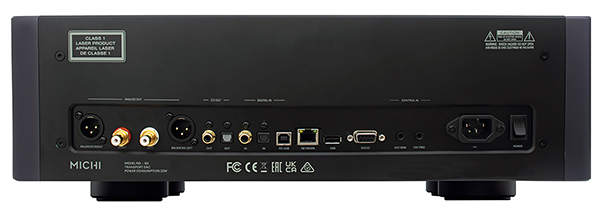
Above: Balanced XLR and unbalanced RCA outputs are joined by optical and coaxial outs (CD transport), optical and coaxial (192kHz/24-bit) and USB-B (384kHz/32-bit, DSD256) inputs, Ethernet (art work, firmware), USB (firmware), and management/RS232 ins
As mentioned, the general appear and feel of the Q5 is lush, however in use there are just a few ‘niggles’. Firstly, what seem like a row of touch-sensitive controls on the participant’s entrance panel are literally indicators. The buttons are bodily, and are mounted on the underside of the chassis, so be sure there’s adequate house for fingers if putting the participant on a rack. Additionally, whereas these controls embrace a Stop button, there is not any apparent Stop button on the distant itself. Instead, it is advisable to maintain down the play/pause key for 4 seconds.
This is price noting as a result of the Q5’s CD cowl is not ‘locked’ when a disc is spinning, and in case you open it throughout playback (or with playback merely ‘paused’) there’s an opportunity it’d elevate off the motor spindle. Also notice that the tolerances of Rotel’s top-loading mechanism and lid imply aftermarket disc stabilisers can’t be used.
The enjoyable gentle present that accompanies the loading of a CD into the mechanism would not rely for a lot if the Q5 fell on the first efficiency hurdle. So wouldn’t it, like all good silver disc gamers, function a reminder of how superb the format can sound?
 Vocal virtuoso
The Q5 slotted comfortably into the HFN reference system [see p39], bringing with it a clear, centered and detailed playback that suited all musical genres. Particularly spectacular was the participant’s dealing with of vocals and their soundstage presentation, which ensured every little thing I performed by means of it felt like a ‘efficiency’.
There are not any filters to experiment with right here, as Rotel runs the ESS DAC in bypass mode with a home-grown digital upsampling algorithm [see PM’s Lab Report]. With that call taken care of, you simply sit and hear, which proved preferrred for Julia Fordham’s ‘Swept’, from the album of the identical title [Circa 262 249]. Given this finely recorded ballad, the Q5 constructed an outstanding image of the singer, ahead of the shimmering instrumentation unfold extensive and deep behind her.
There’s minimal percussion on this monitor, simply faint hi-hats and bells, and these had a gossamer really feel, in distinction to the strong synths and piano. The supply of Christy Moore’s ‘Reel In The Flickering Light’ [Ordinary Man; Demon Records, Fiend CD82] was comparable, the singer spotlit in opposition to a fluid backing, encouraging you to concentrate on the humour-tinged lyrics.
Tight ‘n’ tasty
The Q5 appeared very content material with materials resembling this, the place smoothness and richness are key considerations, however neither did it falter with the lean, rocking sounds of AC/DC’s Ballbreaker [Epic/Albert Productions 5173842]. Produced by Rick Rubin with an eye fixed on returning the Aussie band to the rawer sound of their earlier albums, this set strips again the surplus to concentrate on Malcolm and Angus Young’s guitar taking part in. The Q5 rendered the tight riffs of ‘Whiskey On The Rocks’ with crispness, chew and element. During the chanted refrain of ‘Hail Caesar!’ the person strands of the backing vocals have been straightforward to listen to, not simply misplaced in a mass.
This capability to unearth the finer factors of a mixture remained when pairing the Q5 with an Aurender W20SE music server [HFN Mar ’23] over USB. Rotel’s D/A stage revealed the nice and cozy however glowing manufacturing of Billy Joel’s Piano Man set [Mobile Fidelity Sound Lab; 88kHz/24-bit] and lifted Peter Gabriel’s vocals on ‘Secret World’ [Us; Real World Records, 96kHz/24-bit download] clear from the murky, synth-heavy backing. But it stays to be seen what number of homeowners of Michi’s P5 S2 preamp would bypass that unit’s twin DAC stage, and quantity management, for the Q5’s personal analogue output.
Wing of fireplace
And, actually, this new Michi mannequin performs admirably sufficient as a CD participant to justify its existence, sans digital inputs. Set to work with the CD layer of Stevie Ray Vaughan’s The Sky Is Crying on SACD [Mobile Fidelity Sound Lab UDSACD 2078], a canopy of Jimi Hendrix’s ‘Little Wing’ was brilliantly staged, the Q5 delivering sensation of the house between the gamers and conveying the artist’s shifts in guitar tone and magnificence.
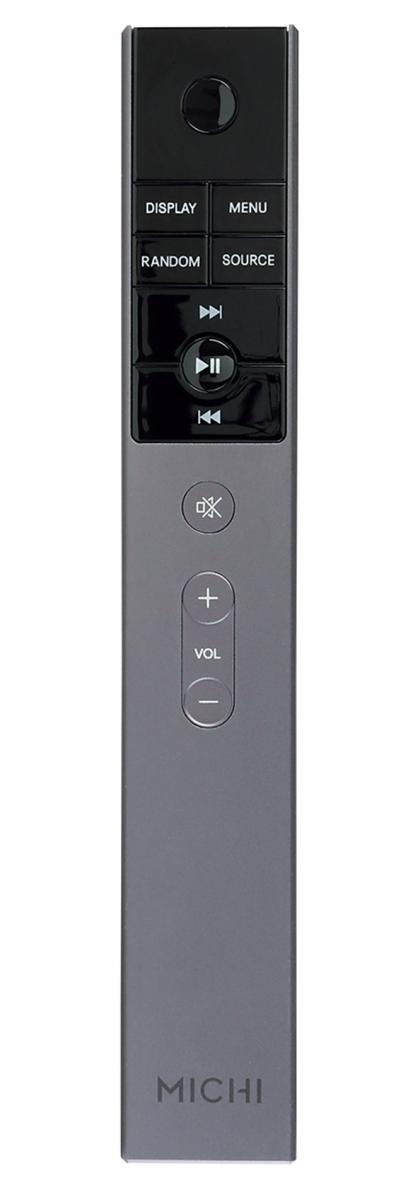
Above: RR-RH9 distant has monitor skip, play/pause and ‘random’ buttons, plus supply choose, show dimming and menu entry. Mute and quantity are for related Michi amps
Next up, Vaughan’s tackle Lonnie Mack’s basic ‘Wham!’ was notable for the punch and drive of bass and drums, even when the intentionally ‘fuzzy’ nature of the manufacturing on this monitor did the Q5 no favours.
There have been events the place I wished a bit extra upper-band element from this Michi participant, resembling throughout Rickie Lee Jones’ ‘Night Train’ from her eponymous debut [Warner Bros. Records, 256 628], the place some wood percussion hits appeared a tad perfunctory. Yet the identical album’s ‘Chuck E.’s In Love’, which got here with twang and snap to the guitar, wealthy vocals and a giant, weighty drum sound, proved to be glorious compensation.
No-fuss focus
Most of the time the Michi Q5 simply drew me into the music with its assured, no-fuss sound, an instance being its dealing with of Debussy’s 12 Etudes, performed by Mitsuko Uchida and recorded in 1989 by Grammy-winning producer Wilhelm Hellweg for the Philips Classics label [422 412-2]. ‘No.1 (Pour Les Cinq Doigts)’ kicks off a collection of items of virtuoso taking part in – the equal of a prog rock guitar solo, circa 1915 – and is a flurry of notes, weights and resonances. The Q5 delivered it with all its prospers and dynamic contrasts intact, and when Uchida’s key presses grew to become faint, it was straightforward to think about the lone piano within the recording house.
Hi-Fi News Verdict
A welcome addition to Rotel’s top-tier Michi strand, the Q5 will quicken the heart beat of CD collectors with its superb fashion and construct high quality, plus a efficiency that extracts a lot from the legacy digital format. There are some usability quirks to report, and the omission of SACD playback may annoy, however digital inputs and outputs deliver system-building flexibility. We love the disc transport gentle present, too…
Sound Quality: 88%
HI-FI News
by way of Hi-Fi News https://ift.tt/Uz3CwtJ
May 2, 2025 at 10:54PM
-
Product on sale
 Audiophile Vinyl Records Cleaning BundleOriginal price was: €69.90.€59.90Current price is: €59.90. incl. VAT
-
Product on saleEasy Start Vinyl Records Cleaning KitOriginal price was: €69.90.€59.90Current price is: €59.90. incl. VAT
-
Vinyl Records Cleaner Easy Groove Concentrate€34.95 incl. VAT
-
Easy Groove Super Set€199.00 incl. VAT
-
Easy Groove Enzycaster – vinyl records prewash cleaner€34.95 incl. VAT
-
Easy Groove Extreme MK. II- vinyl records prewash cleaner€45.00 incl. VAT
-
Vinyl Records Cleaner – Easy Groove Virgin Concentrate€35.00 incl. VAT
-
Easy Groove Spray&Wipe vinyl records cleaner€34.95 incl. VAT


