
World News
DS Audio TB-100 Energiser/Equaliser
DS Audio TB-100 Energiser/Equaliser

This simply will be the most self-fulfilling overview I’ve ever written. DS Audio has unleashed a valve energiser and equaliser, the TB-100, for its optical cartridges. Up so far, each one in every of its cartridges has been launched with an identical solid-state energiser of relative or comparable worth, however the TB-100 has been launched by itself. Because each DS Audio cartridge will work with any of the energisers no matter worth, this time it’s all in regards to the tubes.
At £17,500, the TB-100 joins the present vary of 5 energiser/equalisers, at a worth level just under the center rank. It’s costlier than the DS-W3 (£9105) however cheaper than the DS Master 3 (£18,885), whereas above that reside the two-chassis DS Grand Master (£42,200) and £62,000 GM Extreme [HFN Dec ’22, Jan ’24, Feb ’21 and Oct ’23, respectively]. As you’ll see, the TB-100 shares the output and low-pass filter selections of the assorted solid-state fashions, however I used to be mildly shocked to see it lacks balanced (XLR) outputs – my solely criticism.
Match maker
It’s value noting for newcomers to DS Audio optical cartridges that the pricing checklist doesn’t present a particular ‘deal’ for the TB-100-plus-cartridge – seen with its different combos – however this doesn’t preclude financial savings being supplied if shopping for a cartridge similtaneously a TB-100.
Sleek and glossy, the TB-100’s structure is barely uncommon, occupying a flat and huge however low-profile 440x150x482mm (whd, together with terminals). At the entrance, on full show and sans protecting cage, are 4 ECC82 (12AU7) triode tubes, which DS Audio says are ‘optimised particularly for this mannequin’, being rigorously matched for variations throughout operation, after which paired to inside 1% (or 0.1dB).
Each pair of valves per channel splits their duties into voltage amplification and output buffering, with the passive equalisation located in between. The firm describes the design as a ‘easy two-stage amplification circuit with low-impedance cathode follower output levels’. To cut back crosstalk, DS Audio has opted for a dual-mono configuration with fully impartial earthing and energy transformers.
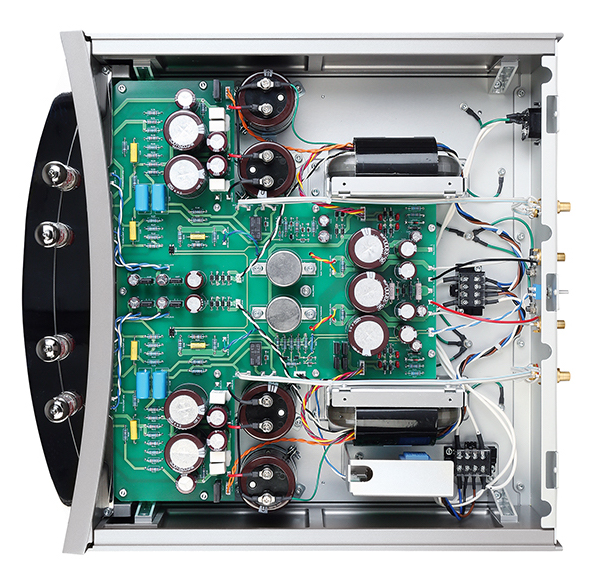
Above: PSU delivers +5V biasing voltage for the optical cartridge [centre/right] and is flanked by dual-mono PSUs for the equaliser. Input transformers [silver, centre] feed a triode tube-based equaliser circuit
The TB-100’s fascia, reminiscent of it’s, hosts a single button for Power On/Off, with partnering LED, beneath the array of valves. After switch-on, the LED glows orange. Warm-up takes between 60 and 90 seconds, then the LED modifications to purple. Now the automated mute operate is deactivated and the TB-100 is operational.
Careful connection
Minimalist, too, is the again, which can be acquainted to all earlier DS Audio clients. There’s one pair of RCA phono sockets for a single turntable with DS Audio cartridge. It have to be remembered – no, make that harassed – that DC energy is fed to DS Audio’s optical cartridges via the sign cables, so you have to by no means join an MM or MC cartridge to a DS Audio energiser (or a suitable equaliser from a 3rd occasion producer – mentioned later). Furthermore, you have to keep away from switching on the energiser earlier than all connections have been made.
Two outputs, nonetheless, are supplied, each on RCA phonos. Output 1 is compliant with normal RIAA specs, and is the more than likely for use, whereas Output 2 incorporates a further subsonic filter working at 20Hz (–6dB/octave). The output selections are augmented by a toggle swap which selects main 30Hz and 50Hz bass roll-offs. Because an optical cartridge can (theoretically) reproduce indicators all the way down to DC, the bass behaviour of your system will decide which output setting is most popular – I used Output 1 with a 30Hz roll-off all through.
Dream come true
In order to understand the boldness of DS Audio launching this all-valve energiser/equaliser, one wants to take a look at how, in simply over a decade, the corporate has efficiently established its new cartridge expertise as a viable different to MCs and MMs. Its optical cartridges, which realised a dream began within the Seventies, have impressed a minimum of eight different manufacturers to develop phono levels with suitable DS Audio energiser inputs, together with Soulnote [HFN Nov ’23], Soulution, EMM Labs, and so on. My personal cowardly alternative, nonetheless, could be to default to the matching energiser from DS Audio. That, nonetheless, doesn’t apply to the TB-100. It’s a free agent, so to talk.
What makes the universality of the TB-100 attainable is how each DS Audio cartridge works with each energiser. While I doubt anybody would feed the Grand Master EX into one of many entry stage fashions, it’s ‘doable’. There’s additionally an argument that the cartridges differ extra sonically than the energisers. But it’s moot: by the point you get to the Grand Masters the decision is of such a excessive normal that, via a large bandwidth system, you’ll hear each refined variance – therefore the necessity to audition each cartridges and energisers.
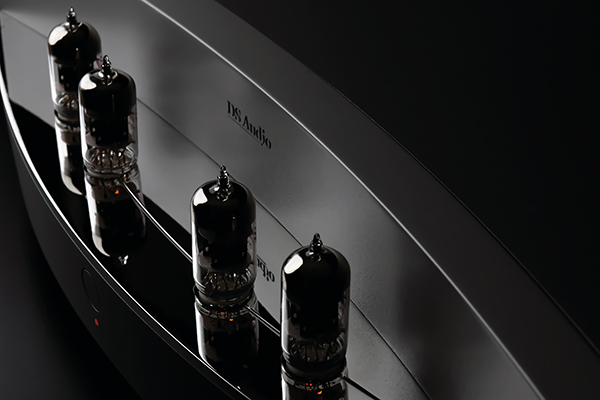
Above: The TB-100’s gunmetal gray casing is paying homage to DS Audio’s Master collection equalisers, however seen right here boasting ECC82/12AU7 triodes on a mirrored platform
It was identified to me to by an proprietor of a Grand Master EX and its two-chassis energiser that the TB-100 prices solely a 3rd of it. Will this be a problem for DS Audio? No, as a result of it brings us again to the apparent… the TB-100 is strictly about tubes-vs-trannies. Although this battle was resolved many years in the past, each applied sciences now present side-by-side, it’s clear that for some audiophiles it’s an both/or state of affairs!
 Turn on the lights
This time round, the consumer expertise was extra than simply watching the LED on the entrance of the Master 3 cartridge mild up – the 4 tubes on the TB-100 create a visible feast for any valve aficionado. But what I used to be not anticipating was the preliminary blast from a barely burned-in unit. ‘Enlightening’ is simply too corny a phrase to make use of, so I’ll keep on with ‘revelatory’.
What occurred was this. When I first put in the TB-100 in my system, I used to be accompanied by a veteran of DS Audio cartridge utilization and his equally audiophilic accomplice. Between us, we’ve heard almost each mannequin of cartridge and energiser, and we complete 18 years expertise with them. But it was a freezing February morning, and the TB-100 went from automobile to system, nonetheless chilly to the contact.
Within three revolutions of the opening of Crosby Stills & Nash’s self-titled debut album [Atlantic 75/Rhino RCD1 8229], we knew that one thing new and thrilling was afoot. Here there have to be declared a attainable bias to our response, as we’re valve-inclined, however prejudice had nothing to do with it. The three of us had been shocked.
For starters, the TB-100 was audibly extra open, separating the music so deftly that zooming in on every voice was rendered virtually too straightforward. It did this with out growth to the purpose of overkill, and definitely not by making a ‘gap within the center’. Positioning remained coherent however with every voice having fun with its personal turf. In phrases of soundstage and transparency, the expertise was akin to the calibre of enchancment you’d affiliate with leaping two or three ranges of upgrading in a recognized system. I repeat, my colleagues and I should not new to the DS Audio method. We knew what we had been listening to – and it was a change on a par with, properly, tubes versus transistors.
Taste take a look at
But was it ‘higher’ or simply ‘totally different’? Here comes the subjectivity, and I’m not about to step between two audiophiles arguing over, say, D’Agostino versus Jadis. The vocals had been a lot extra lifelike and natural-sounding than through both of the solid-state energisers that slight sacrifices in crispness on transients mattered under no circumstances. At least, to not me. But I’m not blind (or ought to that be deaf) to the transistor items.
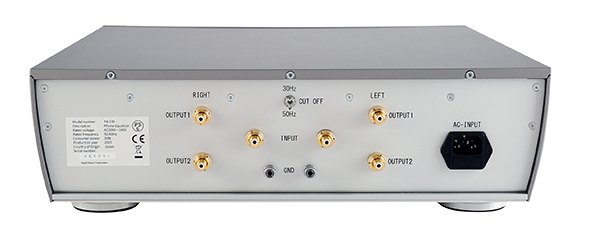
Above: Power for the optical pick-up’s inside LEDs is delivered through the enter RCAs [centre]. Output 2 [left/right] features a 20Hz subsonic filter whereas the 30Hz/50Hz cut-off, chosen through a toggle [centre], applies to Outputs 1 and a couple of
There’s no arguing that they higher suited the shredding on one other eponymous debut, Van Halen [Mobile Fidelity UD1S 2-032]. The fiery break in “You Really Got Me” – arduous to consider it’s now 47 years outdated – had a definable assault and edge through the Master 1 energiser, which categorically would enchantment to a tough rock aficionado. The TB-100 had the mass and the facility, however it was barely slower with transient assault and, on the backside finish, confirmed much less weighty slam.
But it was intangibles that drew me in, reminiscent of Graham Nash’s voice on “Lady Of The Island” from the aforementioned Crosby Stills & Nash, the sense of delicacy and (the way it kills me to confess this) the extent of emotion on this sparse monitor. The identical may very well be stated for the entire of but a 3rd eponymous debut, the brand new mono reissue of Bob Dylan [Mobile Fidelity MFSV 1-523].
Rising star
Acoustic guitar, harmonica and Dylan at his most nasal – it’s controversial that such a recording is both no problem in any way or a more durable recording to resolve as a result of it’s completely unplugged. The Van Halen album was as far faraway from folkie interval Dylan as I may get, and it confirmed up the divergence between valves and solid-state with exceptional readability and efficacy. But listening to Dylan’s ‘House Of The Rising Sun’ with such in-the-room presence and complete freedom from artifice jogged my memory why I’m basically a ‘tube man’.
That, alas, didn’t resolve a battle. I hear to only as a lot powerhouse rock, from The J Geils Band to Whitesnake to Mountain, to know that I’d ideally need to have each solid-state and valve choices. The nice information? You can have a TB-100 for the softer stuff, whereas DS Audio’s entry-level DS-E3 solid-state energiser prices solely £1270. Buy the pair of them and also you’re prepared for something.
Hi-Fi News Verdict
This conclusion calls for a repeat of the raison d’être that defines the DS Audio TB-100: it’s all about valves. Its 5 solid-state siblings share a hyper-precise and funky sound, whereas the TB-100 veers towards the nice and cozy and romantic. And if that doesn’t outline 60 years of tubes versus trannies, nothing does. Your tube-or-tranny choice will determine for you. If I had £17,500, I’d purchase a TB-100 with out a second’s pause.
Sound Quality: 89%
HI-FI News
through Hi-Fi News https://ift.tt/Uz3CwtJ
May 3, 2025 at 06:32PM
-
Product on sale
 Audiophile Vinyl Records Cleaning BundleOriginal price was: €69.90.€59.90Current price is: €59.90. incl. VAT
-
Product on saleEasy Start Vinyl Records Cleaning KitOriginal price was: €69.90.€59.90Current price is: €59.90. incl. VAT
-
Vinyl Records Cleaner Easy Groove Concentrate€34.95 incl. VAT
-
Easy Groove Super Set€199.00 incl. VAT
-
Easy Groove Enzycaster – vinyl records prewash cleaner€34.95 incl. VAT
-
Easy Groove Extreme MK. II- vinyl records prewash cleaner€45.00 incl. VAT
-
Vinyl Records Cleaner – Easy Groove Virgin Concentrate€35.00 incl. VAT
-
Easy Groove Spray&Wipe vinyl records cleaner€34.95 incl. VAT


