
Audio News
Marantz 60n
Marantz 60n
https://ift.tt/3mvhpwP
Marantz has not been immune to the ownership churn that has touched many audio brands over the past decade or two. In nine years, Marantz went from being acquired by Sound United, which itself was acquired by Masimo in 2022, and as of 2025, ended up under Harman. Ownership upheaval like this can unsettledly distract a company, but Marantz has continued to push forward with purpose. If there were ever a product to prove that a brand may not be 100% certain of its destination yet absolutely knows its heritage, it’s this 60n.
Marantz, however, is not a lesser company—it has pressed on regardless. And if there’s a product that embodies the idea that a brand can know where it’s coming from even if its path ahead is unclear, this 60n is it.
All present and correct
The 60n is the right product at the right price. At £1,299 Marantz offers a well-specified, attractive, well-built integrated network streamer capable of meeting the expectations of a mainstream customer. The control options are solid. The finish is distinctive enough to stand out. As long as the 60n delivers competitive performance, Marantz should remain an appealing option for anyone considering a new purchase.
‘The correct product’, in this context, means ‘an integrated Class A/B stereo amplifier with network streaming capabilities, an accessible ESS Sabre ES9018K2M DAC at 32bit/384kHz and DSD256 native, and the ability to slot into a multi-room system’. You’re good to go if you have speakers and a smartphone with a music app.
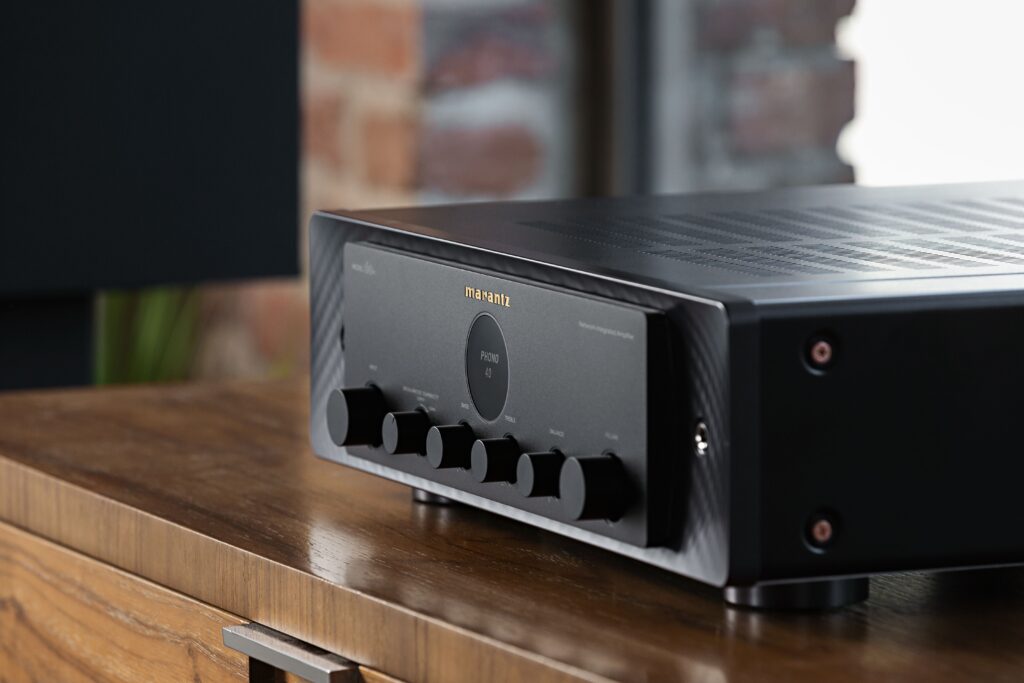
The Marantz 60n can deliver 60 watts of Class A/B power into an 8-ohm load, rising to 80 watts per channel into 4 ohms. Its DAC is accessible via digital optical, digital coaxial, USB-A and Ethernet inputs and wirelessly via Bluetooth 5.4 dual-band Wi-Fi. The wireless capability makes it RoON Ready and it can support the Connect versions of Spotify and TIDAL as well. Install the HEOS (home entertainment operating system) control app, free for iOS and Android, and beyond access to extra music streaming services and internet radio, the 60n can form part of a multiroom system with compatible Denon and/or Marantz equipment.
Side with analogue
The analogue side isn’t neglected either. Three line-level inputs on unbalanced RCA sockets are complemented by a moving magnet phono stage, and there are pre-outs for a subwoofer and for a power amp. Sturdy SPKT-1 binding posts for a single pair of speakers complete the rear panel.
The 60n presents a floating section ahead of a slightly contoured, subtly patterned metal front panel that shifts appearance with the light. A compact ‘porthole’ display keeps the traditional Marantz branding, and there are controls for volume, balance, bass and treble along with a source-direct control that bypasses the tone controls. A power button and a 6.3mm headphone jack round out the front. Build quality and finish are well in line with the asking price.
In addition to the control app (comprehensive but not the tidiest layout), the 60n can be controlled with a large, logical remote. It’s straightforward to operate and to place within a multi-room setup.
Able driving
The Marantz 60n handles a pair of Bowers & Wilkins 705 S3 Signature loudspeakers on their FS-700 S3 stands for the test. Sources include a Clearaudio Concept turntable to the MM phono input, a Rega Apollo CD player to both the digital coaxial and one analogue input for a straight A/B comparison between the Rega’s DAC and Marantz’s, a FiiO M15S digital player loaded with hi-res files, and an iPhone 14 Pro running Presto and TIDAL apps. The 60n can also access a Buffalo TeraStation NAS via its Roon compatibility.
With proper material, the 60n sounds fuller, more complete and more convincing. It remains commendable that the Marantz doesn’t give up if the “proper stuff” isn’t available.
Don’t sweat the lesser stuff
So while a heavyweight 180g vinyl pressing of The Hold Steady’s Stay Positive [Vagrant] is preferable to a 320kbps MP3 of the same album streamed via Bluetooth, and a 24bit/96kHz FLAC of Arvo Pärt’s Cantus in Memoriam Benjamin Britten performed by Staatsorchester Stuttgart and Dennis Russell Davies [ECM] is a better bet than the 16bit/44.1kHz CD alternative, the 60n doesn’t spurn the lower-resolution formats. It handles them with care that’s not guaranteed in similarly priced products.
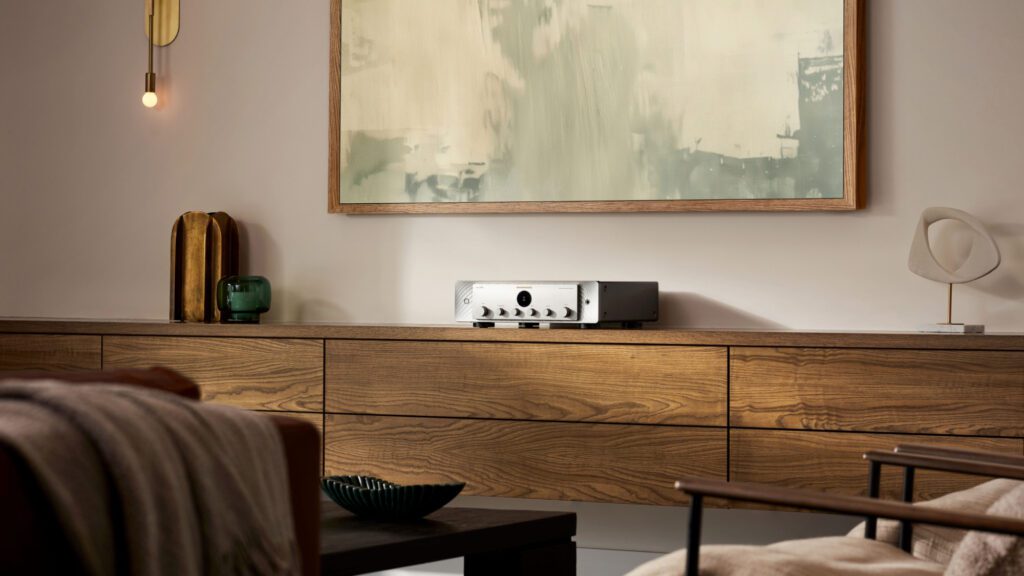
There is a smooth, unfussy quality to the overall sound of the 60n that makes it a) adaptable and b) suitable for use with a wide range of price-appropriate loudspeakers. Its low-end is robust and slightly forward relative to the rest of the response, with controlled bass attack that supports cogent rhythmic expression. Detail in tone and texture is impressive, and there’s a touch more low-end variation here than is typical.
Shine scintilla
The top end of the spectrum is not aggressively extended, and that final hint of brilliance is missing from the treble. Yet the high end remains substantial rather than harsh, and it’s as detailed and informative here as at the other end. Midrange is where the Marantz truly shines, not only for its ability to reveal detail but also for its natural, neutral tonal balance and its responsiveness to the subtle harmonic nuances of voices, yielding a naturalistic, convincing listen.
The overall frequency range stays coherent, with only a hint of low-end overconfidence, and there’s plenty of dynamic headroom when a recording increases in intensity or volume. The Arvo Pärt recording shows that even the smallest, most transient dynamic shifts in harmonic response aren’t overlooked.
The soundstage the 60n creates is well-organised and spacious, allowing even a massed orchestra to breathe. The left-to-right layout is broad, with a gentle sense of front-to-back and even top-to-bottom depth. The Marantz presents a unified picture, weaving even the most complex recordings into a single experience rather than a sequence of separate events.
Just the facts
The Marantz 60n isn’t the most aggressive or assertive listen. Despite its dynamic potential, it remains a calm, measured presentation: “The facts, just the facts” could be its guiding principle. For listeners who value a composed and thoughtful delivery, this is near ideal—but those who expect music to be pure entertainment might find the 60n a touch lacking in animation. The “fact-led” approach can be helped or hindered by the choice of partnering loudspeakers, and to a lesser extent by the source gear being amplified. Still, there’s no denying the 60n’s overall appeal. You either like it or you don’t.
Regardless, the 60n is an admirable device in many respects. It presents itself with confidence and makes music sound good, regardless of origin. And it remains distinctly a Marantz product, a trait unlikely to be diminished by another ownership change.
Technical specifications
- Type: network streamer/Class AB amplifier/DAC
- Analogue inputs: 3 x line-level unbalanced RCA; MM phono
- Digital inputs: digital coaxial; digital optical; HDMI ARC; USB-A; Ethernet; dual-band wi-fi; Bluetooth 5.4; Roon Ready; Spotify Connect; TIDAL Connect
- DAC resolution and supported digital formats: 32bit/384kHz PCM; DSD256 (inc. DSF). AAC; ALAC; FLAC; MP3; WAV; WMA
- Music services and wi-fi inputs (country dependent): Amazon Music HD; AWA; Deezer; iHeartRadio; Mood:Mix; Pandora; Qplay; SiriusXM; SoundCloud; Sony HiRes; TIDAL; TuneIn
- Analogue outputs: unbalanced RCA stereo pre-out; subwoofer pre-out; Marantz SPKT-1 speaker outputs
- Digital outputs: none
- Frequency response: 5Hz – 100kHz
- Distortion (THD + noise): 113dB
- User interface: ‘HEOS’ app; RC006PM remote control
- Dimensions (H×W×D): 139 x 442 x 431mm
- Weight: 7.2kg
- Price: £1,299, $1,500, €1,500
Manufacturer
Marantz
The post Marantz 60n appeared first on hi-fi+.
HI-FI News,Audio
via Articles Archive – hi-fi+ https://ift.tt/h6IO7SK
April 28, 2026 at 07:22PM
-
Product on sale
 Audiophile Vinyl Records Cleaning BundleOriginal price was: €69.90.€59.90Current price is: €59.90. incl. VAT
-
Product on saleEasy Start Vinyl Records Cleaning KitOriginal price was: €69.90.€59.90Current price is: €59.90. incl. VAT
-
Vinyl Records Cleaner Easy Groove Concentrate€34.95 incl. VAT
-
Easy Groove Super Set€199.00 incl. VAT
-
Easy Groove Enzycaster – vinyl records prewash cleaner€34.95 incl. VAT
-
Easy Groove Extreme MK. II- vinyl records prewash cleaner€45.00 incl. VAT
-
Vinyl Records Cleaner – Easy Groove Virgin Concentrate€35.00 incl. VAT
-
Easy Groove Spray&Wipe vinyl records cleaner€34.95 incl. VAT







