
Audio News
EAR Yoshino V20
EAR Yoshino V20
https://ift.tt/AmgeXkV

Leave it to Tim de Paravicini to devise something deliciously twisted that no tube aficionado can resist. The new EAR Yoshino V20 integrated amplifier, though priced at a not-unreasonable-by-today’s-standards £2495, looks unlike anything else and features a tube count rivaled by only a few. The only items I can recall offhand with comparable numerical appeal—more tubes than anyone sane would deem necessary—are high-end designs like the GRAAF GM200 OTL with 16 output tubes per channel, and the recent Silvaweld design with 48 per monoblock.
Ten by two
Now the V20 isn’t quite in that league for tube count, nor is it in price. Even better, its glassware profusion is of the everyday variety, offering a rare chance to enjoy a plethora of tubes without worrying about re-valving costs. Tim has chosen ten ECC83s per channel as output tubes—hence the model number.
In fact, the name ‘V20’ was inspired by Tim’s passion for cars (he’s known to drive with a bit of flair), particularly the V12 Jaguar engine. The prototype amp had a dozen output valves, and the company flirted with calling it the V12 Amplifier Engine. Tim ultimately upgraded the project to the present V20 spec, with no fewer than 20 output valves. The amp is also known in-house and among enthusiasts as ‘Mickey Mouse’ because, when viewed from the front at eye level, its volume and source controls resemble a pair of eyes, and the half-cylindrical tube covers resemble that famous rodent’s ears. Or EARs, if you prefer.
Steampunk style
It’s a stunning, covetable little gadget, a compact 427x139x426mm (whd) with a substantial 20kg mass, and its steampunk aesthetic comes from a mix of materials. That Victorian Modernist vision makes it look like a prop from Nemo’s Nautilus—gold-plated knobs and connectors, chromed fascia and transformer caps, black tube cages, and wooden end-pieces in a dark rosewood. The left-hand knob selects one of five inputs, the right controls level, while the far-right ‘point’ houses an on/off button that glows orangey-yellow, as with earlier Yoshino products.
Thoughtful touches abound, such as a chrome rail shielding the CE-approved yet still multi-way binding posts mounted at the top back of the transformer row. For banana-plug users, a screwdriver can remove the safety caps. Output terminals support 4, 8 or 16 ohm loudspeakers, and you’ll want to optimize impedance matching since this is, after all, a 24-watt unit. The rear panel holds gold-plated binding posts for five line-level sources and a tape output.
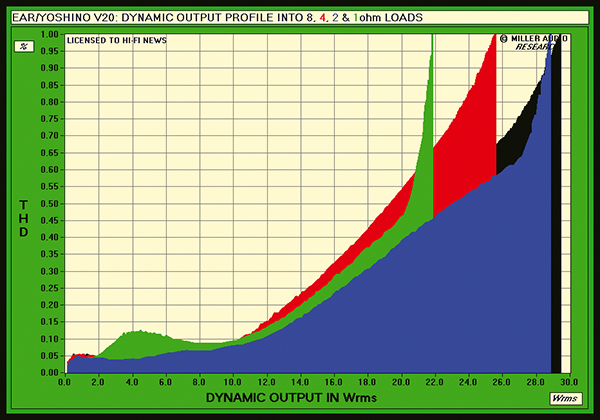
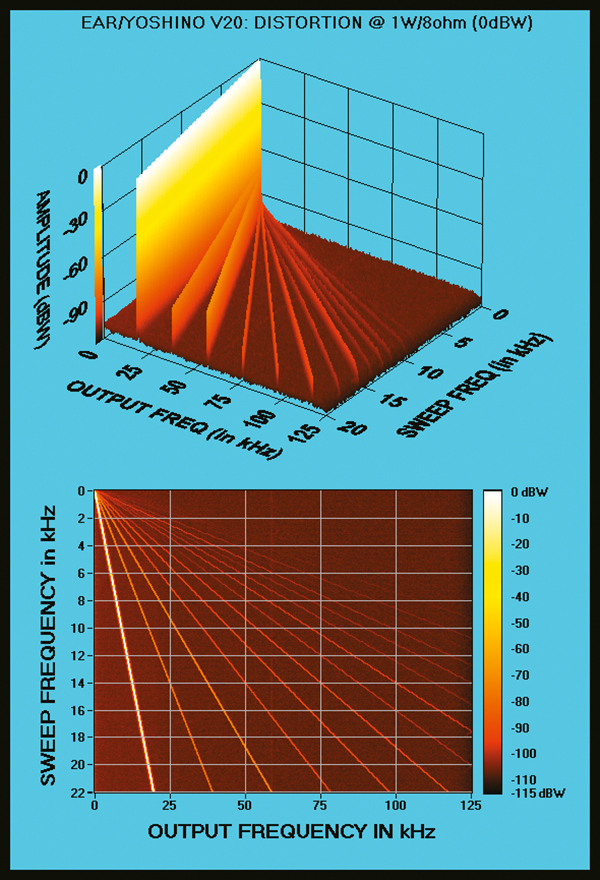
Above: Paul Miller provided the lab report to accompany Ken Kessler’s review. Above is an early example of the dynamic power profile graph seen in today’s HFN reviews while below is a 3D rendering of the V20’s THD versus frequency (re. 1W/8ohm)
As part of the Yoshino DNA line, the V20 marks a departure from Tim’s description of ‘the currently fashionable approaches of pentodes and tetrodes in ultralinear configuration and of large direct-heated triodes’ (though Tim was among the first in the West to embrace the Single Ended Triode revival). Instead, the V20 employs parallel-connected ECC83 (12AX7) indirectly heated double triodes in the output stage.
Most of us think of these tubes as preamp tubes or drivers. Yet Tim arranges them to deliver just under 2.5W each, for an integrated amplifier rated at 24W/ch, in push-pull, pure Class A mode. An additional five tubes per channel complete the lineup, including three more ECC83s for the input stages and a pair of ECC82 driver tubes. Again, this amp won’t break its owners when re-tubing time arrives.
Fun, fun, fun
For those who regard the Yoshino line as a source of iconoclastic treasures, the V20 will prove to be as enjoyable as it is challenging—akin to the still-hard-to-beat EAR 859 [HFN Nov ’94]. That 13W single-ended triode design will be viewed in 2025 as a pioneer in its genre comparable to the Krell KAV-300i [HFN Apr ’96] and the Audio Research CA50. This ongoing shift away from integrateds shows no signs of stopping, and it’s refreshing that it hasn’t forced a rigid topological mold. Tim de Paravicini continues to produce dazzling, innovative gems like this.
And it’s a gem—a bijou trinket that provokes a double-take: should you take it seriously, or treat it like the EarMax or an X-Series module—as a source of grin-inducing musical joy? Regardless of the funky styling, the urge to cuddle it, nickname it, and adorn it with white gloves, yellow shoes, and a Minnie Mouse girlfriend persists. Something tells you you’re in the presence of a radical new listening tool, capable of a rare freedom from coloration, nastiness, and grunge typical of 20 tubes of ordinary variety.
The Tim car analogy is apt: transforming the ECC83 into a notable output-tube echoes a point raised in Richard Williams’ Racers, about turning a junker into a world-beater. Conditions are different now, but the spirit remains—the idea of turning something common and cheap into something truly remarkable.
 Think again
Now I’m not suggesting the ECC83 is anything less than a classic tube… but for preamp use. Who would have thought it could out-sweet an EL34? That it could match a KT66 for midband warmth, or rival a 6550 for speed? And without a trace of edge, grit, or any artefacts you might associate with being over-driven?
But let’s be realistic: two dozen watts are still a modest amount of grunt, suitable for 90dB-plus speakers, or oddballs like the 15-ohm LS3/5A with its narrowly defined power handling, or the original Quad ESL, designed to work with 15W of Quad II power. Although the V20 is more generous than the average SET, it still imposes restrictions on loudspeaker choice. Still, the V20 owner is as free to pair with horns or other high-sensitivity designs as any SET user.
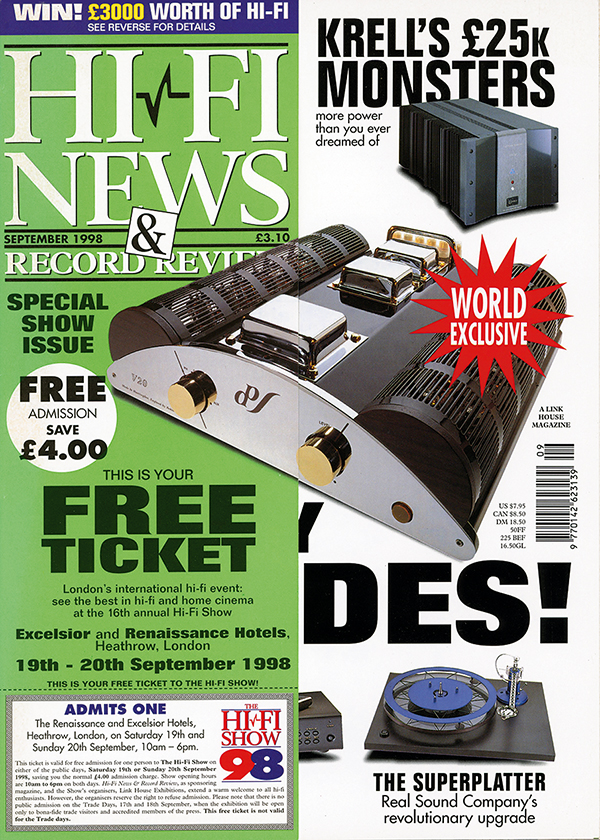
Above: There were two ‘world first’ reviews in HFN Sep ’98 – the EAR Yoshino V20 and Krell’s FPB-650 monoblock amp
Don’t mistake the V20’s performance for a typical SET just because it shares some of its power limitations. EAR Yoshino’s amp deliberately avoids SET weaknesses that undermine the breed’s strengths. Where SET can be sweet but soggy, the V20 remains sweet yet controlled and precise. Where SET can be warm and forgiving to the point of seeming to sacrifice something, the V20 remains emotive and lifelike, yet detailed, dynamic and commanding.
Having it all
Listening to this amplifier is like experiencing the same pleasures that make caviar more delicious than a pickled egg, a wristwatch more desirable than a wall clock, or a Lotus 7 more fun to drive than a Ford Sierra. It’s about quality over quantity. The V20 delivers the high-end traits of a large, layered soundstage, swift dynamic swings, low coloration, natural timbre, and more, but in a package that avoids excess. If I must explain my indecision—whether the V20 is a novelty or a revolution—the answer is that the listener must re-educate themselves to accept all these desirable qualities without an overabundance of power baked in.
The only concession is to pair with suitably high-sensitivity speakers within budget. In other words, for example, the Wilson WATT/Puppy System 5.1 is superb but priced well beyond the V20’s reach, so one might revert to old Quad electrostatics, LS3/5As, or horn systems that don’t demand sacrificing comfort.
Conclusion
So why worry? The challenge of choosing compatible speakers notwithstanding, the V20 is worth the effort because what we may be witnessing is Tim de Paravicini’s finest moment. And that’s a bold claim when you consider that even his missteps are better than many designers’ triumphs. Buy a V20 now, before EAR Yoshino’s tube supplier catches on and prices ECC83s as if they were KT88s.
HI-FI News
via Hi-Fi News https://ift.tt/xyodVgI
May 29, 2026 at 08:04AM
-
Product on sale
 Audiophile Vinyl Records Cleaning BundleOriginal price was: €69.90.€59.90Current price is: €59.90. incl. VAT
-
Product on saleEasy Start Vinyl Records Cleaning KitOriginal price was: €69.90.€59.90Current price is: €59.90. incl. VAT
-
Vinyl Records Cleaner Easy Groove Concentrate€34.95 incl. VAT
-
Easy Groove Super Set€199.00 incl. VAT
-
Easy Groove Enzycaster – vinyl records prewash cleaner€34.95 incl. VAT
-
Easy Groove Extreme MK. II- vinyl records prewash cleaner€45.00 incl. VAT
-
Vinyl Records Cleaner – Easy Groove Virgin Concentrate€35.00 incl. VAT
-
Easy Groove Spray&Wipe vinyl records cleaner€34.95 incl. VAT







