
Audio News
Braun PS 500 turntable
Braun PS 500 turntable
https://ift.tt/Ta92xDK

The Braun PS 500 might be the best turntable you’ve never heard of. Introduced in 1968 and styled by Dieter Rams, it stood as Braun’s top model and the culmination of a long line of evolving machines dating back to the start of the decade. Unlike the later PS 450 [HFN Apr ’25], the PS 500 was almost entirely an in-house creation, designed and produced by Braun itself. This may surprise those who now primarily associate the brand with alarm clocks, razors, and electric toothbrushes.
Back in black
The PS 500 originally arrived in grey with a silver top plate to match Braun’s amplifiers and tuners of the era. A shift came in 1972 when the Regie 510 receiver [HFN Jun ’16] debuted with an all-black cabinet. The PS 500 was then offered in a slightly darker grey with a black top plate to harmonize, with the power switch lever changing from black to Braun’s signature ‘action yellow’ to complete the look.
Although the grey/silver variant was retained for systems built around Braun’s CSV 300 and CSV 510 integrated amplifiers, the black version shown here, paired with the Regie 510, represented Braun’s top-tier offering. “Hi-Fi at the edge of absolute perfection” was the claim for this system, supported by independent German consumer tests that placed both units in the highest category for performance and quality.

Above: The partnering alloy tonearm features spring-loaded downforce up to 3g, indicated just beyond the three-axis bearing, and spring-loaded bias adjustment controlled by an adjacent dial
As with Braun’s previous turntables, the PS 500 was built on a plinth of sheet steel. Internally, resilient material was placed at key points to damp structural resonances, foreshadowing practices that would become mainstream decades later. Inside the plinth, the bulk of the structure rested on a substantial three-point alloy casting hung from the top plate. This suspended subchassis arrangement is common, but the PS 500 stood out by using oil-filled dashpots to damp the springs for improved resonance control and isolation.
Stepping up
The motor block was mounted separately and, following Braun’s earlier tradition, used an intermediate idler drive between motor and main belt. A stepped pulley on the motor shaft offered four speeds, with fine adjustment achieved by a slightly conical driving pulley. Moving the idler up and down the angle allowed precise tuning of each speed [see inset pic, p131]. Some earlier Braun models used an eddy current brake on the motor shaft to accomplish the same task, but that approach prevented the use of a synchronous motor (the most accurate and speed-stable type). The PS 500’s design allowed a superior four-pole synchronous AC motor.
The platter was die-cast from zinc in two parts — a central hub and an outer disc. Weighing a total of 3 kg, the platter was dynamically balanced for smooth operation. The outer disc was damped both by the heavy rubber mat on top and by a rubber ring bonded into a machined groove on its underside.

Above: Synchronous motor, idler wheel, conical pulley, belt and sub-platter support four-speed operation. Fine speed adjustment is possible, aided by an illuminated strobe with segments printed on the platter’s underside
The PS 500’s tonearm was Braun’s own design, built to the highest standards. It used ball bearings throughout and could be balanced in all three axes. Braun offered a choice of Shure moving-magnet cartridges as standard, starting with the M75MG II and upgrading to the M75EM II. In practice, any Shure cartridge could be ordered, with the arm specifically designed to accept the V-15 Type II, tracking at a mere 0.75g. Although largely manual, the turntable did feature an automatic lift at the end of the record. A small lever at the arm base could disable this function, recommended for tracking weights under 1g.
Braun briefly offered a quadraphonic version of the PS 500 called the PSQ 500. This was identical except for the fitted JVC 4MD-20X CD-4 compatible cartridge and a low-capacitance signal cable terminated with RCA connectors (the standard model used a 5-pin DIN plug). The decoder was in a separate unit matching Braun’s Studio series. The PS 500 remained Braun’s heaviest turntable until 1975, when it was superseded by the lighter, direct-drive PDS 550.
While I preferred the looks of the more affordable PS 450, the PS 500 is by my eye significantly more attractive. It embodies Dieter Rams’s philosophy of ‘minimal design,’ with a timeless quality that could easily pass for a contemporary model.
Smooth mover
Though not fussy or over-styled, it’s evident that substantial attention went into the shape, colour, texture, and feel of every visible part. The finish is exquisite, and the tonearm matches the contemporary SME 3009 [HFN Jan ’61].
The oil damping gives the subchassis a firm vertical “bounce,” while the damped cueing mechanism for the arm glides up and down with complete smoothness. Operation is straightforward — simply place the stylus on the record before pulling the yellow lever forward. This starts the motor and lowers the cueing platform. Notches in the mechanism allow the arm to click into correct positions for standard record starting points, though this can be disabled by raising a small collar on the lifting post. I did notice some drift as the arm lowered.

Above: With platter removed, the alloy sub-platter is exposed — as are the friction/idler wheel and conical pulley [see picture below] driving the belt around its edge. Note red transit screws

Speed can only be set when the motor is switched off, which disengages the drive and prevents damage to the idler wheel. The variable speed control works well, but precise adjustment was challenging on our sample because the strobe rings [placed under the platter and viewed via a prism and built-in neon lamp – see p129] were mounted slightly eccentrically. Perhaps a case of am freitagabend gebaut?
Setup is reasonably straightforward, the main difficulty being balancing the arm in three axes, which requires the deck to be laid on its back and side. This isn’t easy with a heavy (12.6 kg) chassis and internally sloshing oil. The oil is contained and you must keep the red transit screws in place before balancing to avoid seal damage. Downforce is set by a simple slider under the arm, and anti-skating by a small dial beside it. The dial is part of the suspended subchassis, so handle with care.
 Tim listens
Our PS 500 was fitted with a Shure M95, one of the brighter-sounding options in the range, delivering a strikingly dynamic performance rich with detail. It’s easy to drift off in your chair, as this Braun turntable puts you in the front row. There’s also a level of precision here that other designs miss, revealing clarity around each sound and note that’s quite addictive. I found myself trying a wide range of familiar recordings, listening for details I’d previously missed.
Beethoven’s Piano Concerto No. 1 in C major, performed by the Vienna Philharmonic [Deutsche Grammophon 2532 103], showcased the PS 500’s insightfulness. The solo piano sections were particularly clean and well-lit, making the instrument’s individual character easy to appreciate. Some hi-fi gear falls short in this regard, but the Braun turntable made it sound effortless.

Above: The PS 500 comes with a heavyweight, clear Plexiglass lid that stands about one-third the deck’s total height
Against this superb resolution, the full weight of the orchestra filled out the sound with welcome richness — not always expected from an arm and cartridge leaned toward brightness. A deep, wide soundstage helped recreate the experience of a live performance. Played at high volumes, the PS 500 captured the thrill of being at a concert.
Noise niggle
One complaint is that the motor and idlers are noisier than one might expect from a high-quality turntable. This doesn’t translate into rumble [see PM’s Lab Report, p133], but there was some mechanical noise during quiet passages and between tracks. Electrical noise was well suppressed, with no audible hum through the loudspeakers, even when handling the arm. The cartridge output is muted when the motor isn’t running, making for easy operation when changing records or flipping sides.
In another musical vein, Depeche Mode’s 1986 album Black Celebration [Mute STUMM 26] sounded stark and bright, almost CD-like, on the PS 500. I mean this as a compliment, though those seeking the “warm vinyl sound” might look elsewhere. The deck’s weight and complex mechanics likely contribute to a brisk and propulsive drive on tracks like “Stripped,” without sounding coarse. The PS 500 achieves a fine balance, and I felt that more would have been excessive.
Vinyl surprise
Turntable preferences are personal, and recommendations vary. In my view (setting aside premium Japanese direct-drives and large Bang & Olufsen models), this is by a wide margin the best turntable I’ve heard in a long time. It’s also among the most attractive, and for a deck of this stature, can currently be found at relatively reasonable prices.
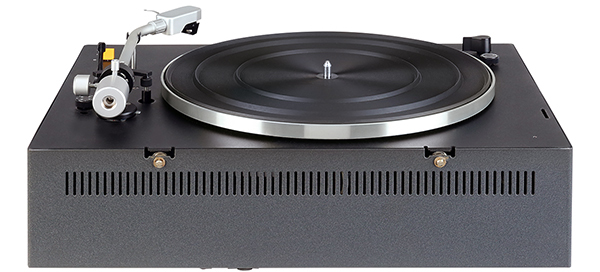
Above: Captive AC mains and audio output cables (the latter terminated in a 5-pin DIN) exit beneath the rear of the deck. The heavy steel chassis conceals the PS 500’s semi-auto mechanism and hydraulically damped subchassis
By the time the PS 500 appeared, Braun had largely lost interest in selling hi-fi gear in the UK, though a few units remain in circulation. The deck is far more common in Germany, which remains the best place to look. Our unit came from the German site www.kulthifi.de, which typically has several in stock and can arrange UK shipping.
Buying secondhand
The PS 500 is rugged, but there are a few considerations when shopping for a used model. Oil-filled dashpot seals can leak, impairing damping and creating a sticky mess underneath — repairs are difficult, so inspect this first. The tonearm is sturdy, but bearings can be damaged by mishandling, so check for any play in the pivot and swivel; there should be none. If the platter scrapes the top plate, verify that the hub hasn’t slipped down its shaft before adjusting suspension — these parts take their toll over the years.
Lastly, like much Braun equipment, the steel cabinet can rust and spoil the paint finish if stored in damp conditions. This is hard to remedy, so it’s worth holding out for a well-looked-after example.
HI-FI News
via Hi-Fi News https://ift.tt/GqRh6dW
August 21, 2026 at 10:39PM
-
Product on sale
 Audiophile Vinyl Records Cleaning BundleOriginal price was: €69.90.€59.90Current price is: €59.90. incl. VAT
-
Product on saleEasy Start Vinyl Records Cleaning KitOriginal price was: €69.90.€59.90Current price is: €59.90. incl. VAT
-
Vinyl Records Cleaner Easy Groove Concentrate€34.95 incl. VAT
-
Easy Groove Super Set€199.00 incl. VAT
-
Easy Groove Enzycaster – vinyl records prewash cleaner€34.95 incl. VAT
-
Easy Groove Extreme MK. II- vinyl records prewash cleaner€45.00 incl. VAT
-
Vinyl Records Cleaner – Easy Groove Virgin Concentrate€35.00 incl. VAT
-
Easy Groove Spray&Wipe vinyl records cleaner€34.95 incl. VAT







