
Audio News
Analog that isn’t analog
Analog that isn’t analog
https://ift.tt/Z0nq6Bi
Some time ago, for no specific reason, the YouTube algorithm suggested a video about a recording engineer who explained that vinyl records aren’t necessarily as analog as people think. Quick context: cutting a record is an optimization problem. The grooves aren’t fixed at a single distance. The tighter you pack them, the more duration you can fit on the medium.
A mono signal is captured by horizontal motion. So the side-to-side movement of the needle represents your mono signal. That part matters here. Stereo adds another dimension with vertical motion as well. For this anecdote, we can ignore that.
Therefore, louder signals produce more side-to-side motion, effectively creating a broader groove. This means quiet signals can have grooves placed closer together, while louder signals require greater spacing.
The signal’s loudness isn’t constant. There are louder and softer passages, so the groove spacing can be optimized locally. But how can this spacing be optimized properly? If only you could foresee the signal on the next revolution.
Well, you can’t predict the future, but you can delay the sound. If you were mastering from tape, you could use a special tape machine with an additional ‘preview’ head. The delay could be adjusted because the tape ran in a loop around a sliding guide between the heads. By sliding the guide up or down, you could enlarge or shrink the tape loop, making the delay longer or shorter. However, these machines were for playback only. The extra preview head and the accompanying circuitry typically replaced the recording head and circuitry. So you had to record your master on one tape deck, then transfer the tape to the playback machine to cut the actual record. This meant you needed a matching set of tape machines, kept maintained and properly calibrated.
In 1974, HAECO introduced the VP-1000 system. Instead of a tape loop, it used a 14-bit digital PCM delay line with a 50 kHz sampling rate. It allowed the incoming audio signal to serve as the ‘preview’ to determine spacing, and then record the delayed signal onto the disc. But since the delayed signal had been digitized, you were effectively cutting the vinyl from a digital source.
Only about four or five of these machines were built, but they demonstrated the concept. Other companies adopted the idea, and it gained traction. The most popular was the Ampex ADD-1, introduced in 1979. It also operated at a 50 kHz sampling rate and claimed an 80 dB signal-to-noise ratio. There are conflicting claims about its resolution. Some say it used 16-bit PCM, but for 80 dB you would only need 14 bits. 16 bits would imply 96 dB. It’s more plausible that it employed a robust 14-bit PCM implementation rather than a 16-bit one where the analog circuitry could only manage 80 dB of SNR. Remember, this was before the CD era, and 16-bit PCM wasn’t an industry standard yet (Philips only had 14-bit DACs for early CD players and relied on oversampling to achieve 16-bit resolution).
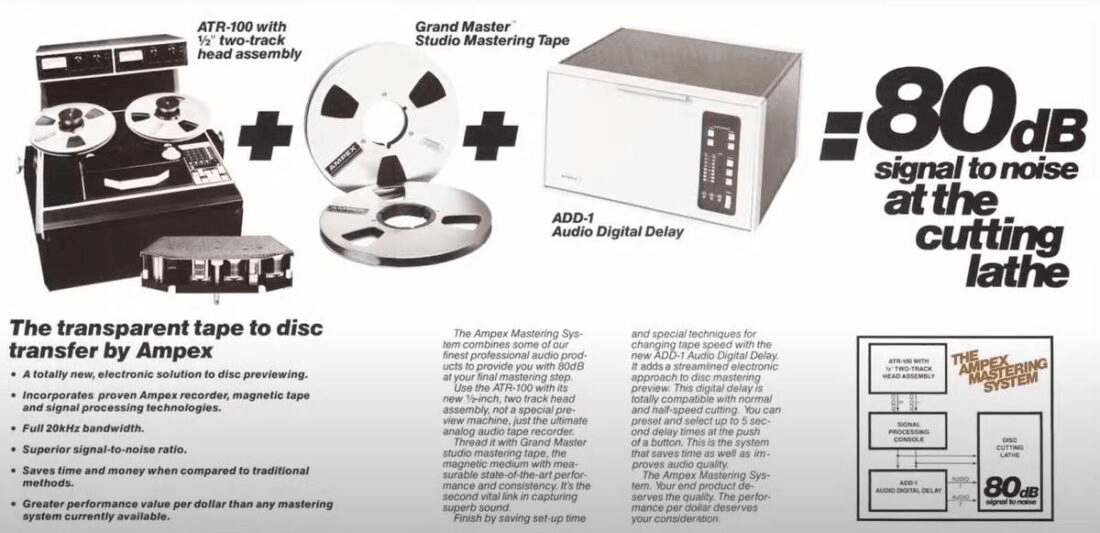
These Ampex ADD-1 machines and similar setups based on a digital delay line became very popular, not only because you could cut your record directly from your mastering deck, but also because you didn’t necessarily need a tape source (compatible with the preview deck). This was particularly convenient for upcoming digital multitrack systems. By the mid-1980s, most vinyl was cut this way, effectively making it a digital process.
Those golden ears
That’s where things get interesting. Audiophiles who claim vinyl sounds better than digital often cite “great-sounding analog vinyl” recordings that actually passed through an ADC and DAC, and they rarely notice the transformation.
One claim can be dismissed immediately: that 20 kHz bandwidth would be too limited and digital recordings would cut off high frequencies that aren’t audible but still influence the sound. We know the ADD-1 is band-limited to 20 kHz, just like a CD is (though a CD runs at 44.1 kHz while the ADD-1 operates at 50 kHz; this difference isn’t huge in practice. A steep filter was needed to limit a 44.1 kHz signal to 20 kHz, which was challenging in early days. That may explain why Ampex chose 50 kHz while filtering to 20 kHz. The Philips approach with oversampling solved this because the DAC didn’t operate at 44.1 kHz but at four times that, so the filtering didn’t have to be as steep. Thus, anything above 20 kHz is removed before it ever reaches the vinyl. And somehow, vinyl still sounded like vinyl.
Other claims rooted in misunderstandings of digital signals, such as ‘stairstepping’ or other ways something would sound ‘digital’ to these folks, also seem false because their inability to tell that their vinyl was recorded digitally suggests the digital delay was transparent enough.
Paint me a picture
Right, shifting from audio to video. A while back, for no particular reason, the YouTube algorithm surfaced a video of the Nagano 1998 Olympic figure skating competition. My trained eye noticed something odd. It clearly came from Nagano 1998, something I’d seen before. Yet I saw it in 4:3 SD, while this recording appeared in a wider format and looked substantially higher in definition than SD. I can’t locate the exact video now, but I can find other Nagano 1998 videos to illustrate the point:
wew
HI-FI News
via Scali’s OpenBlog™ https://ift.tt/Pxrjg31
September 1, 2026 at 11:44PM
-
Product on sale
 Audiophile Vinyl Records Cleaning BundleOriginal price was: €69.90.€59.90Current price is: €59.90. incl. VAT
-
Product on saleEasy Start Vinyl Records Cleaning KitOriginal price was: €69.90.€59.90Current price is: €59.90. incl. VAT
-
Vinyl Records Cleaner Easy Groove Concentrate€34.95 incl. VAT
-
Easy Groove Super Set€199.00 incl. VAT
-
Easy Groove Enzycaster – vinyl records prewash cleaner€34.95 incl. VAT
-
Easy Groove Extreme MK. II- vinyl records prewash cleaner€45.00 incl. VAT
-
Vinyl Records Cleaner – Easy Groove Virgin Concentrate€35.00 incl. VAT
-
Easy Groove Spray&Wipe vinyl records cleaner€34.95 incl. VAT


