
Audio News
TAKUMA ENOKI
TAKUMA ENOKI
https://ift.tt/SpctGsJ
[ JAPANESE / ENGLISH ]
Photos courtesy of Kazuya Okude
VHSMAG (VM): Let’s rewind to your school days. What led you to choose VANTAN?
TAKUMA ENOKI (TE): I got into skating in my first year of junior high. Schoolwork never appealed to me, and sports weren’t really my thing either. I was the kid who’d act up at school, trying to get people’s attention and clowning around. But I loved drawing, music, and movies. Once I started skating, I became obsessed with the culture around it. When it was time to choose a high school, I hadn’t studied much, my grades were awful, and there weren’t many places I could get into (laughs). I was also pretty rebellious. Even then, the idea of sucking up to teachers to get into a good school and grow up to be a respectable adult seemed lame to me. This was before skateboarding became an Olympic sport, so it was much less mainstream than it is today. Since people already thought of me as a troublemaker, my friends and teachers would tease me about skating. I wanted to prove them wrong and make something of myself through skateboarding. To be honest, I wasn’t that interested in having a typical high school experience. Then I came across an article on VHSMAG about the opening of Japan’s first skateboarding high school. I thought, “No fucking way!” I asked for information, and it turned out to be real. The school offered filmmaking and design alongside skating. I’d already been thinking vaguely about starting a brand or putting my drawings on T-shirts, so I thought, “This is everything I want to do, all in one place.” I begged my parents to let me go, and they said, “You only get one life, so go for what you really want.” They’ve always followed their own passions, too, so they supported me. That’s how I ended up there. I’m really grateful to them.
VM: You were in the school’s first class, so there wasn’t an earlier class to show you the ropes. How was student life? Were there any classes or experiences that left a strong impression?
TE: It was a blast. There were about 18 guys, all into skating, so naturally we had a great time every day (laughs). We weren’t exactly the most attentive students, and we’d make a lot of noise in class, but everyone had their own interests. Some wanted to do photography, others were into filmmaking, and some just wanted to skate. It was a great mix. I remember visiting a screen-printing factory. I’d always pictured T-shirts being printed by machines, so watching people apply each color by hand, one at a time, blew my mind. Hiroki Muraoka’s skate classes were another highlight. I’d seen him skate in magazines and videos, so having him right there in front of me was amazing. He was a great teacher, too. Rather than just explaining how to do something, he’d skate with us and say things like, “Land it before I do and I’ll buy you a drink.” It was so much fun. The teachers were more than just teachers. They’d teach during the day, then organize video premieres or exhibitions outside of school. Seeing them do all that really inspired me. They were people I wanted to be like, and I learned a lot from them beyond what they covered in class. Looking back, those three years were absolutely worth it.
VM: Did you have plans for the future and a sense of what you wanted to work toward at the time?
TE: I was mainly focused on having fun, and sometimes I didn’t think about the future at all. But I always had this idea that I’d start a brand or make skate videos with my friends someday. In my second year of high school, I started a crew called Nuts with a few school friends. We filmed on our iPhones and edited the footage ourselves. Kento Yoshioka, also known as Japanese Super Rat, was a big influence. He was in my class, and I’d see him working on projects like apple and Pokett Patrol, skate videos filmed entirely on iPhones. He was an incredible skater, knew so much about video, and had an amazing eye for spots. Even though he was already getting a lot of attention, he’d still invite some unknown kid like me along. He’d say, “Takuma, let’s go skate street!” His drive to get out there and make things happen, and his passion for it, really inspired me. Having him around made us think, “We can do this shit too.” We started making videos, getting them featured on VHSMAG, and holding premieres at skate shops. The more we did, the more ideas we came up with. By the time I graduated, I was pretty sure I wanted to start a brand.
VM: Do you still draw on what you learned at VANTAN in your work today?
TE: For sure. Honestly, it’s scary to think about where I’d be if I’d never started skating or gone to VANTAN (laughs). There is one thing I regret, though: I wish I’d taken my Illustrator classes more seriously. After graduating and starting PLANT, I realized I couldn’t do anything without knowing how to use Illustrator. I remember thinking, “Fuck, I should’ve paid attention in class!” I taught myself in the end, but whenever I meet VANTAN students now, I tell them, “Whatever else you do, pay attention in Illustrator class.”
VM: Do you still keep in touch with your former classmates?
TE: Yeah, we’re still really close. A lot of them are still part of the skate scene. Some are working at skate shops, while others work behind the scenes for brands. One of the best artists in our class became a tattooist. Another took over his family’s construction company and is talking about building a skatepark one day. We’ve all taken different paths, but we still share a love of skateboarding. Quite a few of them came to the recent LIDLOCKS launch, and they haven’t really changed. Sure, we’ve grown up, but we’re still the same people we were back then. Since everyone’s doing their own thing now, I think we’ve also developed a natural respect for one another. They’re great friends. More and more of them are getting married, though, which is starting to make me nervous (laughs).
VM: What would you say to people about to start at VANTAN, or to those already studying there?
TE: Three years fly by, so it helps to have some idea of what you want to do. Skating every day is fun, and there’s nothing wrong with that, but I’d also encourage them to explore interests beyond skateboarding. If you like drawing, you might become a designer. If you enjoy making T-shirts, you could work at a print shop. It can be anything; what matters is finding something you truly want to pursue. Most of all, go out and meet people. Visit skate shops, attend events, skate different spots, and put yourself in unfamiliar situations. That’s what my friends and I did during those three years, and the connections we made still help us now. Some shop owners I met back then got in touch when I started my brand, and a few of those relationships have even led to work. That’s one of the great things about being young. As a teenager, you can experience things with an open mind and take in so much. Make the most of that time and try as many different things as you can.
VM: Let’s move on to LIDLOCKS. You already have PLANT, so what made you want to launch another brand? To put it plainly, couldn’t you have just released boards under PLANT?
TE: I run PLANT with Yukiya Obuchi, and over the years we’ve built a pretty distinct identity for it. I’d been wanting to try something on a different level. There was another idea I’d been turning over for a long time, too. As Japanese skaters, we look up to riders overseas. We’ll see some amazing skater from another country and think, “That dude’s so cool. I want to skate for the brand he rides for.” But why shouldn’t it work the other way around? I want an American skater to see a Japanese rider and think, “That skater from Japan is sick. I want to ride a Japanese board.” I don’t think that happens enough yet. Japan has so many great skaters, and I think the scene here has a lot more potential than people realize. The streets and the markets are different in Japan and overseas, of course. But why should we always measure ourselves against everyone else? I’m Japanese. I grew up skating here and have been shaped by the Japanese skate scene. I wanted to create a board brand that could represent Japan and tell the rest of the world, “Hey, there’s some sick shit happening in Japan.”
VM: What made you finally act on that idea?
TE: After PLANT released its full-length video, I felt pretty burned out. Until then, I’d been working part-time while running PLANT. I’d always assumed that once we finished the video, I might need to get a proper job and enter the workforce. That made me think hard about what I could actually do. I love clothes, I draw, I can design, and I can film and edit videos, but all of those things are connected to skateboarding. If I took skating out of the picture, I started thinking, “Fuck, I’ve got nothing.” People around me say I’m talented and can do lots of things. But could I really make a living just as a filmmaker or designer? Probably not. Without skateboarding, I felt like I was nobody. I started feeling small and insignificant, and it hit me hard. Around that time, a lot of friends my age were facing similar questions. Some were leaving their jobs, some were thinking about marriage, and many of us were wondering what to do with our lives. I considered all kinds of options, but eventually I realized that sitting around thinking wasn’t helping. If I tried something and it didn’t work, I could figure out the next move then. It felt like the right time, so I decided to go for it. That’s why I called the first video Time for Action. It means it’s time to stop thinking and take action.
VM: How does it feel now that you’ve taken that first step?
TE: Honestly, I’m scared shitless (laughs). Starting a board brand in this day and age? Sometimes I think I’ve taken on something ridiculous. It’s definitely going to be tough. The value of a brand has changed so much since the past, and naturally I find myself thinking, “What if these boards just sit here and nobody buys them?” But I’ve already jumped in, so there’s no going back. I just have to see how far I can take it. I want to keep making things I genuinely believe are cool.
VM: How did you come up with the name LIDLOCKS?
TE: I knew this brand would mark a major turning point in my life, so I wanted a name connected to something that had made a big impact on me. For me, that was movies. Movies first got me into skateboarding, and they also sparked my interest in music and fashion. My parents showed me all kinds of films when I was growing up, so I thought I’d borrow a name from a movie. I started revisiting different films, and around then Stanley Kubrick’s A Clockwork Orange was back in theaters. I went to see it again. I first watched it in junior high, and it blew my mind. Even the poster looked amazing, and the film was unlike anything I’d seen before. I’ve watched it so many times; it’s one of my all-time favorites. There’s a torture scene where the main character’s eyelids are held open so he can’t shut his eyes while he’s made to watch violent footage again and again. The devices holding his eyelids open are called lidlocks. In the movie, they obviously have a pretty dark meaning. But when I’m watching a movie or skate video, looking for spots, or watching a live show, I get so absorbed that I can’t look away. And nowadays, social media floods us with information. You scroll past something, and a second later it’s gone from your mind. There’s a little sarcasm about that culture in the name, too. It’s our way of saying, “Keep your eyes on us. We’re going to make something so sick you won’t be able to look away.” That’s what LIDLOCKS means to me.
VM: So the name is also a response to social media’s dominance.
TE: That’s right. We’ll film on the streets all night, sometimes from midnight until sunrise, then put all the footage together into a proper video. Social media has a lot more power these days, obviously. Still, I love skate videos that come together as complete works. Social media is convenient, and I use it too, but I truly believe there’s something special about watching and making a full video. I want to keep putting that kind of work out and creating things people can really get absorbed in. In that way, I think LIDLOCKS is a perfect fit for the name.
VM: The first ad LIDLOCKS shared on Instagram really stood out. It referenced Blind’s famous “Dear George” ad, aimed at Powell Peralta in the early ’90s. What was the thinking behind it?
TE: I’ve always been into ’80s skateboarding, especially the late ’80s and early ’90s. The videos and music from that period played a big part in getting me into skating. I was drawn in by that whole culture. Skateboarding was booming in the ’80s, and a lot of money was flowing into the industry. Businessmen were running brands, professional filmers were making videos, and designers were creating graphics. Then a different attitude started to take hold: “Fuck that. Why don’t we do all of it ourselves?” I think that was such an exciting time. Skate companies began to be run by skaters with a real DIY mentality and rebellious streak. H-Street, New Deal, World Industries, and Blind all had a huge influence on me. Skaters were starting brands, making videos, and creating designs on their own. That way of thinking reminds me of punk, reggae, and hip-hop, where people use music to express what they believe and what they want to do. It’s about using skating and your own creativity to get a message across. That’s the attitude that’s always inspired me.
VM: Did you choose to reference that ad in 2026 because you see parallels between the skate scene then and the scene today?
TE: Yeah, more or less. I didn’t set out from the start to pay tribute to that particular ad. But I’d been thinking about what’s happening in skateboarding now. The scene is booming again, and there’s a lot of money coming into it. I don’t necessarily think that’s a bad thing. It gives skaters more chances to make a living, which is great. But some people have spent years building the scene from the ground up. I don’t think it’s right for someone to show up without knowing that history, do whatever they want, and push those people aside. Then there’s AI. I understand that it can be useful, and I think it depends on how you use it. But for me, having AI make board graphics or clothing designs is a definite no. If we accept that, what’s left for designers and artists to do? Meanwhile, we spend hours at our computers, racking our brains, or redraw things by hand again and again until a graphic feels right. AI can generate something in seconds. Sure, it saves time and effort, but where’s the respect? Where’s the love? That’s just not what a skateboard brand should stand for, in my opinion.
VM: It sounds like you have strong opinions about the skate scene right now.
TE: I do. Social media keeps sending new information our way, and trends move incredibly fast. I feel like some younger skaters who grew up with that don’t dig very deeply into skate culture or skate videos anymore. Sometimes it seems as if everyone dresses alike and skates alike. I also get the sense that people worry so much about how they’re seen that they end up following the crowd. But skateboarding is supposed to be about freedom, and its appeal comes from how different everyone is. Some people make music, some create art, and others start brands or make videos. That variety is what makes skateboarding so great. If you’re only trying to look the part, with nothing behind it, what’s the point? You might as well do something else. Of course, I know times have changed, and it isn’t all bad. But instead of just complaining, I wanted to express how I felt through my own actions. That’s when I started seeing similarities between today’s scene and the late ’80s and early ’90s, and decided to pay tribute to that ad.
VM: The ad also featured the provocative line, “Is Skateboarding Dead?”
TE: In some ways, it’s aimed at those people. There’s definitely a bit of a “Just wait and see what we do” feeling behind it. But it’s also a reminder to myself. I want to look back at the ad decades from now and think, “Man, I said some pretty wild shit when I was young.” It’d be awful if I’d turned into a lame old guy by then (laughs), so it’s partly a way of keeping myself in check. I’d also love it if a young skater saw the ad, searched for the original, and got interested in skate culture from that era. I genuinely think what Blind and World Industries did back then is part of skateboarding’s cultural history. They didn’t just complain; they took action and changed the whole scene. I’d love to make that kind of movement with my friends one day.
VM: Even with short clips dominating now, you’re still committed to making complete videos.
TE: Absolutely. We’ve made a lot of videos with PLANT, and it’s funny: a seven- or ten-minute edit gets far fewer views than some raw footage we post on Instagram. I’m like, “Come on, watch the actual fucking video!” But I still want to make proper videos, even knowing that. That’s the kind of skateboarding I love. Making a complete video has become pretty unusual, and maybe that’s exactly why it has value. Sometimes I think skate videos could become a culture like vinyl records. We might be a minority, but I don’t think that culture will disappear. We’re going to keep doing things our way.
VM: Tell us about the LIDLOCKS team. What qualities were you looking for in the riders?
TE: If you’re launching a board brand, you need riders, obviously. I also wanted LIDLOCKS to have a very different identity from PLANT. When I was a teenager, I watched a lot of videos from crews and brands like Toriotoko, ManWho, and Evisen. The skaters in those videos were really inventive about how they used spots. They’d find ways to skate tiny spots, hit quick tricks, do wallrides and slappies, and so on. I was heavily influenced by that style, so it’s what I naturally gravitated toward. A lot of PLANT’s riders skate that way, too. But when I talk to younger skaters and ask what they’re into, many mention people who skate huge rails and gaps or do highly technical tricks. It feels like the 2000s style is coming back around. Trends really do come in cycles. That got me thinking: incredible skill never goes out of style. In any era, someone who’s really fucking good at skating is always going to be sick. For LIDLOCKS, I wanted a crew of talented skaters who could do it all, from technical tricks to heavy hammers.
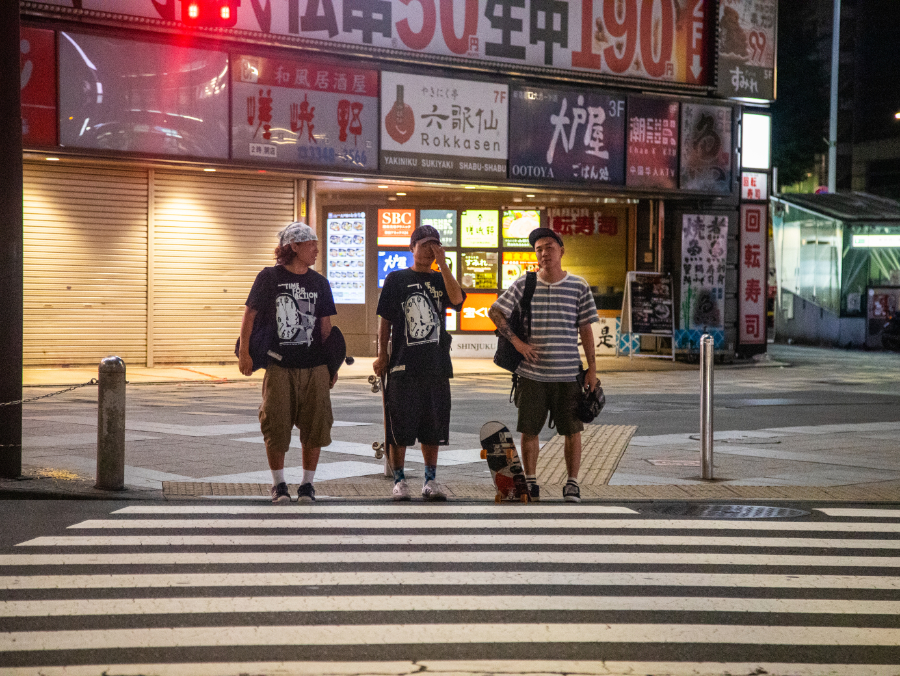
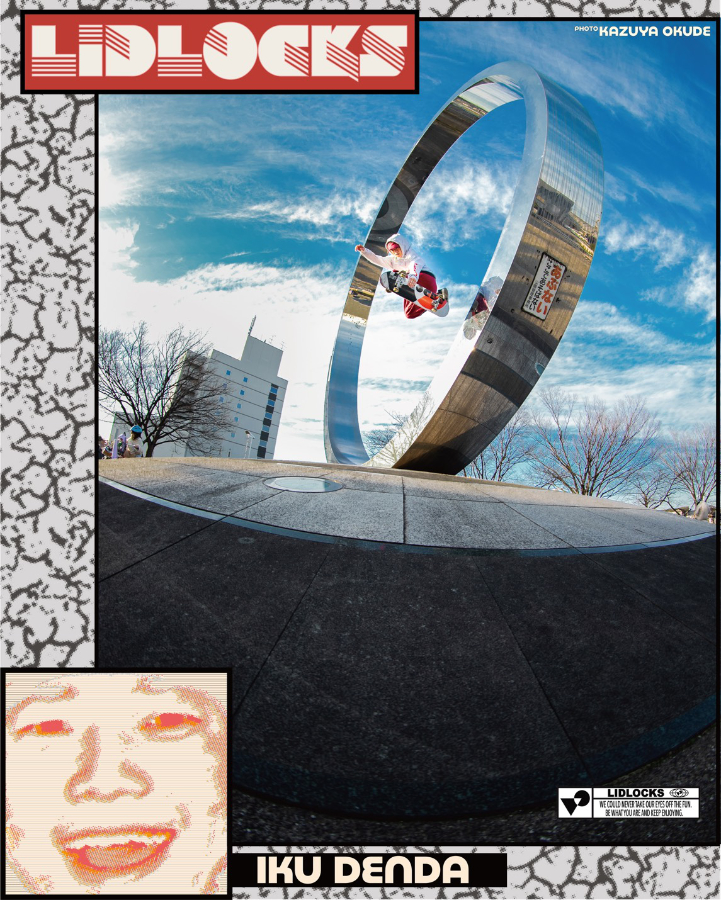
VM: That’s what led you to reach out to Iku Denda?
TE: Yeah. I’d known of Iku for a while because I watched videos from his crew, Peace, when I was in junior high, but I didn’t know him personally. Honestly, I’d always thought of him as more of a contest skater. Then we were filming in Kobe one day, and Kazuha, PLANT’s filmer and a childhood friend of Iku’s, brought him along. So we ended up skating together. Until then, I’d associated him with contests, but seeing him in person changed my mind completely. His ledge skating was incredible, his style was really clean, and he was just an amazing skateboarder. The funny thing was, he seemed so serious, but once we started drinking, he turned out to be a total idiot (laughs). I thought, “This dude is fucking awesome!” After that, we took trips together to places like Nagoya and Kanazawa, and he eventually joined PLANT. When we released his footage, people responded so well. A lot of them were saying, “Damn, I had no idea Iku was this sick!” That made me really happy. He’s a fantastic skater and such a funny, interesting guy. I felt he deserved more recognition. Seeing a video I’d made help people understand what made Iku special meant a lot to me. It made me think I could do even more for him, so I asked him to join LIDLOCKS.
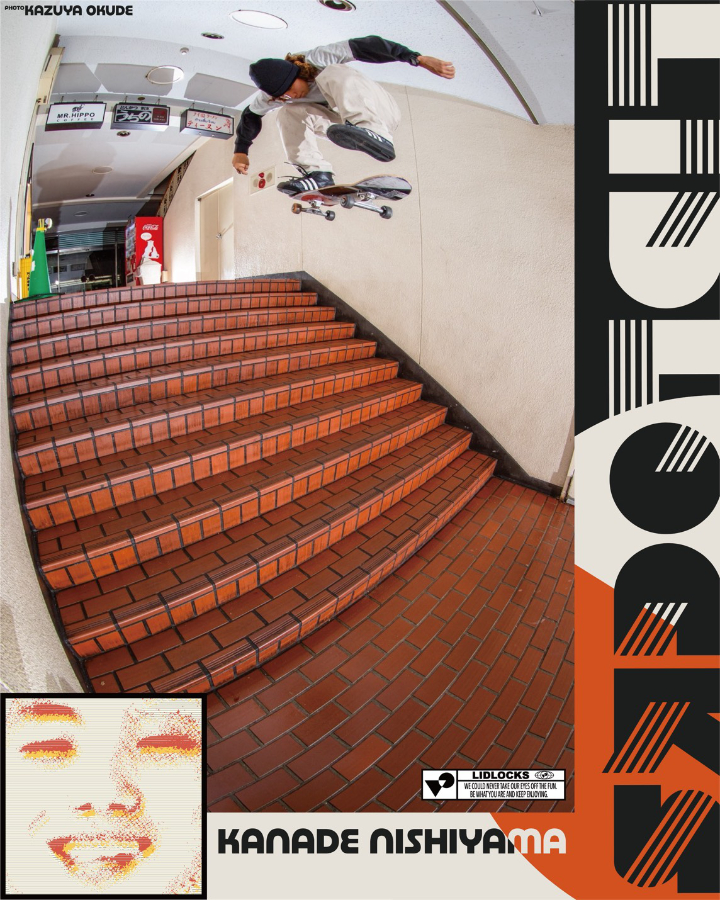
VM: How did you meet the other rider?
TE: I was in Nagoya for an art exhibition, and a friend brought Kanade Nishiyama to the bar where we were hanging out. He was around 18. We didn’t speak much, but he followed me on Instagram afterward. I checked his stories, and his skating was unreal. He was doing things like switch back tailslide heelflips out on long ledges. There was also a clip of him doing a frontside noseslide and coming back to regular, then nollie heelflipping out instead of coming out fakie. I thought, “Who the fuck is this kid?” You could see he had really solid fundamentals, and he could do some serious hammers. I was curious about him and wanted to meet properly, so I messaged him: “Wanna go film?” Then I went straight to Nagoya. We spent about three days filming together. Apparently, he’d barely skated street before and had never been in a proper skate video. Even so, we got some incredible footage. At one point, we were sitting in the car, and I asked, “What kind of skater do you want to become?” He said, “I’ve been skating since I was a little kid, so I want to give something back to skateboarding, whatever that looks like.” What 18-year-old says that? I thought, “Man, I really like this kid.” So I asked him to join LIDLOCKS right then and there.
VM: It sounds like a lot of it was completely new to him.
TE: Definitely. He wasn’t used to street skating at first. We’d film until the middle of the night, and when everyone went to get food in the morning, he’d be the only one literally falling asleep while eating (laughs). He was also surprised by how much we push around Tokyo. In Nagoya, apparently, most spots are fairly close to each other, and because the city is so car-oriented, people usually drive. In Tokyo, it’s normal to push the distance of two or three train stops. He wasn’t used to that, and he hadn’t really developed the habit of looking at a spot and thinking about creative ways to skate it. But as he started coming to PLANT filming sessions and skating with people who had more street experience, he changed quickly. At first, he didn’t seem to watch many skate videos either. So when we went filming, I’d show him videos and say, “Check this out,” or, “This skater’s really sick.” Over time, he started looking up old videos on his own. Eventually, he’d come over and tell me about skaters he liked, saying things like, “Peter Smolik and PJ Ladd are so sick!” His approach to filming changed as well. At the beginning, he’d let me film without really thinking about how the shot looked. Toward the end, if I was choosing between a long lens and a fisheye, he’d ask, “Can you shoot this one with the fisheye?” I hadn’t forced my preferences on him; he’d started developing his own idea of what looked cool. Watching that happen up close made me really happy. It made me feel that skateboarding has a bright future ahead.
VM: The launch video, Time for Action, is a double part featuring the two riders, right?
TE: Yeah. I originally wanted three riders, but I couldn’t find a third person I really connected with. We were running short on time, too, so I decided to make this one with the two of them. I’d never before filmed and edited an entire video entirely on my own, so I wanted this project to be something I controlled completely, from shooting through editing. I didn’t skate in it at all; I wanted the focus to stay completely on those two. Seeing how much footage they got in about six months reminded me just how good they are. It inspired me, too, and made me realize I need to improve my filming. It also made me want to start filming myself again, and maybe even put together another part. I think we’re pushing and inspiring one another in a really positive way.
VM: You held the launch event at the end of October. Looking forward, what kind of brand do you hope LIDLOCKS will become?
TE: PLANT is celebrating its fifth anniversary this year, and the journey hasn’t always been easy. We’ve been through a lot. Even so, we’re still having a great time. We get along, skate our asses off, and mess around just as hard. We’re always getting excited about the next thing, like, “Let’s do this,” or, “We should make a video like that.” We recently made a collaboration video with Hi-Lite, too, and we’ve had a chance to do fun things with friends who share our passion. That’s the kind of brand I want LIDLOCKS to be. I’d love for a young skater to see one of my videos or designs and think, “I want to start a brand,” or, “Let’s make a skate video.” Even better, I’d love some young kids to come up saying, “PLANT ain’t shit,” or, “We’re going to destroy LIDLOCKS!” That would be the best (laughs). I really want to see more cocky, rebellious young kids coming up and doing their own thing. There are so many things I want to try with LIDLOCKS as a board brand that I don’t even know where to begin. What I have in mind for PLANT and LIDLOCKS is completely different, and I think there’s a lot of exciting potential for both. Now I just need to work my ass off and make it happen.
Takuma Enoki
@_morningboner @plantgriptape @lidlocks_skateboards
Born in Tokyo in 2002, Takuma Enoki graduated as part of the first class from VANTAN’s Skateboarding & Design program. He runs PLANT Griptape and directed its debut full-length video, Honogura. He recently started the skate brand LIDLOCKS and continues to work across creative fields, including filmmaking and graphic design, with skateboarding at the center of it all.
The post TAKUMA ENOKI first appeared on VHSMAG.
HI-FI News
via VHSMAG https://www.vhsmag.com
November 16, 2026 at 06:54AM
-
Product on sale
 Audiophile Vinyl Records Cleaning BundleOriginal price was: €69.90.€59.90Current price is: €59.90. incl. VAT
-
Product on saleEasy Start Vinyl Records Cleaning KitOriginal price was: €69.90.€59.90Current price is: €59.90. incl. VAT
-
Vinyl Records Cleaner Easy Groove Concentrate€34.95 incl. VAT
-
Easy Groove Super Set€199.00 incl. VAT
-
Easy Groove Enzycaster – vinyl records prewash cleaner€34.95 incl. VAT
-
Easy Groove Extreme MK. II- vinyl records prewash cleaner€45.00 incl. VAT
-
Vinyl Records Cleaner – Easy Groove Virgin Concentrate€35.00 incl. VAT
-
Easy Groove Spray&Wipe vinyl records cleaner€34.95 incl. VAT







