Author Archives: Richard Austen

Hong Kong: A License to Thrill, Part 1 – From Hong Kong with Love.


Every Day an Audio Show

“Hey Richard, will you be attending the California Audio Show in California this summer?”

“Sure. Are you going?” I reply.

“Yes. I have saved up for the air and hotel and am excited to hear all those brands I read about in the press. The hotel is booked and the kids will fly  with their mom down to Disneyland.”

Does any of this sound familiar?

Similar conversations take place every year with folks planning their annual or bi-annual visit to the “event” known as the audio show.

Imagine what it would be like if every day there was an audio show? I wonder if you can. You may say I’m a dreamer, but I’m not the only one. A land where every day is an audio show? Well friends, that land is Hong Kong.

As a young lad, Asia always seemed to me to be an exotic mistress with its flashing lights, martial arts, mysterious foods, and beautiful women who were sultry by day and deadly ninja assassins by night. Asia was James Bond’s playground where baccarat trumped poker as the game of choice, played in broodingly lit red-tinged hotels where it seemed that You Only Live Twice.

Moving from British Columbia, Canada, to Hong Kong back in 2011, I planned to fulfill a two-year teaching contract and return home. Two years have now become nine and Hong Kong has become my home away from home. You Only Live Twice isn’t just a Bond film; it is the way I feel about my second life in Hong Kong (HK). HK has become a kind of mistress. She offers a totally different world from my western upbringing.

The endless array of premium sports cars weaving in and out of traffic, the well-tailored suits, and the fashionable thirty-somethings showing off their posh handbags, jewels, and exotic manicured pets. The world of James Bond that I imagined has come alive.

Zigzagging through the crowds of Hong Kong you shall assuredly improve your skiing skills as you navigate through the sea of people. Looking down from a drone’s eye view you will see a sea of people looking deeply into the glow of their smartphone screens all seeming akin to human bumper cars.

Had 007 been an audiophile, Hong Kong would have stirred his spirit and shaken his soul.

Clearaudio Statement turntable (back left), VTL Monoblocks – 1 pair per speaker, Rockport Technologies Arrakis loudspeakers

Hong Kong has likely forever ruined the excitement of the audio show-going experience for me in the west. Let’s see, what shall I do this fine Saturday? I know, I will get on the MTR and within 25 minutes I will be in Kowloon. A short walk from the train exit passing the sights and sounds of the crowds, I will arrive at the Grancastle Building in the MongKok district. A twenty-something floored building where virtually every floor is one audio showroom stacked upon another. Take the elevator to the top and head down floor by floor and room by room. Here, retail spaces are filled with some of the most expensive and exotic brands in the audio world. Oh James!

YG Acoustics, Luxman, Pass Labs,etc.

Twenty rooms? That doesn’t seem like a large show to me? Wait! I forgot to mention that within a five-minute walking radius of this building, there are six or seven more buildings that are beckoning you to listen and to open your wallet. Moreover, there are several other buildings specializing in second-hand items. Oh yes, the second-hand market where you will find your classic McIntosh or Kondo tube amplifiers or large Krell monoblocks or Magico and Wilson Audio speakers.

Ten to fifteen minutes in either direction on the train will land you in two other audiophile hotspots where you will once again find buildings with specialty audio retailers, repair shops, and of course stores dedicated to selling tubes. They will sell you rare NOS tubes, run of the mill tubes and — being China —fake NOS tubes. They will rub off the silk screening on new $10 tubes and put a fake label of an old NOS tube and charge $200. Caveat emptor.


Richard Austen will return

in

LS 3/5as Are Forever


Copy editor: Dan Rubin


The post Hong Kong: A License to Thrill, Part 1 – From Hong Kong with Love. appeared first on Dagogo.

Audio Note UK TT3 turntable system Review

Vinyl is alive in 2020 and records have made a strong comeback over the last several years. Unlike CD, SACD, or computer audio, I have always felt that turntables require a certain level of mechanical quality to play them back properly.  While on audio forums I would often read that vinyl was better than digital but my experience never mirrored the lore when I would audition budget LP spinners. Indeed, my experience was generally a mixed bag of sonic performance. Due to the nature of turntables it seemed to me that they rely on so many things to be correct or there is a good chance the sound will often be charitably called so-so.

The problem for those of us who largely grew up on the CD format we would read all these vinyl-phile exaltations, largely on forums, exclaiming that every $400 turntable would trounce CD players at 10 times the price. It wasn’t the case in my experience. Back in the late 1980s I went with CD and dumped my vinyl collection. The $400ish turntables from the usual suspects did very little to sway me back especially considering the numerous issues associated with vinyl replay such as noisy tables with some speed issues, bad pressings, surface noise and compressed phono stages and of course the difficulty to set the things up to avoid excessive inner groove distortion or channel imbalance.  And when you got all of these things correct – you would often not get performance that beat a good CD player.

More than a decade later, circa 2001, I had a transformative experience listening to vinyl. This time, however, it was on a world class turntable, the Voyd Reference. The Voyd Reference was Terry Crabbe’s personal turntable, owner of Soundhounds located in Victoria British Columbia and when I met him he reminded me of a man who never left the 1960s hippie generation. His shop was unlike any other high end dealer I had seen. Firstly, they allowed dogs.  Secondly, they never pushed you into making quick decisions. Stay, listen for hours and go home and have a think about it. Come back and try something else but the store always had a big selection of vinyl to play.

Terry demonstrated vinyl on the Voyd Reference (which would later become the Audio Note’s first version of the TT3).  He was not trying to sell me on it because it was well beyond my means. However, the demonstration was an eye opener to what was possible with the oversized black coasters. Terry’s turntable was vastly superior to the other tables by no small margin. That is saying something as the store carried some well known players. However, it was the Voyd that was “special.”  The problem of course was trying to get the sound of the 5 figure turntable for 3 or low 4 figures.

With my university beer budget I dabbled with second hand Duals, Rega’s and even my dad’s Fisher.  But none of these were providing me the “promise of vinyl.” The NAD 533 (Rega P2 Clone) with Rega’s 250 arm and Shure M97xE cartridge wasn’t sounding better than my modest Cambridge Audio CD 6.  I would hear hints of what the Voyd Reference was doing – but only hints.  It merely teased at what could be. My record collection had grown to a little over 500 and with the middling performance I had once again contemplated chucking it all. I was not likely to be able to afford something as nice as the Voyd Reference and I was not hearing the “magic” with such players. Furthermore, I was not hearing that magic from players in the $2,000 range either.

On a subsequent to Soundhounds they demonstrated the Audio Note UK TT2 – I was impressed.  This had the tactile speed and lightness of touch of the Voyd – it had the nimble bounce and energy of the Voyd – well – almost. The TT2 sounded more transparent and “locked in” in terms of pace. It had energy and pizzazz where some of the store’s high mass turntables sounded bloodless and overly polite to me in comparison.  I was drawn to the sound of the TT2 over some dearer turntables from Linn, Clearaudio, and Oracle.

Audio Note UK TT-2 Deluxe

I bought the TT2 turntable. The TT2 stands for TurnTable 2 and the 2 means that it has two motors. Audio Note makes an entry level model called; you guessed it, the TT1. And yes it has one motor. Both tables are based on the famed suspended SystemDek IIx. The TT2 is a rather big improvement on the original SystemDek IIx and it was able to get me back into my vinyl collection. As good as the TT2 is it still wasn’t transformative like the Voyd Reference.

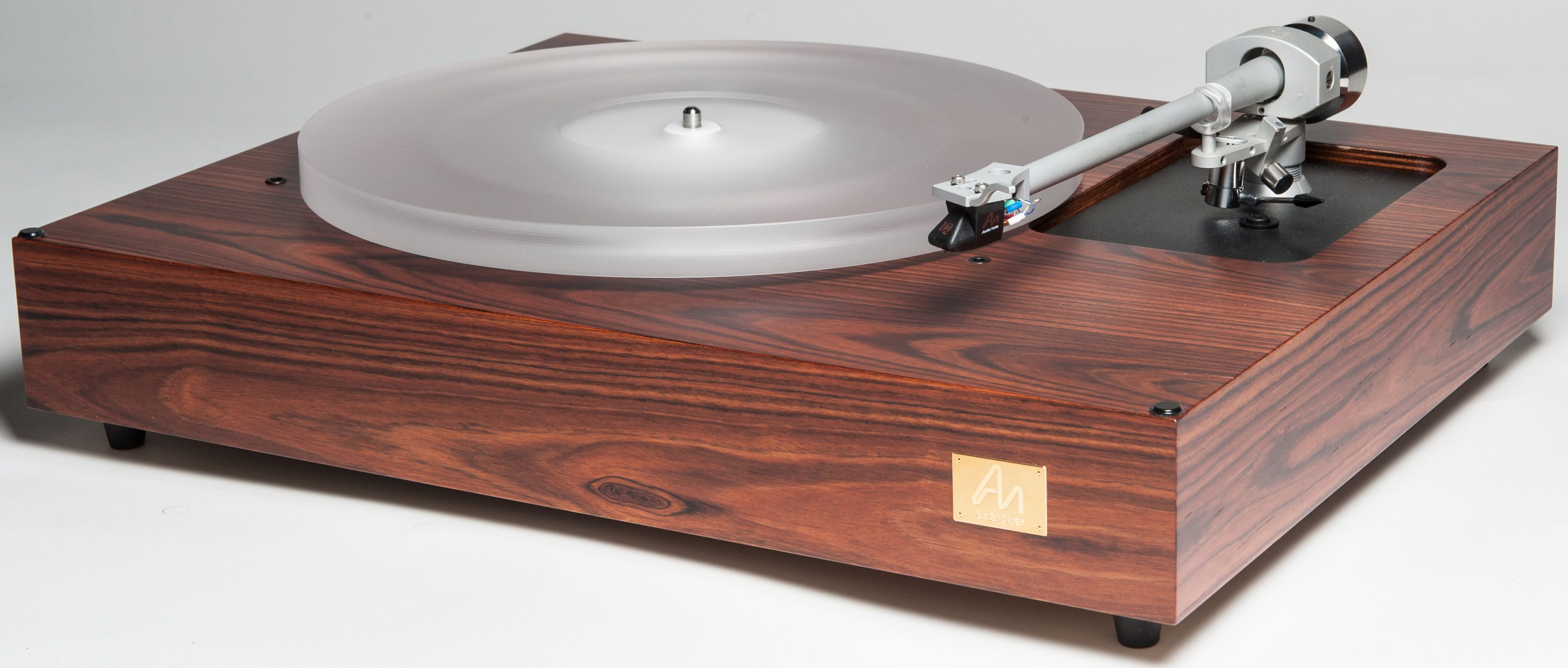
Enter the new Audio Note UK TT3 with the PSU1 (Power Supply Unit 1), accompanied by Audio Note UK’s Arm 3/II tone arm and IQ3 moving-magnet cartridge.

I mentioned earlier that the first Audio Note UK TT3 was based on the Voyd Reference. Well the more things change the more they stay the same. The new TT3 looks wildly different. It looks modern and solid. Nevertheless, it shares the bloodlines, heart and soul of that amazing Voyd Reference. It is still a three motor turntable with an external power supply. The table is still a suspended turntable design. Thus, you will need to ensure it sits on a rock steady stand or have it wall-mounted so that foot falls do not have the arm bounce around while it plays.

Audio Note UK PSU-1

The power supply keeps the turntable speed constant and adjusts for 33 and 45 records. Audio Note UK claims that this high torque platter has the equivalent mass of a 50kg platter. Audio Note’s design is a different approach to most other turntable manufacturers and this alone makes it worthy of an audition to perhaps unsettle some preconceived expectations.

So what is it about the TT3 that makes it special? Well it helps to have an owner of a company who is a vinyl fanatic with tens of thousands of albums as a baseline for the listening.  It is also helpful to hire engineers who clearly know what they are doing.  Obviously this is critical if you are going to design and try to sell a premium priced turntable against some big name turntable brands on the market. Designing and manufacturing your own tone arms, cartridges and turntables when you know the market is filled with well established products from the likes of VPI, Rega, Clearaudio, Linn, Thorens, and Michell etc.

There are currently three colour options for the turntable: matte black, white, gloss white and a gloss black.  The power supply unit comes in a standard black and tone arms come in silver or black.

The power supply unit 1 is a large box – it is housed in an Audio Note M2 preamp case. This unit comes with an umbilical cord that connects to the back of the turntable.  There is a power switch on the back. The power supply has universal voltage so it will work in both the East and West. On the front, there are two knobs, one is to start and stop the table and the other is to control for 33/45 rpm.

As with most things Audio Note there are multiple options with the power supply. Audio Note currently has three PSUs and a PSU4 is coming. The TT3 turntable itself remains the same. I can’t speak to the difference or improvements that can be achieved with upgraded power supplies. I am told by ears I trust that these power supplies offer striking levels of improvement.  If I receive an upgraded unit in the future I will circle back to this review to provide additional thoughts.

The post Audio Note UK TT3 turntable system Review appeared first on Dagogo.

Pure Audio One solid-state integrated amplifier Review

I met up with Dave Cope of Old Forge Marketing and Old Forge Studio at the California Audio Show (CAS) in July 2019.  Dave is the US importer for Pure Audio, a line of audio equipment amplification from New Zealand. After listening in the room Dave had set it up it was very clear to me that this room was one of the two best rooms at the show. Dave has always shared a similar ear to my own and so I was not surprised that I liked the system he brought to CAS. However, what did surprise me was that he was running a solid-state amplifier and getting a sound that had none of the solid-state nasties to which I have been accustomed for decades.

I went back to the room a number of times to be sure that what I was hearing was this good. The amplifier was the Pure Audio One integrated, and I became convinced that this amplifier had something special going on so I requested a review sample.

The Pure Audio One is a 100 watt Class A dual mono integrated amplifier. It has four line inputs as well as a direct input so it may be used as a dedicated power amp. Co-founder Gary Morrison also sent along their dedicated Control 2 preamplifier, which I will review separately.

The One is a rather large integrated weighing in at 26kg (57lbs) and the partnering remote control is a hefty affair in its own right. The artisanship of the amplifier and the matching remote control is first rate.  The One gives the impression of a prestige product that could sit beside far costlier amplifiers. The chassis is made from heavy aluminum and stainless steel mesh. The amplifier runs quite warm, being Class A, so the large heat sinks on both sides of the amplifier with a mostly mesh top allows the heat to dissipate.

Class A amplifiers run hot and soak up a lot of electricity, so does the One. It has an automatic standby mode: if no music signal is being sent, the amplifier will conserve energy until it is woken up by a music signal.

The front panel is minimalist. There is a large smooth volume knob on the right and an input pad on the left for the four inputs and DIRECT IN. There is no power button on the front of the amplifier. On the back, there is a large power switch. The remote control only controls volume up and down. Moreover, Pure Audio uses single-ended (RCA) inputs only, eschewing balanced inputs for reasons they note on their website http://www.PureAudio.co.nz/?page_id=270

Nothing is perfect, so I will get my complaints out of the way.

The back panel layout is perhaps my main gripe about the amplifier. The RCA alignment will require you to separate your RCA cables. The Black and Red are spaced quite far apart as all the black RCAs are aligned in a row on one side, and red aligned on the other. Further, the high quality Cardas speaker connectors do not accept banana plugs, so you will need to purchase adapters if your speaker cables are fitted with bananas. This mystifies me given that bananas are arguably the most common speaker connectors in use today. Fortunately, I had a set of cables with spade/fork connectors just in case this situation arose. I would suggest that Pure Audio include adapters with the amplifier or ensure that dealers stock them. Better yet, look for a high quality 5-way binding post and incorporate that instead.

My last issue is that when you turn the amplifier on, you must always push the SOURCE button. If you are using just one source, the amplifier “forgets” that you were using source 1. Therefore, you must always push the source 1 button. You will forget. You will turn the amplifier on, sit down, and get no sound. Then after you scratch your head, you will say “ahh” and then have to get up and walk over to the amplifier and select number 1. Granted this is probably that bit of exercise most audiophiles need, so the more you forget the healthier you will be. Once you have made your connections you will rarely need to go behind the amplifier and, if you leave the amplifier on in standby mode, you will not need to press the input pad.


Sonic surprise

When I first connected the system and pushed play, I was rather surprised by the valve-like presentation emanating from the amplifier. There was ambiance and depth to my first recording, Loreena McKennitt’s “Lullaby” from her album Elemental, which features Loreena’s vocals overtop of Douglas Campbell’s reading of William Blake’s Prologue intended for a dramatic piece of King Edward the Fourth. One of my complaints about solid state is that it often seems unable to play “gently” and provide an emotional experience with music that should touch your soul. It is usually an abysmal failure in this regard. Yes, solid state can punch you in the kidneys with massive bass slam at obnoxious volume levels, but usually at the expense of delicacy and insight. Thus, I was relieved that the Pure Audio One didn’t manhandle this album and retained the delicacy and allure of Loreena’s vocals and what I often refer to as the “breath of life” that goes missing with a lot of high end audio.

Interestingly, the Pure Audio One sounded more stereotypically “tube” than some tube amplifiers I have auditioned over the years. The fluidity, big tone, ambiance, and portrayal of three-dimensional space should endear the amplifier to tube amplifier fans.

Chantal Chamberland’s “Here Comes the Rain Again” from her album This is Our Time is an excellent recording that, like the Loreena McKennitt, offers a non-digital, you are there experience. With the One integrated, I was hearing big breathy vocals and solid bass lines along with coherency similar to what I remember about my big Line Magnetic 219IA.

The post Pure Audio One solid-state integrated amplifier Review appeared first on Dagogo.