Tag Archives: integrated amplifier

Aavik Acoustics I-580

In our ongoing survey of the Danish Power Trio – Aavik, Ansuz, and Børresen – we finally come to the heart of the Aavik Acoustics I-580 integrated amplifier. The 580 line is the top of Aavik Acoustic’s tree (with the I-180 and I-280 below it). We still have a phono stage and a streamer in the 580 line to cover, but this is the significant link in the chain; if the amplifier isn’t up to scratch, the quality of front-ends, speakers, cables and everything in between can never catch up, and the sound quality suffers as a result.

The Aavik Acoustics I-580 integrated amplifier is always going to court controversy twice over. First, it’s a Class D amplifier, which in and of itself is often ‘dismissed’ by some audiophiles (‘dismissed’ being the polite term for ‘angry mob with pitchforks and burning torches’). Despite many high-end ‘wins’ – Bel Canto, Jeff Rowland, Merrill, Mola Mola and Primare being notable contenders – many enthusiasts reject Class D out of hand, often for vague notions of something intangible ‘wrong’ or ‘missing’ from the sound, compared to larger, older and less efficient designs.

Pascal power

Regardless, for its Class D engines, Aavik uses the Danish-designed UMAC amplifier modules from Pascal throughout. Pascal’s devices are relatively uncommon in the audiophile world. Still, they are gaining traction in Public Address systems, where their combination of high power, good loudspeaker compatibility and low distortion at higher frequencies make UMAC an increasingly popular choice for concert halls, churches and touring rock bands.

Why are they gaining ground against other Class D modules? Unlike traditional switching amplifiers that generate their PWM (Pulse Width Modulation) signal against a square wave, UMAC modules use sine waves instead; this makes for less high-frequency noise and requires less filtration at the output as a result. This has a knock-on effect of lowering the inductance of the output and giving the amplifier both a higher damping factor and provision to double its output as you move from eight Ohm to four Ohm loads. In other words, it drives loudspeakers with more authority, an early criticism of Class D designs.
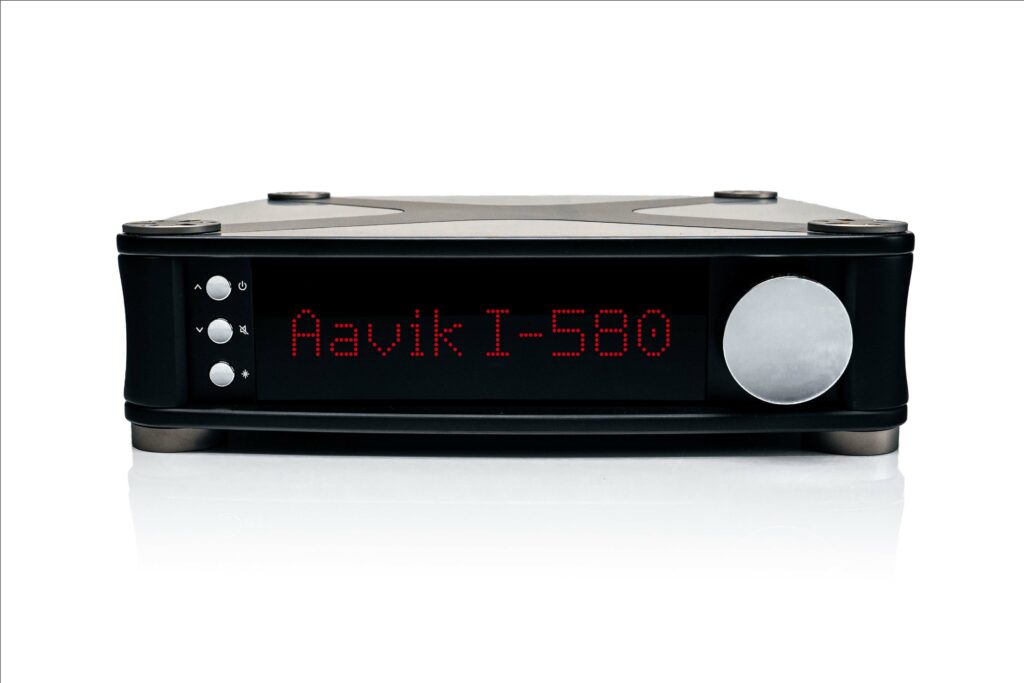
Aavik Acoustics I-580

This is an inherently low noise design, but Aavik reduces that noise floor further by using ultra-low noise regulators to supply power to the amplifier’s circuitry. Aavik claims these regulators offer significantly lower noise than conventional regulators. The I-580s line stages also feature an inverted, virtual ground topology for greater stability and low signal-to-noise ratio irrespective of volume level. This last is seldom discussed, but often the signal-to-noise ratio is a snapshot of the amp’s performance that doesn’t take very high or very low volume levels into account. Many amps might sound dynamic, expressive, and accurate at normal listening levels (where they are measured), but things fall apart at very high or very low volumes.

As above, not so below

The other part of the I-580 controversy relates to how it justifies its place relative to the I-180 and I-280 below. An on-paper basic audit of the specifications of the three amplifiers shows them to use the same basic layout and amplifier module roll-out. They are all 300W amplifiers capable of delivering 600W into four-ohm loads, they are all single-ended only amplifiers with the same number of inputs and outputs, the same large multi-LED front panel and on surface inspection, a similar case. Looks can be deceptive, however, because the I-580 includes a copper inner chassis and titanium resonance control plates in the case that are not included in the other models.

However, perhaps the most significant change is the sheer number of Ansuz Active Tesla Coils in each device; for example, where the I-180 uses 132 such coils, the I-580 uses 348 (240 of which are the company’s square coils). Factor in more than double the amount of Aavik’s dither modules (five in the I-280, 11 in the I-580) and four of the company’s Anti Aerial Resonance Coils, and the I-580 is about as RF and EM interference-free as it is possible to make currently. Those who get hot under the collar about whether RF and EM interference is a blight on audio will grind off some tooth enamel at the thought of so much treatment.

Finally, and common to all models in the Aavik line, the I-580 has built Darkz-ready bases into the top and bottom plates allowing Ansuz’s clever mechanical vibration system to help eliminate yet another potential source of interference. Given the low heat output and the shielding of the amplifier, it’s perfectly acceptable to stack 580-series models on top of one another using a quartet of Darkz to separate each level.

Rest after moving

The amplifier itself does need some time to bed in. This isn’t so much ‘running in’ as ‘needing a bit of a rest after moving about’. I also found that cycling the power several times after changing loudspeakers or loudspeaker cables did seem to make the system more of a ‘match’. But regardless, after a few hours of amplifier pampering, it’s ready to fly!

I’ve heard several iterations of the Aavik amplifier now, from the hulking great U-380 Unity metal version with the large central dial and built-in DAC to the smaller but equally impressive U-150 Unity and now the I-580. With each iteration, they have got lighter in weight and better in sound. The difference in sound quality is not profound – more evolution than revolution, to harness the cliché – but it is better. The previous generations always had a deep, muscular bass and an extremely dynamic and transparent presentation, albeit with a small amount of soundstage limitation and some dry, slightly laid-back sound typical to Class D.

The I-580 expands that soundstage a lot while making that signature dryness less of a feature and more of just a Class D accent. The leading edges speed through this amplifier significantly, giving it a remarkable sense of ‘thereness’ that is hard to beat. Out came ‘Clara’ by Jarvis Cocker and Chilly Gonzales [Room 29, DG], and the combination of piano and slightly broken voice in a hotel suite was like you had been transported into the live event.

Volume sensitivity

This also showed up the volume sensitivity of the amplifier; I’ve been used to hearing some amps – especially Class D designs – have a distinct ‘goldilocks’ point on the dial, where ‘too much’ gets too hard and dry sounding and ‘too little’ breaks up the authenticity and integrity of the sound. Any such changes will be easy to hear because there’s no hiding place. But with the I-580, you could play whisper quiet or very loud with no sense of change in tonality at all.

The I-580 should silence the Class D naysayers because that flat, artificial, electronicky sound associated with the technology had all but disappeared back when the U-380 first dropped (sadly, literally; my sample ended up falling out of its box and narrowly missed flattening my foot). It’s gone now; the sound is still slightly dry and precise, but this is more like a focused sound than a musical desert.

Soundstaging is broader and deeper than I expected; the I-580 doesn’t have the lush imaging of the best valve amplifiers. However, one could argue the best valve amplifiers don’t have the ‘snap’ and imaging precision of the I-580. Couple that with almost no background hash or noise, and sounds are portrayed with near-textbook detail and accuracy, powerful dynamics, outstanding bass and an accurate, zing-and-sting-free top-end.
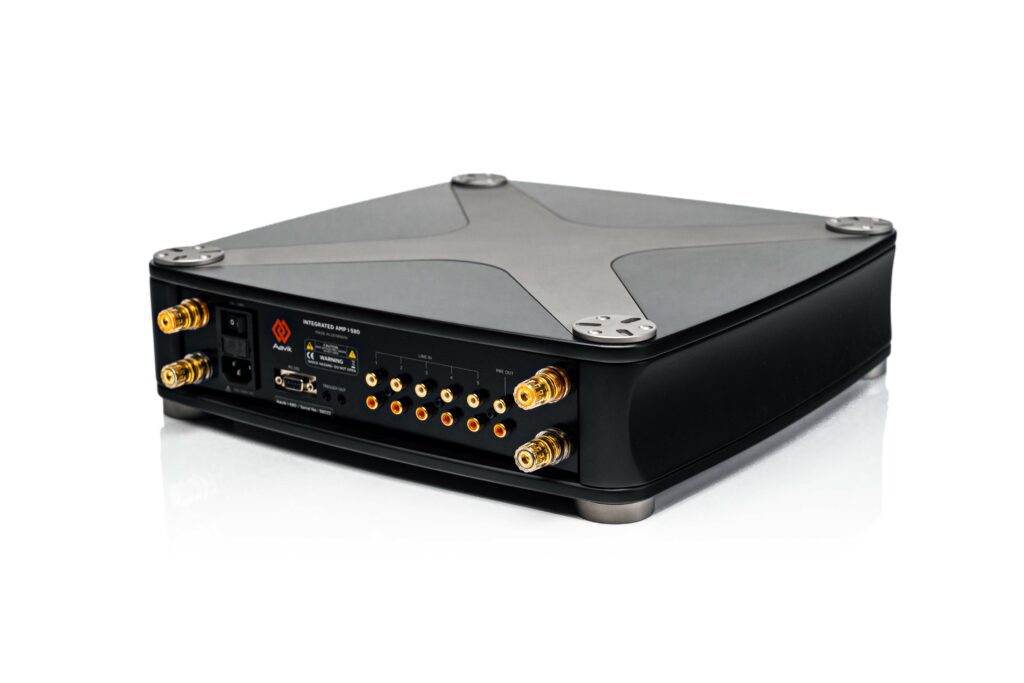
Aavik Acoustics I-580

This made me want to explore all of Ma Rainey’s Black Bottom [Branford Marsalis, Sony], from the 1920s recreations like ‘Those Dogs of Mine’ to the atmospheric ‘Levee Confronts God’. And it all worked brilliantly. Even without the need for double entendre. And you know you are on to a good thing when you can play anything from Liszt to Led Zep in a single sitting and enjoy it all equally well.

While the inevitable and seemingly endless car analogies used in audio are now almost painfully overused, there is a surprisingly strong parallel between the audio and motoring world when it comes to damn good amplifiers; both fields are in that transition point between an old and a new technology (moving from petrol to electric in cars, Class A and AB to Class D in audio).

Perception shift

Just as driving a high-performance electric car requires a few slight tweaks on the driver’s part to accommodate and genuinely understand how an electric car performs, we are at a point where listeners are starting to shift their perceptions about how recorded music sounds through amplification. All of which means this amplifier is very likely the Tesla Model S Plaid of the audio world!

On the face of it, the fact the Aavik Acoustics I-180, I-280 and I-580 look similar and share a similar essential performance would make it seem that the big boy is a poor proposition. However, the proof is in the listening, and this is one of the best Class D amps out there, and one of the best amps irrespective of amp design. While understandably at its best in the sublime company of its Ansuz and Børresen peers, it’s both a remarkable performer and a perfect gateway into the company’s ethos… and probably many products from these companies.

TECHNICAL SPECIFICATIONS

  • Type: Integrated Class D amplifier
  • Inputs: 5× RCA stereo pairs
  • Outputs: 1× RCA stereo pair, speaker terminals
  • Volume Control: 76×1dB steps
  • Power output: 2x 300/8Ω, 2x 600/4Ω
  • THD+N: < 0.006% (1-100W, 1kHz, 8Ω)
  • IMD: < 0.002% (1x100W, 4Ω)
  • TIM: < 0.008% (1-100W, 4Ω)
  • Aavik Noise Reduction systems included (see text)
  • Dimensions(W×H×D): 40 × 10.2 × 38.4cm
  • Weight: 10.7kg
  • Price: £20,000

Manufacturer:

Aavik Acoustics

URL: audiogroupdenmark.com

Tel: +45 40 51 14 31

Back to Reviews

The post Aavik Acoustics I-580 appeared first on Hi-Fi+.

Musical Fidelity M8xi

I recall that at some point in the dim and distant past Musical Fidelity founder Anthony Michaelson decided that the world needed educating about real world power requirements. To get this message across, he produced a cardboard calculator on which you dialled in the sensitivity of the loudspeaker next to the power output of your amplifier and this gave you a quality rating based on potential SPL (sound pressure level). Equating level with quality is a bit dubious but it did reveal that you need an awful lot of power to get high levels out of even a reasonably high sensitivity loudspeaker like the B&W 802D (listed on the back among other popular models). 200 Watts was required to get it into the ‘high quality’ zone and produce 106dB but to push it to the 110dB peak called for 500W. Which even today is a lot of power. It does explain however why Musical Fidelity has been building substantial integrated amplifiers since 1990 when the M8xi’s A1000 ancestor was released.

I imagine that it was nearly as heavy as the M8xi that takes its place in the company’s line up today as the biggest integrated in the catalogue. At 46kg the M8xi has the scale of a serious power amplifier and the specs to match; these are quoted as 550W into eight ohms and 870W into four with a peak offering of 1.2kW, so clearly ‘high quality’. But there is of course more to amplifier quality than sheer power; if it was that easy then the M8xi would probably be using Class D amps which deliver the most Watts per pound (sterling and avoirdupois) you can get.

A Class (AB) Act

Instead, the M8xi is very much a Class AB amplifier. Or should that be ‘amplifiers’, as this large but not excessive chassis houses a pair of monoblock power amplifiers and a preamplifier and each has its own transformer and power supply, hence the high mass. Each of the heat sinks that flank the chassis are dedicated to a channel and serve to keep a dozen bipolar transistors at a steady operating temperature, one that rises pretty high if the temperature on the outside is any indication. This is not like the legendary heat sinking atop a Musical Fidelity A1 Class A amp, which was hot enough to grill a burger. This is perhaps a reflection of the fact that this is a low feedback design with a Class A driver stage, but more likely because of the sheer quantity of power on offer.

The preamplifier circuitry has been placed right at the back of the box next to the input sockets, a move that keeps signal paths about as short as is possible. Inputs are both traditional analogue and contemporary digital, with the former in both balanced and single ended forms and the latter including USB and S/PDIF types in sufficient quantity to satisfy most system set-ups. Unusually, the Musical Fidelity has a wide range of outputs in both digital and analogue form; it seems unlikely that it would be used as a preamplifier but I guess it’s possible to bi-amp with a power amplifier if you have particularly insensitive speakers and a thirst for volume. Digital outputs can be used for a headphone amp/DAC of course, something that the M8xi doesn’t accommodate in its roster of features.

Musical Fidelity M8xi

The DAC also has its own power supply, and while its hi-res figures are not particularly impressive (it maxes out at 24-bit/192kHz with no DSD or MQA support) they are at least realistic in the context of widely-available music files. All incoming data is upsampled and reclocked to reduce jitter.

Inputs are selected via a suitably large controller on the front panel or more often with the remote control, a rather heavily festooned example of the art that surprisingly does not offer up a power button. This it seems is one thing you can’t do from the sofa. It’s not hard to locate the volume buttons though, and I appreciated the fact that you can adjust level in half-decibel steps; steps that are reflected in the M8xi’s central display alongside the chosen input. I was a little surprised that it’s not possible to change the input names given the flexibility of the display, but this does mean that outside of the DAC there is little in the way of processing power onboard to corrupt the sound.

A Sense of Headroom

In the first instance I hooked this Musical Fidelity up to Bowers & Wilkins’ new 802 D4 loudspeakers, noting along the way that it has the lesser spotted C18 IEC power inlet and two sets of speaker terminals per channel for easy bi‑wiring. Initially I used the USB digital input on the amp and connected a Melco N10 streaming drive via Network Acoustics cable. London Grammar’s ‘Stay Awake’ revealed that those Watts count for something, producing a sense of headroom that you rarely encounter and which translates into prodigious bass when it’s on the recording, and on this one it certainly is. This is not bludgeoning power either, it’s articulate and able to respond to the nuances of the material with remarkable speed. High power and serious immediacy are not often found in combination even at this price yet the M8xi is very capable in both departments. Particularly with things like the synth powered vibes of Leifur James’ ‘Mumma Don’t Tell’ where the gradations in the bass come through superbly and the overall ease of delivery encourages you to push the volume.

Meshell Ndegeocello’s take on ‘Who Is He (And What Is He To You)?’ is underpinned by a dark chewy bass line that is positively sinuous in the M8xi’s hands, the tune flows with a powerful ease and the plushness of its production is brought to the fore. It brought to mind the possibly apocryphal story about Anthony Michaelson talking to Tim de Paravicini in the early days of Musical Fidelity where the latter is said to have scribbled down circuit details on the back of a cigarette packet, ideas that are probably still to be found in the company’s amplifiers today. How will the designer’s of today pass on their ideas in the touch screen age one wonders?

Imaging is good too, the soundstage reflecting the various recordings well with plenty of scale and energy, the Grateful Dead’s ‘Cumberland Blues’ being delivered in a less timely way than usual but with excellent flow. I also rather enjoyed an old Fleetwood Mac tune from Kiln House called ‘Station Man’, where Jeremy Spencer’s guitar playing is top notch and not unlike that of Paul Koss (Free). This band may not have hit the big time in 1970 but they were hot stuff and the Musical Fidelity lets you hear as much. Switching to a separate DAC and using one of the amplifier’s single ended line inputs produced a clear improvement in timing and solidity of stereo image. This combined with the power and sometimes startling ability to turn on a dime made for an even more enthralling experience. The sheer dynamic range on offer revealing that many amplifiers, even high power ones, are still reining in the potential of better recordings.

Timing and muscle

Switching to a fairly new pair of PMC twenty5.26i loudspeakers which have a lower sensitivity than the 802s but offer an easier load the sound initially seemed a little dry from a tonal perspective. After a few tunes this characteristic took a back seat to the spectacular combination of timing and muscle on offer from the M8xi, with track after track offering up oodles of detail in a very coherent and engaging manner. Even an orchestral Schubert piece was delivered with the tempo in full effect, this didn’t take precedence over the dynamics however which were delivered with gusto yet without any discomfort in crescendos. All that power really counts when you are trying to reproduce a ‘big band’ with real world loudspeakers, and it matters with smaller stuff too. Somewhat controversially I put on Nils Lofgren’s rather overplayed dem favourite ‘Keith Don’t Go’, just for old times sake you understand, and heard a fabulous acoustic guitar, a croaky voice and the energy of a live event in surprisingly convincing virtual reality.

Power does not equate too directly with quality unless it is clean, controlled and able to make a speaker do exactly what’s required when it’s required. The Musical Fidelity M8xi does that with knobs on, and rather nice knobs they are too.

TECHNICAL SPECIFICATIONS

  • Type: Solid-state, 2-channel integrated amplifier with built-in DAC
  • Analogue inputs: Four single-ended line-level inputs (via RCA jacks), two balanced inputs (via XLR connectors)
  • Digital inputs: Four S/PDIF (two coaxial, two optical), one USB port
  • Analogue outputs: One single-ended line-level fixed (via RCA jacks), one single-ended line-level variable (via RCA jacks), one balanced variable (via XLR connectors)
  • Digital outputs: Two S/PDIF (one coaxial, one optical)
  • Supported sample rates: up to 24-bit, 192kHz
  • Input impedance: High-level: 25kOhms single ended, 50 kOhms balanced
  • Output impedance (preamp): Not specified
  • Headphone Loads: N/A
  • Power Output: 550Wpc @ 8 Ohms
  • Bandwidth: Not specified
  • Distortion: THD+N < 0.004% typical, 20Hz to 20 kHz (XLR)
  • Signal to Noise Ratio: > 86dB A-weighted (XLR)
  • Dimensions (H×W×D): 185 × 485 × 510mm
  • Weight: 46kg
  • Price: £5,649

Manufacturer: Musical Fidelity

URL: musicalfidelity.com

UK Distributor: Henley Audio Ltd

Tel: +44(0)1235 511 166

URL: henleyaudio.co.uk

Back to Reviews

The post Musical Fidelity M8xi appeared first on Hi-Fi+.

Marantz SACD 30n and Model 30

It’s the start of 2022 when writing this, and CD and SACD are supposedly ‘dead’ formats. So it might seem strange for Marantz to launch a new silver disc player. But the 30n is more than that; it’s also a streamer and hub, and thus hugely versatile. Marantz describes its new creation like this:

“The Marantz SACD 30n marries a classic premium SA‑CD / CD player with a modern digital source’s hub/preamp. It plays hi-resolution files including FLAC HD and DSD from your home network, local USB storage, and online sources such as streaming services and Internet radio.

“It features HEOS streaming, voice and multi-room support, and DAC functionality, as well as Apple AirPlay 2 and Bluetooth integration. The SACD 30n is future-proofed, accepting file formats all the way up to 11.2Mhz quad-DSD and 384kHz/32-bit PCM via USB-B/USD-DAC.”


Skin in the game

Speaking as someone with skin in the game (I’m currently in the market for a streamer and looking at various acronym-led options) a product like the 30n that features a CD/SACD player and Streamer interests me greatly – providing the performance on silver discs is outstanding.

To partner the SACD 30n, Marantz offer the matching Model 30 integrated amplifier. This is a compact 100W Class D design featuring tone and balance controls and an MM/MC phono stage. The UK price of both of the 30 components is £2,899 each.

Marantz Model 30

Both the Model 30 and SACD 30n have a quilted front panel, with a raised central section that’s back-lit from the sides. It looks very unusual – both classy and nicely understated. Pictures of the items don’t always make this clear – you have to see them to appreciate the styling.

I began with the SACD 30n, and it quickly became obvious that it’s a very capable CD/SACD player. I’d been enjoying the Denon DCD A110 player very much, and the 30n matched it for clarity and detail, while delivering a slightly more immediate and assertive sound.

On both standard Red Book CD and SACD, the 30n produced an impressively-clean and focused sound that had great presence and dynamic range. Given that the SACD 30n costs £100 less than the Denon, and features a built-in streamer/hub, it’s excellent value.

Compared to many other silver disc players, CDs on the SACD 30n had a nice depth and weight that made them sound more like SACDs. SACDs sounded better still – solid, weighty, and clean, with bite and clarity, plus a nice unexaggerated naturalness.

Playing Copland Orchestral works Vol 1 SACD [Chandos CHSA 5164] the bass drum on ‘Fanfare for the Common Man’ had truly awesome heft and depth – real floor-shaking bass, but only if your speakers are capable of reproducing low frequencies below 25Hz.

Superior build?

I’d say the Denon DCD-A110 and matching PMA-A110 amplifier offer superior build quality over the Marantz items, but not by much. The Denon items are heavier and more solidly-made, but the quality of finish is about equal and the Marantz certainly looks classy and attractive.

Marantz’s HEOS app works well, and allows you to stream from subscription platforms such as Spotify, Tidal, Deezer, Napster, Amazon music, Soundcloud, etc. At the time of writing (June 2021) the SACD 30n does not support MQA files on Tidal, but this is a future possibility.

Marantz SACD30n

Marantz tell me MQA support could be added in a future firmware update, should they decide to go for it. So, if you’re a Tidal user, lack of MQA might be a deciding factor, but maybe not for long. The 30n sounded very good with Tidal, but MQA files via Arcam’s ST60 were generally better. Some MQA files are only 44.1kHz and deliver CD quality, while others are 96kHz and sound superior. Playing ‘Come Together’ from the Beatles Abbey Road album [Apple], the MQA version (via the Arcam) sounded more dynamic and better separated.

The non-MQA file sounded ‘flatter’ and voices/instruments did not project out from the speaker enclosures. The MQA file had more depth and space, and the placement of voices and instruments in the stereo soundstage was more holographic and real-sounding. However, comparing the 30n against the ST60 on Tidal with non-MQA files, I’d actually put the Marantz slightly ahead of the Arcam for clarity and separation.

Given the range of options offered, the SACD 30n is simple and straightforward to use. A small rotary control selects functions, and runs HEOS Favourites (subscription needed), Internet Radio, Music Servers, USB Music, Bluetooth, CD/SACD, USB-DAC, Co-Axial, Optical 1 and 1, and Set-Up.

You can select most of these options from the supplied remote handset. The display on the SACD 30n is clear and easy to read, but – unlike many current streamers – you don’t get a representation of the album cover when streaming.

I used the SACD 30n via USB with a hard-drive containing downloaded music. For some reason, the SACD 30n didn’t always read the file name. Many of these I’ve created myself, usually with the composer’s surname at the first item. But sometimes the SACD 30n chose to read hidden metadata.

All of which means that instead of an item coming under (say) B for Beethoven or Brahms (as per the file name) it’s found under S – S for Sir John Barbirolli… Maybe there’s a way around this – I’m not sure. But interestingly, the Arcam ST60 did not do this.

HEOS Man

Marantz’ HEOS app is a lot better than Arcam’s MusicLife app, though hopefully the latter will soon have a significant upgrade that sorts out its problems. I could navigate files on my USB hard drive connected to the SACD 30n using HEOS, unlike the Arcam/MusicLife.

Given all the exciting headline features of the SACD 30n, the Model 30 amplifier could easily be overlooked. I went over to it from my £8k Musical Fidelity NuVista 800 and was impressed by the clarity and focus of the Marantz. Class D seems to deliver a sound of great solidity and precision.

I typically find Class D amps a little ‘dark’ in terms of tonal balance. There’s a slightly lack of ‘sparkle’ and brilliance perhaps, but overall the presentation itself strikes me as very natural and truthful. I like the effortless focus and clarity of the Marantz Model 30. It’s an exceptional amplifier.

To draw an analogy, the Marantz Model 30 is a bit like freshly-squeezed orange juice compared to fizzy orange squash. It offers a purer, truer flavour without false excitement or drama, yet delivers the music with great integrity that involves and moves the listener.

Marantz Model30

I’d be intrigued to hear it in a variety of situations, driving other loudspeakers, but in my set-up it works extremely well – to the point where I’d be very happy to live with it full-time. I even liked the ‘sound’ of the tone controls; the way they let you boost/cut the extreme bass and treble.

Go Direct

That said, I preferred to use the amp on its ‘direct’ setting, which by-passes the tone controls and balance control. The built-in phono stage was very good too, and I liked the visual readout of volume level in decibels.

Being Class D, the Model 30 amplifier operates very efficiently and draws very little power. It gets very slightly warm during extended use, but runs cooler than a typical Class A/B amp. The SACD 30n is shown standing on the Model 30, and you could do that without overheating problems.

Opinions seem polarised when it comes to a CD/SACD player that incorporates a streamer and USB DAC. Those who prefer downloads and streamed music may well regard silver disc as obsolete. So a product that combines CD/SACD playback with streaming might seem a ludicrous combination.

Others, like myself, may still prefer CD/SACD as their main source, but require a good streamer. Given how good the SACD 30n is playing silver discs, it’s likely to be an upgrade on older CD players. For those with Hybrid SACDs but no dedicated SACD player, something like the 30n is worth considering.

True, it’s more than double the price of a Streamer such as Arcam’s ST60, but I’d argue it represents very good value. For someone like myself, with a big collection of CDs and SACDs, the Marantz is arguably a better option over a dedicated streamer.

Neat and Compact

Then there’s the matching Model 30 amplifier. It’s neat and compact, yet delivers music with impressive clarity and precision. I like it’s focus and ability to deliver detail without seeming splashy or edgy. But, is there a slightly lack of sparkle at the top end?

Maybe; but possibly it’s more a lack of control and a slight added emphasis with other amps. I sometimes wonder if there’s a slight lack of top-end openness with Class D, but at the same time I love the ‘nothing added, nothing taken away’ clarity of the sound.

I find both Marantz 30 models especially good at low dynamic levels. The music retains focus and solidity, and never gets smeared. All told, the Marantz SACD 30n and Model 30 is a very impressive combination that sounds really great and offers outstanding value. Go hear it!

TECHNICAL SPECIFICATIONS

Model 30

  • Type: Integrated amplifier
  • Inputs: five line-level stereo RCA pairs, one MM/MC phono input, exterior preamp input, remote control bus terminal
  • Outputs: 1× RCA stereo pair record output, 1× RCA stereo pair preamplifier output, ¼” headphone jack
  • Power output: 100W/8Ω, 200W/4Ω
  • Frequency Range: 5Hz–50kHz
  • THD: 0.005% (1kHz, 8Ω)
  • Signal to noise ratio: 88dB (MM), 75dB (MC), 107dB (line)
  • Dimensions (W×H×D): 44.3 × 13 × 43.1cm
  • Weight 14.6kg
  • Price: £2,899

SACD 30n

  • Type: SACD/CD player featuring network audio streaming and DAC Mode
  • Inputs: 1× coaxial S/PDIF, 1× optical S/PDIF, 1× USB Type A, 1× USB Type B, built in dual-band Wi-Fi and Bluetooth
  • Outputs: 1× RCA stereo pair (fixed), 1× RCA stereo pair (variable), ¼” headphone jack
  • Sampling/File support: PCM files up to 32-bit/384kHz and DSD files up to 11.2 MHz, Gapless playback of FLAC, WAV, AIFF, and ALAC files up to 24-bit/192kHz (DSD files up to 5.6 MHz)
  • Frequency Response: 2Hz–50kHz
  • THD: 0.0008%
  • Dynamic Range: 109dB
  • Dimensions (W×H×D): 44.3 × 13 × 42.4cm
  • Weight: 13.5kg
  • Price: £2,899

Manufacturer: Marantz

URL: marantz.com

Tel: +44 (0)2081034770

Back to Reviews

The post Marantz SACD 30n and Model 30 appeared first on Hi-Fi+.