
World News
TAD CE1TX loudspeaker
The most cash I’ve ever spent on a pair of loudspeakers was again within the early Nineties, after I purchased a pair of used TAD TH-4001 wood horns and their related TD-4001 compression drivers. The TAD horn’s clean, micro-resolved response was a refinement improve from my multicell Altec horns; plus, the TADs’ French-polished wooden seemed radically much less industrial than the soldered-tin, tar-filled 1005/288C horns they changed. None of my horn-fanatic pals had something sonically or aesthetically comparable, and all of them have been envious. I did not maintain the TADs lengthy, as a result of the good friend who admired them most made me a really “pleasant” supply.
That was my first expertise with Japanese loudspeaker design, and it uncovered me to a stage of engineering precision and nice craftmanship I had not but encountered in American-made audio system.
Thirty years later, I discover myself listening to a pair of brand-new TAD audio system, and as soon as once more, none of my pals have something sonically or aesthetically comparable. This time, although, it is a front room–pleasant, three-way, dynamic-driver standmount/bookshelf referred to as Compact Evolution One – Bookshelf Speaker System. The mannequin quantity is TAD-CE1TX-WN. It is exposing me to a stage of match’n’end and sonic insightfulness that’s uncommon amongst modern audio system, even on the highest costs.
In the start
The firm everyone is aware of as Pioneer was based by Nozomu Matsumoto in 1938 as a radio retailer and speaker restore store in Tokyo. Over the following a long time, Pioneer grew right into a revered model with a worldwide attain. In 1978, Pioneer determined to interrupt into the skilled speaker market with a line of all-out recording studio screens manufactured underneath the title Technical Audio Devices Laboratories. TAD’s first product was the TD-4001 compression driver talked about above.
According to the TAD web site, that driver and its related TH-4001 horn “discovered its approach into famed recording studios world wide, together with these designed by Tom Hidley, who was a top-rated acoustic designer of the time, in addition to AIR Studios, Capitol Records studios, and Record Plant.
“TAD speaker items have been additionally used as a part of a sound reinforcement system through the live performance tour the Eagles made round Japan in 1979, throughout which the efficiency of the TAD audio system dazzled audiences. Impressed with the fame of TAD audio system, big-name musicians equivalent to Jimmy Page and Prince put in TAD audio system of their non-public recording studios.”
In 2000, TAD launched its first speaker designed particularly for residence audio use, the floorstanding M1, which featured the primary incarnation of TAD’s now-famous coaxial Coherent Source Transducer. The M1 developed into at this time’s flagship Reference One Floor Standing Speaker (TAD-R1TX-EB/TAD-R1TX-BR), the large brother of the Compact Evolution One I’m reviewing right here.
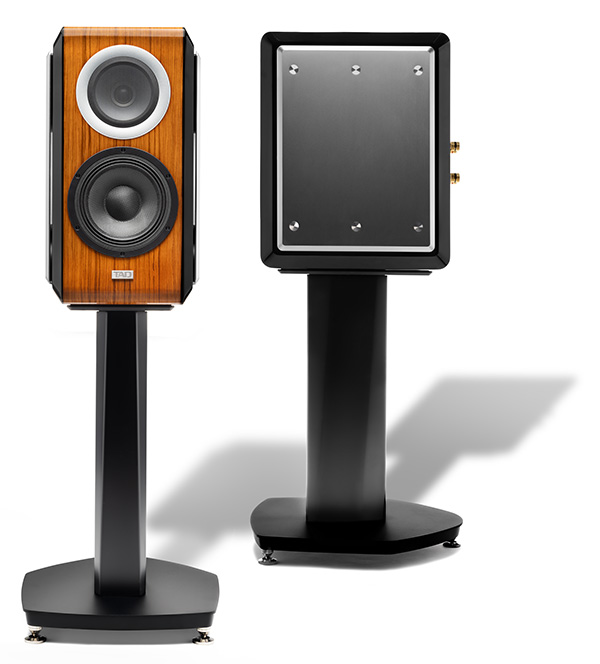
Description
What separates Technical Audio Devices Compact Evolution One from its audiophile-speaker rivals is its extremely developed 5.5″ coaxial “Coherent Source Transducer” (CST) driver, which is manufactured in-house in Japan and incorporates a “newly developed” magnesium midrange cone with a concentrically mounted beryllium dome tweeter that, in line with TAD, is manufactured with their “proprietary vapor deposition method.” Impressively, TAD’s CST is specified to function between 250Hz and 100kHz.
The CE1TX is a three-way design. The backside three octaves are reproduced by TAD’s 7″ “aramid composite” (footnote 1) bass driver, which is manufactured from “5 layers of woven and non-woven cloth” that TAD says “optimizes the vibration traits of the shell-shaped diaphragm that integrates the middle and the cone right into a single piece.”
Another characteristic, which absolutely contributes to the CE1TX’s sound character, is its “Bidirectional ADS Port”; ADS is brief for “AeroDynamic Slot.” These bidirectional slots are slit-shaped ducts with flared openings behind the audio system’ 17″ × 13″ sculpted-aluminum aspect panels, which seem to drift about 4mm past the cupboard’s sides. According to TAD’s web site, these slots permit inner air to movement out easily, with out turbulence: “The symmetrically positioned port openings … scale back port noise and maintain inner standing waves from escaping from the ports.”
These made-in-Japan audio system are heavy (63.9lb) and on the big aspect for standmounts, measuring 11.3″ broad × 20″ excessive × 17.6″ deep. Their sensitivity is listed as 85dB/W/m, and their nominal impedance is specified as 4 ohms. The CE1TX is priced at $32,500/pair; a pair of optionally available stands provides $2500.
Setup
Early in my TAD auditions, I noticed that the CE1TX presents unusually constant dispersion in each the vertical and horizontal planes, and that these twin aspect ports make them straightforward to position. The first couple of days, I moved them about in an compulsory method; regardless of the place I set them down, they only checked out me and shrugged as if to say, “Put us anyplace you need. We do not care.” I did not put them within the fridge, or underneath the mattress, however as I used to be transferring them, I remembered that skilled studio screens are usually not sometimes designed to sit down removed from the entrance wall as many audiophile audio system are. Monitor audio system are, by necessity, pleasant with room boundaries. I did not strive it, however I really feel fairly sure the CE1TX would even work on an enormous desktop or a large shelf, so long as the tweeters have been roughly stage with the listener’s eyes and toed in to cross behind the listener’s head.
My overview samples ended up on 24″ Sound Anchor Reference stands, about 6′ aside and possibly 30″ from their entrance face to the wall behind them. In that place, the 50Hz-to-200Hz area was flatter and cleaner than with any speaker I’ve reviewed on this room. All listening was achieved with the included woofer grilles off.
Listening
The distributor advised me that my pair of CE1TXs had greater than 100 hours on them on arrival. Nevertheless, for the primary week, I allow them to play 24/7 within the background at low quantity whereas I labored in my studio. Yet, again and again, I’d need to cease what I used to be doing and test my iPad to see: what is this fabulous new music Roon Radio has found for me? Every time I seemed, it was some new conductor or model of large-scale classical music I do not normally get pleasure from as a result of the orchestra is just too large, the music’s bombastic, and the recording sounds clogged and fatiguing to take heed to. This occurred so steadily that the very first thing I wrote in my notes was “These audio system power me to love music I do not like.”
Powered by Parasound’s Halo A 21+ amplifier, the CE1TX loudspeakers sorted and introduced the densest, most intricate and overproduced music in ways in which made it extra intelligible and agreeable—and oftentimes extra stunning than it’s with my Falcons powered by the identical Parasound amp. During these early auditions, the CE1TXs made each recording sound correct and uniquely “like itself ” and, more than likely, the best way its producers hoped it will sound.

With this mix, on the mind-pulling 33-minute Forbidden Love by Pulitzer Prize– profitable composer Julia Wolfe (24/96 FLAC, Nonesuch/Qobuz), the So Percussion Ensemble generated startling, percussive struck-string transients that I might really feel in my intestine. The So Ensemble did this whereas portray probably the most delicate particulars right into a deep, galaxy-like area behind them. If you benefit from the sound of seems like I do, this demonstration-quality recording will thrill you and your guests.
As I listened to the Julia Wolfe, I saved considering, it seems like I’m listening to every part on the recording, but the sound is rarely too tough, sharp, dry, moist, muddled, muted, quick, or chilly, or something! Nothing is misplaced, and nothing is exaggerated. The CE1TXs sounded extra supple, textured, and relaxed than the Genelec G Threes or my reminiscence of the Harbeth 30.2 monitor audio system—which is the one speaker this TAD jogs my memory of most. Their sonics and tone stability are related, however the CE1TX is smoother, finer grained, and focuses the lens one other half-turn.
What stunned me was how these TAD audio system made the Parasound A 21+ sound extra colourful, three-dimensional, and energetic than common. I prefer it when a brand new speaker makes a well-known amp sound higher. And vice-versa.

Shake Sugaree
I’m embarrassed to say I’d by no means heard of singer–songwriter–guitar participant extraordinaire Elizabeth Cotten (1893–1987). A music she wrote when she was 11 years outdated, “Freight Train,” was lined by Peter, Paul and Mary and have become a staple of the Sixties folks revival (footnote 2). Her signature tune, “Shake Sugaree,” was lined by each Dylan and the Grateful Dead. I found Cotten’s music as a result of Roon Radio steered me to her after I listened to gospel by Old Regular Baptists. The sound of her voice and her subtle, left-handed, upside-down guitar selecting induced her to leap proper out of the music stream. Cotten’s expertise was found whereas she was working as a maid for Pete Seeger’s household within the early Fifties. Through the CE1TXs, her vocal tone was exceedingly pure, disarmingly clear and honest—and adorably unpretentious (16/44.1 FLAC, Smithsonian Folkways/Tidal).
Footnote 1: Kevlar is an instance of an aramid fiber.
Footnote 2: See youtu.be/R2DCWfBkMSI.
-
Product on sale
 Audiophile Vinyl Records Cleaning BundleOriginal price was: €69.90.€59.90Current price is: €59.90. incl. VAT
-
Product on saleEasy Start Vinyl Records Cleaning KitOriginal price was: €69.90.€59.90Current price is: €59.90. incl. VAT
-
Vinyl Records Cleaner Easy Groove Concentrate€34.95 incl. VAT
-
Easy Groove Super Set€199.00 incl. VAT
-
Easy Groove Enzycaster – vinyl records prewash cleaner€34.95 incl. VAT
-
Easy Groove Extreme MK. II- vinyl records prewash cleaner€45.00 incl. VAT
-
Vinyl Records Cleaner – Easy Groove Virgin Concentrate€35.00 incl. VAT
-
Easy Groove Spray&Wipe vinyl records cleaner€34.95 incl. VAT







