
World News
THE EVOLUTION OF SOUND
THE EVOLUTION OF SOUND
A visitor posting by Fraser Pettigrew

For me, probably the most fantastic issues about vinyl records is that they represent a present expertise that in essence hasn’t modified in almost 150 years. Apart from the migration from a wax cylinder onto a flat disc and advances in digital amplification, the replica of sound by way of a needle transmitting vibrations from the bodily rotation of an etched groove is similar expertise that Thomas Edison patented in 1877. That’s fairly outstanding when you think about how radical our technological evolution has been in most different respects over the identical interval.
I had by no means actually thought a lot in regards to the growth of various document codecs till comparatively not too long ago after I spent a 12 months and a half working at New Zealand’s movie, TV and radio archive. Ngā Taonga Sound & Vision doesn’t actually cowl music records in its assortment, however I used to be to find that the origins of the 33 1/3 rpm vinyl LP – as distinct from the 78 rpm disc – truly lie within the growth of sound within the motion pictures, and in radio, not within the music trade.
But first, some early historical past.
It was about ten years after Edison’s patent that the lateral disc first emerged, and some extra years till the top of the century earlier than it developed as a viable industrial sound format. The 78 rpm disc didn’t turn into commonplace till across the begin of WW1 – early discs diverse in diameter and rotation pace, from 7 to 12 ½ inches and from 60 to 130 rpm. The Gramophone Company settled on 78 rpm in 1912 just because it was the common pace of a lot of the records it had been releasing as much as then. It wasn’t till the mid-Twenties that 78 rpm grew to become the trade commonplace.
Even then, electrically powered gramophone gamers would differ based on the score of the native energy provide. So, in a metropolis with a 50hz AC provide your 78rpm disc would play slower than in a metropolis with a 60hz provide. If you had been nonetheless utilizing a hand-cranked spring pushed gramophone you had been on the mercy of all kinds of mechanical malfunction.
Electricity didn’t play an element within the recording course of till the mid-Twenties. Louis Armstrong’s second spouse famously recalled a recording session in 1923 the place the younger Armstrong and band chief King Oliver performed aspect by aspect into the big horn that acoustically channelled the sound to the lathe reducing the grasp disc. King Oliver couldn’t be heard in any respect within the resultant recording, so Satchmo was made to face about fifteen ft away for the following take.
mp3: King Oliver’s Creole Jazz Band – Dippermouth Blues (1923)
When electrical energy started to play an element in each recording and amplifying the contents of discs, it was the movie trade that took the expertise and initiated a growth that was step one in direction of the vinyl LP that we all know and love.
Films had lengthy been accompanied by stay musicians, typically a single pianist or organist, but additionally entire ensembles. Filmmakers started commissioning arrangers and composers to create suites of music, scored to enhance the motion on display screen, together with sound results. Clever-clogs Charlie Chaplin composed his personal musical accompaniments. Where musicians had been too troublesome or pricey to supply at screenings, the apparent various was recorded discs, however the 78rpm disc has one important disadvantage right here – every 10-inch aspect can maintain barely three minutes of music. The sound man would wish to do extra flipping than a McDonald’s burger chef.
mp3: Charlie Chaplin (composer) – Afternoon (from ‘City Lights, 1931)
Some brief movies had used synchronised 78rpm discs to supply sound as early as 1902, however it wasn’t till the event of the Vitaphone system in 1926 that the method matured to supply sound for full-length options. Vitaphone used 16-inch discs that ran on the slower pace of 331/3 rpm, enabling the sound man to calm down and luxuriate in a fag or two between aspect adjustments. Vitaphone was used for quite a few movies up till 1931, by which period the usage of optical soundtrack expertise had been perfected.
This proto-talkie historical past helps to elucidate how the artwork of sound mixing and soundtrack route appeared to emerge virtually fully-formed within the earliest years of sound cinema. The manner, for instance, that Hitchcock was in a position to make use of sound in ‘Blackmail’, a movie that started manufacturing as a silent function, appears miraculously superior, however then you may see how filmmakers had been fascinated about, if not truly utilizing sound for a number of years already.
Despite its apparent benefits, it’s unusual that the 33 1/3 rpm disc didn’t instantly discover favour within the music trade even because it fell out of favour within the cinema. It continued in use for radio transcription, nonetheless typically utilizing 16-inch discs, proper by means of till after WW2 when magnetic tape started to displace the big and fragile lacquer discs. Meanwhile the 78 nonetheless reigned on this planet of music, and was nonetheless in use in the beginning of the rock’n’roll period. Early Elvis Presley and Bill Haley 78s will fetch a fairly sum nowadays.

mp3: Elvis Presley – Heartbreak Hotel (78rpm)
In half, the gradual creation of the vinyl 33 may be attributed to the easy barrier of getting to exchange one common commonplace format with one other. The 78 rpm gramophone gamers to be present in shoppers’ houses couldn’t play every other kind of document. It’s akin to the change from vinyl to CD that occurred within the late Eighties and Nineties. To play the brand new format disc you wanted to purchase a wholly new hi-fi element.
This explains why a lot of the first CD releases had been classical reasonably than pop. Classical fanatics tended to belong to a wealthier stratum of society who had been ready to spend money on the brand new expertise. A big chunk of my very own classical vinyl assortment was picked up for buttons within the late Eighties at Edinburgh’s Record Shak boutique on Clerk Street, the place some well-heeled collector had deposited all his undesirable records after changing the whole thing at a stroke with new CDs!
Throughout the Nineteen Thirties and 40s the event of the 33 crept forwards in relative obscurity. As talked about, radio continued to make recordings for broadcast (or from broadcasts) onto the long-playing format, on 10, 12, 14 or 16-inch discs. These had been totally on extremely fragile ‘acetate’ discs – aluminium platters lined in a lacquer onto which the sound lathe might lower straight, liable to cracking with age or if temperature adjustments triggered the metallic base to broaden and contract.
Typically these discs had been one-off recordings and didn’t must be reproduced, however more and more they might be pressed in a number of copies in order that they may very well be despatched to quite a few radio stations concurrently. Advertisers for radio exploited this chance too. Polyvinyl chloride (‘vinyl’) as a medium for reproducing these discs was developed and proliferated through the late Nineteen Thirties and 40s owing to its capability to be transported and even posted with out risking breakage like acetates or heavy, brittle shellac.
RCA Victor had tried to launch vinyl 33s as early as 1931. Their timing was off, nevertheless. The Great Depression ensured that there have been not sufficient consumers ready to spend money on new gear for a few years. It wasn’t till after the conflict that the document firms got here again to the thought for one more strive. This time the situations had been proper because the legacy of the New Deal and post-war restoration put cash in extraordinary individuals’s pockets.
Interestingly, Columbia’s first 12-inch 33 1/3 RPM ‘long-players’ launched in 1948 had been classical, maybe prefiguring the identical financial dynamic of the CD period. The following 12 months, RCA Victor re-entered the vinyl market with the primary 45 RPM 7-inch discs, in seven completely different colors of vinyl based on music style! Green (nation), yellow (youngsters’s), pink (classical), orange (R&B and gospel), blue vinyl/blue label (semi-classical instrumental) and blue vinyl/black label (worldwide).
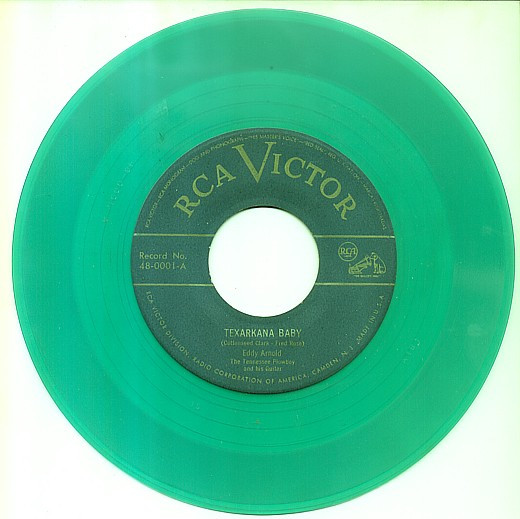
mp3: Eddy Arnold – Texakarna Baby (RCA Victor Green Vinyl & Label, 1949)
At first the 33 and the 45 had been seen by the 2 firms as competing codecs, however inside two years every had additionally adopted the opposite’s innovation, and the acquainted ‘single’ and ‘LP’ distinction shortly shaped throughout the entire trade.
That then, in a really giant nutshell, is the story of the vinyl document. Before I end, right here’s a few additional random bits of document information:
It is perhaps thought that the music album is a commodity born from the emergence of the 33 1/3 long-player within the Nineteen Fifties. However, the primary so-called ‘albums’ of music date again to the primary decade of the twentieth century. While a single 78 solely held three or 4 minutes of sound per aspect, longer items of music (corresponding to classical compositions) had been recorded onto a number of discs after which packaged collectively right into a book-like format, the place the pages had been the person document sleeves. Because of their resemblance to giant format photographic albums, already frequent to many households, the title was borrowed for the gathering of discs. The first such music albums had been classical collections (funnily sufficient) produced in 1908 and 1909. You might quickly purchase empty albums wherein to retailer your individual assortment of 78s, reasonably like these transportable CD instances you may presumably nonetheless get. When the 33 1/3 LP format grew to become established with the flexibility to carry a dozen or extra songs on one disc it grew to become the pure heir of the ‘album’ label.
Finally, there may be one other iconic expertise invented at virtually the identical time as Edison’s phonograph that has equally survived virtually unchanged into the present period – the bicycle. Aside from the development in supplies and variations for various terrain, the bike that Bradley Wiggins toured France on or Danny MacAskill rides down mountains is in its fundamentals an identical to the ‘security bicycle’ of the late 1870s that shortly consigned the penny farthing to historical past.
All of which should make my vinyl copy of Kraftwerk’s Tour de France Soundtracks the final word retro-modernist artefact, most particularly when it’s performed on this: https://peewee.com/2015/10/16/tgif-a-bicycle-that-plays-vinyl-records-on-its-wheels/
mp3: Kraftwerk – Tour de France
Fraser
Vinyl
by way of THE NEW VINYL VILLAIN https://ift.tt/o0vX8DO
May 30, 2024 at 07:00AM
-
Product on sale
 Audiophile Vinyl Records Cleaning BundleOriginal price was: €69.90.€59.90Current price is: €59.90. incl. VAT
-
Product on saleEasy Start Vinyl Records Cleaning KitOriginal price was: €69.90.€59.90Current price is: €59.90. incl. VAT
-
Vinyl Records Cleaner Easy Groove Concentrate€34.95 incl. VAT
-
Easy Groove Super Set€199.00 incl. VAT
-
Easy Groove Enzycaster – vinyl records prewash cleaner€34.95 incl. VAT
-
Easy Groove Extreme MK. II- vinyl records prewash cleaner€45.00 incl. VAT
-
Vinyl Records Cleaner – Easy Groove Virgin Concentrate€35.00 incl. VAT
-
Easy Groove Spray&Wipe vinyl records cleaner€34.95 incl. VAT


