
World News
Experiments in Concretism
Experiments in Concretism
Every whereas after which it’s helpful for every of us to cease for an inside debate on the ontology of recent summary artwork, this time concerning Concrete Art. Concretism is an artwork motion characterised by means of non-representational kinds, buildings and geometry. It was born in Europe within the Twenties and 30s within the thoughts of such artists as Theo van Doesburg (Netherlands), Max Bill (Switzerland) and later eg. Alberto Magnelli (Italy). And many others. It was van Doesburg who first based the group Art Concret, with a powerful emphasis on geometrical abstraction, and it was him who changed the time period ‘summary’ with a extra constructive ‘concrete’.
A joint manifesto from the May 1930 declares that (i) Work of artwork have to be completely conceived and formed by the thoughts earlier than its execution, and shall not obtain something of nature’s or sensuality’s or sentimentality’s formal information (no lyricism, drama, symbolism, and so forth); (ii) The portray have to be completely constructed up with purely plastic parts, particularly surfaces and colours (a pictorial component should not have any that means past itself); (iii) The building of a portray, in addition to that of its parts, have to be easy and visually controllable. (iv) The portray method have to be mechanic, and precise (ie. anti-impressionistic); (v) An absolute readability is necessary. (Wikipedia)
It adopted that for the artwork to be common, it should abandon all subjectivity and discover impersonal inspiration purely within the parts of which it’s constructed: line, aircraft and colour. Theoretically the origin of Concrete Art (pure abstraction) has been recognized with the synthesis of Russian Constructivism and Dutch Neo-Plasticism within the Bauhaus, in shut reference to structure and engineering (offering new supplies: metal, aluminium, glass, artificial supplies and so on.).
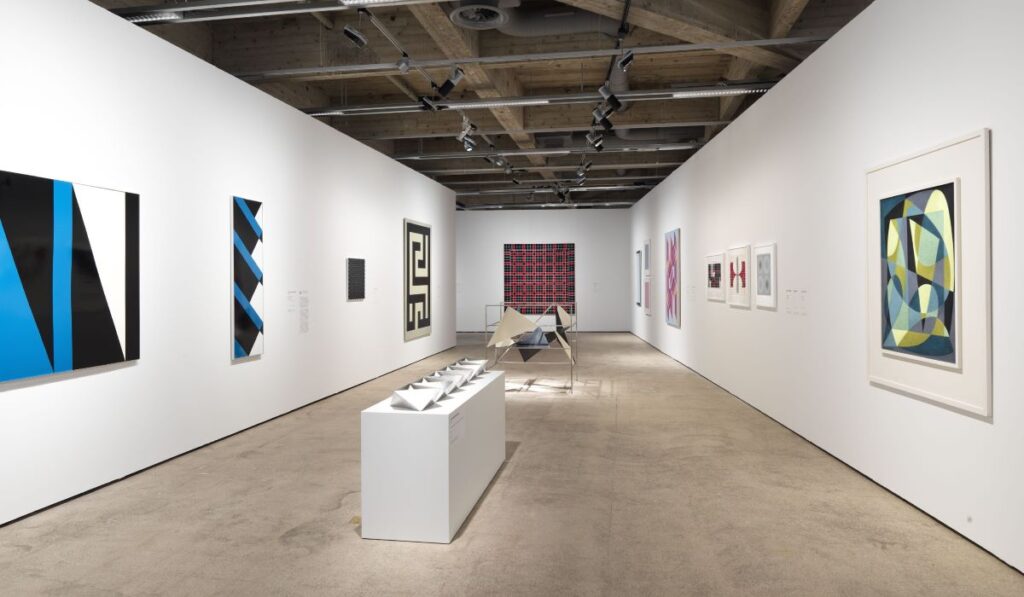
Experiments in Concretism (06.03.2024 – 02.03.2025) is an exhibition of the EMMA (Espoo Museum of Modern Art) that goals to takes a recent have a look at the range of concrete artwork, after 100 years of its invention. More than fifty artists from the Nineteen Fifties to the current day are represented. The works, chosen from the EMMA Collection (plus artworks acquired or commissioned particularly for this present), are stated to spotlight the formal selection and complexity of concretism and the range with which the featured artists use supplies, buildings and hues. Experiments in Concretism additionally celebrates the centenary of the start of Lars-Gunnar “Nubben” Nordström (1924–2014), a pioneer of Finnish concretism, by showcasing the legacy of his work.
COILS
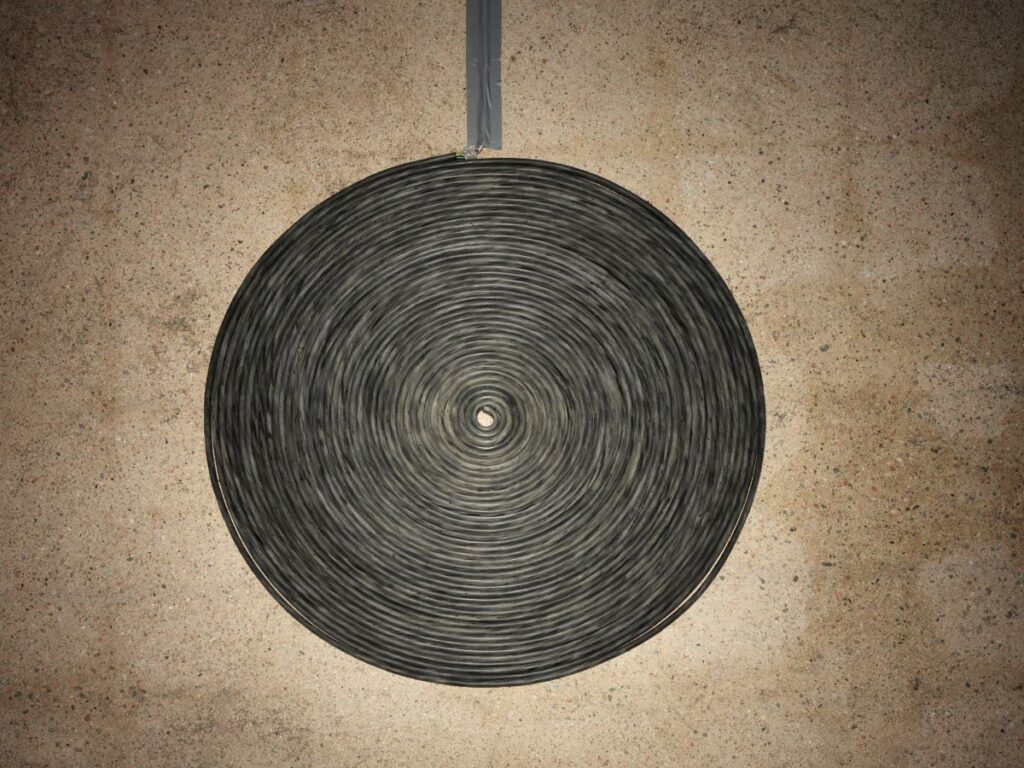
What could possibly be a extra acceptable starting to the journey towards ___ of concrete artwork than a coil, a chunk of electrical cable (conductor) wrapped right into a coil, simply as in Guðmundsson’s (b. 1941) Current Roll (1987). The objective is to make in any other case invisible electrical present inside a cable seen to the attention. “The finish of the cable will provide you with an electrical shock!” warns the textual content under.
SPIKES
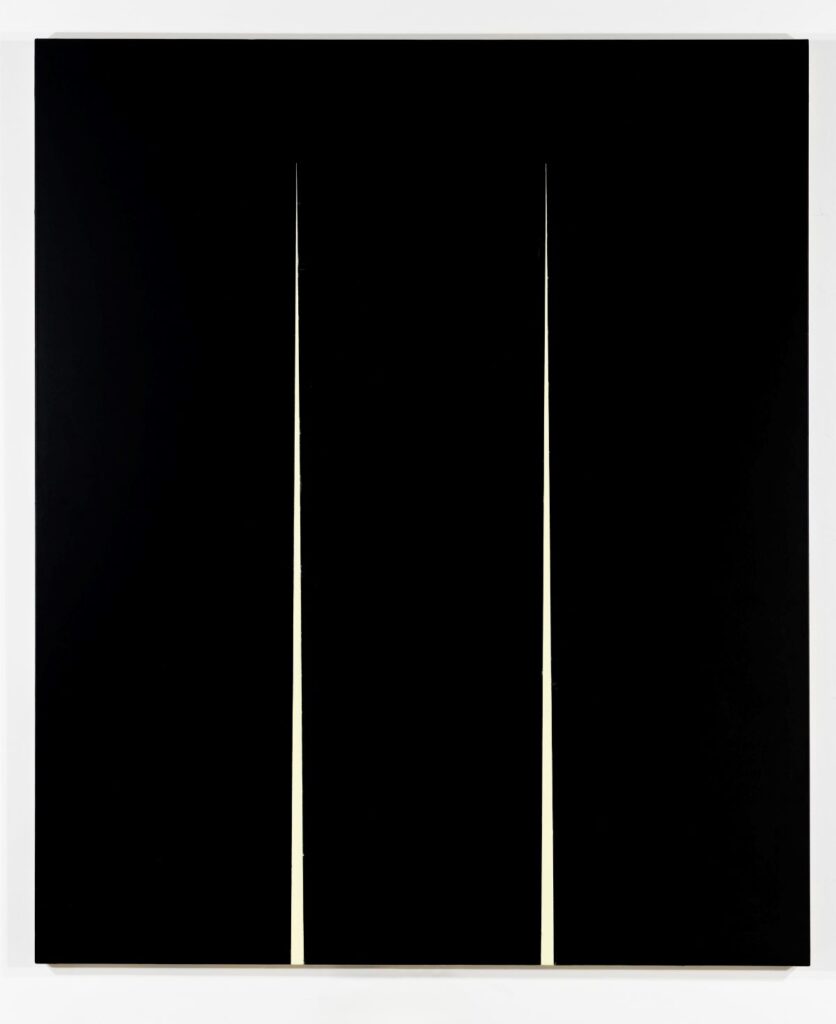
Geometric abstraction can take many kinds. Some artists within the custom are obsessive about the aesthetics of sharpness and spikes. In Ann Edholm’s (b. 1953) Lichtzwang the viewer sees a black floor with two white, slender, sharp shapes in entrance of it, however the work additionally appears to recommend a brilliant house in the back of the work behind a darkish curtain. Edholm says she seeks to achieve a way of the sacred and the bodily in her work.
SEVERE AND PLAYFUL
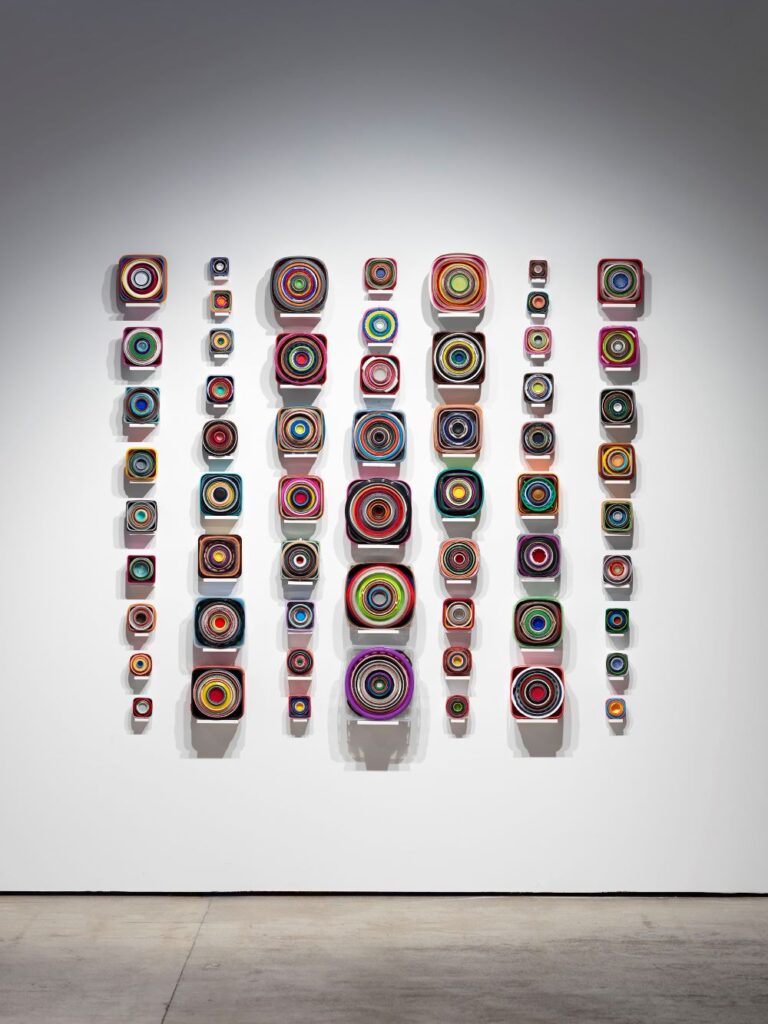
Abstract artwork, and concrete artwork particularly, usually seems extreme and strict, inhumane. And that’s because it ought to, however there are extra playful examples as properly. Maija Närhinen (b. 1967) makes her works principally with recycled supplies, equivalent to used spherical and rectangular plastic pots that match inside one another with precision. The colors, shapes and variations in measurement make the pots not stand nonetheless.
BLOCKS AND COLOURS
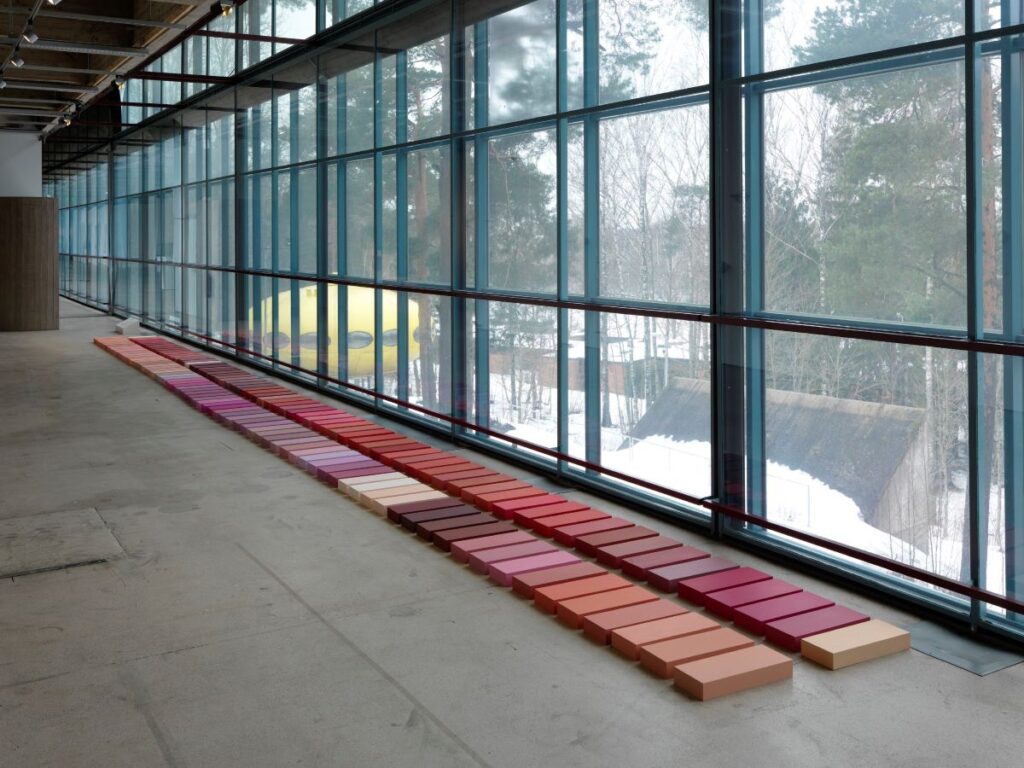
This work by Silja Rantanen’s (b. 1955), named as Knowledge on the Floor, follows the Doesburg’s manifesto to the letter. Simple plywood blocks (brick-shaped monochromatic objects) in colors taken from a lipstick colour chart. That’s it. The color samples are for Rantanen nothing however color charts, and she or he likes them simply as they’re, with out commenting any additional on modernism or gender identities.
FRAGILE
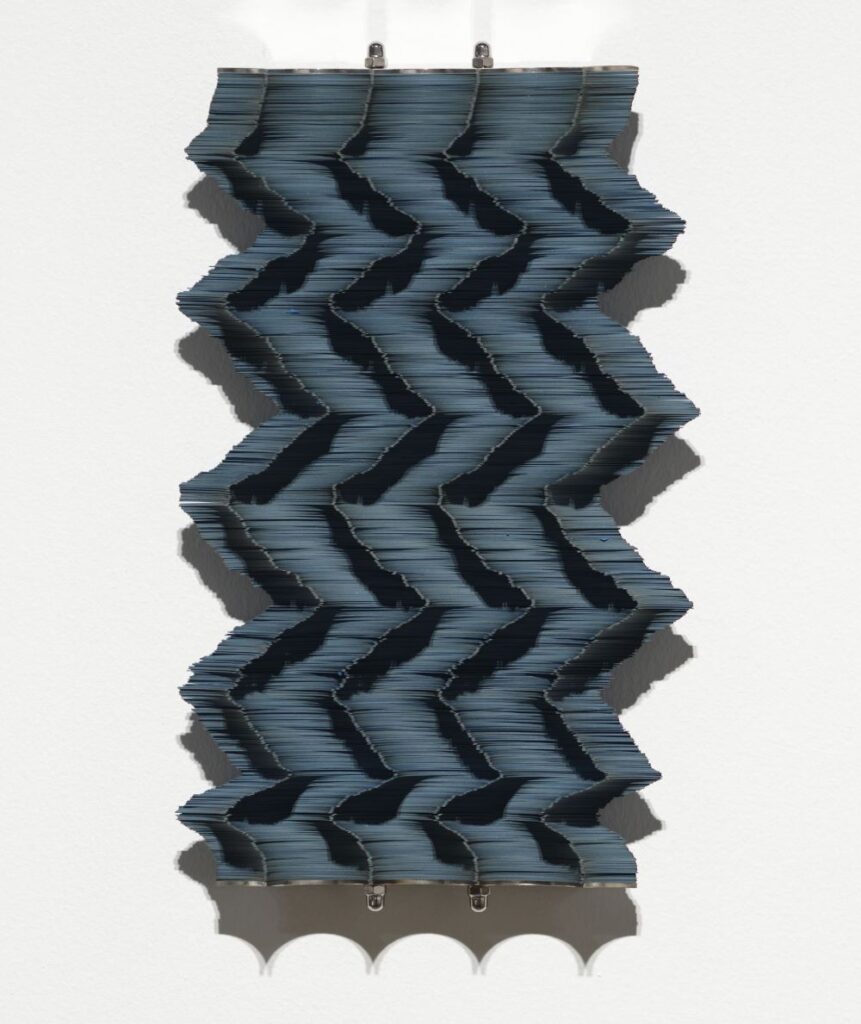
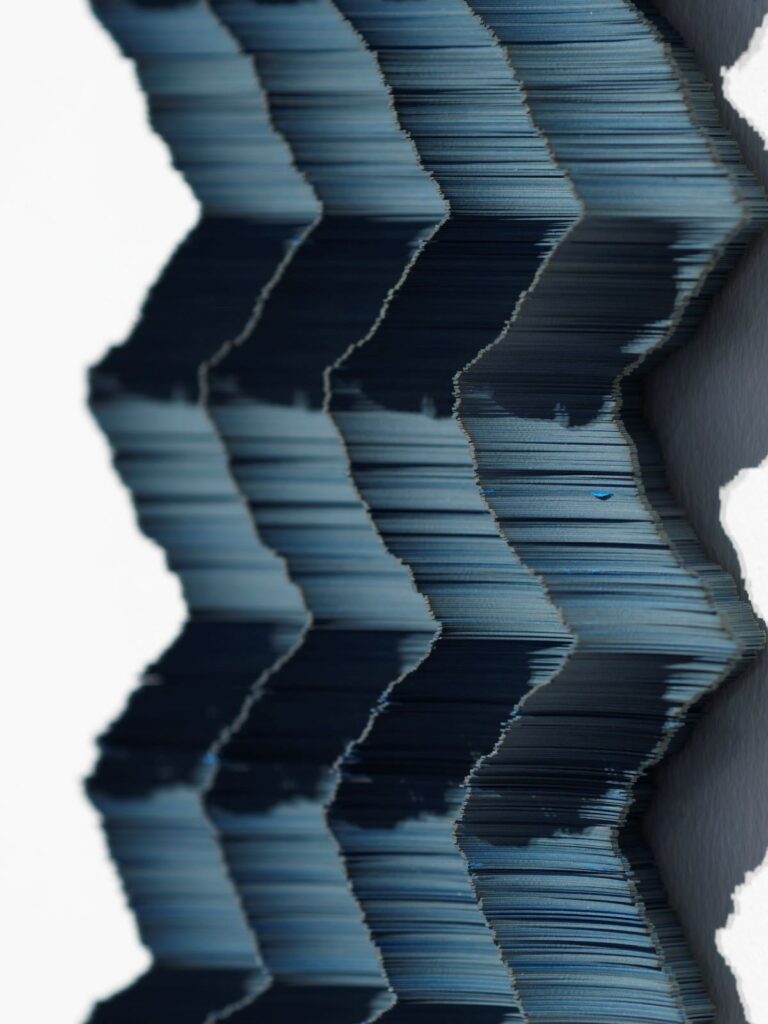
Many works of Concrete artwork play with the feel of the supplies. Inka Bell (b. 1981) works on colored utilizing repetition, layering and ranging shapes. The works look completely different from completely different angles and distances. In line with the necessities of concretism, Bell’s works escape verbal clarification or narrative, however her textures threat of being dangerously sensual.
FROM PAINTINGS TO 3D OBJECTS
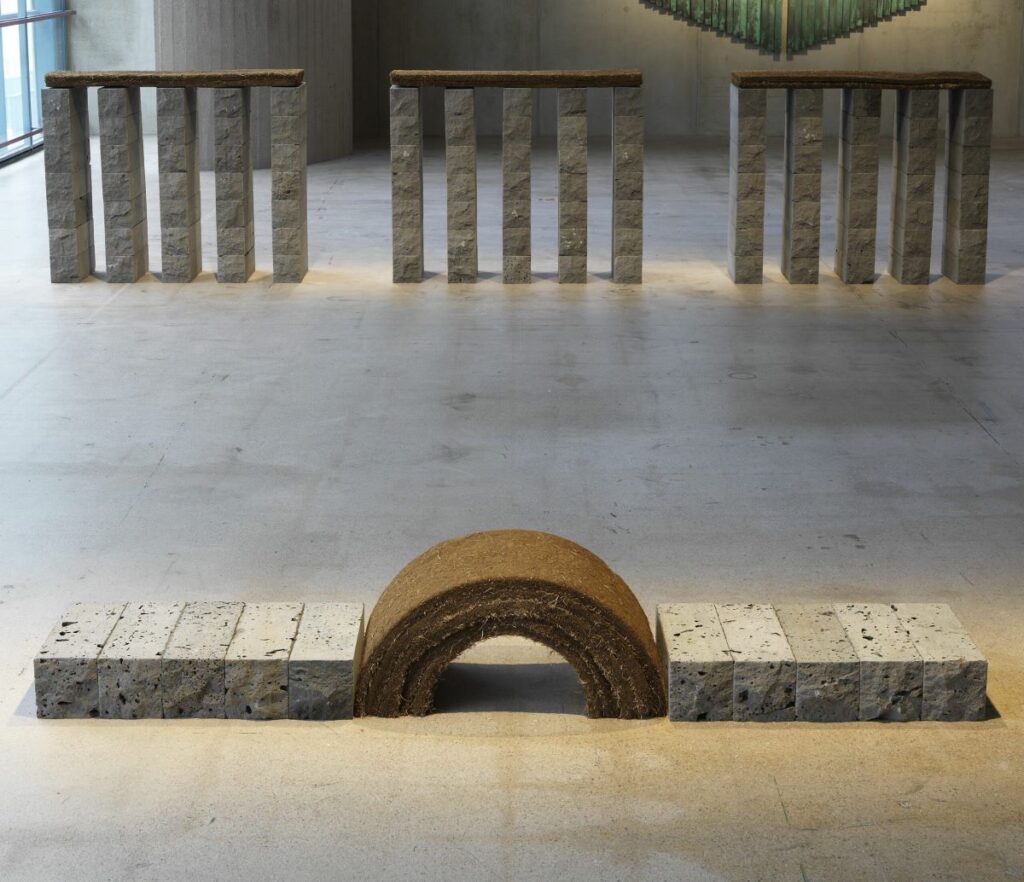
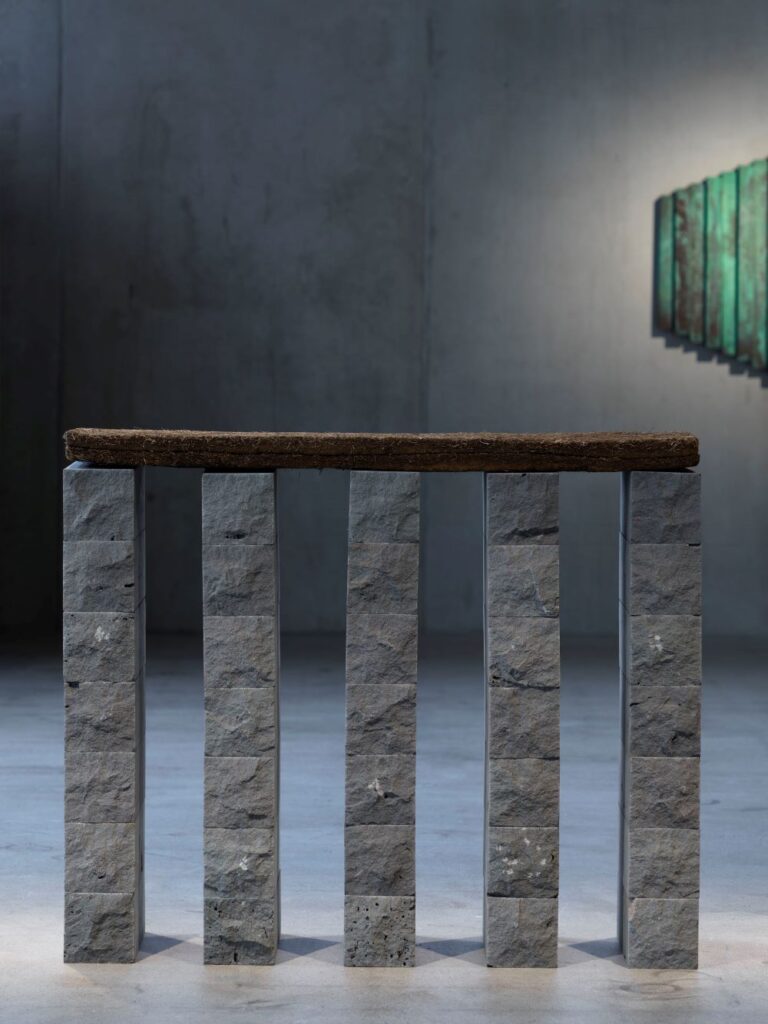
Fifties and Sixties onwards, the time period Concrete started step by step to be prolonged to different disciplines than portray, together with sculpture and images. Majority of the works at this exhibition aren’t work. The untitled work of Ragna Róbertsdóttir (b. 1945) include exactly stacked blocks of lava and peat. Both supplies are formed by the earth and are the outcomes of sustained processes. This work jogs my memory of Jopseph Boyes, and the works for which he used felt.
GEOMETRY
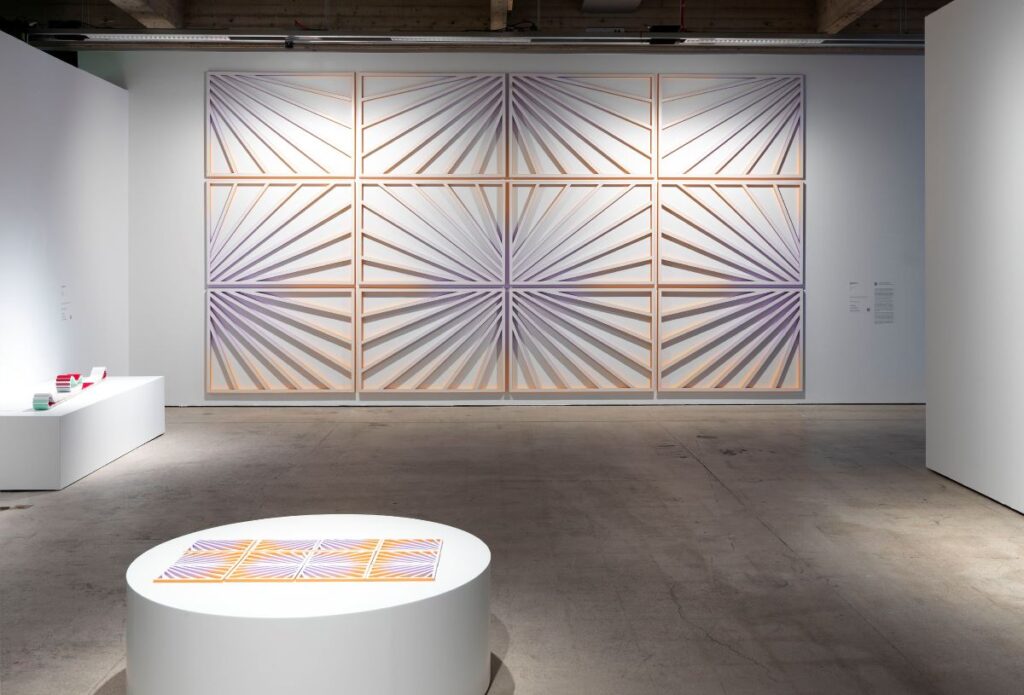
Team Play by Elina Autio (b. 1985) consists of twelve similar parts, which may be put in in numerous methods to create new variations. The work is made out of laminated veneer lumber from the development web site, together with triangular strips of wooden. This isn’t any exception as a result of aside from color, Autio’s sculptures and installations usually discover supplies and buildings, and make use of ready-made parts equivalent to pipes and battens. The geometric abstraction of the work reminds the mathematical works of Victor Vasarély.
A CONCRETE VIDEO
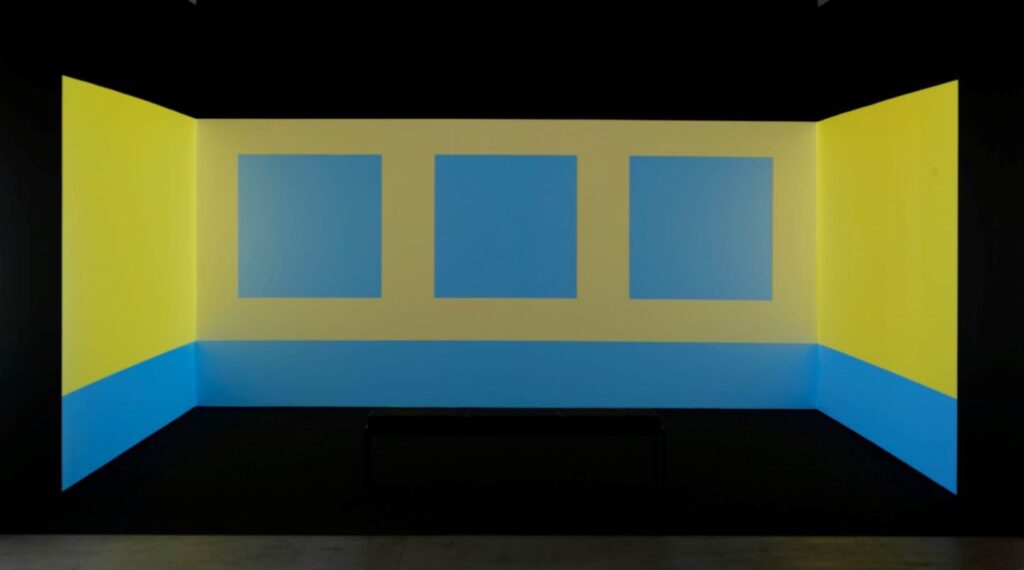
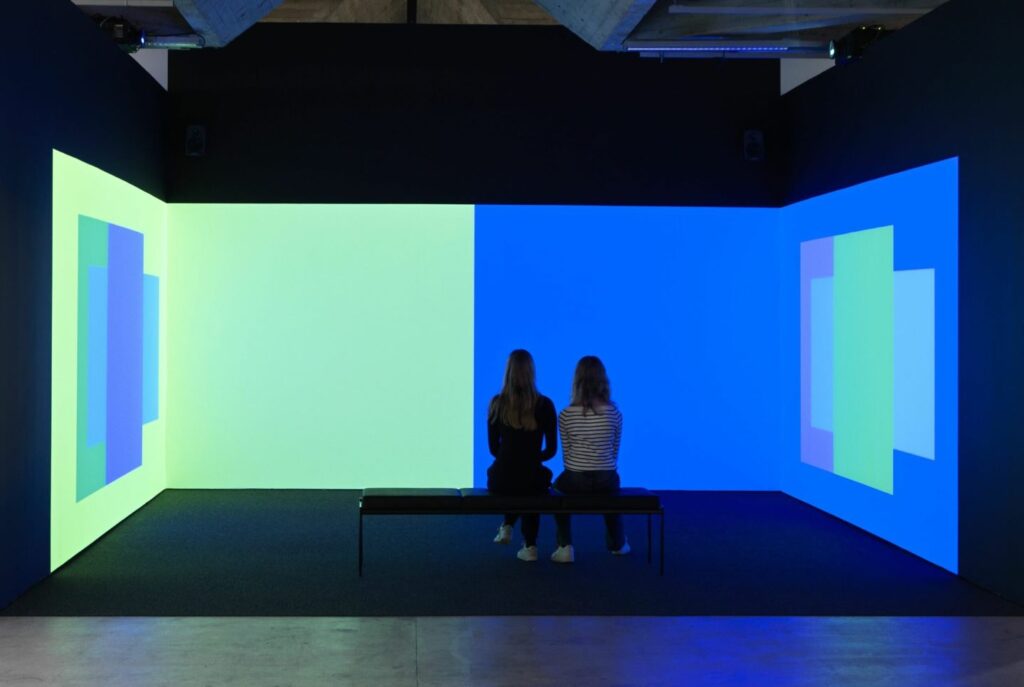
Pekka Sassi’s (b. 1969) video work COLOURS is non-representational geometric artwork in that its predominant working instruments are easy alternating shapes and hues. It’s an immersive 3D work surrounding the viewer, complemented by a relaxed soundscape. It pushes the standard boundaries of concrete artwork in direction of that of a holistic and religious expertise.
STEP ON ME
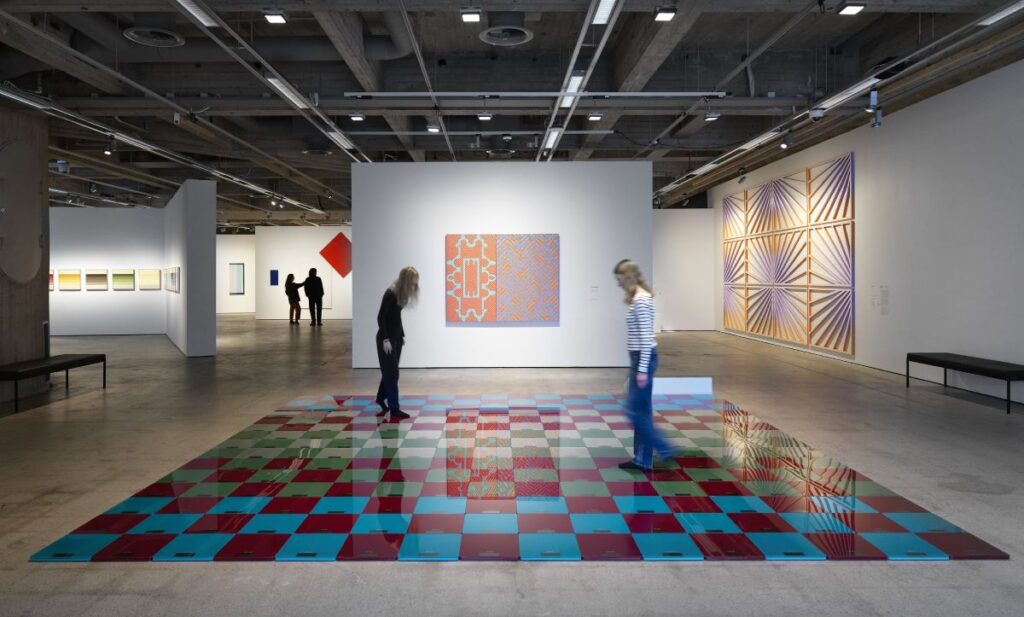
Jacob Dahlgren’s (b. 1970) Heaven Is a Place On Earth (2018) is made on 240 scales (on a regular basis materials) that may be stepped on. The work principally meets the factors of the Doesburg’s manifesto however the truth that it may be bodily skilled is a bit problematic mixing the expertise of artwork with on a regular basis life. Best summary artwork all the time distracts, not attracts. But it’s a geometric and symmetric work however. Food for thought.
WALL TEXTILES ON THE FLOOR
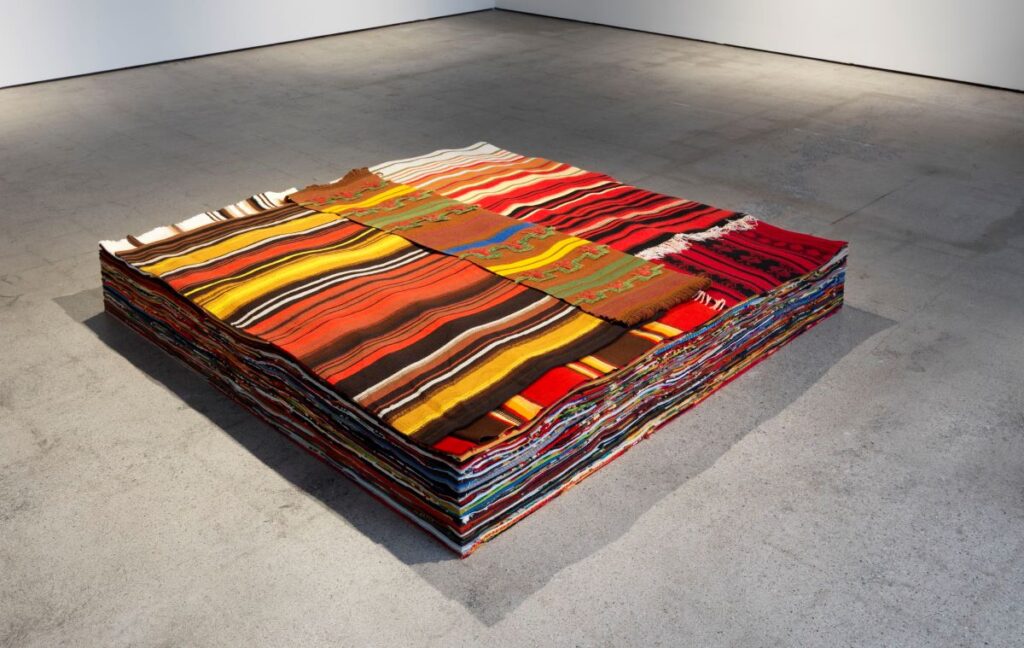
Elina Juopperi’s HERITAGE (2010) is made up of raanus, clean woven textiles that have been historically used as a blanket or overlaying on pole tents within the Northern Scandinavia. This is a a lot telling instance of a contemporary concrete artwork: a neat pile of textiles on a concrete ground dropped at a big artwork museum. The complete factor turns into summary, and the viewer is left along with her/his personal concepts and aesthetic impressions, activating and difficult the viewer’s schools of notion. Concrete artwork and summary artwork normally is extra concerning the viewer than on the item of artwork itself. The extra summary the work is, the extra religious it turns into. Superiority of concrete summary artwork in posing the ontological query is one in every of its main strengths.
Artists featured within the exhibition:
Timo Aalto, Martti Aiha, Siim-Tanel Annus, Elina Autio, Stig Baumgartner, Inka Bell, Juhana Blomstedt, Bård Breivik, Birger Carlstedt, Kari Cavén, Lars Christensen, Jacob Dahlgren, Sonia Delaunay, Ann Edholm, Carolus Enckell, Beryl Furman, Kristján Guðmundsson, Jorma Hautala, Erkki Hervo, Mikko Jalavisto, Elina Juopperi, Kaisu Koivisto, Ola Kolehmainen, Matti Koskela, Matti Kujasalo, Muriel Kuoppala, Antti Kytömäki, Leonhard Lapin, Maija Lavonen, Ernst Mether-Borgström, Eila Minkkinen, Sarah Morris, Kasper Muttonen, Pekka Nevalainen, Jussi Niva, Lars-Gunnar Nordström, Maija Närhinen, Paul Osipow, Kyösti Pärkinen, Ritva Puotila, Mari Rantanen, Silja Rantanen, Louis Reith, Ragna Róbertsdóttir, Pekka Ryynänen, Piila Saksela, Pekka Sassi, Hannu Siren, Sandra Sirp, Airi Snellman-Hänninen, Antti Ukkonen, Raimo Utriainen and Irma Weckman.
HI-FI News
through Inner Magazines https://ift.tt/9HCnOrb
July 21, 2024 at 06:16PM
-
Product on sale
 Audiophile Vinyl Records Cleaning BundleOriginal price was: €83.88.€73.88Current price is: €73.88. incl. VAT
-
Product on saleEasy Start Vinyl Records Cleaning KitOriginal price was: €83.88.€73.88Current price is: €73.88. incl. VAT
-
Vinyl Records Cleaner Easy Groove Concentrate€41.94 incl. VAT
-
Easy Groove Super Set€238.80 incl. VAT
-
Easy Groove Enzycaster – vinyl records prewash cleaner€41.94 incl. VAT
-
Easy Groove Extreme MK. II- vinyl records prewash cleaner€54.00 incl. VAT
-
Vinyl Records Cleaner – Easy Groove Virgin Concentrate€42.00 incl. VAT
-
Easy Groove Spray&Wipe vinyl records cleaner€41.94 incl. VAT







