
World News
Amplifier Classes
Amplifier Classes
Class D would be the future (i.e. the current), however traditional AB circuits are nonetheless very a lot in excessive demand even within the hi-fi mainstream. Naturally, this invitations exhaustive discussions in regards to the technical and sonic professionals and cons, however that’s not what we’re right here for immediately. Instead, let’s get the basics of this complete alphabet soup sorted: What do these “courses” even imply?
Circular sections
There is a complete vary of amplifier courses, however for hi-fi purposes the working courses A, B, AB and D are significantly related. Let’s have a look at courses A and B first, as they comply with a uniform fundamental precept: They are outlined in keeping with the proportion of the enter sign over which the amplification units (be it transistors or tubes) conduct present, the place the period of the conductivity is expressed as an angle. I do know this sounds summary, however it shortly turns into clear if we take into account a sine wave because the enter sign. The whole wave is analogous to a full circle, i.e. it corresponds to 360 levels, so a half-wave “lasts” 180 levels – there you go, period expressed as an angle. So, if an amplification gadget carries present over the complete wave, it’s operated with a conduction angle (additionally referred to as line angle) of 360 levels; a component that solely reproduces a half-wave and is switched off in the course of the reverse half of the wave is operated with an angle of 180 levels. And with that we have now already outlined our first two courses: Class A merely implies that the transistor or tube carries present completely, whereas Class B describes a line angle of 180 levels.
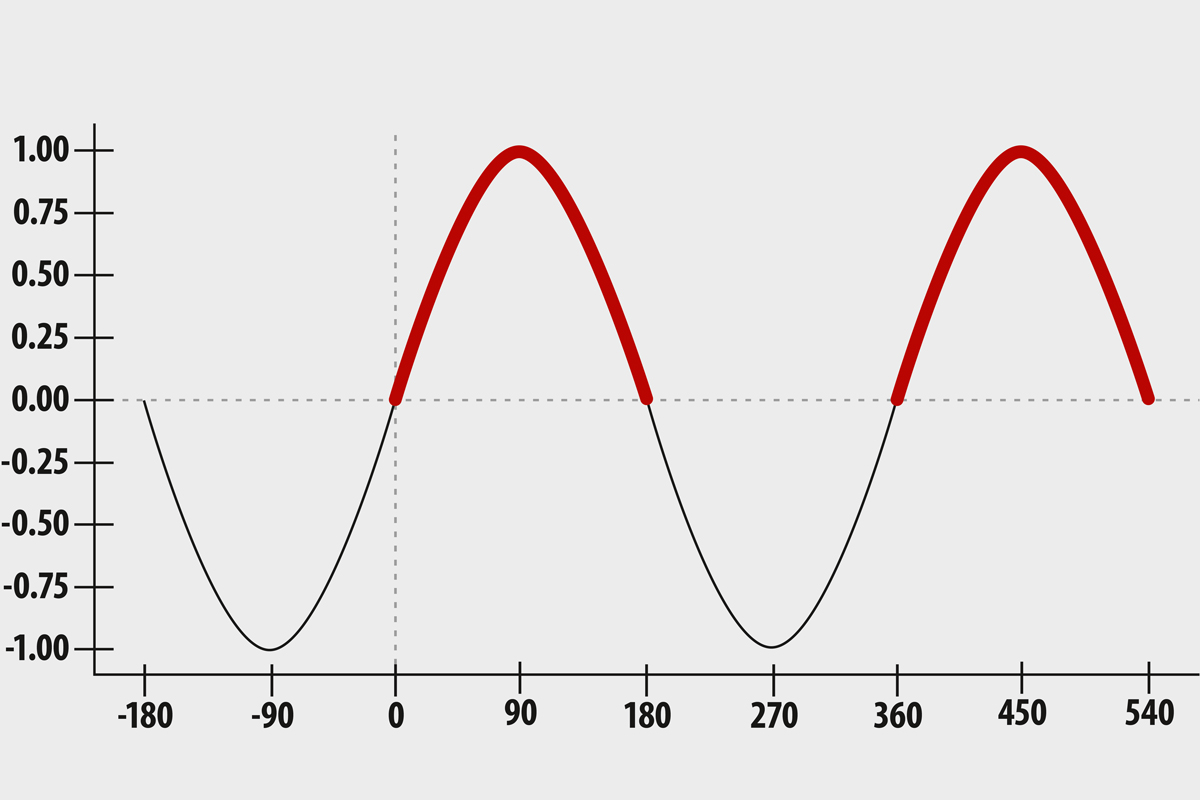
However, if we solely permit 180 levels to cross, we inevitably lose half of the sign – additionally, why not have the ingredient conduct completely within the first place? Since music consists of strain peaks and dips which can be electronically translated into constructive and detrimental voltage swings, it is sensible to manage an amplification ingredient in such a means that it might modulate the voltage in each instructions from the middle of its working vary and thus merely monitor the complete sign. In reality, that is the working precept of the technically easiest amplifier topology: single-ended amplifiers. While these are nonetheless considered the Holy Grail of sound high quality, they sadly additionally undergo from awful effectivity by design. After all, the amplification gadget works up or down from the center of its attribute curve, which additionally implies that it’s completely energized – no matter whether or not a sign is current or not. As it modulates the voltage up and down from this level, it delivers, on common, precisely its full energy energy output, irrespective of if it’s idling or taking part in music at full blast – it’s a bit like bolting the throttle to the ground pan in a automobile, then controlling the pace by modulating the brakes.
Ripped aside and made complete once more
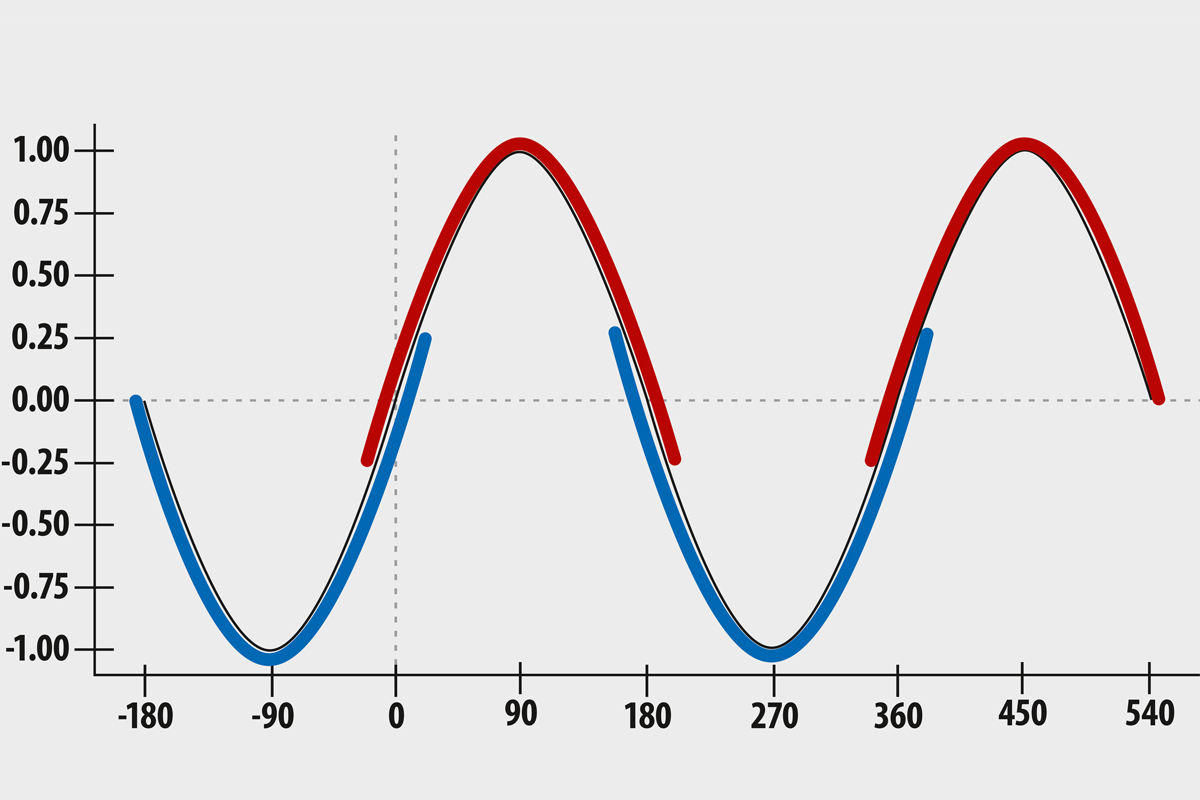
For causes of power effectivity, it’s subsequently fascinating to decrease the bottom voltage from which the gadget swings up and down, and even set it to zero. But because of this we acquire headroom for the upswing whereas giving up “backside room” for the downswing, which means that geometrically talking, we will not map the complete wave to the amplification gadget’s attribute. This downside will be prevented by merely splitting the sign into two half-waves and transferring them to 2 oppositely doped transistors (npn and pnp). This working precept is called push-pull amplification. Each of the transistors then solely works over “its” 180 levels of the sine wave, which brings us again to our class B. This is elegant and environment friendly, however comes with two drawbacks: firstly, transistors don’t change from the primary millivolt, however relatively need to be pushed past a threshold voltage earlier than they “get up” – the sign would subsequently be briefly interrupted at every transition between the wave halves, which is unacceptable in music copy; pure Class B amplifiers are subsequently not likely a factor in hi-fi.
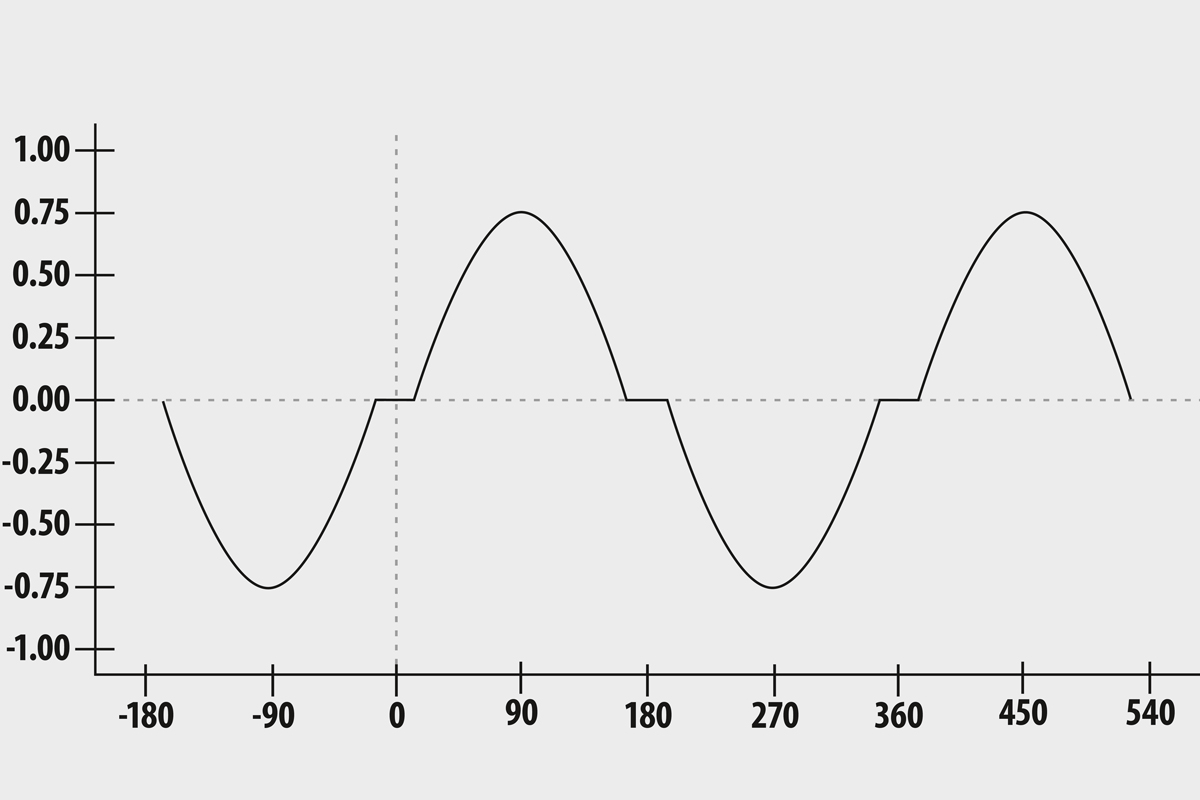
Instead, a neat little trick is used: a small quiescent present (referred to as idle present od bias present) is utilized that retains the amplification ingredient completely above the brink voltage and likewise permits it to transmit at the least a small a part of the other half of the wave, which will increase the road angle to greater than 180 levels – and that is exactly how a Class AB circuit is outlined; if the idle present is about such that each parts conduct over the complete 360 levels, we’re as soon as once more speaking pure Class A, even when it’s a push-pull amplifier.
Even although Class AB solves the brink voltage concern, distortion nonetheless happens because of the alternate switching of the amplification units within the transition between the wave halves. As the lively phases partially overlap because of the elevated conduction angle, this downside solely arises when the sign amplitude exceeds the bias present – beneath this, each amplification units stay repeatedly lively, and since they by no means change off, no switching-related distortion happens. In this sense, a category AB amplifier isn’t even a compromise amplifier, because it operates in precise class A at low masses and solely switches to class B at increased amplitudes. In high-quality amplifiers, the idle present is subsequently usually set fairly excessive in order that they’ll ship, say, round ten p.c of their rated energy at school A. This could not sound like a lot, however in case you take into account that in most of a traditional listening session, lower than one Watt per channel is used, such designs normally run virtually repeatedly in Class A mode whereas providing loads of energy reserves for dynamic peaks.
Rounded peaks
Finally, Class D describes a very completely different means of utilizing amplification units. Whereas the working modes described thus far modulate the conductivity of the weather between the brink and saturation factors, class D solely distinguishes between on and off and normally represents the tour curve utilizing pulse width modulation (though pulse frequency modulation can be used): The period of the on versus off state over a sure time period leads to a median sign amplitude. If the switching interval is about orders of magnitude increased than the best frequency to be reproduced – for the audio vary, that may be just a few hundred kilohertz, and even significantly increased – and the bandwidth is then restricted to a smart higher cut-off frequency via a low-pass filter, the output doesn’t “see” numerous switching operations, however relatively a sign amplitude that varies easily over time to precisely symbolize the amplified music sign.
The submit Amplifier Classes appeared first on Fidelity Magazine.
HI-FI News
by way of Fidelity Magazine https://ift.tt/Ta1bvVr
April 28, 2025 at 03:32PM
-
Product on sale
 Audiophile Vinyl Records Cleaning BundleOriginal price was: €83.88.€73.88Current price is: €73.88. incl. VAT
-
Product on saleEasy Start Vinyl Records Cleaning KitOriginal price was: €83.88.€73.88Current price is: €73.88. incl. VAT
-
Vinyl Records Cleaner Easy Groove Concentrate€41.94 incl. VAT
-
Easy Groove Super Set€238.80 incl. VAT
-
Easy Groove Enzycaster – vinyl records prewash cleaner€41.94 incl. VAT
-
Easy Groove Extreme MK. II- vinyl records prewash cleaner€54.00 incl. VAT
-
Vinyl Records Cleaner – Easy Groove Virgin Concentrate€42.00 incl. VAT
-
Easy Groove Spray&Wipe vinyl records cleaner€41.94 incl. VAT







