
Audio News
Audiovector R 5
Audiovector R 5
https://ift.tt/0f82ewi
Audiovector has been crafting speakers of all sizes for 45 years. The Audiovector R 5 floorstanding loudspeaker draws upon a rich design lineage, not just distant history. The new R 5 leans heavily on the company’s current R 10 flagship (which we tested in Issue 243). It sits between the R 3 Arreté (tested in Issue 253) and the R 6 (tested in Issue 191), and it sits in the same price bracket as the Trapeze Reimagined (tested in Issue 231). In the wider world beyond Audiovectorland, it enters a highly competitive market segment.
That creates a challenging path, likely resolving in one of three directions. It could be a ‘bitza’ product that scavenges the parts bin for middling performance. It could be the ‘superstar’ product so strong it cannibalises half the catalog. Or, it could be the well-balanced ‘tweener’ that slots neatly into the lineup. The R 5 sits between ‘superstar’ and ‘tweener.’ It delivers a genuine upgrade for R 3 Arreté owners without stepping on the Trapeze Ri’s sonic toes. It also offers a taste of what the R 6 and beyond can achieve. Yet it does this without undermining or diminishing the R 5’s larger siblings.
No halfway measures
The R 5 is a three-and-a-half-way loudspeaker with a down-firing bass reflex system. That extra half-way section lets one bass driver operate higher into the lower midrange, while the second bass driver concentrates on deep bass extension. This enhances dynamic headroom, reduces intermodulation, and improves overall clarity. Additionally, venting low-frequency energy toward the floor smooths bass integration across different placements.
These two elements help give the R 5 a weighty, deep bass extension while preserving the slim, streamlined lines of the R series floorstanders. This matters more than it might seem at first glance. There seems to be an unwritten – and often unnecessary – inflexion point in loudspeaker design. The clean, domestically friendly aesthetics of the company’s early models can give way to something more ‘statement-like.’ The R 5 ventures into that danger zone, where ‘aesthetically pleasing’ could tilt toward exaggerated lines that verge on the grotesque. Fortunately, Audiovector remains distinctly Scandinavian in its design criteria… in all the right ways. It is large enough to offer a meaningful performance gain over the R 3 without being an intimidating presence for those sharing the listening space.
No ice forming
I’ll be frank: you’re not immune to such pressures even when evaluating audio gear professionally. A frosty reception—“How long will those last?”—is a clear sign that a product has crossed the aesthetic Rubicon. In some cases, ice forms on the partner’s tolerance within moments. Audiovector, however, has stayed mercifully free from arctic blasts. The R 5 is no exception.

Similarly, the down-firing port means the Audiovector R 5 is comparatively easy to place in most listening rooms. It needs some space and benefits from sitting a bit further into the room than the brand’s smaller models. However, it does not incorporate the rear-firing drivers found in the R 6 and beyond that require deeper room placement.
It also demands high-quality equipment partnerships and an installation commensurate with its performance. But that doesn’t require a complete system rethink or speaker positioning overhaul. A three-position damping control makes the R 5 uniquely adaptable, allowing it to match the damping factor of mid-to-high-damping-factor amplifiers, as well as the low-damping-factor of valve amps. A degree of experimentation to find the optimal setting is worthwhile. In short, the R 5 delivers solid performance under most conditions, but extra care and setup can unlock truly first-rate performance—the kind of sound that trickles down from the R 10 flagship.
Drawing inspiration
It’s easy to say a loudspeaker draws inspiration from a flagship design. It’s something else to actually do it. The R 5 borrows from the R 10 range-topper in areas such as its midrange driver. It is the first model outside the flagship to feature the second generation of the company’s Freedom Grounding system. It is also the first model outside the R 10 to incorporate Audiovector’s Accelerated Force Concept (AFC), developed to minimise inertia during the critical first millimetres of diaphragm movement. Instead of a conventional heavy half-roll surround, the driver uses a lightweight concertina suspension made from a carefully developed rubber compound. This reduces mechanical resistance.
Additionally, the motor structure has been redesigned to improve magnetic symmetry, yielding a more balanced magnetic field around the motor. This enhances control of the drive unit (the component responsible for converting electrical signals into sound) throughout its excursion (the motion of the speaker cone back and forth) and improves its initial acceleration.
Low Compression Concept
This design works in tandem with Audiovector’s Low Compression Concept (LCC), which reduces air pressure build-up behind the driver (the moving part that creates sound), improving transient response (how quickly the speaker reacts to input changes) and granting greater freedom under dynamic loads (changes in sound intensity).
The R 5 also uses the latest version of the company’s Air-Motion Transformer (AMT) tweeter—a high-frequency driver that moves air rapidly using a folded diaphragm, rather than a dome or cone. This tweeter was first introduced with the R 10 model. The updates here are refinements of previous technology rather than entirely new developments.
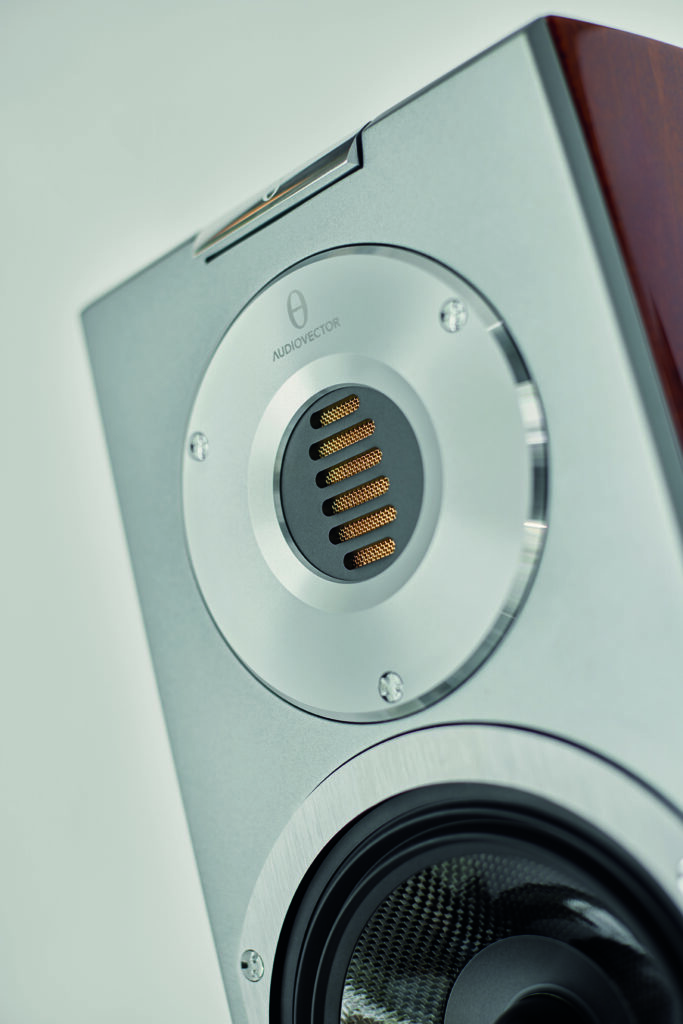
Several features distinguish the R 5 as a unique model. Most notably, the Arreté plinth has a larger footprint and an open-slot design. The wider base enhances energy distribution, improves floor coupling, and lowers the speaker’s centre of gravity. The open-slot design also benefits the reflex port by reducing turbulence and compression. The Arreté-level crossover network features carefully selected components that are twice cryogenically treated.
No signature required
These last improvements imply that the R 5 is an Arreté-grade product. That could use some explanation. Models like the R 1 and R 3 come in two grades. The ‘Signature’ models are best recognised by their use of a soft-dome tweeter, a dome-shaped component that produces high-pitched sounds by moving air with a soft diaphragm. Meanwhile, ‘Arreté’ replaces that driver with the company’s own AMT (Air Motion Transformer) folded ribbon high-frequency unit, a device that moves air using a pleated membrane for clearer treble. ‘Arreté’ also adds cryogenic component treatment (a process exposing parts to extremely low temperatures to potentially enhance performance), Freedom Grounding (a grounding method to reduce electrical noise), a carbon terminal plate, and the company’s internal damping and shock absorption techniques (features designed to reduce unwanted vibrations within the product).
There is no ‘Signature’ version of the R 5. So, the need to assign it the ‘Arreté’ suffix goes away, as with the larger models in the range. However, that also invites a philosophical discussion that extends to the rest of the R range: should every model simply be at Arreté level performance? Looking at current trends (and the vibrant Audiovector owners group on Facebook), most buyers today choose the QR or Arreté level loudspeaker for their size. I wouldn’t be surprised to see future models that replace the R 1 and R 3 with a single performance grade.
Covers ground
The Audiovector R 5 is one of those products that covers a lot of ground. It’s a loudspeaker that simply fits in. It fits in most rooms and with most systems. If you lean toward a particular musical genre or enjoy a bit of everything, it matches your taste. Prefer polite or club-level volume? The R 5 fits there too. In short, it fits perfectly within the Audiovector line. It contrasts well with the Trapeze Ri. It’s an ideal upgrade from the R 3 Arreté, yet there’s more in the R 6 and beyond. Far from being ‘filler’ in an established range, it completes the lineup.
As you’d expect from an Audiovector loudspeaker, the R 5 delivers clean, clear sound with a fine sense of rhythm. The treble is delicate, sweet yet extended, fast, and focused. The midrange is articulate and communicative. The bass is deep, yet taut and tidy. The R 5 creates an excellent, three-dimensional image. Its dynamic range—both broad and nuanced—is expressive and powerful. There is less distortion from the drivers, less coloration from the cabinet, and—especially with Freedom Grounding—less noise from the crossover. Whether you are familiar with Audiovector or hearing it for the first time, the R 5 sound is sure to impress and uplift.
More than terms
I’ve grouped the usual audio terms together because that’s only the start of the R 5 experience. Beyond those elements is how the Audiovector R 5 brings everything together to make music. It does not differentiate at all. You can be as musically eclectic as you like with these loudspeakers; nothing fazes them. I moved from Mahler’s Second Symphony’s symphonic bombast to the Unthanks singing acapella in a tiny pub back room, and everything in between. In each case, the R 5s revealed the information and the enjoyment equally.
Of course, part of that is because the Audiovector R 5 can play loudly, but they aren’t simply boomboxes. There are trends in high-end audio demonstrations, and Audiovector brought Danish DJ and producer Hedegaard into the mix. Hard techno tracks like ‘Rachets’ and ‘Inferno’ are used by many high-end brands to show their products aren’t just for delicate audiophile listening, but Audiovector was there first. And in the R 5, it demonstrates that many rivals still have a way to go to catch up.
Visceral aplomb
The R 5 handles these recordings with aplomb: a visceral, pounding beat, fast-attacking synths, and vocal transparency that lets you hear what’s spoken clearly even amid such a dense recording. It makes sense of this fast-paced track, whether played softly or at organ-quenching levels. The tight rhythmic properties of the R 5 are best heard mid-way through ‘Rachets’ by Hedegaard; when the beat returns, it does so with all the pace and excitement you’d want. This can be a double-edged sword in the wrong hands; a lively loudspeaker can sound too forward and edgy. But the R 5 stays just on the right side of ‘bright’ for all but the most traditional listeners.
Beyond the bass energy and drive, there’s a deceptively subtle and agile loudspeaker here. That midrange unit from the R 10, together with the latest AMT tweeter, helps deliver an extremely articulate and transparent vocal presentation. You hear every scintilla of information, from the finger noises on an acoustic guitar to the quality of a singer’s embouchure and its impact on their tone and articulation; it all just makes more sense. Those “surprising” recordings – such as Nick Cave singing Leonard Cohen’s ‘Suzanne’ – feel less surprising because you recognise the voice faster. That doesn’t detract, though. As your brain spends less time thinking ‘who is that?’, you simply enjoy the performance.
A red thread
That line about enjoying the performance ran through my listening notes like a red thread. It put everything else in a distant second place. Yes, imaging is superb. OK, the bass is fast, deep, and very tuneful. Sure, vocals are clear and distinct. But underpinning all of that is a sound that never forgets that people love listening to music. It’s a speaker that puts a smile on your face even before your foot taps.
The Audiovector R 5 hits the ground running. It joins the Trapeze Ri as one of the loudspeakers you should hear at this price. More importantly, like the Trapeze Ri, it places music—rather than merely polite hi-fi sounds—at the center of your life. This R 5 represents Audiovector at its finest!
Technical specifications
- Type: three-and-a-half-way ported, down-firing loudspeaker
- Drive units: 3800 AMT N 51 tweeter, 6.5” AFC carbon sandwich midrange, lower-midrange and bass drivers
- Frequency Response: 23Hz-53kHz
- Sensitivity: 90dB
- Nominal Impedance: 8Ω
- Minimum Impedance: 3.6Ω
- Crossover frequencies: 200Hz, 600Hz, 3kHz
- Finishes: Black Piano, White Silk Matte, African Mahogany Piano, Italian Walnut Matte. Custom paint finishes available on request.
- Size (WxHxD): 111cm x 22cm x 41cm (with plinth width and depth 26cm x 48cm
- Weight: 32.1kg per pair
- Price: £17,950, €19,950, $24,500 per pair
Manufacturer
Audiovector
Home Page: audiovector.com
R5 Product Page: audiovector.com/r-5/
Where to buy: audiovector.com/where-to-buy/
UK distributor
Renaissance Audio
+44(0)131 555 3922
The post Audiovector R 5 appeared first on hi-fi+.
HI-FI News,Audio
via Articles Archive – hi-fi+ https://ift.tt/5FTHzaG
May 13, 2026 at 12:37PM
-
Product on sale
 Audiophile Vinyl Records Cleaning BundleOriginal price was: €69.90.€59.90Current price is: €59.90. incl. VAT
-
Product on saleEasy Start Vinyl Records Cleaning KitOriginal price was: €69.90.€59.90Current price is: €59.90. incl. VAT
-
Vinyl Records Cleaner Easy Groove Concentrate€34.95 incl. VAT
-
Easy Groove Super Set€199.00 incl. VAT
-
Easy Groove Enzycaster – vinyl records prewash cleaner€34.95 incl. VAT
-
Easy Groove Extreme MK. II- vinyl records prewash cleaner€45.00 incl. VAT
-
Vinyl Records Cleaner – Easy Groove Virgin Concentrate€35.00 incl. VAT
-
Easy Groove Spray&Wipe vinyl records cleaner€34.95 incl. VAT


