
World News
Aurorasound HFSA-01 built-in amplifier
Aurorasound HFSA-01 built-in amplifier
Audiophiles are sometimes misunderstood as mere hobbyists; in truth they maintain a profound reverence for sound. Japanese jazz kissas, the place classic vinyl, turntables, tube amplifiers, and horn audio system have drawn audiences for the reason that Nineteen Fifties, exemplify this ardour. Western audiophiles share an analogous fervor, although our pursuit of sonic perfection usually manifests in a extra discreet, nearly monastic, way of life (footnote 1).
Shinobu Karaki, a 65-year-old electronics designer, is the founder and chief designer of Japan’s Aurorasound. A music lover first, an audiophile second, and an aspiring jazz and classical guitarist, Karaki crafts phono phases, step-up transformers, preamplifiers, energy amplifiers, and built-in amplifiers for his Yokohama-based audio firm.
Prior to founding Aurorasound in 2010, Karaki held the place of Digital Audio Group Business Director at Texas Instruments Japan, the place he amassed practically three many years of expertise in analysis and improvement. Earlier, in his early life, Karaki attended Osaka University and Yokohama Polytechnic, incomes levels in digital engineering and enterprise. His experience enabled him to design and manufacture a variety of high-performance amplifiers and DACs, ensuing within the small bounty of merchandise presently obtainable from Aurorasound.
Despite its modest dimensionthe corporate employs 4 individuals, together with Karaki and his spouseAurorasound has cultivated a world following, with merchandise distributed in 12 nations throughout Asia, Europe, and the United States. The lineup, obtainable within the US via a small supplier community serviced by California distributor HighFinish Electronics, contains three phono phases, a multicurve phono equalizer, two step-up transformers, two preamplifiers, and a $20,790 pair of tubed monoblocks. This overview focuses on the most recent addition to the corporate’s choices, the Aurorasound HFSA-01 Integrated Tube Amplifier ($3680).
Design
The HFSA-01brief for High Fidelity Stereo Amplifier Onereverses the standard hybrid method, utilizing 10 Texas Instruments OPA604 FET op-amps to drive 4 Sovtek EL84 pentode tubes working in Ultralinear, class-AB, push-pull mode and outputting a most of 14Wpc with an 8 ohm load. Why reverse the extra typical hybrid method? Karaki has his causes.
"HFSA-01 makes use of tubes and semiconductors," Karaki defined over e mail. "The enter stage, tone controller, and phono EQ stage are all semiconductor designs. Also, the part inverter and driver for the EL84 tubes is a semiconductor circuit. Only the output stage [uses] the EL84 tube. A semiconductor has very low distortion, good S/N ratio, and longer life than tubes. The EL84 tube is straightforward to drive at low bias, so a semiconductor can drive the tubes simply, and it makes a great part inverter for each push-pull tubes. Small dimension, decrease value, longer life, much less failure, and low energy consumption are benefits over an all-tube resolution. The sound character primarily is determined by the tubes, so HFSA-01 has actual tube sound."
I requested in regards to the sound he was looking for. "I needed to develop a singular and unique design for a tube energy amplifier that has push-pull tubes and an output transformer. The Texas Instruments OPA604 semiconductor could make excellent optimistic and unfavourable sign for a push-pull design and may drive a 600 ohm load. The EL84 tube’s bias stage is 1213V, so this building makes a great push-pull amplifier for an EL84."
The HFSA-01 is a compact 14" huge × 5.7" excessive × 12.5" deep and weighs simply 23lb. The high cowl, shell, and backside plate are product of 1.2mm-thick iron, suggesting it means enterprise. Its fascia and rear plate are 3mm-thick aluminum, anodized with a hairline end. Chunky mahogany trim adorns the amplifier’s sides, projecting out on both sides of the fascia. The HFSA-01 is sturdily constructed, and its retro enchantment "seems the dickens" as my mother would say. It resembles a ’50s built-in tube amp from H.H. Scott or Dynaco, I’d say.

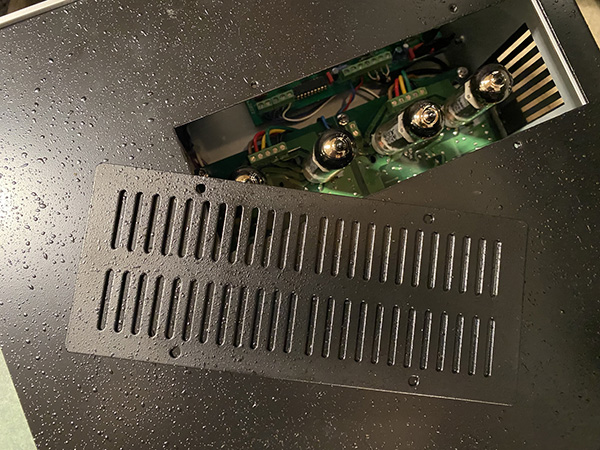
Lifting the lid unveils Karaki’s artistry, which is clear within the pristine epoxy and copper-print circuit boards; its exact wiring with premium Furukawa Electric and Beamex wire; and ceramic and gold-plate tube sockets to assist the Sovtek EL84s.
A hulking energy transformer, custom-created by Aurorasound and Japan’s General Industry KK, dominates the insides, wrapped in a copper band to scale back EMI. Also taking over important area (and rising weight) are a pair of iron-core output transformers. Populating the circuit boards are premium parts together with Rohm silicon carbide diodes (used as rectifiers), an Alps quantity pot, Dale resistors, and a collection of KOA and Nichicon (Muse, KX Series Radial, Fine Gold) capacitors.
A "CR" tone management is used for "simple changes to attain extra wealthy bass and cozy treble to satisfy listeners’ style even with small-size audio system," the web site states. A CR tone management is a fundamental, passive circuit that makes use of solely capacitors (C) and resistors (R) to regulate the frequency response of an audio sign. The tone controls may be bypassed with a "Tone/Direct" change for optimum sign integrity.
Those tone controls double as EQ curves for the MM phono enter, enabling playback of pre-RIAA records. Rather than altering the RIAA stage, Karaki made it attainable to make use of the tone controls to regulate tone in keeping with varied EQ curves: Decca, Columbia, AES, NEB. The included "Old Disk Easy Compensator," an etched plastic panel that matches over the tone management knobs, lets you simply set the tone controls to the right positions to mimic the sound of these EQ curves.
Which implies, after all, that the HFSA-01 has an onboard RIAA phono stage; the Aurorasound web site, in Japanese, describes it as "an NF-type circuit"presumably that is negative-feedback, versus a passive CR or LCR circuit"with glorious SN traits utilizing Linear Technology semiconductors." The HFSA-01 additionally has a function craved by many old-school audiophiles however lacking on many fashionable preamps and built-in amps: a mono/stereo change. All these options add as much as a flexible built-in amplifier regardless of the HFSA-01’s obvious simplicity.
Karaki made certain that the semiconductor and tubed sides are properly remoted: "The energy provide part is totally remoted between the vacuum tube and semiconductor to utterly eradicate any interference, no matter quantity stage and frequency vary." While there’s just one energy transformer, Karaki defined, "the tube part energy regulator and semiconductor part regulator are all divided and remoted. No affect collectively."
The front-mounted controls of the HFSA-01 may hardly be less complicated: flanking an Aurora emblem, 4 massive dials labeled "Bass," "Treble," "Volume," and "Selector" (the latter with choices "Phono," "CD," "Line 1," "Line 2"). Below, a round energy button trimmed in crimson mild, these tone/direct and stereo/mono switches, and a ¼" headphone jack share area with the phrases "Vacuum Tube EL84 Push-Pull UL Operation Hybrid Direct Coupling."
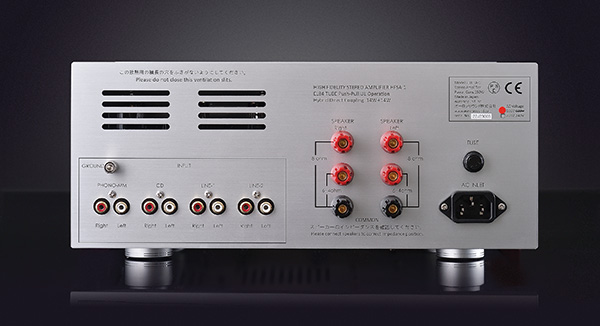
The rear panel echoes the entrance panel’s spartan design. A cautionary notice warns in opposition to blocking the air flow openings, in Japanese and English. On the again panel, two rows of 4 vent holes are located above 4 pairs of RCA inputs (with many extra on the highest and sides). To the fitting are the L and R speaker terminals and separate 46 and eight ohm faucets. Four stable toes, machined from aluminum and cushioned by rubber rings, guarantee a sturdy, steady platform. Which provides as much as a stable, compact, good-looking unit, like a small Abrams tank prepared for responsibility.
Setup
Given the amplifier’s comparatively mild weight and the absence of any app or community connection, setup was simpler than sliding a pizza out of the oven. Speaking of pizza ovens, the HFSA-01 ran highly regarded, although I smelled no odorsor none past the standard ones rising up from my musty Greenwich Village avenue.
I experimented with quite a lot of cables. After intensive comparisons, I settled on AudioQuest Pegasus (2m) interconnects from phono stage to the HFSA-01, with, alternately, ArgentPur AgPur12 (3m) and Auditorium 23 (2m) speaker cables. The AudioQuest ICs offered distinctive pressure and backbone. The ArgentPur AgPur12 speaker cables carried out equally to my Triode Wire Labs cables, creating an uncolored tonal steadiness with a touch of heat in an atmospheric, large-scale soundfield. The Auditorium 23 cables tilted the sound towards a richer tonal steadiness and deep, spherical bass with a delicate, harmonic glow. AudioQuest William Tell speaker cables (3m) revealed the best element, drama, and superior general velocity however produced a barely ahead treble.
Footnote 1: Which is smart: The US equal of jazz kissas are principally discovered solely in bigger cities, and infrequently the patrons there cannot be quiet. Apparently, if you wish to really hearken to recorded jazz, that you must keep at house.
HI-FI News
by way of InteriorFidelity https://ift.tt/7dOyu4b
March 6, 2025 at 04:40PM
-
Product on sale
 Audiophile Vinyl Records Cleaning BundleOriginal price was: €69.90.€59.90Current price is: €59.90. incl. VAT
-
Product on saleEasy Start Vinyl Records Cleaning KitOriginal price was: €69.90.€59.90Current price is: €59.90. incl. VAT
-
Vinyl Records Cleaner Easy Groove Concentrate€34.95 incl. VAT
-
Easy Groove Super Set€199.00 incl. VAT
-
Easy Groove Enzycaster – vinyl records prewash cleaner€34.95 incl. VAT
-
Easy Groove Extreme MK. II- vinyl records prewash cleaner€45.00 incl. VAT
-
Vinyl Records Cleaner – Easy Groove Virgin Concentrate€35.00 incl. VAT
-
Easy Groove Spray&Wipe vinyl records cleaner€34.95 incl. VAT


