Author Archives: Kalman Rubinson

Arvus H2-4D multichannel Dolby Atmos digital processor

Before I can get to what the Arvus H2-4D does and the way properly it does it, I’ve to clarify why I believe it is an essential product. I spent years as an advocate for multichannel audio for music, primarily based on discrete, lossless sources comparable to DVD-A, SACD, and high-quality downloads. All of those have been both PCM or DSD and have been accessible through a variety of disc gamers, DACs, and native file playback apps.


I’m properly conscious that almost all of Stereophile readers will not be (but) into multichannel, however two-channel and multichannel audiophiles have lengthy relied on related media and elements. Some of us have added extra channels. In parallel with this, the house theater world was dedicated to multichannel (or encompass sound), however as a substitute of DSD and PCM, they spoke a number of dialects of Dolby and DTS. Those oft-compressed codecs required proprietary decoders for every dialect, which their builders have been pleased to license to be used in AVRs and preamp/processors.


The leisure business observed that the newer sound codecs that help many horizontally and vertically arrayed sound sources, comparable to Dolby Atmos, Sony 360 Reality Audio, DTS-X, and Auro-3D, have been pure for cinema and residential theater, since they may create a extra convincing expertise of being current or immersed within the motion. By making use of these immersive applied sciences to music, the music business may entice music patrons to buy new tools and music, together with a back-catalog of music they already personal in different codecs.


I got here away from the 2019 AES Convention fascinated by these new choices for encoding, mastering, and distributing music. “Instead of a number of masterings and codecs for binaural, stereo, and multichannel,” I wrote in January 2019, “a single-format launch may be performed on any suitably geared up system.” It can be the equal of a “single stock” for the streaming and distribution websites for all codecs.


It has taken virtually three years, however Dolby Atmos is now permeating the music-streaming websites; word that a lot of the current Grammy winners can be found in Atmos.


Up to now, entry to Atmos has been largely restricted to HT {hardware}; its success for music will depend upon vast availability and non-HT choices for audiophile music lovers to stream and to play discs or information in Atmos, particularly in lossless variations (footnote 1). Enter the Arvus H2-4D.



What is it?

There are three fundamental sources for Atmos playback: net streaming from an app or a tool like an AppleTV, native discs, and native information. But with out an Atmos-enabled AVR or pre/professional, there was no easy technique to decode these streams (footnote 2). The Arvus (footnote 3) H2-4D is a straightforward answer to this drawback. Its compact, nondescript 1U chassis incorporates an HDMI enter and digital, analog, and LAN outputs. It decodes and renders all extant forms of Dolby (together with Atmos), DTS (together with DTS-X), and stereo and multichannel PCM (as much as 24/192). The solely front-panel options are an influence swap and multicolor LED that signifies energy, sign lock, and knowledge format; as soon as arrange, it ought to require no person consideration.


The rear panel incorporates, on the far left, a single HDMI enter and a phrase clock enter; on the intense proper is a spot to attach a wall-wart energy provide. In between is an array of outputs, all lively concurrently. The outputs embody (from left to proper): two HDMI pass-throughs (one full A/V, one audio-only), 16 channels of AES3 outputs through a DB25 connector, 16 channels of Dante outputs and inputs on a single RJ45 connector (footnote 4); 16 channels of balanced analog output through two DB25 connectors, and an information connection on RJ45 for setup and management through the native community.


A one-page GUI (above) is accessible from any machine in your LAN, for accessing the Arvus from a pc, however I discovered my iPad most handy. The GUI lets you choose an enter (HDMI, ARC/eARC, Dante) and a loudspeaker configuration. You can select amongst settings for Mute, Standby, and Global Delay (helpful for video sync), LAN settings, and particular person speaker delays for every channel. There can be a Global Volume management, which is important if you’re utilizing output gadgets that lack that function, as once you’re feeding an array of lively loudspeakers. (Essential as that is, it’s not supreme: Tapping on a display in 1dB increments is tedious; Arvus has promised new prospects within the subsequent firmware replace.) The GUI additionally shows the firmware model, permits you to replace the firmware with a click on, and permits for a manufacturing facility reset. It additionally exhibits the codec in use, which is helpful, though it does not present the pattern fee.


The H2-4D in my system

I arrange a system to audition distant streaming, disc playback, and native file playback in Atmos, DTS-X, and PCM through the Arvus. For the enter finish, I acquired a Marantz VS3003 3 in/1 out HDMI Switch ($199), which helps the identical audio codecs because the Arvus. I linked the HDMI outputs from my Apple TV 4K, my Oppo BDP-105, and my PC/Windows-based streamer to the Marantz. The Marantz’s output fed the enter of the Arvus, and the HDMI output of the Arvus went to my Toshiba PC monitor in order that I may see every person interface because it was chosen.


My common speaker system setup is 5.1, consisting of 5 full-range audio system plus a trio of subwoofers run through the BassQ controller. For this evaluate, I added PSB Imagine XA and Atlantic Technology 44-DA Dolby-enabled audio system, relocated from my Connecticut to my New York City system, as entrance and rear peak speaker pairs, respectively, every pushed by a Parasound Zamp.


I started utilizing the Arvus’s AES3 outputs as a result of my DACs have quantity controls, and when the Arvus first arrived, its quantity management had not but been carried out. With the help of Mogami’s Phil Tennison (footnote 5), I obtained a customized Mogami Gold AES TD DB25–XLR snake to connect with the AES3 connector on the Arvus. I then plugged XLRs 1–4 to the Okto DAC8 Pro and XLR 5 right into a Mytek Brooklyn+ DAC. I assumed that software program would route the suitable channels via to the ability amps, as would sometimes occur with a pre/professional. But after I switched every thing on, with the Arvus set to output 5.1.4, I acquired 5.1 appropriately—plus Front Height sounds out of the Rear Height audio system and nothing from the Front Height audio system. If I switched the Arvus to output 7.1.4, I acquired the same old 5.1 plus Rear L/R channels out of the Rear Height audio system!


Here’s why. The order of the channels in Atmos world is fastened, and it’s essential to join your DAC/amp/speaker to the proper bodily channel even when the intervening channel cables are left unused. The Arvus was designed for studio professionals, who would know this. For reference, here’s a listing of the default AES3 outputs; the asterisks point out channels utilized in my 5.1.4 channel setup:


1 Left, Right *

2 Center, LFE *

3 Left encompass, Right encompass *

4 Left again, Right again

5 Top entrance left, Top entrance proper *

6 Top facet left, Top facet proper

7 Top again left, Top again proper *

8 Left vast, Right vast


Thus, in my setup for the digital outputs from the Arvus, outputs 1–3 and 5 went to the Okto for five.1 and the entrance heights and output 7 went to the Mytek for the rear heights.
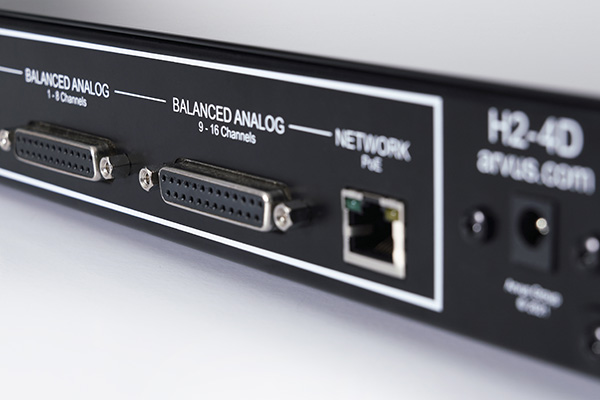


Later, after the central quantity management was added to the Arvus, I used direct balanced connections from the 2 analog output connections utilizing a pair of DB25-to-8XLR snakes. Of course, with analog, there may be one XLR per channel; those I used are listed beneath.


• Balanced Analog(1–8): 1 Left, 2 Right, 3 Center, 4 LFE, 5 Left encompass, 6 Right encompass


• Balanced Analog(9–16): 1 Top entrance left, 2 Top entrance proper, 5 Top again left, 6 Top again proper.


Streaming Atmos with the H2-4D

I acquired an AppleTV 4K a while in the past (footnote 6), for the categorical function of streaming Atmos from Apple Music; since then, the quantity of Atmos content material has exploded. Browsing the Classical repertoire, a randomly chosen recording is nearly as more likely to be accessible in Atmos as not.



I clicked on Sol & Pat. The Arvus acknowledged it as “Dolby Atmos (Multi-CH PCM)” at 48kHz, however to me the sound was fully new. The transition from stereo to “immersive” was startling. From the opening tambourine fanfare on via, the expertise was far more “you might be there” than the “we’re right here” of the stereo depiction (24/96 obtain, Alpha ALPHA757). The recorded, reproduced atmosphere fully changed any consciousness of my listening room. The two performers have been steadfastly stationed up entrance, the place they need to be. I’ve no data on how the recording was mastered for Atmos—whether or not it was mastered for Atmos within the studio or by some automated course of (footnote 7). Apple Music’s Atmos is lossy (footnote 8), however I discover it a reputable different to the high-rez stereo launch (24/96 on this case), swapping the latter’s readability and immediacy for an enormous enhancement within the acoustic area. Moving to music that’s already acquainted in multichannel,


Footnote 1: Some music labels, most notably 2L, nonetheless supply discrete 7.1.4 channel information in WAV format for obtain. These may be performed again on programs with the requisite variety of channels with none decoding.


Footnote 2: Dolby affords desktop/DAW software program licenses just for the skilled market.


Footnote 3: Arvus is a 40-year-old impartial firm with deep ties to the music business. Its earlier merchandise embody many loudspeakers and an 8-channel HDMI to AES3 digital audio converter that has lengthy been described as “unobtanium” within the US.


Footnote 4: Due to a shock go to from COVID, I used to be unable to make use of the H2-4D in a Dante atmosphere, however I hope to take action quickly.


Footnote 5: When I defined what I used to be doing, Phil swiftly realized the inventory cables wouldn’t go well with. “Normally, AES DB25 cables have 4 XLRs out and 4 in. Yours has 8 out, so it deviates from the conventional configuration. More like a Tascam Analog cable utilizing AES cable.” He was proper.


Footnote 6: In 2019, my Marantz AV8085 pre/professional was up to date to help Atmos and Auro-3D, and I used to be vastly inspired by the first immersive audio recordings I sampled.


Footnote 7: Mastering engineers have instructed me that nowadays an Atmos combine is a necessary deliverable in most studios, which argues for the previous for current releases like Sol & Pat.—Jim Austin


Footnote 8: In Apple Music, lossless and Atmos are two distinct codecs.
Arvus H2-4D multichannel Dolby Atmos digital processor

Before I can get to what the Arvus H2-4D does and the way nicely it does it, I’ve to elucidate why I feel it is an vital product. I spent years as an advocate for multichannel audio for music, based mostly on discrete, lossless sources corresponding to DVD-A, SACD, and high-quality downloads. All of those had been both PCM or DSD and had been accessible through a variety of disc gamers, DACs, and native file playback apps.


I’m nicely conscious that almost all of Stereophile readers should not (but) into multichannel, however two-channel and multichannel audiophiles have lengthy relied on related media and elements. Some of us have added extra channels. In parallel with this, the house theater world was dedicated to multichannel (or encompass sound), however as a substitute of DSD and PCM, they spoke a number of dialects of Dolby and DTS. Those oft-compressed codecs required proprietary decoders for every dialect, which their builders had been joyful to license to be used in AVRs and preamp/processors.


The leisure trade seen that the newer sound codecs that assist many horizontally and vertically arrayed sound sources, corresponding to Dolby Atmos, Sony 360 Reality Audio, DTS-X, and Auro-3D, had been pure for cinema and residential theater, since they might create a extra convincing expertise of being current or immersed within the motion. By making use of these immersive applied sciences to music, the music trade might entice music patrons to buy new tools and music, together with a back-catalog of music they already personal in different codecs.


I got here away from the 2019 AES Convention fascinated by these new choices for encoding, mastering, and distributing music. “Instead of a number of masterings and codecs for binaural, stereo, and multichannel,” I wrote in January 2019, “a single-format launch might be performed on any suitably geared up system.” It can be the equal of a “single stock” for the streaming and distribution websites for all codecs.


It has taken nearly three years, however Dolby Atmos is now permeating the music-streaming websites; observe that many of the current Grammy winners can be found in Atmos.


Up to now, entry to Atmos has been largely restricted to HT {hardware}; its success for music will rely upon extensive availability and non-HT choices for audiophile music lovers to stream and to play discs or recordsdata in Atmos, particularly in lossless variations (footnote 1). Enter the Arvus H2-4D.


What is it?

There are three primary sources for Atmos playback: net streaming from an app or a tool like an AppleTV, native discs, and native recordsdata. But with out an Atmos-enabled AVR or pre/professional, there was no easy technique to decode these streams (footnote 2). The Arvus (footnote 3) H2-4D is a straightforward answer to this drawback. Its compact, nondescript 1U chassis comprises an HDMI enter and digital, analog, and LAN outputs. It decodes and renders all extant sorts of Dolby (together with Atmos), DTS (together with DTS-X), and stereo and multichannel PCM (as much as 24/192). The solely front-panel options are an influence swap and multicolor LED that signifies energy, sign lock, and knowledge format; as soon as arrange, it ought to require no person consideration.


The rear panel comprises, on the far left, a single HDMI enter and a phrase clock enter; on the acute proper is a spot to attach a wall-wart energy provide. In between is an array of outputs, all energetic concurrently. The outputs embody (from left to proper): two HDMI pass-throughs (one full A/V, one audio-only), 16 channels of AES3 outputs through a DB25 connector, 16 channels of Dante outputs and inputs on a single RJ45 connector (footnote 4); 16 channels of balanced analog output through two DB25 connectors, and an information connection on RJ45 for setup and management through the native community.


A one-page GUI (above) is accessible from any gadget in your LAN, for accessing the Arvus from a pc, however I discovered my iPad most handy. The GUI lets you choose an enter (HDMI, ARC/eARC, Dante) and a loudspeaker configuration. You can select amongst settings for Mute, Standby, and Global Delay (helpful for video sync), LAN settings, and particular person speaker delays for every channel. There can be a Global Volume management, which is important in case you are utilizing output units that lack that function, as once you’re feeding an array of energetic loudspeakers. (Essential as that is, it isn’t best: Tapping on a display screen in 1dB increments is tedious; Arvus has promised new prospects within the subsequent firmware replace.) The GUI additionally shows the firmware model, permits you to replace the firmware with a click on, and permits for a manufacturing facility reset. It additionally reveals the codec in use, which is beneficial, though it does not present the pattern fee.


The H2-4D in my system

I arrange a system to audition distant streaming, disc playback, and native file playback in Atmos, DTS-X, and PCM through the Arvus. For the enter finish, I acquired a Marantz VS3003 3 in/1 out HDMI Switch ($199), which helps the identical audio codecs because the Arvus. I related the HDMI outputs from my Apple TV 4K, my Oppo BDP-105, and my PC/Windows-based streamer to the Marantz. The Marantz’s output fed the enter of the Arvus, and the HDMI output of the Arvus went to my Toshiba PC monitor in order that I might see every person interface because it was chosen.


My common speaker system setup is 5.1, consisting of 5 full-range audio system plus a trio of subwoofers run through the BassQ controller. For this overview, I added PSB Imagine XA and Atlantic Technology 44-DA Dolby-enabled audio system, relocated from my Connecticut to my New York City system, as entrance and rear peak speaker pairs, respectively, every pushed by a Parasound Zamp.


I started utilizing the Arvus’s AES3 outputs as a result of my DACs have quantity controls, and when the Arvus first arrived, its quantity management had not but been carried out. With the help of Mogami’s Phil Tennison (footnote 5), I obtained a customized Mogami Gold AES TD DB25–XLR snake to hook up with the AES3 connector on the Arvus. I then plugged XLRs 1–4 to the Okto DAC8 Pro and XLR 5 right into a Mytek Brooklyn+ DAC. I assumed that software program would route the suitable channels by means of to the facility amps, as would usually occur with a pre/professional. But once I switched the whole lot on, with the Arvus set to output 5.1.4, I acquired 5.1 appropriately—plus Front Height sounds out of the Rear Height audio system and nothing from the Front Height audio system. If I switched the Arvus to output 7.1.4, I acquired the standard 5.1 plus Rear L/R channels out of the Rear Height audio system!


Here’s why. The order of the channels in Atmos world is mounted, and you should join your DAC/amp/speaker to the proper bodily channel even when the intervening channel cables are left unused. The Arvus was designed for studio professionals, who would know this. For reference, here’s a record of the default AES3 outputs; the asterisks point out channels utilized in my 5.1.4 channel setup:


1 Left, Right *

2 Center, LFE *

3 Left encompass, Right encompass *

4 Left again, Right again

5 Top entrance left, Top entrance proper *

6 Top facet left, Top facet proper

7 Top again left, Top again proper *

8 Left extensive, Right extensive


Thus, in my setup for the digital outputs from the Arvus, outputs 1–3 and 5 went to the Okto for five.1 and the entrance heights and output 7 went to the Mytek for the rear heights.


Later, after the central quantity management was added to the Arvus, I used direct balanced connections from the 2 analog output connections utilizing a pair of DB25-to-8XLR snakes. Of course, with analog, there may be one XLR per channel; those I used are listed beneath.


• Balanced Analog (1–8): 1 Left, 2 Right, 3 Center, 4 LFE, 5 Left encompass, 6 Right encompass


• Balanced Analog (9–16): 1 Top entrance left, 2 Top entrance proper, 5 Top again left, 6 Top again proper.


Streaming Atmos with the H2-4D

I acquired an AppleTV 4K a while in the past (footnote 6), for the specific objective of streaming Atmos from Apple Music; since then, the quantity of Atmos content material has exploded. Browsing the Classical repertoire, a randomly chosen recording is sort of as prone to be obtainable in Atmos as not.


I clicked on Sol & Pat. The Arvus acknowledged it as “Dolby Atmos (Multi-CH PCM)” at 48kHz, however to me the sound was fully new. The transition from stereo to “immersive” was startling. From the opening tambourine fanfare on by means of, the expertise was way more “you’re there” than the “we’re right here” of the stereo depiction (24/96 obtain, Alpha ALPHA757). The recorded, reproduced atmosphere fully changed any consciousness of my listening room. The two performers had been steadfastly stationed up entrance, the place they need to be. I’ve no info on how the recording was mastered for Atmos—whether or not it was mastered for Atmos within the studio or by some automated course of (footnote 7). Apple Music’s Atmos is lossy (footnote 8), however I discover it a reputable different to the high-rez stereo launch (24/96 on this case), swapping the latter’s readability and immediacy for an enormous enhancement within the acoustic house. Moving to music that’s already acquainted in multichannel,


Footnote 1: Some music labels, most notably 2L, nonetheless provide discrete 7.1.4 channel recordsdata in WAV format for obtain. These might be performed again on techniques with the requisite variety of channels with none decoding.


Footnote 2: Dolby affords desktop/DAW software program licenses just for the skilled market.


Footnote 3: Arvus is a 40-year-old unbiased firm with deep ties to the music trade. Its earlier merchandise embody many loudspeakers and an 8-channel HDMI to AES3 digital audio converter that has lengthy been described as “unobtanium” within the US.


Footnote 4: Due to a shock go to from COVID, I used to be unable to make use of the H2-4D in a Dante atmosphere, however I hope to take action quickly.


Footnote 5: When I defined what I used to be doing, Phil swiftly realized the inventory cables wouldn’t go well with. “Normally, AES DB25 cables have 4 XLRs out and 4 in. Yours has 8 out, so it deviates from the conventional configuration. More like a Tascam Analog cable utilizing AES cable.” He was proper.


Footnote 6: In 2019, my Marantz AV8085 pre/professional was up to date to assist Atmos and Auro-3D, and I used to be enormously inspired by the first immersive audio recordings I sampled.


Footnote 7: Mastering engineers have informed me that as of late an Atmos combine is a vital deliverable in most studios, which argues for the previous for current releases like Sol & Pat.—Jim Austin


Footnote 8: In Apple Music, lossless and Atmos are two distinct codecs.
Posted in Uncategorized

KEF LS60 Wireless loudspeaker

I became interested in hi-fi well before the stereo era, at a time when DIY was a significant part of the hobby. In store catalogs of the time, as much or more space was devoted to raw speaker drivers and enclosures than to complete speaker systems. Those of us who wanted or needed to save some money built our own speaker enclosures from kits or plans or from articles in magazines like Radio-Electronics, Audiocraft, and Audio.


In those early days, the popular choices were corner horns and bass reflex speakers, but everyone was welcome to put drivers into any box they would fit in. Then, in 1956, came Ed Villchur’s patent (footnote 1) for acoustic-suspension loudspeaker systems, marketed under the brand name Acoustic Research, and then, in 1961, the groundbreaking study by A. N. Thiele, “Loudspeakers in Vented Boxes” (footnote 2), which defined a series of sealed-box and vented alignments that related low-frequency performance characteristics (frequency response, power handling, cone excursion, and so on) to enclosure design and electromechanical driver parameters.


In a well-known corollary, known as Hofmann’s Iron Law, Josef Anton Hofmann (an audio engineer who worked at Acoustic Research—the H in KLH) posited that three parameters cannot all be had at the same time: low bass, small (enclosure) size, and high sensitivity. You can have any two of these, but not all three. These seminal works underlie most mainstream loudspeaker design to this day.


Most, but not all. Neither Hofmann, Thiele, nor Villchur anticipated KEF’s employment of active digital signal processing (DSP) to mate the driver, its enclosure, and the room. The KEF LS60 Wireless loudspeaker system ($6999.98/pair) is an end run around Hofmann’s Iron Law.


Planned for KEF’s 60th anniversary, much as the LS50 was planned for the company’s 50th, the LS60 Wireless is a statement product that encompasses the premise of company founder Raymond Cooke that loudspeaker performance could be improved through the application of new materials and new technologies. Improvements in recent KEF designs include the refinement of the Uni-Q coaxial driver, Metamaterial Absorption Technology (MAT), force-canceling Uni-Core woofers with P-Flex surrounds, cabinets shaped to reduce diffraction, and the configuration and arrangement of drivers to create what KEF calls a Single Apparent Source.


All those features except Uni-Core and P-Flex were incorporated in the Blade Two Meta, whichStereophile‘s editors selected as the 2022 Loudspeaker of the Year. The LS60 goes a few steps further, adding built-in amplification and electronics for wired or wireless streaming and, as already noted, DSP. That’s also true of the LS60’s smaller wireless siblings, the LS50 Wireless and the LSX, the latter reviewed in 2019 by Herb Reichert. KEF’s successful integration of these technologies in a trim, attractive, high-performance floorstanding loudspeaker makes the LS60 a landmark product.


KEF delivers

The team from KEF in New Jersey delivered and installed the LS60s, just as they did last year with the Blade Two Metas. Locating the speakers in the room progressed just as swiftly as before, but extra time was needed to link them to my local network so that I could control them and stream music to them. Ben Hagens, KEF’s product training manager, got me up and running in a few minutes. All seemed well, and the guys picked up the shipping cartons and departed.


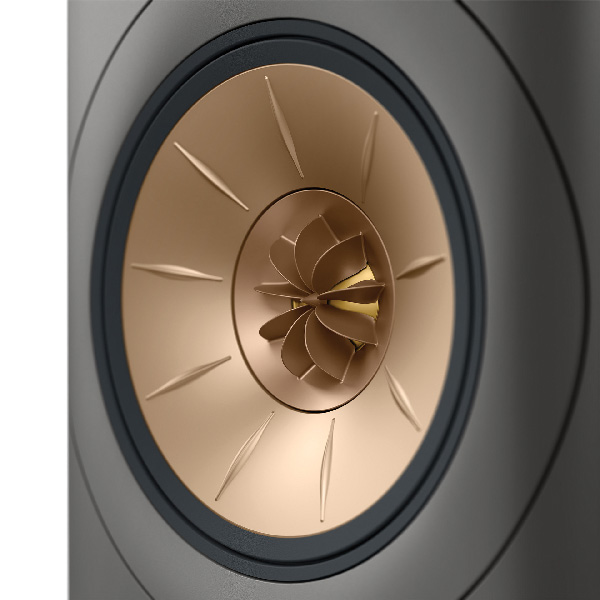
The LS60’s matte-finished MDF cabinets are striking in appearance: Clean rectangular columns with radiused vertical edges, they are a petite 41″ high, 5.1″ wide, and 12.6″ deep. Each cabinet has three internal compartments. The lower compartment holds the electronics; the port on the back above the connection panel is a hot-air exhaust and serves no acoustical purpose; a small opening at the bottom of the cabinet is the cool air intake. An upper compartment holds the transducers, within which the Uni-Q has its own subcompartment. The upper compartments are sealed. The cabinets sit on flat bases that, though only slightly larger, are heavier and provide stability. Even in striking Royal Blue with bright copper Uni-Q drivers, they blended well with our mixed traditional/contemporary decor.


The 4″ Uni-Q driver is mounted to the 5″-wide front. The cabinet’s curve begins at the edge of its Shadowed Flare surround, which also acts as a waveguide for the tweeter. The cabinet’s curved edge minimizes diffraction. The Uni-Q is positioned a considerable distance from the top edge of the cabinet, so the impact of that transition on the radiated sound is minimal. The four low-frequency drivers are positioned in pairs on the cabinet’s sides, symmetrically just above and below the Uni-Q driver. The members of each pair share a common magnetic structure, their individual voice-coils mounted coaxially. Electrically, they operate in phase, their cones facing the world in opposite directions. This force-canceling configuration, which KEF calls a Uni-Core LF, permits—indeed, requires—the LS60 to maintain a narrow profile, which is key to the speaker’s operation as a Single Apparent Source.


While the above describes both speakers, the two speakers differ in that one, the “Primary” speaker, manages inputs and outputs and serves as the user interface. Starting at the bottom of this speaker’s back panel are five rows of connectors, from top to bottom, reset, speaker pairing, and Bluetooth pairing buttons; HDMI, TosLink, and RCA S/PDIF connectors; analog inputs on RCA, USB service port, and a subwoofer connection; RJ45 jacks for wired internet and interspeaker linkage; and a connector for AC power. The Secondary speaker has five rows, too, but each row has just one item: a button for pairing to the primary speaker, a USB service port, a subwoofer connection, an RJ45 jack for pairing, and an IEC connector for AC power.


After connecting both speakers to power, basic setup consists of loading the KEF Connect app from the Apple Store or (for Android devices) Google Play to a smartphone or tablet, pairing the app and tablet to the Primary speaker via Bluetooth, and following the onscreen instructions to connect the LS60 to your LAN. Then you pair the Primary speaker with the Secondary speaker and access your choice of an impressive array of music sources.


As is obvious from its name, the LS60 Wireless is designed to stream via Wi-Fi, and that includes the interspeaker link. My apartment does have Wi-Fi, but coverage dwindles at the speaker end of my living room. Consequently, upon setting the system up wirelessly, I quickly found myself dealing with dropouts and disconnections. There were two possible cures: to wire the LS60s to my LAN with an Ethernet cable or add a Wi-Fi extender. I did both. I have since encountered no problems with the system with either the wireless or wired connections.


Footnote 1: US Patent 2,775,309.


Footnote 2: Thiele, A. Neville (1961). “Loudspeakers in Vented Boxes,” Proceedings of the Institute of Radio Engineers, Australia, 22 (8), pp. 487–508.

Posted in Uncategorized