Author Archives: Robert Schryer

Totem, Yamaha, MoFi, AudioQuest


When I requested Totem’s Vince Bruzzese, eventually yr’s “static” launch of the brand new Bison collection, what the impetus was to create the Bison vary, he mentioned it got here all the way down to eager to create one thing particular to mark the corporate’s thirty fifth birthday but additionally that of the Model 1, which got here out within the yr of the corporate’s founding, 1989. “I needed to carry us again to Model 1 territory,” Vince mentioned, “the place folks had been wowed and saying, ‘oh my gosh, I spent how a lot previously and by no means obtained this?'”


The Bison collection consists of the two-way Bison Monitor ($2250), which Vince instructed me is just like the Model 1 however a bit bigger and extra succesful in some ways, together with two floorstanders: the shorter two-way Bison Tower ($2850) and the taller two-way Bison Tower T ($3750). The low-frequency response for the three fashions are specified as 40Hz, 33Hz, and 31Hz, respectively.


I’ve all the time appreciated the home sound of passive Totem audio system (I have never auditioned the lively ones)—woody, wealthy, pure, full—and on this room, the place I had the possibility to hearken to each the standmounts and the Tower T, powered by a Yamaha A-S2200 Integrated Amplifier ($4499 US), which in flip was fed by a MoFi Electronics turntable with MasterTracker cartridge ($2999 US), all cabled along with AudioQuest cabling. I heard, throughout a few vocal and jazz LPs, the identical ingratiating, satisfying, healthful sound I affiliate with the Totem model however maybe extra of it. These fashions impressed me with their huge, heat, pure-toned, substantial displays. They struck me as offering a whole lot of music for the cash.


I remembered one thing Vince mentioned on the Bison launch that made me smile. “These audio system aren’t simply big killers, they’re big satisfiers.” From what I heard on this room, he could also be proper.

Posted in Uncategorized

ArtistCloner

Our fearless reporter–left–waxing eloquent in his pocket book.


I’ve ran into producer Artist Cloner’s proprietor and designer, Sylvio Comtois, many occasions at audio reveals. He strikes me as being a little bit of a mad scientist. Not “loopy” mad however mad within the sense of being obsessive about a selected goal.


In Sylvio’s case, that goal is the belief of the last word in sound replica via meticulous system synergy. It’s why he designs, builds, and demoes whole ArtistCloner programs, to point out what may end up when every little thing within the playback chain, from cables to audio system, is optimized to work along with one voice. And whereas he’s completely happy to promote you a element or two to suit into your current system—and I’ve little doubt they sound superb that means—that sort of misses the purpose, which is: Sylvio’s merchandise are designed to work collectively a lot in the identical means that your limbs and digits are supposed to work for you, as elements of an natural complete.

Sylvio Comtois and his spouse Isabelle with the Ether. This photograph and the highest photograph, credit score: Maxime Dorand.


Consider the 40″-tall, 2.5-way Ether audio system (introductory value, $22,000/pair, $25,000/pair after that). Their drivers and sequence crossovers all have their very own chambers. Their inch-thick enclosures are made of 1 layer of elastomer, one layer of plywood, one layer of acrylic, and one layer of a grounded slate compound.


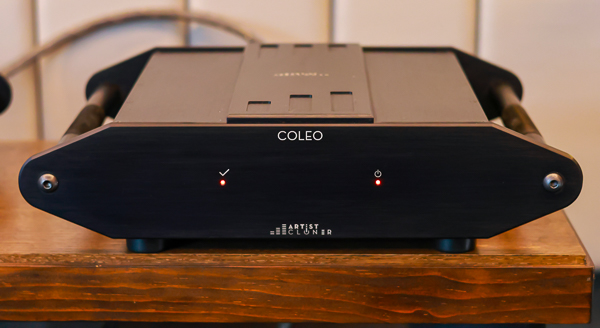
Feeding the audio system on this room had been a pair of 48W (into 8 ohms) Coleo monoblock amplifiers (introductory value $8000 every, $9500 every after that), a Luceo preamp (introductory value $7000, $8000 after that.), and a Librarium music server / streamer (value varies). ArtistCloner cables, cable risers, and energy conditioners had been used all through.


Music was streamed from the Librarium’s inside onerous drive. On the lower “No Need to Argue” by the Cranberries, the organ’s bass tones produced tremors within the room’s construction and pushed a heavy blanket of low-octave vitality into my chest. O’Riordan’s vocals hovered above, undisturbed, sounding candy, tangible, colourful, clear.


A quieter observe with acoustic guitar and fowl sounds highlighted how spacious, pure, cohesive, and dimensional the soundstage sounded. In a extra basic sense, the music sounded pure and unobstructed, like a gushing river of tactile sound, proving that system synergy is a noble goal to obsess over. Since, hey, you have to obsess over one thing, proper?

Posted in Uncategorized

Audio Note

Of course this technique had two audio system; it is simply that each did not match within the body.


As ordinary, I discovered cellist and Audio Note UK music ambassador Vincent Bélanger internet hosting the Audio Note UK room, however this time, Vincent wasn’t alone. He was accompanied by two gross sales executives hailing from Audio Note central in England: Daniel Qvortrup, son of firm founder Peter, and a chap who, at night time, goes by the artist identify A:D and by day, Adrian Ford-Crush. Adrian composes a mode of bass-heavy digital music that is standard in England referred to as drum and bass. He and Daniel got here to Montreal to assist Vincent watch the room and play music, which included a few of A:D’s personal compositions.


I’ve heard many Audio Note programs through the years, however by no means earlier than one on this league, as measured by efficiency or worth. It included a 27Wpc, single-ended, 211 tube–primarily based built-in amplifier ($220,000) and a pair of AN-E/SPx SE Signature loudspeakers with the Apple end ($25,000).

                      Daniel Qvortrup


Sources included an analog front-end I did not audition: a TT Three turntable with PSU3 energy provide ($25,000), an Arm Three/II tonearm ($3750), an IO II MC phono cartridge ($11,500), an M5 RIAA phono stage ($20,000), and an AN-S8 step-up transformer ($24,000)—and a digital front-end that I did audition: a CDT Four CD transport ($32,500) and a tube-rectified DAC 5 Special ($99,000). Cables had been additionally by Audio Note UK, making this a purebred Audio Note UK system.


Listening to Adrian’s spacey, beat-driven, effects-laden music streamed from an exterior arduous drive, I heard a presentation that was fluid, seamless, deep-hued, textured, and layered in air currents—air appeared palpabe within the entrance of and behind the devices. The soundstage was huge and appeared microscopically energised with tactile musical data.


Most importantly, this technique made me actually dig A:D’s music.

Posted in Uncategorized

Montreal Audio Fest 2023: Final observations


Finally, it snowed throughout the weekend of the present, on Saturday, which was disappointing. It meant I wasn’t in an alternate ‘verse of the multiverse in spite of everything and, consequently, I wasn’t Alternate Rob with a half-million-dollar hi-fi ready at house.


On the great aspect, in my ‘verse, the Montreal Audiofest 2023 was a bonafide hit, in two methods specifically. First, there’s attendance, which was bigger and extra different—many ladies and kids—than I keep in mind ever seeing on the Montreal present. Organizer Sarah Tremblay remarked with incredulity that it was the primary time the present has ever run out of admission bracelets.


Second, on common, the sound of the demoes was higher than ordinary. I’ve no double-blind statistical proof to help this declare, however I speculate that this was because of a mixture of exhibitors paying extra consideration to room setup and audio gear sounding universally higher.


Tidal-streaming was by far the tactic of selection for music playback. (Qobuz is not right here but, in Canada, although it is launching in May.) I noticed virtually no CDs, only a few LPs, not very many information saved regionally, and overlook about reel-to-reel; the one reel-to-reel I noticed (however did not hear) was within the Nagra room. When it involves music sources, streaming guidelines.


Another pattern? Class-D is getting extra fashionable—and higher. It’s humorous to suppose how only a few years in the past class-D wasn’t even value speaking about. Now it appears poised to turn into ubiquitous. I requested one veteran tube-amp designer if he would ever take into account constructing a transistor amp: “No, as a result of solid-state amps can’t seize the soul of the music like a tube amp can,” he stated. “But possibly sooner or later class-D amps will be capable of.”


So there you have got it. Another present wrapped. Time for me to unwind, and I do know precisely how I’m going to do it.

Rob and calamari
Posted in Uncategorized

Sonic Artistry: Stenheim, darTZeel, Merging Technologies, Nordost, Seismion


Talk a few dream triad of fabulous gear from Switzerland: darTZeel, Stenheim, Merging Technologies. The very first thing I stated to myself once I noticed this easy, sharp-looking unfold in Toronto-based retailer Sonic Artistry’s room was, “Damn, that is a sexy group!”.


That attractiveness prolonged to the Swiss group’s collective sound. Doing internet hosting duties on the time of my go to was all-around nice man and Audio Fest common Walter Schofield, proprietor of Nexus Audio Technologies, which represents Stenheim amongst different high-end manufacturers. Walter Tidal-streamed an array of dazzling, principally digital music. The audio system disappeared utterly. (It wasn’t the primary time I’d heard a pair of Stenheims disappear), whereas the soundstage blew open like a high-resolution hologram, contoured photos positioned solidly in house. The presentation brimmed with info delivered in a assured, coherent, tactile, easy, refined method. The synergy was apparent.


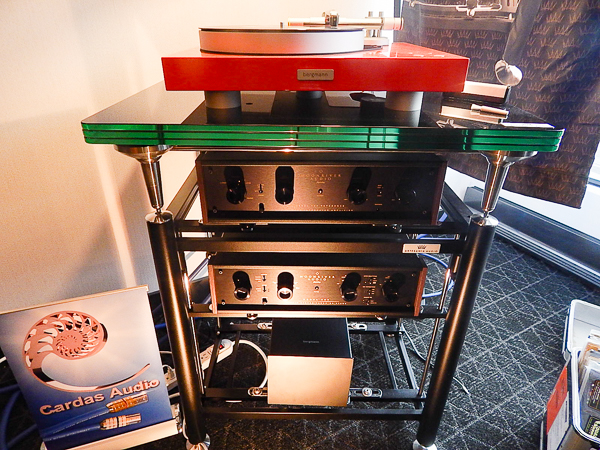
What have been the elements? The 3-way, high-sensitivity Stenheim Alumine 3SE Special Edition audio system with upgraded crossovers and wiring ($59,000/pair); the darTZeel LHC-208 Mk2 DAC/streaming built-in amplifier, ($31,500), and the Merging Technologies streaming DAC with Roon Core inbuilt ($18,800). Cabling was by Nordost, and all of the elements rested on Seismion Reactio Model 54 lively isolation bases ($7600).

Art et Son, On a Higher Note, MoonRiver, Graham Audio, Bergman Audio, Artesania, Cardas


“Are you positive there aren’t any tubes within the chain?” I requested On a Higher Note’s Philip O’Hanlon, North American distributor of the BBC-inspired Graham Audio speaker line, in Montreal retailer Art et Son’s room. Philip was sitting with me listening to an LP of Belgian singer Mélanie De Biasio. He responded to my query with a smile and a chin-jab towards the amplifier in use, a 50Wpc strong state MoonRiver 404 Reference built-in ($5995; see Jason Victor Serinus’s Stereophile assessment), a modular design that features such luxuries as a steadiness management and a stereo/mono change and might accommodate an MM or MM/MC phono stage and a asynchronous-USB DAC.


I requested as a result of it was exhausting to consider that the sound I used to be listening to—intimate, targeted, introspective, seamless, tremendous tactile, and vividly colourful—was coming from a strong state amplifier and never, say, a SET amp. Of course, it wasn’t simply the amp making this “midrange magic”, as Philip likes to explain the character of his techniques, appropriately in my opinion. Also doing work have been a Bergman Audio Modi air-bearing turntable with an air-bearing linear monitoring tonearm ($17,000 for each), a Hana ML MC cartridge ($1200), a MoonRiver 505 phono stage ($5995), and a pair of Graham Audio LS8/1 audio system ($9700 together with stands and spikes). Designed by Derek Hughes as an homage to the Spendor BC1 created by his father, Spencer Hughes, the LS8/1 is supplied with each a tweeter and tremendous tweeter and, based on Philip, can ship 10dB extra output than the unique BC1. Racks and platforms have been by Artesania Audio, and cables have been from the Cardas Audio Clear collection.


This system delivered sound so pure and welcoming, I felt helplessly compelled to hold on to each element. It sucked me in as manner few techniques can.

Art et Son, On a Higher Note, MoonRiver, Graham Audio, Bergman Audio, Artesania, Cardas


“Are you positive there are not any tubes within the chain?” I requested On a Higher Note’s Philip O’Hanlon, North American distributor of the BBC-inspired Graham Audio speaker line, in Montreal retailer Art et Son’s room. Philip was sitting with me listening to an LP of Belgian singer Mélanie De Biasio. He responded to my query with a smile and a chin-jab towards the amplifier in use, a 50Wpc stable state MoonRiver 404 Reference built-in ($5995; see Jason Victor Serinus’s Stereophile evaluation), a modular design that features such luxuries as a stability management and a stereo/mono change and might accommodate an MM or MM/MC phono stage and a asynchronous-USB DAC.


I requested as a result of it was laborious to imagine that the sound I used to be listening to—intimate, centered, introspective, seamless, tremendous tactile, and vividly colourful—was coming from a stable state amplifier and never, say, a SET amp. Of course, it wasn’t simply the amp making this “midrange magic”, as Philip likes to explain the character of his methods, accurately in my opinion. Also doing work had been a Bergman Audio Modi air-bearing turntable with an air-bearing linear monitoring tonearm ($17,000 for each), a Hana ML MC cartridge ($1200), a MoonRiver 505 phono stage ($5995), and a pair of Graham Audio LS8/1 audio system ($9700 together with stands and spikes). Designed by Derek Hughes as an homage to the Spendor BC1 created by his father, Spencer Hughes, the LS8/1 is provided with each a tweeter and tremendous tweeter and, in keeping with Philip, can ship 10dB extra output than the unique BC1. Racks and platforms had been by Artesania Audio, and cables had been from the Cardas Audio Clear collection.


This system delivered sound so pure and welcoming, I felt helplessly compelled to hold on to each element. It sucked me in as approach few methods can.

Monitor Audio, Rotel Michi, Nordost


MartinLogan’s Motion F200XT within the Planète Haute-Fidélité room wasn’t the one speaker on the town to make use of a Heil Air Motion Transformer tweeter. So did Monitor Audio’s 3-Way Platinum 300 3G (for third technology) floorstander ($22,000). Monitor Audio calls the tweeter an MPD (Micro Pleated Diaphragm) III transducer. Also geared up with two 8″ woofers (along with a 4″ midrange), the speaker is claimed to go right down to 17Hz in-room, with a rated sensitivity of 88dB/2.83V/m. A speaker like this most likely wants some juice to get it going; therefore the amps that had been feeding them, a pair of Rotel Michi M8 monoblocks ($10,000 every), that are able to delivering 1080W to an 8 ohm load and 1800W into 4 ohms. Also within the system was the companion Michi P5 preamplifier. The supply was a Roon Nucleus feeding a Rotel Diamond Series DT-6000 DAC-transport ($3000; see Herb Reichert’s take). Nordost cables cabled every thing collectively.


Playing Tidal-streamed rock and vocal tracks, the Monitor Audio / Rotel system exhibited liquid momentum, prolonged dynamics, life-sized photographs, explicitly rendered vocals, an interesting sense of the vitality of notes being expulsed into the air, and a deep, layered soundstage.

Monitor Audio, Rotel Michi, Nordost


MartinLogan’s Motion F200XT within the Planète Haute-Fidélité room wasn’t the one speaker on the town to make use of a Heil Air Motion Transformer tweeter. So did Monitor Audio’s 3-Way Platinum 300 3G (for third technology) floorstander ($22,000). Monitor Audio calls the tweeter an MPD (Micro Pleated Diaphragm) III transducer. Also geared up with two 8″ woofers (along with a 4″ midrange), the speaker is claimed to go right down to 17Hz in-room, with a rated sensitivity of 88dB/2.83V/m. A speaker like this most likely wants some juice to get it going; therefore the amps that had been feeding them, a pair of Rotel Michi M8 monoblocks ($10,000 every), that are able to delivering 1080W to an 8 ohm load and 1800W into 4 ohms. Also within the system was the companion Michi P5 preamplifier. The supply was a Roon Nucleus feeding a Rotel Diamond Series DT-6000 DAC-transport ($3000; see Herb Reichert’s take). Nordost cables cabled all the things collectively.


Playing Tidal-streamed rock and vocal tracks, the Monitor Audio / Rotel system exhibited liquid momentum, prolonged dynamics, life-sized photographs, explicitly rendered vocals, a captivating sense of the power of notes being expulsed into the air, and a deep, layered soundstage.

Filtronique: Nagra, Wilson Audio, AudioQuest, Luna Cables


Remember in my first publish once I stated “How cool it could be if I’d become Alternate Rob with a half-million greenback system ready for him at house?” Well, the system I encountered in certainly one of Filtronique’s rooms would match the invoice properly.


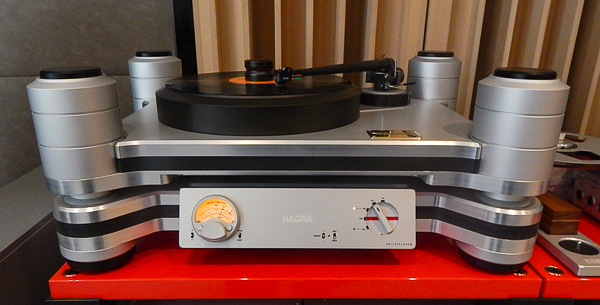
It included the architectural surprise that’s Nagra’s Reference seventieth Anniversary Limited Edition turntable ($232,500 with tonearm), of which solely 70 can be made and bought worldwide; a Nagra MC-6 cartridge ($24,500); a Nagra HD DAC X ($89,500); a Nagra HD preamp ($90,500); a pair of 250W 2020 Edition Nagra HD monoblocks ($124,500/pair); and a pair of Wilson Alexia V audio system ($95,000). Cables and energy conditioning had been by AudioQuest and Luna Cables.


The room was constantly abuzz throughout the three-day weekend, and the pure stream of site visitors led folks proper between the loudspeakers and the listeners, so getting a transparent line of listening with the system was the music-listening equal of a spotty web connection. But nonetheless! The sound that got here by way of throughout the interludes in foot site visitors, from a cross-section of blues and jazz cuts, was elegant, candy and complicated, with ranges of contact, microdynamics, texture, coloration, veracity, and musical rightness that made me mutter below my breath, “Oh please let me be the Alternate Rob who will get to personal this technique!”