Author Archives: Robert Schryer

Moon by Simaudio Voice 22 loudspeaker

I’m picturing a gaggle of cigar-chomping Simaudio execs in an workplace discussing what to do about the truth that their high-end amplification strains have change into so profitable that their names have change into synonymous with the corporate. “In the ’90s, folks thought our firm was known as Celeste,” one floor-pacing exec says, talking for everybody within the room. “Now they suppose we’re known as Moon! How will we repair this?” After a lot debate, a member shouts: “We add ‘by Simaudio’ on the finish!” The execs hoot, holler, and slap the conference-room desk—and thus is born Moon by Simaudio.


A fictional account? Sure, however, as they are saying within the motion pictures, it is based mostly on a real story. In truth, I supposed it as a type of parable, the message being that we people all the time search stability. The identify “Moon by Simaudio” struck a stability, like a see-saw, the 2 manufacturers pivoting on the phrase “by.”


For those that stay confused concerning the naming: Simaudio is the corporate. Moon is a line of merchandise produced by the corporate. When referring, eg, to the monoblock amplifier we not too long ago reviewed, it’s normal to jot down, or say, “Simaudio Moon.” That is not fallacious, however “Moon by Simaudio” does a greater job of conveying the connection between the 2 phrases, the corporate identify and the identify of the road of elements.


Another instance of the seek for stability may be discovered within the firm’s determination to stray from its amplification roots into digital sources and enter the all-in-one product class with its ACE: simply add audio system. The ACE then turned the catalyst for yet one more product. To quote the literature for the Moon Voice 22, “The ACE is a well-liked mid-priced product, and so many occasions we have been requested if speaker X-Y-Z could be match with it. Now, with the 22s, there may be little doubt concerning the match between audio system and the ACE, whether or not concerning sensitivity, impedance, or sonic presentation.” It’s a match—or stability—that earned the ACE/Voice 22 mixture the EISA Award for High-End Audio System 2022–2023.


The Voice 22

The Voice 22 is smallish—7.9″ (200mm) W, 13.8″ (350mm) H, 11.4″ (290mm) D. Look at it on a desk or stand, and it seems weightless, floating about an inch off the floor. This just isn’t because of any Moondust magic. It’s an optical phantasm attributable to the speaker’s detachable “hover” base, a tapered platform magnetically affixed to the speaker. On the underside of the bottom is Poron—a rubberlike materials—which compresses underneath the burden of the speaker and isolates it mechanically, changing vibrational vitality into warmth. It additionally protects the floor underneath the speaker, protecting it secure from scratches whereas holding the speaker stably in place.
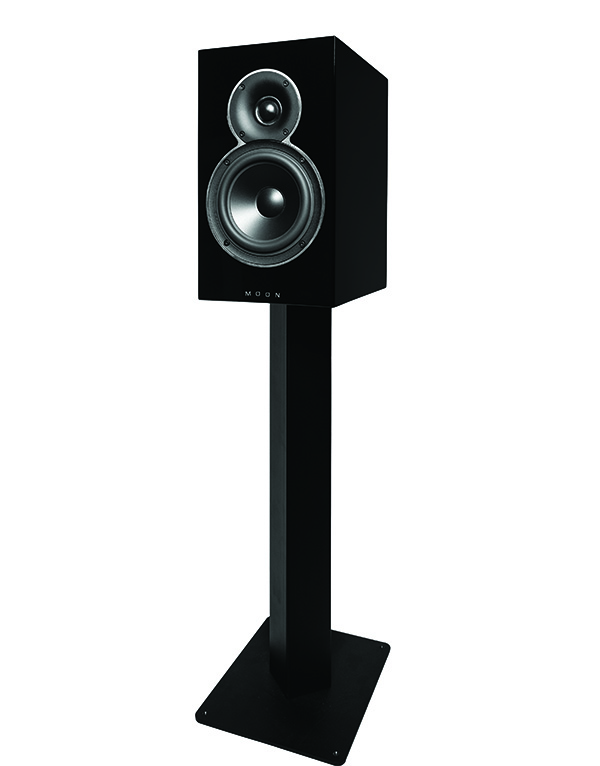


Like all audio system, although, the Voice 22 sounds finest when positioned fastidiously on an acceptable stand. Moon provides a stand made by Target Audio particularly for the Voice, a metal one in a black powder-coat “Sandtex” end ($400/pair). When the stand is used, the “hover” base is faraway from the underside of the speaker; some effort is required to pry it off. The high of the stand—additionally geared up with the damping materials—extends up into an indention within the speaker base, forming maybe the snuggest, most safe speaker/stand integration I’ve encountered.


The Voice makes use of a 1.14″ (29mm) textile-dome tweeter with a big encompass and a waveguide optimized for directivity; the waveguide permits the Voice 22 to cross over to the woofer at a lower-than-usual frequency, which is beneficial in a two-way. The tweeter employs a saturation-controlled motor system to scale back distortion and a “nonreflective” (footnote 1) rear chamber for improved dynamics. The long-throw woofer’s 6.1″ (155mm) cone is fabricated from polypropylene that is mineral-filled to extend its stiffness-to-weight. It’s geared up with a solid aluminum basket, a mushy, low-damping rubber encompass for good transient response, and a pole piece that is vented to scale back compression and coated in an prolonged copper sleeve for low inductance and distortion.
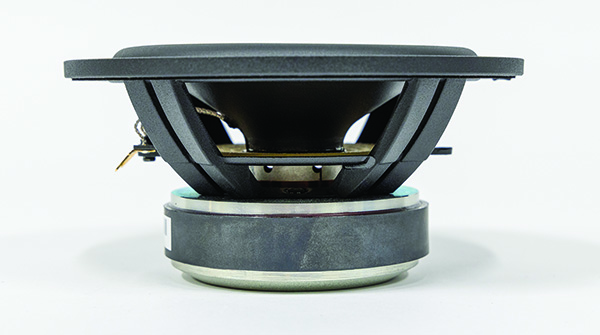


Why not a paper membrane? In considered one of our a number of conversations, Moon Product Director Dominique Poupart defined: “Paper works nice, however we most well-liked to make use of polypropylene as a result of it is a extra secure materials for numerous environments, particularly humid ones, and fairly merely for the sound we managed to get from it. It’s a cloth with extremely related sonics to the textile materials used for the tweeter. Achieving good integration of sound from the drivers relies upon not solely on the crossover but in addition on the similarity of the sonic shade of the respective drivers. For instance, metallic domes usually have a brighter, shinier sound—which you’ll or might not want, however it has a singular timbre. That implies that even with the best-designed crossover and tweeter, if the timbre of the separate drivers just isn’t alike, or at the very least related sufficient, the loudspeaker will sound totally different in several frequency bands, which causes the copy to be unnatural, particularly noticeable in a two-way loudspeaker. An actual piano retains the identical timbre when taking part in its low notes or its excessive notes (footnote 2). A loudspeaker ought to behave the identical approach. For the Voice 22, we labored to ensure the 2 drivers have been properly matched when it comes to sonic character.”


At 1.5kHz, the Voice 22’s crossover frequency is low for a two-way standmount geared up with a 6″ woofer. Poupart: “There are a number of benefits to having a low crossover, particularly dispersion-wise. A woofer, by its nature, begins to beam as its frequencies rise. In loads of loudspeakers, the place the crossover frequency is about larger, the woofer will begin to beam earlier than the crossover sends the sign to the tweeter, which has a a lot wider dispersion sample. This causes a discontinuity within the sound and a worldwide frequency response that’ll range off-axis. In the Voice 22—and this was a design objective—the off-axis dispersion is superb all through the frequency vary.


“Another benefit is [that] a tweeter produces decrease distortion than a woofer. Having the tweeter taking part in decrease within the midrange lowers the distortion within the higher midrange and offers the Voice nice readability and definition in that register. Not all tweeters can behave properly in such a low frequency vary, however we designed our tweeter so it may.”


The crossover itself is assembled on a dual-layer PCB utilizing metalized polypropylene movie capacitors and air-core inductors. The audio system have been designed in Canada however, in distinction to the corporate’s electronics, that are inbuilt Canada, the Voice 22 is inbuilt Indonesia. Poupart mentioned there was merely no approach the corporate may obtain the 22’s degree of high quality, particularly when it got here to the cupboard’s building and end, at its supposed promoting value if it have been made in North America.


And that is the catch for these audio system: the taking part in discipline. Competition within the 22’s value vary is fierce. Only one speaker, although, is meant as a perfect companion for the Moon by Simaudio ACE.


During my go to at Moon headquarters, a 30-minute automobile journey from the place I stay, Poupart confirmed me a piece view of the cupboard’s inside. The inside and outside bracing panels regarded chalet-board thick and durable. A singular characteristic is the corporate’s patent-pending CGD (Curved Groove Damping) expertise—a squiggly snake-shaped groove, asymmetrical to the opposite groove, crammed with a damping materials, on the within of every facet panel. According to Poupart, “The path of the groove makes the lengths between edges totally different at any level on the floor, limiting panel resonance.”


The Voice 22 is a bass-reflex speaker; its port is flared to keep away from chuffing. “The aerodynamics of the port matter,” Poupart mentioned. “Air velocity can get fairly excessive with bass, and a port with out flared ends can create turbulence within the air movement at better sound pressures.” Their nominal impedance is specified at 6 ohms, its sensitivity at 89dB/2.83V at 1m.


The Voice 22 is out there in black or white “piano” finishes.



Setup

Poupart advised me the Voice 22 likes some juice to get going. The guide recommends driving them with a minimal of 50Wpc, however I heard no signal of congestion or clipping utilizing them with my 37Wpc Grandinote Shinai with music performed at normal-to-loudish quantity. Still, Poupart wasn’t blowing smoke. A phrase about which, later.


The Voices are designed to be positioned going through ahead, not toed in, a setup that has all the time felt counterintuitive to me: If I’m speaking to somebody, I count on them to face me in order that I can hear them higher. But audio, thank its artful little coronary heart, is not all the time so apparent.


Using my very own trusty stands, provenance unknown, which positioned the tweeters roughly 1.5″ above ear degree, I tried each straight and angled positions and their subvariants—towards me, straight forward, and in slivers of angular pie slices in between. Huh. The designers at Moon have been proper. The counterintuitive, straight-ahead toe-in (or lack of it) was higher. The sound was clearer and extra incisive that approach, but additionally bloomier and extra open-air breathy.


The Moons appeared to supply a extra secure picture than different audio system I’ve tried at residence that work finest when toed in towards my ears. When I moved my head sideways to outdoors the candy spot, with the audio system pointed ahead, the picture did not collapse or shift excessively. The guide advises protecting the house between the audio system and surrounding partitions to at the very least twice the size of the cupboard. Position them too near a wall, the guide cautions, and the bass may change into bloated and sluggish. If that occurs, advises the guide, insert the included port foams.


The guide was preaching to the choir when it boldly introduced, and I’m paraphrasing, “Remove the grilles earlier than you hear to those audio system! They will sound worse with them on!” You do not have to inform this sharp-witted man twice after my KLH Three fiasco (footnote 3).


Footnote 1: Presumably, because of this the again wave from the driving force is absorbed or subtle—a quite common characteristic in loudspeakers.—Jim Austin


Footnote 2: This is true of excellent actual pianos—not all actual pianos.—Jim Austin


Footnote 3: With the quantity turned up, the KLH Three’s grilles produced fairly a racket.
Posted in Uncategorized

Moon by Simaudio Voice 22 loudspeaker

I’m picturing a gaggle of cigar-chomping Simaudio execs in an workplace discussing what to do about the truth that their high-end amplification traces have change into so profitable that their names have change into synonymous with the corporate. “In the ’90s, folks thought our firm was known as Celeste,” one floor-pacing exec says, talking for everybody within the room. “Now they suppose we’re known as Moon! How can we repair this?” After a lot debate, a member shouts: “We add ‘by Simaudio’ on the finish!” The execs hoot, holler, and slap the conference-room desk—and thus is born Moon by Simaudio.


A fictional account? Sure, however, as they are saying within the films, it is based mostly on a real story. In reality, I meant it as a kind of parable, the message being that we people all the time search stability. The identify “Moon by Simaudio” struck a stability, like a see-saw, the 2 manufacturers pivoting on the phrase “by.”


For those that stay confused in regards to the naming: Simaudio is the corporate. Moon is a line of merchandise produced by the corporate. When referring, eg, to the monoblock amplifier we lately reviewed, it is common to put in writing, or say, “Simaudio Moon.” That is not flawed, however “Moon by Simaudio” does a greater job of conveying the connection between the 2 phrases, the corporate identify and the identify of the road of parts.


Another instance of the seek for stability might be discovered within the firm’s choice to stray from its amplification roots into digital sources and enter the all-in-one product class with its ACE: simply add audio system. The ACE then grew to become the catalyst for one more product. To quote the literature for the Moon Voice 22, “The ACE is a well-liked mid-priced product, and so many instances we have been requested if speaker X-Y-Z can be match with it. Now, with the 22s, there might be little question in regards to the match between audio system and the ACE, whether or not relating to sensitivity, impedance, or sonic presentation.” It’s a match—or stability—that earned the ACE/Voice 22 mixture the EISA Award for High-End Audio System 2022–2023.


The Voice 22

The Voice 22 is smallish—7.9″ (200mm) W, 13.8″ (350mm) H, 11.4″ (290mm) D. Look at it on a desk or stand, and it seems weightless, floating about an inch off the floor. This just isn’t on account of any Moondust magic. It’s an optical phantasm attributable to the speaker’s detachable “hover” base, a tapered platform magnetically affixed to the speaker. On the underside of the bottom is Poron—a rubberlike materials—which compresses beneath the burden of the speaker and isolates it mechanically, changing vibrational vitality into warmth. It additionally protects the floor beneath the speaker, maintaining it protected from scratches whereas holding the speaker stably in place.


Like all audio system, although, the Voice 22 sounds greatest when positioned rigorously on an applicable stand. Moon provides a stand made by Target Audio particularly for the Voice, a metal one in a black powder-coat “Sandtex” end ($400/pair). When the stand is used, the “hover” base is faraway from the underside of the speaker; some effort is required to pry it off. The prime of the stand—additionally geared up with the damping materials—extends up into an indention within the speaker base, forming maybe the snuggest, most safe speaker/stand integration I’ve encountered.


The Voice makes use of a 1.14″ (29mm) textile-dome tweeter with a big encompass and a waveguide optimized for directivity; the waveguide permits the Voice 22 to cross over to the woofer at a lower-than-usual frequency, which is helpful in a two-way. The tweeter employs a saturation-controlled motor system to scale back distortion and a “nonreflective” (footnote 1) rear chamber for improved dynamics. The long-throw woofer’s 6.1″ (155mm) cone is product of polypropylene that is mineral-filled to extend its stiffness-to-weight. It’s geared up with a forged aluminum basket, a mushy, low-damping rubber encompass for good transient response, and a pole piece that is vented to scale back compression and coated in an prolonged copper sleeve for low inductance and distortion.


Why not a paper membrane? In certainly one of our a number of conversations, Moon Product Director Dominique Poupart defined: “Paper works nice, however we most well-liked to make use of polypropylene as a result of it is a extra secure materials for numerous environments, particularly humid ones, and fairly merely for the sound we managed to get from it. It’s a fabric with extremely related sonics to the textile materials used for the tweeter. Achieving good integration of sound from the drivers relies upon not solely on the crossover but in addition on the similarity of the sonic coloration of the respective drivers. For instance, metallic domes usually have a brighter, shinier sound—which you’ll or might not desire, but it surely has a singular timbre. That implies that even with the best-designed crossover and tweeter, if the timbre of the separate drivers just isn’t alike, or not less than related sufficient, the loudspeaker will sound totally different in several frequency bands, which causes the copy to be unnatural, particularly noticeable in a two-way loudspeaker. An actual piano retains the identical timbre when taking part in its low notes or its excessive notes (footnote 2). A loudspeaker ought to behave the identical manner. For the Voice 22, we labored to verify the 2 drivers had been effectively matched when it comes to sonic character.”


At 1.5kHz, the Voice 22’s crossover frequency is low for a two-way standmount geared up with a 6″ woofer. Poupart: “There are a number of benefits to having a low crossover, particularly dispersion-wise. A woofer, by its nature, begins to beam as its frequencies rise. In plenty of loudspeakers, the place the crossover frequency is about increased, the woofer will begin to beam earlier than the crossover sends the sign to the tweeter, which has a a lot wider dispersion sample. This causes a discontinuity within the sound and a world frequency response that’ll differ off-axis. In the Voice 22—and this was a design objective—the off-axis dispersion is excellent all through the frequency vary.


“Another benefit is [that] a tweeter produces decrease distortion than a woofer. Having the tweeter taking part in decrease within the midrange lowers the distortion within the higher midrange and provides the Voice nice readability and definition in that register. Not all tweeters can behave effectively in such a low frequency vary, however we designed our tweeter so it might.”


The crossover itself is assembled on a dual-layer PCB utilizing metalized polypropylene movie capacitors and air-core inductors. The audio system had been designed in Canada however, in distinction to the corporate’s electronics, that are inbuilt Canada, the Voice 22 is inbuilt Indonesia. Poupart stated there was merely no manner the corporate might obtain the 22’s stage of high quality, particularly when it got here to the cupboard’s development and end, at its meant promoting value if it had been made in North America.


And that is the catch for these audio system: the taking part in subject. Competition within the 22’s value vary is fierce. Only one speaker, although, is meant as a great companion for the Moon by Simaudio ACE.


During my go to at Moon headquarters, a 30-minute automobile journey from the place I dwell, Poupart confirmed me a bit view of the cupboard’s inside. The inside and outside bracing panels seemed chalet-board thick and durable. A novel characteristic is the corporate’s patent-pending CGD (Curved Groove Damping) expertise—a squiggly snake-shaped groove, asymmetrical to the opposite groove, stuffed with a damping materials, on the within of every aspect panel. According to Poupart, “The path of the groove makes the lengths between edges totally different at any level on the floor, limiting panel resonance.”


The Voice 22 is a bass-reflex speaker; its port is flared to keep away from chuffing. “The aerodynamics of the port matter,” Poupart stated. “Air velocity can get fairly excessive with bass, and a port with out flared ends can create turbulence within the air stream at higher sound pressures.” Their nominal impedance is specified at 6 ohms, its sensitivity at 89dB/2.83V at 1m.


The Voice 22 is on the market in black or white “piano” finishes.


Setup

Poupart advised me the Voice 22 likes some juice to get going. The guide recommends driving them with a minimal of 50Wpc, however I heard no signal of congestion or clipping utilizing them with my 37Wpc Grandinote Shinai with music performed at normal-to-loudish quantity. Still, Poupart wasn’t blowing smoke. A phrase about which, later.


The Voices are designed to be positioned going through ahead, not toed in, a setup that has all the time felt counterintuitive to me: If I’m speaking to somebody, I count on them to face me in order that I can hear them higher. But audio, thank its artful little coronary heart, is not all the time so apparent.


Using my very own trusty stands, provenance unknown, which positioned the tweeters roughly 1.5″ above ear stage, I tried each straight and angled positions and their subvariants—towards me, straight forward, and in slivers of angular pie slices in between. Huh. The designers at Moon had been proper. The counterintuitive, straight-ahead toe-in (or lack of it) was higher. The sound was clearer and extra incisive that manner, but additionally bloomier and extra open-air breathy.


The Moons appeared to supply a extra secure picture than different audio system I’ve tried at residence that work greatest when toed in towards my ears. When I moved my head sideways to outdoors the candy spot, with the audio system pointed ahead, the picture did not collapse or shift excessively. The guide advises maintaining the area between the audio system and surrounding partitions to not less than twice the scale of the cupboard. Position them too near a wall, the guide cautions, and the bass might change into bloated and sluggish. If that occurs, advises the guide, insert the included port foams.


The guide was preaching to the choir when it boldly introduced, and I’m paraphrasing, “Remove the grilles earlier than you pay attention to those audio system! They will sound worse with them on!” You do not have to inform this sharp-witted man twice after my KLH Three fiasco (footnote 3).


Footnote 1: Presumably, because of this the again wave from the motive force is absorbed or subtle—a quite common characteristic in loudspeakers.—Jim Austin


Footnote 2: This is true of excellent actual pianos—not all actual pianos.—Jim Austin


Footnote 3: With the quantity turned up, the KLH Three’s grilles produced fairly a racket.

Moon by Simaudio Voice 22 loudspeaker

I’m picturing a gaggle of cigar-chomping Simaudio execs in an workplace discussing what to do about the truth that their high-end amplification traces have turn into so profitable that their names have turn into synonymous with the corporate. “In the ’90s, folks thought our firm was known as Celeste,” one floor-pacing exec says, talking for everybody within the room. “Now they assume we’re known as Moon! How can we repair this?” After a lot debate, a member shouts: “We add ‘by Simaudio’ on the finish!” The execs hoot, holler, and slap the conference-room desk—and thus is born Moon by Simaudio.


A fictional account? Sure, however, as they are saying within the motion pictures, it is primarily based on a real story. In truth, I supposed it as a form of parable, the message being that we people all the time search steadiness. The identify “Moon by Simaudio” struck a steadiness, like a see-saw, the 2 manufacturers pivoting on the phrase “by.”


For those that stay confused in regards to the naming: Simaudio is the corporate. Moon is a line of merchandise produced by the corporate. When referring, eg, to the monoblock amplifier we lately reviewed, it’s normal to put in writing, or say, “Simaudio Moon.” That is not flawed, however “Moon by Simaudio” does a greater job of conveying the connection between the 2 phrases, the corporate identify and the identify of the road of parts.


Another instance of the seek for steadiness could be discovered within the firm’s choice to stray from its amplification roots into digital sources and enter the all-in-one product class with its ACE: simply add audio system. The ACE then turned the catalyst for yet one more product. To quote the literature for the Moon Voice 22, “The ACE is a well-liked mid-priced product, and so many instances we have been requested if speaker X-Y-Z could be a very good match with it. Now, with the 22s, there could be little question in regards to the match between audio system and the ACE, whether or not concerning sensitivity, impedance, or sonic presentation.” It’s a match—or steadiness—that earned the ACE/Voice 22 mixture the EISA Award for High-End Audio System 2022–2023.


The Voice 22

The Voice 22 is smallish—7.9″ (200mm) W, 13.8″ (350mm) H, 11.4″ (290mm) D. Look at it on a desk or stand, and it seems weightless, floating about an inch off the floor. This just isn’t on account of any Moondust magic. It’s an optical phantasm attributable to the speaker’s detachable “hover” base, a tapered platform magnetically affixed to the speaker. On the underside of the bottom is Poron—a rubberlike materials—which compresses below the load of the speaker and isolates it mechanically, changing vibrational power into warmth. It additionally protects the floor below the speaker, retaining it secure from scratches whereas holding the speaker stably in place.


Like all audio system, although, the Voice 22 sounds finest when positioned fastidiously on an acceptable stand. Moon provides a stand made by Target Audio particularly for the Voice, a metal one in a black powder-coat “Sandtex” end ($400/pair). When the stand is used, the “hover” base is faraway from the underside of the speaker; some effort is required to pry it off. The high of the stand—additionally outfitted with the damping materials—extends up into an indention within the speaker base, forming maybe the snuggest, most safe speaker/stand integration I’ve encountered.


The Voice makes use of a 1.14″ (29mm) textile-dome tweeter with a big encompass and a waveguide optimized for directivity; the waveguide permits the Voice 22 to cross over to the woofer at a lower-than-usual frequency, which is helpful in a two-way. The tweeter employs a saturation-controlled motor system to cut back distortion and a “nonreflective” (footnote 1) rear chamber for improved dynamics. The long-throw woofer’s 6.1″ (155mm) cone is made from polypropylene that is mineral-filled to extend its stiffness-to-weight. It’s outfitted with a solid aluminum basket, a tender, low-damping rubber encompass for good transient response, and a pole piece that is vented to cut back compression and coated in an prolonged copper sleeve for low inductance and distortion.


Why not a paper membrane? In certainly one of our a number of conversations, Moon Product Director Dominique Poupart defined: “Paper works nice, however we most popular to make use of polypropylene as a result of it is a extra steady materials for numerous environments, particularly humid ones, and fairly merely for the sound we managed to get from it. It’s a cloth with extremely comparable sonics to the textile materials used for the tweeter. Achieving good integration of sound from the drivers relies upon not solely on the crossover but additionally on the similarity of the sonic shade of the respective drivers. For instance, metallic domes sometimes have a brighter, shinier sound—which you’ll or might not want, however it has a novel timbre. That implies that even with the best-designed crossover and tweeter, if the timbre of the separate drivers just isn’t alike, or at the least comparable sufficient, the loudspeaker will sound completely different in numerous frequency bands, which causes the replica to be unnatural, particularly noticeable in a two-way loudspeaker. An actual piano retains the identical timbre when enjoying its low notes or its excessive notes (footnote 2). A loudspeaker ought to behave the identical approach. For the Voice 22, we labored to ensure the 2 drivers have been properly matched when it comes to sonic character.”


At 1.5kHz, the Voice 22’s crossover frequency is low for a two-way standmount outfitted with a 6″ woofer. Poupart: “There are a number of benefits to having a low crossover, particularly dispersion-wise. A woofer, by its nature, begins to beam as its frequencies rise. In lots of loudspeakers, the place the crossover frequency is ready larger, the woofer will begin to beam earlier than the crossover sends the sign to the tweeter, which has a a lot wider dispersion sample. This causes a discontinuity within the sound and a worldwide frequency response that’ll range off-axis. In the Voice 22—and this was a design purpose—the off-axis dispersion is superb all through the frequency vary.


“Another benefit is [that] a tweeter produces decrease distortion than a woofer. Having the tweeter enjoying decrease within the midrange lowers the distortion within the higher midrange and provides the Voice nice readability and definition in that register. Not all tweeters can behave properly in such a low frequency vary, however we designed our tweeter so it may.”


The crossover itself is assembled on a dual-layer PCB utilizing metalized polypropylene movie capacitors and air-core inductors. The audio system have been designed in Canada however, in distinction to the corporate’s electronics, that are inbuilt Canada, the Voice 22 is inbuilt Indonesia. Poupart mentioned there was merely no approach the corporate may obtain the 22’s stage of high quality, particularly when it got here to the cupboard’s development and end, at its supposed promoting worth if it have been made in North America.


And that is the catch for these audio system: the enjoying area. Competition within the 22’s worth vary is fierce. Only one speaker, although, is meant as a super companion for the Moon by Simaudio ACE.


During my go to at Moon headquarters, a 30-minute automotive trip from the place I reside, Poupart confirmed me a piece view of the cupboard’s inside. The inside and outside bracing panels regarded chalet-board thick and durable. A singular characteristic is the corporate’s patent-pending CGD (Curved Groove Damping) expertise—a squiggly snake-shaped groove, asymmetrical to the opposite groove, stuffed with a damping materials, on the within of every aspect panel. According to Poupart, “The path of the groove makes the lengths between edges completely different at any level on the floor, limiting panel resonance.”


The Voice 22 is a bass-reflex speaker; its port is flared to keep away from chuffing. “The aerodynamics of the port matter,” Poupart mentioned. “Air velocity can get fairly excessive with bass, and a port with out flared ends can create turbulence within the air move at higher sound pressures.” Their nominal impedance is specified at 6 ohms, its sensitivity at 89dB/2.83V at 1m.


The Voice 22 is obtainable in black or white “piano” finishes.


Setup

Poupart informed me the Voice 22 likes some juice to get going. The handbook recommends driving them with a minimal of 50Wpc, however I heard no signal of congestion or clipping utilizing them with my 37Wpc Grandinote Shinai with music performed at normal-to-loudish quantity. Still, Poupart wasn’t blowing smoke. A phrase about which, later.


The Voices are designed to be positioned going through ahead, not toed in, a setup that has all the time felt counterintuitive to me: If I’m speaking to somebody, I count on them to face me in order that I can hear them higher. But audio, thank its artful little coronary heart, is not all the time so apparent.


Using my very own trusty stands, provenance unknown, which positioned the tweeters roughly 1.5″ above ear stage, I tried each straight and angled positions and their subvariants—towards me, straight forward, and in slivers of angular pie slices in between. Huh. The designers at Moon have been proper. The counterintuitive, straight-ahead toe-in (or lack of it) was higher. The sound was clearer and extra incisive that approach, but additionally bloomier and extra open-air breathy.


The Moons appeared to supply a extra steady picture than different audio system I’ve tried at residence that work finest when toed in towards my ears. When I moved my head sideways to outdoors the candy spot, with the audio system pointed ahead, the picture did not collapse or shift excessively. The handbook advises retaining the house between the audio system and surrounding partitions to at the least twice the size of the cupboard. Position them too near a wall, the handbook cautions, and the bass may turn into bloated and sluggish. If that occurs, advises the handbook, insert the included port foams.


The handbook was preaching to the choir when it boldly introduced, and I’m paraphrasing, “Remove the grilles earlier than you pay attention to those audio system! They will sound worse with them on!” You do not have to inform this sharp-witted man twice after my KLH Three fiasco (footnote 3).


Footnote 1: Presumably, which means that the again wave from the driving force is absorbed or subtle—a quite common characteristic in loudspeakers.—Jim Austin


Footnote 2: This is true of excellent actual pianos—not all actual pianos.—Jim Austin


Footnote 3: With the amount turned up, the KLH Three’s grilles produced fairly a racket.
Gershman Acoustics, Eon Art, Oracle Audio, Reed, Cardas

Jacques Riendeau of Oracle Audio


I used to be operating out of time.


The present was closing quickly and I hadn’t heard both of Gershman Acoustics’s two new choices on the present. Well, one new, the opposite new-ish. The new-ish one was the corporate’s Grand Avant Garde thirtieth Anniversary Edition mannequin. This wasn’t a Special Edition with a restricted run however a tweaked model of the favored Grand Avant Garde, a speaker I all the time preferred for its wealthy, full-bodied sound. It changed the unique, and it provides bass extension specified to go 2dB decrease.


The different mannequin was genuinely new: It launched at this present. The Studio XdB ($12,000) seems like a standmount, nevertheless it is not, or not precisely. It seems like a field on a stand, however the stand is provided with Gershman Acoustics’s patented Bass Trap, which is alleged to increase the speaker’s bass response right down to 23Hz and eradicate the again wave.


The crux of my dilemma was this: The fashions have been being proven in several rooms, and I had time to go to just one. I needed to listen to each. So, which one? After some soul looking, my choice was made. Switching into James Bond mode, throughout which Monty Norman’s basic “James Bond Theme” performed like a cool film rating behind my head, I darted previous the gang and throughout the mezzanine, down the escalator (leaving a path of dazed our bodies in my wake), and into the spacious St-Laurent 8 room.


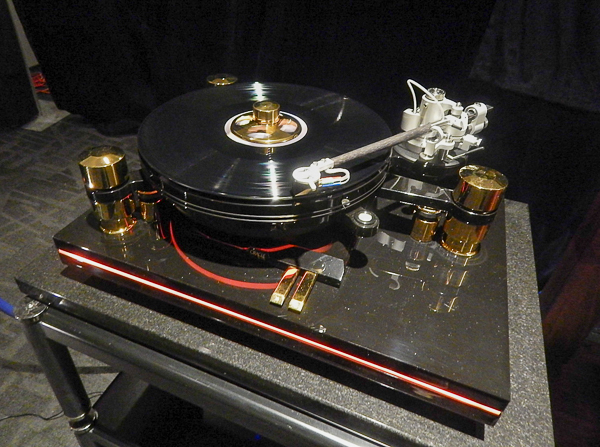
I took a seat dealing with the system, which included an Oracle Audio Delphi Reference MkVII Signature turntable with 24K Gold plating ($18,500 US), fitted with a Reed 2G 9.5″ tonearm ($4850 US) and an Oracle Corinth cartridge ($2350 US). Phono preamplification and equalization have been carried out by an Oracle Paris PH200 Mklll phono preamplifier ($2250 CA), which fed a pair of 250W (rated into 8 ohms) Eon Art Boson built-in monoblocks ($72,535)—”built-in” as a result of every monoblock has its personal (tubed) preamplifier. Cardas cabling interconnected the system.


The audio system, in fact, have been the $12,000 Gershman Acoustics Studio XdB.


The system produced an open, large-scale vista of colourful, expressive, intimate, organically flowing, tonally colourful sound. It made me blissful I’d picked this technique over the opposite.


Still, after I’d left the room, I felt vacancy. I actually needed to listen to that thirtieth Anniversary Grand Avant Garde mannequin; who is aware of, perhaps I’m even happier within the alternate ‘verse by which I selected that room as an alternative. Maybe, on this verse, they will present them at this yr’s Toronto Audiofest in October. Cue the James Bond Theme.

Posted in Uncategorized

Totem, Yamaha, MoFi, AudioQuest


When I requested Totem’s Vince Bruzzese, ultimately 12 months’s “static” launch of the brand new Bison collection, what the impetus was to create the Bison vary, he mentioned it got here right down to desirous to create one thing particular to mark the corporate’s thirty fifth birthday but in addition that of the Model 1, which got here out within the 12 months of the corporate’s founding, 1989. “I wished to convey us again to Model 1 territory,” Vince mentioned, “the place folks have been wowed and saying, ‘oh my gosh, I spent how a lot previously and by no means acquired this?'”


The Bison collection consists of the two-way Bison Monitor ($2250), which Vince instructed me is just like the Model 1 however a bit bigger and extra succesful in some ways, together with two floorstanders: the shorter two-way Bison Tower ($2850) and the taller two-way Bison Tower T ($3750). The low-frequency response for the three fashions are specified as 40Hz, 33Hz, and 31Hz, respectively.


I’ve all the time favored the home sound of passive Totem audio system (I have not auditioned the lively ones)—woody, wealthy, pure, full—and on this room, the place I had the prospect to hearken to each the standmounts and the Tower T, powered by a Yamaha A-S2200 Integrated Amplifier ($4499 US), which in flip was fed by a MoFi Electronics turntable with MasterTracker cartridge ($2999 US), all cabled along with AudioQuest cabling. I heard, throughout a few vocal and jazz LPs, the identical ingratiating, satisfying, healthful sound I affiliate with the Totem model however maybe extra of it. These fashions impressed me with their huge, heat, pure-toned, substantial shows. They struck me as offering quite a lot of music for the cash.


I remembered one thing Vince mentioned on the Bison launch that made me smile. “These audio system aren’t simply large killers, they’re large satisfiers.” From what I heard on this room, he could also be proper.

Totem, Yamaha, MoFi, AudioQuest


When I requested Totem’s Vince Bruzzese, eventually yr’s “static” launch of the brand new Bison collection, what the impetus was to create the Bison vary, he stated it got here all the way down to desirous to create one thing particular to mark the corporate’s thirty fifth birthday but additionally that of the Model 1, which got here out within the yr of the corporate’s founding, 1989. “I wished to deliver us again to Model 1 territory,” Vince stated, “the place folks have been wowed and saying, ‘oh my gosh, I spent how a lot previously and by no means received this?'”


The Bison collection consists of the two-way Bison Monitor ($2250), which Vince informed me is just like the Model 1 however a bit bigger and extra succesful in some ways, together with two floorstanders: the shorter two-way Bison Tower ($2850) and the taller two-way Bison Tower T ($3750). The low-frequency response for the three fashions are specified as 40Hz, 33Hz, and 31Hz, respectively.


I’ve at all times appreciated the home sound of passive Totem audio system (I have not auditioned the energetic ones)—woody, wealthy, pure, full—and on this room, the place I had the possibility to take heed to each the standmounts and the Tower T, powered by a Yamaha A-S2200 Integrated Amplifier ($4499 US), which in flip was fed by a MoFi Electronics turntable with MasterTracker cartridge ($2999 US), all cabled along with AudioQuest cabling. I heard, throughout a few vocal and jazz LPs, the identical ingratiating, satisfying, healthful sound I affiliate with the Totem model however maybe extra of it. These fashions impressed me with their huge, heat, pure-toned, substantial shows. They struck me as offering a whole lot of music for the cash.


I remembered one thing Vince stated on the Bison launch that made me smile. “These audio system aren’t simply large killers, they’re large satisfiers.” From what I heard on this room, he could also be proper.

ArtistCloner

Our fearless reporter–left–waxing eloquent in his pocket book.


I’ve ran into producer Artist Cloner’s proprietor and designer, Sylvio Comtois, many instances at audio exhibits. He strikes me as being a little bit of a mad scientist. Not “loopy” mad however mad within the sense of being obsessive about a selected goal.


In Sylvio’s case, that goal is the belief of the last word in sound copy by way of meticulous system synergy. It’s why he designs, builds, and demoes whole ArtistCloner programs, to indicate what may result when every part within the playback chain, from cables to audio system, is optimized to work along with one voice. And whereas he’s joyful to promote you a part or two to suit into your current system—and I’ve little question they sound superb that approach—that form of misses the purpose, which is: Sylvio’s merchandise are designed to work collectively a lot in the identical approach that your limbs and digits are supposed to work for you, as components of an natural entire.

Sylvio Comtois and his spouse Isabelle with the Ether. This photograph and the highest photograph credit score: Michel Forbes and Maxime Dorand.


Consider the 40″-tall, 2.5-way Ether audio system (introductory value, $22,000/pair, $25,000/pair after that). Their drivers and collection crossovers all have their very own chambers. Their inch-thick enclosures are made of 1 layer of elastomer, one layer of plywood, one layer of acrylic, and one layer of a grounded slate compound.


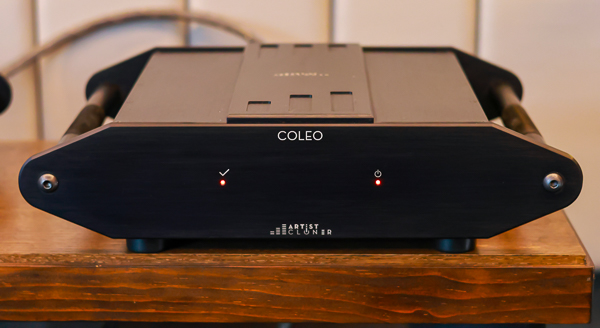
Feeding the audio system on this room have been a pair of 48W (into 8 ohms) Coleo monoblock amplifiers (introductory value $8000 every, $9500 every after that), a Luceo preamp (introductory value $7000, $8000 after that.), and a Librarium music server / streamer (value varies). ArtistCloner cables, cable risers, and energy conditioners have been used all through.


Music was streamed from the Librarium’s inside laborious drive. On the reduce “No Need to Argue” by the Cranberries, the organ’s bass tones produced tremors within the room’s construction and pushed a heavy blanket of low-octave power into my chest. O’Riordan’s vocals hovered above, undisturbed, sounding candy, tangible, colourful, clear.


A quieter monitor with acoustic guitar and chook sounds highlighted how spacious, pure, cohesive, and dimensional the soundstage sounded. In a extra normal sense, the music sounded pure and unobstructed, like a gushing river of tactile sound, proving that system synergy is a noble goal to obsess over. Since, hey, you have to obsess over one thing, proper?

Audio Note

Of course this technique had two audio system; it is simply that each did not match within the body.


As traditional, I discovered cellist and Audio Note UK music ambassador Vincent Bélanger internet hosting the Audio Note UK room, however this time, Vincent wasn’t alone. He was accompanied by two gross sales executives hailing from Audio Note central in England: Daniel Qvortrup, son of firm founder Peter, and a chap who, at night time, goes by the artist title A:D and by day, Adrian Ford-Crush. Adrian composes a mode of bass-heavy digital music that is fashionable in England known as drum and bass. He and Daniel got here to Montreal to assist Vincent watch the room and play music, which included a few of A:D’s personal compositions.


I’ve heard many Audio Note techniques through the years, however by no means earlier than one on this league, as measured by efficiency or worth. It included a 27Wpc, single-ended, 211 tube–based mostly built-in amplifier ($220,000) and a pair of AN-E/SPx SE Signature loudspeakers with the Apple end ($25,000).

                      Daniel Qvortrup


Sources included an analog front-end I did not audition: a TT Three turntable with PSU3 energy provide ($25,000), an Arm Three/II tonearm ($3750), an IO II MC phono cartridge ($11,500), an M5 RIAA phono stage ($20,000), and an AN-S8 step-up transformer ($24,000)—and a digital front-end that I did audition: a CDT Four CD transport ($32,500) and a tube-rectified DAC 5 Special ($99,000). Cables had been additionally by Audio Note UK, making this a purebred Audio Note UK system.


Listening to Adrian’s spacey, beat-driven, effects-laden music streamed from an exterior exhausting drive, I heard a presentation that was fluid, seamless, deep-hued, textured, and layered in air currents—air appeared palpabe within the entrance of and behind the devices. The soundstage was huge and appeared microscopically energised with tactile musical data.


Most importantly, this technique made me actually dig A:D’s music.

Gershman Acoustics, Eon Art, Oracle Audio, Reed, Cardas

Jacques Riendeau of Oracle Audio


I used to be operating out of time.


The present was closing quickly and I hadn’t heard both of Gershman Acoustics’s two new choices on the present. Well, one new, the opposite new-ish. The new-ish one was the corporate’s Grand Avant Garde thirtieth Anniversary Edition mannequin. This wasn’t a Special Edition with a restricted run however a tweaked model of the favored Grand Avant Garde, a speaker I all the time preferred for its wealthy, full-bodied sound. It changed the unique, and it presents bass extension specified to go 2dB decrease.


The different mannequin was genuinely new: It launched at this present. The Studio XdB ($12,000) appears to be like like a standmount, but it surely is not, or not precisely. It appears to be like like a field on a stand, however the stand is provided with Gershman Acoustics’s patented Bass Trap, which is alleged to increase the speaker’s bass response right down to 23Hz and remove the again wave.


The crux of my dilemma was this: The fashions had been being proven in numerous rooms, and I had time to go to just one. I wished to listen to each. So, which one? After some soul looking, my determination was made. Switching into James Bond mode, throughout which Monty Norman’s traditional “James Bond Theme” performed like a cool film rating at the back of my head, I darted previous the group and throughout the mezzanine, down the escalator (leaving a path of dazed our bodies in my wake), and into the spacious St-Laurent 8 room.


I took a seat going through the system, which included an Oracle Audio Delphi Reference MkVII Signature turntable with 24K Gold plating ($18,500 US), fitted with a Reed 2G 9.5″ tonearm ($4850 US) and an Oracle Corinth cartridge ($2350 US). Phono preamplification and equalization had been carried out by an Oracle Paris PH200 Mklll phono preamplifier ($2250 CA), which fed a pair of 250W (rated into 8 ohms) Eon Art Boson built-in monoblocks ($72,535)—”built-in” as a result of every monoblock has its personal (tubed) preamplifier. Cardas cabling interconnected the system.


The audio system, in fact, had been the $12,000 Gershman Acoustics Studio XdB.


The system produced an open, large-scale vista of colourful, expressive, intimate, organically flowing, tonally colourful sound. It made me completely satisfied I’d picked this technique over the opposite.


Still, after I’d left the room, I felt vacancy. I actually wished to listen to that thirtieth Anniversary Grand Avant Garde mannequin; who is aware of, possibly I’m even happier within the alternate ‘verse through which I selected that room as an alternative. Maybe, on this verse, they will present them at this yr’s Toronto Audiofest in October. Cue the James Bond Theme.

Montreal Audio Fest 2023: Final observations


Finally, it snowed through the weekend of the present, on Saturday, which was disappointing. It meant I wasn’t in an alternate ‘verse of the multiverse in spite of everything and, consequently, I wasn’t Alternate Rob with a half-million-dollar hi-fi ready at house.


On the nice facet, in my ‘verse, the Montreal Audiofest 2023 was a bonafide hit, in two methods particularly. First, there’s attendance, which was bigger and extra various—many ladies and children—than I keep in mind ever seeing on the Montreal present. Organizer Sarah Tremblay remarked with incredulity that it was the primary time the present has ever run out of admission bracelets.


Second, on common, the sound of the demoes was higher than traditional. I’ve no double-blind statistical proof to help this declare, however I speculate that this was attributable to a mixture of exhibitors paying extra consideration to room setup and audio gear sounding universally higher.


Tidal-streaming was by far the tactic of alternative for music playback. (Qobuz is not right here but, in Canada, although it is launching in May.) I noticed virtually no CDs, only a few LPs, not very many information saved regionally, and overlook about reel-to-reel; the one reel-to-reel I noticed (however did not hear) was within the Nagra room. When it involves music sources, streaming guidelines.


Another development? Class-D is getting extra standard—and higher. It’s humorous to assume how just some years in the past class-D wasn’t even value speaking about. Now it appears poised to develop into ubiquitous. I requested one veteran tube-amp designer if he would ever contemplate constructing a transistor amp: “No, as a result of solid-state amps can’t seize the soul of the music like a tube amp can,” he stated. “But possibly sooner or later class-D amps will have the ability to.”


So there you’ve got it. Another present wrapped. Time for me to unwind, and I do know precisely how I’m going to do it.

Rob and calamari