I in all probability spent a lot of my time at AXPONA with a extreme case of resting bitch face, as I’m often concentrating onerous. There’s lots to cowl, and a thousand info to get straight. But throughout system auditions, I often smiled too, generally unintentionally making eye contact with exhibitors who have been excited to see that I was excited.
That’s what occurred within the Linkwitz room, the place CEO Frank Brenner and famous Linkwitz evangelist Charles Port have been demoing the corporate’s LX521.4 open-baffle audio system.
Is it a brand new product? Yes and no. The model 4 is barely totally different from earlier 521 iterations in that there is no longer a passive crossover within the prime baffle, theoretically leading to higher decision and purity.
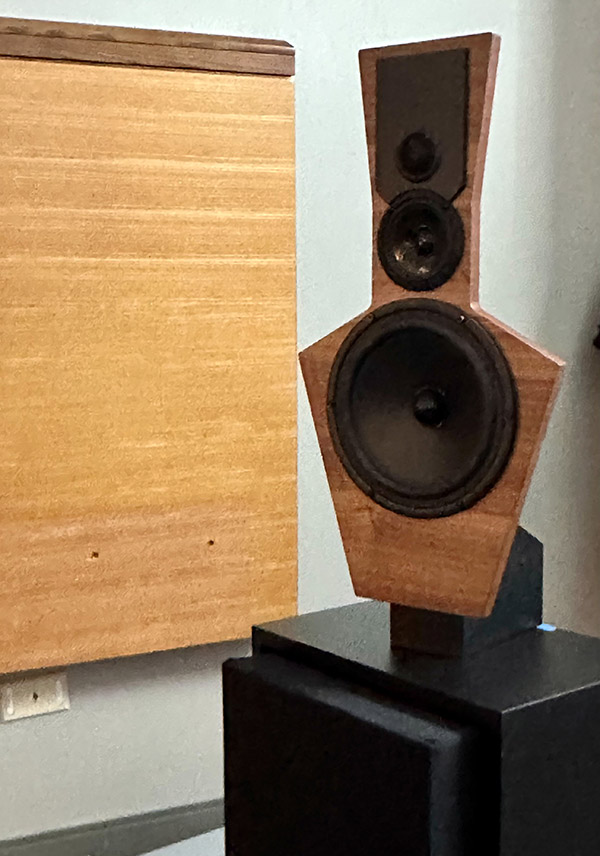
By the way in which, it is time to cease pondering of Germany-based Linkwitz as an organization that simply sells builder plans and numerous components to prospects who want to assemble the audio system as a DIY undertaking. These days, the Linkwitz workforce provides a totally assembled and properly completed “turnkey” system; all it’s a must to do is unbox it and plug it in.
The firm’s flagships, designed a couple of dozen years in the past by business luminary Siegfried Linkwitz (1935–2018), are four-way, full-range dipoles that produce a figure-of-eight radiation sample, claimed to excite fewer room modes than different transducer configurations. The two bass enclosures, every containing a pair of back-to-back woofers mounted at an angle, have 4 sides as an alternative of six, as they’re utterly open in the back and front (you possibly can disguise them behind material grilles in case you like). Up prime, the baffles rotate individually from the woofer buildings that assist them, permitting customers to roughly dial within the width of the specified soundstage. The solely precise containers within the system are the 2 parts that home the Hypex nCore amplifiers and the crossovers, all included within the $26,700 system value.
A very good chunk of that cash goes to pay for Panzerholz (“armored wooden”). It’s a dear, actually bulletproof sort of über-plywood that is so heavy it sinks in water. Panzerholz’s damping properties make it a wonderful alternative for audio system, Brenner stated.
In the usual Renaissance lodge room on the fifteenth ground—perhaps 12′ broad and 18′ lengthy, plus a small hallway—Port and Brenner invited me to sit down very near the Linkwitz audio system: lower than 5′ away, on the tip of a flat imaginary triangle. The sound of an unknown-to-me, all-percussion Chesky recording was admittedly wonderful there, however after I tried different listening positions, I used to be struck by the truth that the soundstage did not collapse or grow to be unbalanced. There wasn’t a candy spot, there was a big candy swath.
We performed “The Real Blues” by the Ray Brown Trio, adopted by Carmen Gomes Inc.’s model of “Come On In My Kitchen” and Pink Floyd’s “Time.” The system’s treble and mid drivers put in a seamless, light-footed presentation with a spatial openness that various from superb to astounding, relying on the recording. Likewise, the bass, rated to 20Hz, sounded nimble however authoritative, and emphatically pure.
In three days I heard perhaps 10% of all AXPONA rooms, so it would be foolish to present a Best in Show award. But to my ears, the German audio system have been among the many tip of the highest: erstklassig (firstclass) and completely wunderbar.
Other parts within the system have been a Jeff Rowland Design Capri S2-SC preamp ($6100); a Kuzma Stabi R turntable ($9595) with a Kuzma Stogi Ref 313 VTA tonearm ($6600) and a NOS Ortofon Rohmann MC phono cartridge ($1300); plus a Linn Akurate streamer ($18,500 together with in depth mods). Cabling was a mixture of Mogami and “generic” OFC and OCC cables that Port stated price lower than a thousand {dollars} complete.