Author Archives: Rogier van Bakel

The Lenbrook room, Paul Barton, and PSB’s Flagship Synchrony T800 Tower

Industry legend Paul Barton (above) has been designing audio system for greater than half a century. He’s additionally fairly the speaker himself.


I’d sauntered into the Lenbrook room to take a look at Barton’s new PSB Synchrony T800 floorstanders (PSB is a Lenbrook model). My go to was serendipitously timed. Not solely was the person himself current; he and I, together with the gregarious Joe Corona of Chicago retailer Saturday Audio Exchange, had been the one ones left when the doorways closed at 6pm. We settled in. Corona supplied slices of espresso cake, and Barton equipped knowledge and bon mots.


For a really pleasing hour, we listened and he held forth: about anechoic and real-world measurements; about psychoacoustics; concerning the blind listening checks to which he’d typically topic audio journalists and others; about listening to loss and the mind’s unbelievable capacity to compensate for it. Last however not least, Barton talked concerning the T800. This is PSB’s flagship speaker, costing $11,999/pair.


Of course we additionally did some listening. My host demoed his brainchild with “Time of the Season,” a 1994 recording by the Nylons. That jogged my memory of the masterpiece that’s 1968’s Odessey and Oracle, the Zombies album on which that tune first appeared. So then we performed that. (Long reside Qobuz!)


The T800’s refined treble comes courtesy of a 1” titanium dome with ferrofluid. A 5.25” carbon-fiber cone takes care of the midrange, whereas three 8″ woofers in cast-aluminum baskets (and ringed by mass-loaded rubber surrounds) deliver the bass, rated to go as deep as 21Hz. Each woofer has its personal inside enclosure, as properly its personal rear port. Two of these ports include covers that T800 homeowners can placed on or go away off to tune the bass response to the room. Though Barton is not vulnerable to chest-thumping, he’ll permit that the crossovers within the T800s are “probably the most superior amplitude-perfect, Linkwitz-Riley, 4th-order crossovers of any PSB speaker.”


In what could also be an business first, the audio system’ outriggers have built-in IsoAcoustics GAIA ft, a $600 worth. (At AXPONA, I clearly heard the GAIAs’ helpful impact throughout a demo within the Focal/Naim room, equivalent to the intriguing A/B check that Jim Austin described right here.)


Driven by an NAD Masters 33 BluOS streaming DAC/amplifier ($5999, above) and cabled with AudioQuest, the PSB towers sounded clean however resolute, balanced but forceful, producing first-rate micro- and macro-dynamics . . . and oodles of enjoyment.
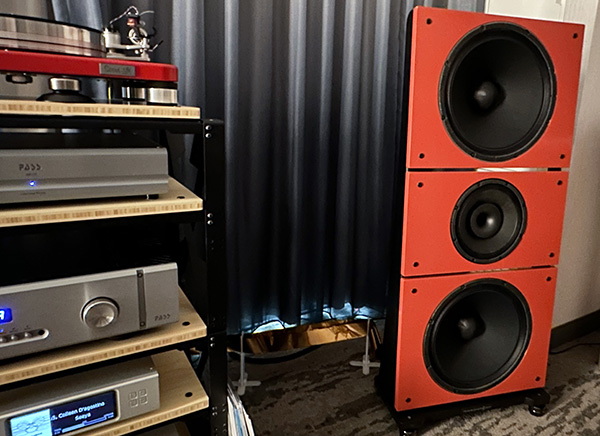
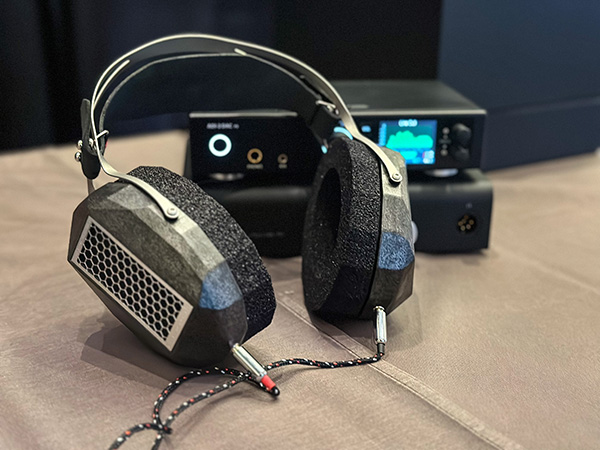
PureAudioProject’s Trio15 open-baffle audio system powered by Pass Labs, Aurender, Denafrips, VPI

On the Renaissance resort’s sixteenth flooring, within the room occupied by PureAudioProject, people have been totally baffled. Also, often attractive.


Apologies. The undeniable fact that I’m away from house for 4, 5 days to cowl AXPONA means I briefly do not have my teenage offspring to mortify with dad humor, so now I’m inflicting it on you. PureAudioProject, you see, makes open-baffle audio system. Some have horns. There’s a motive I write for Stereophile, not Saturday Night Live.


Israeli proprietor Ze’ev Schlik (above) had introduced his Trio15 boxless audio system, plus a playlist stuffed with effective tracks to point out them off. I appreciated the Trios loads, as I figured I’d; in 2020 I’d spent a couple of pleased months with PAP’s five-drivers-per-channel Quintet 10s. As I wrote in my assessment (for one more publication), “Playing Sketches of Spain on the Quintets conjured a mid-career Miles Davis proper there in my room, virtually 60 years after the actual fact. I used to be regularly startled—and happy—by this time-machine-like high quality.”


In extra methods than one, PureAudioProject marches to a distinct drummer. Its audio system are largely modular, permitting the tip person to swap, for instance, a coaxial midrange-and-tweeter cone for a horn transducer, or vice versa. Schlik and his workforce additionally encourage adventurous prospects to experiment with capacitors and different crossover parts that the corporate will gladly make out there or assist supply.


One benefit of open-baffle audio system is that it is easy-ish to customise them, as a result of neither the drivers nor the crossovers are entombed in a field. If you are reasonably useful with a screwdriver and an Allen wrench, you’ll be able to in impact add sugar and spice, or pepper and salt, to style—typically in mere minutes.


The Quintet 10s I reviewed had arrived half-assembled in flight circumstances, as a result of they’d beforehand been demoed at audio reveals. This brought on me to overlook one thing about PAP’s direct-sales mannequin that I solely understood when, at AXPONA, I requested the always-amiable Schlik in regards to the firm’s ordering course of. He defined that prospects fill out a type on the corporate’s web site, specifying the components they need. Those components are then drop-shipped to the customer by their respective suppliers. For occasion, for those who have been to order the Trio15s that took pleasure of place within the PAP room, you’d obtain not less than 4 separate shipments. The crossovers would arrive from Germany, as a result of they’re manufactured there. You’d get the coax drivers from Spain for a similar motive, and the woofers from the USA. Meanwhile, PAP would ship you the modular body and the remainder of the required {hardware}, together with detailed directions so you’ll be able to put every little thing collectively in a couple of hours.


Though I’m certain this quasi-DIY strategy is not for everybody, it is fairly sensible. The items do not should be shipped to a central facility and assembled, neither is an elaborate components stock essential. There’s nice economic system in that strategy. Plus, PAP makes use of no sellers, slicing out the intermediary. Schlik informed me that underneath a conventional enterprise mannequin, the $8500/pair Trios15s would price nearer to $20k.


Sonically, the audio system did refined and candy to nice impact (Amy Winehouse’s “Wake Up Alone”), they usually did plump and punchy simply as properly (Infected Mushroom’s “Head of NASA”).


The remainder of the luxurious system consisted of a Pass Labs INT-25 built-in amplifier ($7250) and an SP-17 phono preamp ($4300); a VPI Scout turntable ($3300); a Denafrips Terminator Plus DAC ($6300); and an Aurender N200 server and streamer (additionally $6300). Literally tying all of it collectively have been cables from Silversmith and Shunyata.

Posted in Uncategorized

The Lenbrook room, Paul Barton, and PSB’s Flagship Synchrony T800 Tower

Industry legend Paul Barton (above) has been designing audio system for greater than half a century. He’s additionally fairly the speaker himself.


I’d sauntered into the Lenbrook room to take a look at Barton’s new PSB Synchrony T800 floorstanders (PSB is a Lenbrook model). My go to was serendipitously timed. Not solely was the person himself current; he and I, together with the gregarious Joe Corona of Chicago retailer Saturday Audio Exchange, have been the one ones left when the doorways closed at 6pm. We settled in. Corona offered slices of espresso cake, and Barton equipped knowledge and bon mots.


For a really satisfying hour, we listened and he held forth: about anechoic and real-world measurements; about psychoacoustics; concerning the blind listening assessments to which he’d generally topic audio journalists and others; about listening to loss and the mind’s unimaginable potential to compensate for it. Last however not least, Barton talked concerning the T800. This is PSB’s flagship speaker, costing $11,999/pair.


Of course we additionally did some listening. My host demoed his brainchild with “Time of the Season,” a 1994 recording by the Nylons. That jogged my memory of the masterpiece that’s 1968’s Odessey and Oracle, the Zombies album on which that track first appeared. So then we performed that. (Long dwell Qobuz!)


The T800’s refined treble comes courtesy of a 1” titanium dome with ferrofluid. A 5.25” carbon-fiber cone takes care of the midrange, whereas three 8″ woofers in cast-aluminum baskets (and ringed by mass-loaded rubber surrounds) deliver the bass, rated to go as deep as 21Hz. Each woofer has its personal inner enclosure, as nicely its personal rear port. Two of these ports include covers that T800 homeowners can placed on or go away off to tune the bass response to the room. Though Barton is not vulnerable to chest-thumping, he’ll permit that the crossovers within the T800s are “probably the most superior amplitude-perfect, Linkwitz-Riley, 4th-order crossovers of any PSB speaker.”


In what could also be an business first, the audio system’ outriggers have built-in IsoAcoustics GAIA toes, a $600 worth. (At AXPONA, I clearly heard the GAIAs’ useful impact throughout a demo within the Focal/Naim room, similar to the intriguing A/B check that Jim Austin described right here.)


Driven by an NAD Masters 33 BluOS streaming DAC/amplifier ($5999, above) and cabled with AudioQuest, the PSB towers sounded clean however resolute, balanced but forceful, producing first-rate micro- and macro-dynamics . . . and oodles of enjoyment.

Posted in Uncategorized

Fidelity Imports and Diptyque planar audio system with Audia Flight, Aurender

Two months in the past, on the audio expo in Tampa, I stumbled upon a pair of most intriguing French audio system. The $8000/pair Diptyque 107 is a medium-sized planar magnetic whose designers, Gilles Douziech and Eric Poix, make no secret of their love for Magnepan. All the identical, the duo has sought to enhance on that firm’s famed panel know-how, principally by addressing a perennial shortcoming of such dipoles: their lack of deep bass.


To my delight, the 107s certainly performed low frequencies as if there was a subwoofer someplace within the room. I did not have the time for a correct present report then, however vowed to appropriate that at AXPONA, the place the boutique model confirmed up with its $50k/pair flagship, the Diptyque Reference.


In a juicy twist, demonstrating the audio system in Chicago was Michael Hoatson of the Listening Room in Maryland, a third-generation audio retailer who sells tons of Magnepan audio system however is worked up in regards to the US model’s cheeky French rivals. With a cheerful grin, Hoatson performed bass-heavy songs like Chris Jones’s “No Sanctuary Here” and James Blake’s “Limit To Your Love,” virtually daring guests to complain of a scarcity of low-end extension. No one did.


How was this bass-performance breakthrough achieved? I used to be instructed that Diptyque locations highly effective, custom-made bipolar magnets on the entrance and rear of the sandwiched Mylar diaphragm, which is simply 12µm thick. Each aspect of the Mylar has its personal voice coil. Diptyque’s designers declare that this creates a relentless magnetic discipline when the membrane strikes, permitting for extra LFE and higher dynamics.


In the midrange and treble, too, the Diptyque Reference sounded articulate and quick-footed, harking back to giant Magnepans and Apogees. Très sympa!


The different tools within the Fidelity Imports room consisted of an Italian Audia Flight Strumento No.1 preamp ($19,999), two Strumento No.8 monoblocks ($59,998/pair), and a $15,000 Aurender A20 music server and streamer.

Fidelity Imports and Diptyque planar audio system with Audia Flight, Aurender

Two months in the past, on the audio expo in Tampa, I stumbled upon a pair of most intriguing French audio system. The $8000/pair Diptyque 107 is a medium-sized planar magnetic whose designers, Gilles Douziech and Eric Poix, make no secret of their love for Magnepan. All the identical, the duo has sought to enhance on that firm’s famed panel know-how, largely by addressing a perennial shortcoming of such dipoles: their lack of deep bass.


To my delight, the 107s certainly performed low frequencies as if there was a subwoofer someplace within the room. I did not have the time for a correct present report then, however vowed to right that at AXPONA, the place the boutique model confirmed up with its $50k/pair flagship, the Diptyque Reference.


In a juicy twist, demonstrating the audio system in Chicago was Michael Hoatson of the Listening Room in Maryland, a third-generation audio retailer who sells tons of Magnepan audio system however is happy concerning the US model’s cheeky French rivals. With a contented grin, Hoatson performed bass-heavy songs like Chris Jones’s “No Sanctuary Here” and James Blake’s “Limit To Your Love,” virtually daring guests to complain of a scarcity of low-end extension. No one did.


How was this bass-performance breakthrough achieved? I used to be instructed that Diptyque locations highly effective, custom-made bipolar magnets on the entrance and rear of the sandwiched Mylar diaphragm, which is simply 12µm thick. Each aspect of the Mylar has its personal voice coil. Diptyque’s designers declare that this creates a relentless magnetic subject when the membrane strikes, permitting for extra LFE and higher dynamics.


In the midrange and treble, too, the Diptyque Reference sounded articulate and quick-footed, harking back to giant Magnepans and Apogees. Très sympa!


The different tools within the Fidelity Imports room consisted of an Italian Audia Flight Strumento No.1 preamp ($19,999), two Strumento No.8 monoblocks ($59,998/pair), and a $15,000 Aurender A20 music server and streamer.

Grimm Audio brings an improved model of its LS1 energetic audio system

If you are like me and the subject turns to energetic audio system, you will most likely consider reasonably priced merchandise. Maybe the mighty $649 Vanatoo Transparent One Encore involves thoughts, or the sub-$1000 powerhouse that may be a pair of SVS Prime Pro wi-fi audio system. The KEF LS50W is a powerful contender even at $2800, and in case your finances permits, you would possibly contemplate Buchardt A5s ($3900/pair).


Beyond that, my sense is that the majority red-meat audiophiles are going to spring for a number of separate parts, regardless of there being one thing vaguely masochistic about that always extended ordeal of trial, error, and complexity.


Me, I like simplicity as a lot as I like wonderful sound, which is why I actually cottoned to the $14,950 powered Dutch & Dutch 8cs I wrote about a number of days in the past. Then I heard that for elevated luxurious and class, you may as well try a pair of energetic Grimm LS1be audio system that’ll set you again a cool $44k, or virtually thrice what the D&Ds value. So I had a pay attention.


I knew nothing of Grimm Audio, which made the double shock all of the better. Number one: extra Dutchmen. They appeared thick on the bottom at AXPONA. Number two: the Grimm LS1be system was blew-me-away wonderful. I heard exemplary coherence and pace, eye-watering musicality, and a strong steadiness between clear taut bass (20Hz) and exact, expansive treble. The resort room the place founder/artistic director Eelco Grimm and his small crew had arrange store was unremarkable, having undergone solely modest acoustic therapies (I believe I counted 4 smallish panels). And but the area appeared to strategy the extent of a tricked-out live performance corridor. Frequency anomalies? Distortion? Hash? Try as I would, I could not hear any.


Grimm’s LS1 speaker is a three-way system should you rely the built-in, upwards-firing Digital Motional Feedback SB1 subwoofer that’s claimed to have 30dB much less distortion than its predecessor. The tweeter within the LS1be has been upgraded to a beryllium-diaphragm SEAS mannequin. As earlier than, contained in the cabinetry there are six NCore amplifiers developed by engineering wizard and Grimm co-founder Bruno Putzeys, who’s now a principal at Purifi. Of course, the Grimm audio system have hi-rez ADC/DACs onboard as properly, plus a digital sign processor. All you want is a supply.


Is $44,000 a loopy amount of cash to spend on a pair of powered audio system? It’s all within the ear of the beholder, however based mostly on admittedly simply quarter-hour of listening, I’d take Grimm’s tweaked-out assertion of excellence over nearly any system I heard at AXPONA that prices as much as six figures.

Grimm Audio brings an improved model of its LS1 lively audio system

If you are like me and the subject turns to lively audio system, you may in all probability consider reasonably priced merchandise. Maybe the mighty $649 Vanatoo Transparent One Encore involves thoughts, or the sub-$1000 powerhouse that could be a pair of SVS Prime Pro wi-fi audio system. The KEF LS50W is a robust contender even at $2800, and in case your finances permits, you would possibly think about Buchardt A5s ($3900/pair).


Beyond that, my sense is that almost all red-meat audiophiles are going to spring for a number of separate parts, regardless of there being one thing vaguely masochistic about that usually extended ordeal of trial, error, and complexity.


Me, I like simplicity as a lot as I like superb sound, which is why I actually cottoned to the $14,950 powered Dutch & Dutch 8cs I wrote about a couple of days in the past. Then I heard that for elevated luxurious and class, you too can take a look at a pair of lively Grimm LS1be audio system that’ll set you again a cool $44k, or virtually 3 times what the D&Ds value. So I had a hear.


I knew nothing of Grimm Audio, which made the double shock all of the better. Number one: extra Dutchmen. They appeared thick on the bottom at AXPONA. Number two: the Grimm LS1be system was blew-me-away glorious. I heard exemplary coherence and velocity, eye-watering musicality, and a stable steadiness between clear taut bass (20Hz) and exact, expansive treble. The resort room the place founder/inventive director Eelco Grimm and his small crew had arrange store was unremarkable, having undergone solely modest acoustic remedies (I feel I counted 4 smallish panels). And but the house appeared to strategy the extent of a tricked-out live performance corridor. Frequency anomalies? Distortion? Hash? Try as I’d, I could not hear any.


Grimm’s LS1 speaker is a three-way system if you happen to depend the built-in, upwards-firing Digital Motional Feedback SB1 subwoofer that’s claimed to have 30dB much less distortion than its predecessor. The tweeter within the LS1be has been upgraded to a beryllium-diaphragm SEAS mannequin. As earlier than, contained in the cabinetry there are six NCore amplifiers developed by engineering wizard and Grimm co-founder Bruno Putzeys, who’s now a principal at Purifi. Of course, the Grimm audio system have hi-rez ADC/DACs onboard as effectively, plus a digital sign processor. All you want is a supply.


Is $44,000 a loopy sum of money to spend on a pair of powered audio system? It’s all within the ear of the beholder, however based mostly on admittedly simply quarter-hour of listening, I’d take Grimm’s tweaked-out assertion of excellence over nearly any system I heard at AXPONA that prices as much as six figures.

RAAL-requisite’s circumaural ribbon headset, the CA-1a

As audiophiles, we attempt nearly obsessively for a low noise flooring and no distractions, solely to be spectacularly thwarted once we consider tools in a retail or present atmosphere. Around us, persons are coming into and exiting, and sometimes speaking up a storm. The air conditioner is about to a low drone. Bass notes leak in from the following room over. AXPONA’s cavernous Ear Gear area, the place greater than two dozen producers of headphones and associated tools have been demonstrating their wares, was awash with buzzing, excited individuals—the perfect type of noise, actually, even when it’s important to flip the demo cans means as much as block it.


I had come to pay RAAL-requisite a go to, hoping to audition a primary for me: a recently-launched ribbon headphone referred to as the CA-1a. The Serbian-American firm beforehand made waves with one other ribbon headset, the SR-1a. SR stands for studio reference, suggesting an elevated commonplace, and reviewers have tended to agree. Stereophile‘s Herb Reichert wrote concerning the SR-1a in Gramophone Dreams #32, calling it “each revelatory and revolutionary” and assigning it class-A+ standing. At $3499, the product is up there in worth, and given an ultra-low impedance of 0.2 ohms, the SR-1a requires an amplifier of not less than 100Wpc to make it sound its finest.


The CA-1a is way the identical beast, however essentially totally different on the identical time. The SR-1a, in Herb’s phrases, “sits evenly in your head and neither covers your ears nor places stress in your pinna . . . [It] photographs outdoors and away out of your cranium—just like floorspeakers!” The CA-1a makes use of primarily the identical ribbons; slender strips of foil, connected solely at their brief ends and energized by an array of small magnets alongside their flanks. But the newer ‘telephones retail for a way more inexpensive $2000, have conventional circumaural cups (comprised of polycarbonate) with interchangeable foam pads, and may be pushed by an amplifier as humble because the Schiit Jotunheim ($299). In reality, that is how I listened to the CA-1a: through a $1299 German-made RME ADI-2 DAC, plugged right into a Jotunheim.


On “The Incredibles” by Gordon Goodwin’s Big Phat Band, an advanced, spy-themed, large-ensemble jazz piece, it was remarkably straightforward to comply with every instrument to the exclusion of all of the others. I delighted in the identical high quality on Stevie Wonder’s “Sir Duke,” and even heard it on a favourite Sixties mono recording by Johnny Barfield and the Men of S.O.U.L referred to as “Mr. Starlight”—a spooky, Lynchian doowop music with Barfield’s pained, piercing falsetto at its core. The RAAL-requisite CA-1a stored main me deep into the music, because of a presentation that was agile, quick, superclean, and revealing to a T.


When it involves headphones, I’m keen on the purity of planar magnetics. The HifiMAN HE1000se and the Audeze LCD-4 are my favourite cans for critical dwelling listening. Considering what I heard within the RAAL-requisite sales space, I’m guessing that in a side-by-side shootout, the CA-1a may rival and maybe surpass them.

RAAL-requisite’s circumaural ribbon headset, the CA-1a

As audiophiles, we attempt virtually obsessively for a low noise ground and no distractions, solely to be spectacularly thwarted once we consider tools in a retail or present atmosphere. Around us, individuals are getting into and exiting, and infrequently speaking up a storm. The air conditioner is ready to a low drone. Bass notes leak in from the subsequent room over. AXPONA’s cavernous Ear Gear house, the place greater than two dozen producers of headphones and associated tools had been demonstrating their wares, was awash with buzzing, excited individuals—the most effective sort of noise, actually, even when you must flip the demo cans approach as much as block it.


I had come to pay RAAL-requisite a go to, hoping to audition a primary for me: a recently-launched ribbon headphone referred to as the CA-1a. The Serbian-American firm beforehand made waves with one other ribbon headset, the SR-1a. SR stands for studio reference, suggesting an elevated commonplace, and reviewers have tended to agree. Stereophile‘s Herb Reichert wrote concerning the SR-1a in Gramophone Dreams #32, calling it “each revelatory and revolutionary” and assigning it class-A+ standing. At $3499, the product is up there in value, and given an ultra-low impedance of 0.2 ohms, the SR-1a requires an amplifier of a minimum of 100Wpc to make it sound its finest.


The CA-1a is way the identical beast, however essentially completely different on the similar time. The SR-1a, in Herb’s phrases, “sits flippantly in your head and neither covers your ears nor places strain in your pinna . . . [It] photographs exterior and away out of your cranium—just like floorspeakers!” The CA-1a makes use of basically the identical ribbons; slender strips of foil, hooked up solely at their brief ends and energized by an array of small magnets alongside their flanks. But the newer ‘telephones retail for a way more inexpensive $2000, have conventional circumaural cups (comprised of polycarbonate) with interchangeable foam pads, and may be pushed by an amplifier as humble because the Schiit Jotunheim ($299). In truth, that is how I listened to the CA-1a: by way of a $1299 German-made RME ADI-2 DAC, plugged right into a Jotunheim.


On “The Incredibles” by Gordon Goodwin’s Big Phat Band, an advanced, spy-themed, large-ensemble jazz piece, it was remarkably simple to observe every instrument to the exclusion of all of the others. I delighted in the identical high quality on Stevie Wonder’s “Sir Duke,” and even heard it on a favourite Sixties mono recording by Johnny Barfield and the Men of S.O.U.L referred to as “Mr. Starlight”—a spooky, Lynchian doowop tune with Barfield’s pained, piercing falsetto at its core. The RAAL-requisite CA-1a saved main me deep into the music, because of a presentation that was agile, quick, superclean, and revealing to a T.


When it involves headphones, I’m keen on the purity of planar magnetics. The HifiMAN HE1000se and the Audeze LCD-4 are my favourite cans for critical residence listening. Considering what I heard within the RAAL-requisite sales space, I’m guessing that in a side-by-side shootout, the CA-1a might rival and maybe surpass them.

RAAL-requisite’s circumaural ribbon headset, the CA-1a

As audiophiles, we try nearly obsessively for a low noise flooring and no distractions, solely to be spectacularly thwarted once we consider tools in a retail or present surroundings. Around us, individuals are getting into and exiting, and infrequently speaking up a storm. The air conditioner is ready to a low drone. Bass notes leak in from the subsequent room over. AXPONA’s cavernous Ear Gear house, the place greater than two dozen producers of headphones and associated tools have been demonstrating their wares, was awash with buzzing, excited folks—the very best form of noise, actually, even when you must flip the demo cans method as much as block it.


I had come to pay RAAL-requisite a go to, hoping to audition a primary for me: a recently-launched ribbon headphone referred to as the CA-1a. The Serbian-American firm beforehand made waves with one other ribbon headset, the SR-1a. SR stands for studio reference, suggesting an elevated customary, and reviewers have tended to agree. Stereophile‘s Herb Reichert wrote concerning the SR-1a in Gramophone Dreams #32, calling it “each revelatory and revolutionary” and assigning it class-A+ standing. At $3499, the product is up there in worth, and given an ultra-low impedance of 0.2 ohms, the SR-1a requires an amplifier of at the very least 100Wpc to make it sound its finest.


The CA-1a is way the identical beast, however basically totally different on the identical time. The SR-1a, in Herb’s phrases, “sits frivolously in your head and neither covers your ears nor places stress in your pinna . . . [It] photos outdoors and away out of your cranium—much like floorspeakers!” The CA-1a makes use of basically the identical ribbons; slender strips of foil, connected solely at their brief ends and energized by an array of small magnets alongside their flanks. But the newer ‘telephones retail for a way more reasonably priced $2000, have conventional circumaural cups (constituted of polycarbonate) with interchangeable foam pads, and will be pushed by an amplifier as humble because the Schiit Jotunheim ($299). In truth, that is how I listened to the CA-1a: by way of a $1299 German-made RME ADI-2 DAC, plugged right into a Jotunheim.


On “The Incredibles” by Gordon Goodwin’s Big Phat Band, a sophisticated, spy-themed, large-ensemble jazz piece, it was remarkably straightforward to comply with every instrument to the exclusion of all of the others. I delighted in the identical high quality on Stevie Wonder’s “Sir Duke,” and even heard it on a favourite Sixties mono recording by Johnny Barfield and the Men of S.O.U.L referred to as “Mr. Starlight”—a spooky, Lynchian doowop music with Barfield’s pained, piercing falsetto at its core. The RAAL-requisite CA-1a saved main me deep into the music, due to a presentation that was agile, quick, superclean, and revealing to a T.


When it involves headphones, I’m keen on the purity of planar magnetics. The HifiMAN HE1000se and the Audeze LCD-4 are my favourite cans for critical house listening. Considering what I heard within the RAAL-requisite sales space, I’m guessing that in a side-by-side shootout, the CA-1a may rival and maybe surpass them.