Uncategorized
Alta Audio Adam loudspeaker
Last 12 months, on the hunt for high-quality espresso beans, I visited some specialty espresso web sites. On one discussion board, I got here throughout this description of a specific roast: “I tasted gentle acidity and bitters with hazelnut, bourbon, and a touch of darkish cherry. As it started to chill, there was a touch of black raspberry syrup or cordial. Then a dominant notice emerged of nuts with gentle distillates, walnut bitters, cacao nib and one thing between 82% darkish chocolate and baker’s chocolate. … Further cooling provided the shock of darkish piecrust and a bitter cherry liqueur. The piecrust then rounded to a barely candy darkish rye. There was a lingering aftertaste of single malt scotch that finally pale to baker’s chocolate with a touch of ashiness.”
A touch of ashiness? More like 15 hints of pretentiousness, I believed. I despatched the paragraph to a couple buddies with the request, “If I ever begin jabbering like these espresso cognoscenti, I would like you to punch me within the taint. Hard.” We laughed and moved on.
I had sufficient self-awareness to understand that within the hi-fi world we typically prattle on about hi-fi in ways in which, to outsiders a minimum of, should appear simply as fustian and florid. With each Stereophile evaluation I write, I really feel a bit belated sympathy for the espresso reviewer. It is maddeningly troublesome to be exact concerning the intricacies and nuances our senses understand. Just just like the argot in The Wine Advocate and Artforum, audio reviewers’ prose can appear swollen, posey, and poncy.
In this evaluation of Alta Audio’s Adam speaker, I might reduce down on the high-flown lingo, as a result of these medium-sized towers sound, in a phrase, proper. The treble, for example, is just not dry or brilliant: It’s proper. But I’ve a accountability to go additional than that, to say what it truly feels like. During my copious notetaking, I struggled to explain this speaker precisely. It occurred to me that the higher the audio product, the more durable it’s to explain. Truly excellent audio system and elements are particular due to what’s not there: sibilance, honkiness, chestiness, tizz, tubbiness, and so forth. So, I wracked my mind: What else is like this? What’s one other factor that reveals its character primarily by the absence of imperfections? I by no means discovered the suitable simile—strategies are welcome—however through the six weeks I spent with the Adams, that is what I saved reaching for.

Arrival, look, setup
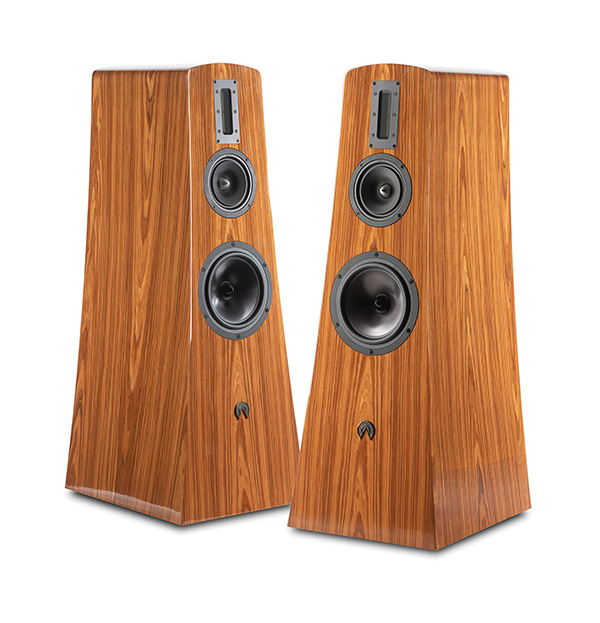
The Adams arrived, strapped to a pallet, on a freight truck. If that conjures up a pair of gargantuan, room-dominating audio system, you may be pleasantly shocked. At 41″ tall, with a tapered, curvy profile and a weight of 96lb every, the Adams look substantial however not overpowering. The end on my pair was a limited-edition silvery grey. “That’s the identical paint Lexus used on its 2004 autos,” Mike Levy, Alta Audio’s founder, instructed me over the cellphone.
When I requested, he advisable that I exploit my Townshend Seismic Isolation Podiums (footnote 1) to decouple the Adams from the hardwood flooring in my listening room, whose boards are nailed into joists positioned over a 6′-deep basement. Levy additionally advisable utilizing the provided two-stage conical spikes proper on high of the Podiums, which raised the ribbon tweeters properly above ear degree. With Levy’s approval, I tipped up the Adams’ rears, extending the rear spikes so far as they’d go, pointing the audio system down at my ears. I measured a 3.8° ahead tilt. (Those spikes screw aside alongside a threaded middle stem, permitting the consumer to differ the peak from roughly 1.5″ to 2.5″—a pleasant little function that may also be used to degree the audio system in case of uneven flooring.) Levy instructed me that if my flooring had been laid over strong concrete, I’d in all probability get the very best outcomes with the spikes put in however with out the Podiums.
I used the Bubble Level app on my iPhone to verify the Adams had been laterally degree. After some experimenting, I settled on gentle toe-in, the imaginary straight traces emanating from the drivers crossing about 20″ behind my head. I had the Adams 6′ 10″ aside (measured from the facilities of the drivers), their backs 3′ from the entrance wall, their outer flanks 3′ 4″ from the aspect partitions, and their ribbon tweeters at a distance of 10′ 2″ from the tops of my pinnae, as affirmed by my Bosch Blaze laser measure.
Just when all appeared nearly proper for prolonged listening, one thing unexpectedly tied my abdomen in knots. As I moved the spiked proper speaker a number of millimeters on the steel Townshend plate, a small, flat piece of MDF broke away from the Adam’s rear backside, across the rightmost thread insert. I skilled roughly the sensation you get once you by accident smash a flagship smartphone—however 20 instances worse as a result of a pair of Adams prices about 20 instances the worth of that bauble.
I took a better look. The drill gap in query was solely 0.15″ from one edge and at most 1 / 4 inch from the opposite—maybe too near the nook. Two-stage spikes which are screwed aside and prolonged (per Alta Audio’s directions) will not be as steady/tight as spikes which are totally screwed in. If the load of the heavy-ish speaker is partially borne by that barely wobbly spike, and if the cupboard materials is MDF—, inert materials for a loudspeaker in most different respects—chipping or breaking might happen. Levy talked to his manufacturing staff the identical night I emailed him images that confirmed what had occurred. The crew addressed the problem in two methods. “We instituted a modification that each reinforces the underside construction that holds the ft and modifications the bottom-plate materials to a higher-density materials,” Levy defined. “We have additionally moved the insert for the ft deeper into the outlet. Our assessments shifting the audio system round haven’t proven any drawback after this repair.”
Alta Audio’s guarantee guarantees to deal with any high quality points for half a decade after buy, upon registration.
Drivers and supplies
Levy piqued my curiosity when he claimed that the Adam’s pure-aluminum ribbon tweeter, which is sort of 6″ tall and contains a magnesium case and neodymium magnets, is “larger than the sum of its components.” A pinkie’s breadth beneath the tweeter housing is a 6″ midrange driver, and a bit farther down is a single 8¾” woofer, which alone is answerable for a frankly astonishing quantity of tight, penetrating bass. We’ll get to that.
Alta Audio’s web site claims that the wideband midrange driver, which was designed in-house, is “underhung for exceptionally low distortion and ultra-fast transient response, whereas its aluminum pole will increase dispersion.” If the claims are true, the wideband moniker is greater than justified: this transducer can, it’s mentioned, deal with 50Hz–20kHz, however Levy determined to cross it over from beneath and above at 250Hz and a couple of.25kHz. That ought to permit for “a large, linear crossover vary,” he mentioned, with easy transitions from bass to mids to treble.
The woofer, outfitted with a black anodized cone, is the important thing element within the patent-pending “XTL” design, with a low-loss rubber encompass and magnet boot plus a solid-aluminum part plug. XTL stands for eXtended Transmission Line, an Alta-exclusive know-how that, based on the corporate’s web site, “applies sonic geometry to tune speaker cupboards as if they’re musical devices, delivering an correct, quick, and highly effective low frequency response.”
Levy was impressed by a number of influential Seventies papers on loudspeaker design co-written by Australian sound engineer Neville Thiele and American electroacoustician Richard Small, of the well-known Thiele-Small parameters (footnote 2). He expanded upon that duo’s insights with a number of of his personal. Boxes, he mentioned, create standing-wave resonances that degrade sound, which leads loudspeaker designers to make use of absorptive supplies inside to easy out the response. “I reasoned that the padding could also be the issue,” Levy ventured. “Looking at instrument design, there are similarities between how a cello or a standup bass is designed and what’s accomplished in a loudspeaker. The strings act as the driving force, and the cavity is used to amplify them into the decrease frequencies. Panel resonances create the sound character of the instrument. Eliminate the panel resonances, and you’ve got one thing similar to a loudspeaker.”
So, Alta Audio skips the padding and builds its cupboards out of a proprietary materials it calls DampHard, touted as a “multi-layered, multi-density materials,” which is used on the driving force board of the Adams. While customary MDF would let sure frequencies resonate, Levy mentioned, DampHard is claimed to “stay lifeless to nearly all vibration.” Levy famous dryly, “I’ve by no means seen anybody put padding of their Stradivarius to make it sound higher.” Fair level (footnote 3).
He’s additionally by no means seen a classical instrument formed like a field. “The shaping of devices is just not for appears or comfort,” he observes. “It’s to create a easy musical sound.” Similarly, Alta Audio’s six present speaker fashions have tapering traces and sleek curves within the service of a single purpose. “When you expertise nice performers in a detailed setting, you are feeling each notice because it goes proper by way of you. You resonate with the efficiency and, in impact, turn out to be a part of it. From the inception of Alta, I wished to breed that feeling, going past palpable imaging and tonal accuracy to place you within the venue, sitting in the very best seat.”
Rounding out the Adam’s topography are two smallish rear ports per aspect, one close to the highest and one on the backside, and two pairs of shielded five-way binding posts with factory-installed jumpers, which you’d take away must you resolve to biamp the Adams.

Footnote 1: See townshendaudio.com/hi-fi-home-cinema-equipment-vibration-isolation/hi-fi-home-cinema-vibration-isolation-speaker-podiums.
Footnote 2: See en.wikipedia.org/wiki/Thiele/Small_parameters.
Footnote 3: I’ve lengthy discovered the analogy between loudspeakers and musical devices flawed. The cause is easy and, to me, apparent. The purpose of a string-instrument designer is to create a tool that transforms a string’s vibrations into wealthy and fascinating sound, whereas the purpose of a loudspeaker designer is to create a tool that precisely reproduces a file of a sonic occasion. The loudspeaker designer has an obligation to constancy that the instrument-maker would not share. When a high quality violin performs a G5, the second harmonic is down simply 5dB or so in comparison with the elemental.
There’s one other a part of me, nevertheless, that suspects that the perfect elements, together with loudspeakers, handle to transcend mere constancy and deepen our expertise of listening. Whether that has something to do with loudspeakers appearing like musical devices, I don’t know.—Jim Austin