Author Archives: Rogier van Bakel

On A Higher Note: Graham Audio, Moonriver, Bergmann, Cardas

It’s a personal thing, perhaps a shortcoming: I don’t care for harps, having never heard a piece of harp music I found appealing. Truthfully, that didn’t suddenly change when I heard French Canadian harpist Isabeau Corriveau perform in the Embassy Suites room outfitted with hi-fi gear from On a Higher Note, distributor Philip O’Hanlon’s company. (O’Hanlon can be seen on the right in the photo.) But Corriveau is a fetching presence and a helluva musician, and it was impressive to listen to her play along to A Leap of Faith, a vinyl disc of her own music. With eyes closed, I had a hard time reliably delineating the sonic boundary between live instrument and recorded music.


That level of challenge indicated highly capable speakers—in this case, a pair of Graham Audio LS8/1 standmounts, their iconically British design and character much akin to Wharfedale Lintons and Harbeth SHL5s. The Grahams retail for $9700/pair including stands. (During her performance, Corriveau was seated right between them, leading O’Hanlon to quip that she was “the most fantastic center channel” we’d ever hear.)


Driving the speakers were a Moonriver 404 Reference integrated amplifier and 505 phono stage ($5995 each), fed by a Danish-made Bergmann Modi turntable ($17,000)—all of it connected by Cardas Clear cables. Unusually, the Grahams were positioned along the long wall of the standard hotel room, about 7.5′ apart, putting the listening position just 6′ away. While that wasn’t ideal on paper, it worked out pretty excellently. I enjoyed the delicateness of Joe Chambers’ brushwork on saxophonist Wayne Shorter’s “Penelope,” and the caramel-colored, mysterious quality of Melanie De Biasio’s voice on “Your Freedom is the End of Me.” The system generated a sweet midrange purity, erring on the side of mellow rather than incisive—correctly so, to my ears.
On A Higher Note: Graham Audio, Moonriver, Bergmann, Cardas

It’s a personal thing, perhaps a shortcoming: I don’t care for harps, having never heard a piece of harp music I found appealing. Truthfully, that didn’t suddenly change when I heard French Canadian harpist Isabeau Corriveau perform in the Embassy Suites room outfitted with hi-fi gear from On a Higher Note, distributor Philip O’Hanlon’s company. (O’Hanlon can be seen on the right in the photo.) But Corriveau is a fetching presence and a helluva musician, and it was impressive to listen to her play along to A Leap of Faith, a vinyl disc of her own music. With eyes closed, I had a hard time reliably delineating the sonic boundary between live instrument and recorded music.


That level of challenge indicated highly capable speakers—in this case, a pair of Graham Audio LS8/1 standmounts, their iconically British design and character much akin to Wharfedale Lintons and Harbeth SHL5s. The Grahams retail for $9700/pair including stands. (During her performance, Corriveau was seated right between them, leading O’Hanlon to quip that she was “the most fantastic center channel” we’d ever hear.)


Driving the speakers were a Moonriver 404 Reference integrated amplifier and 505 phono stage ($5995 each), fed by a Danish-made Bergmann Modi turntable ($17,000)—all of it connected by Cardas Clear cables. Unusually, the Grahams were positioned along the long wall of the standard hotel room, about 7.5′ apart, putting the listening position just 6′ away. While that wasn’t ideal on paper, it worked out pretty excellently. I enjoyed the delicateness of Joe Chambers’ brushwork on saxophonist Wayne Shorter’s “Penelope,” and the caramel-colored, mysterious quality of Melanie De Biasio’s voice on “Your Freedom is the End of Me.” The system generated a sweet midrange purity, erring on the side of mellow rather than incisive—correctly so, to my ears.
AV Luxury Goods: Raidho and Margules

If you’re pressed for time at a busy audio show, it can be a mistake to walk into a room just to say hi to an industry contact. Should the music speak to you, and the sound is dead-on, you may succumb to the temptation to sit down for a longer-than-expected listen. That’s what occurred this morning. You know what? I regret nothing.


Mexican electronics company Margules and Denmark’s Raidho speakers, both brands represented by distributor Bruce Ball’s AV Luxury Goods, have a rare synergy. I first got to experience it at the 2022 AXPONA, where a duo of Margules U280-sc tube amps drove a pair or Raidho TD3.8 loudspeakers ($119,999/pair) to such heights that two things happened: seemingly helpless, I eventually had to buy one of those Margules amps; and I excitedly arranged to audition the TD3.8s in my home (review to come).


In Tampa, Ball had installed a pair of “lesser” Raidho’s, the TD2.2s ($46,500/pair)—but clearly lesser is a relative word here. The 2.2s had no problem bowling me over in seconds flat. “Tight and right,” was the phrase that came to mind. Also: “Seductive.” “Engaging.”


Low-end grunt was just about unbelievable considering that it was produced by just four 6″ drivers, two for each channel. Margules Group USA’s Carlos Smith brought out the tape measure to confirm the transducers’ diameter beyond a doubt, and reminded me that there were no subwoofers in the room. I’m told the 2.2s go down to 32Hz, but it sure seemed even lower than that.


Margules’ head honcho Julian Margules was on hand to explain why, from his perspective, the rig managed to sound as holographic as it did—something to do with feedback adjustments that benefit harmonics over fundamentals. It’s above my pay grade, but my ears knew how to appreciate Margules’ careful work and decades of experience.


Inevitably, it all comes at a price: the U280-sc amps now cost $12,000 each (up from 10 grand last year), while the SF220 preamp retails for $8000. The digital source was a prototype Margules music server, specs and price to be announced. Cable brands were RSX and Atlas.


From solo voices to lone percussion hits to full-force orchestras: everything sounded first-class . . . and often borderline exhilarating.

Acora, VAC, Aurender

If admiring a pair of Acora Acoustics speakers up-close inspires a sudden desire to cut some broccoli or wash the dishes, it’s probably because they’re handcrafted from naturally flecked granite, similar to some bespoke countertops. But there’s nothing wishy-washy—or cold—about the sound of the Acoras I briefly auditioned at the Florida show. Beguiling and authoritative is more like it. In Tampa, Acora paired its brand new VRC speakers with VAC Statement 452 monoblocks ($150,000/pair), an Aurender digital front end consisting of an N30SA streamer ($25,000) and an MC20 clock ($30,000), and a $50,000 LampizatOr Horizon DAC.


The VRCs are double-ported in the rear and sport five drivers mounted on each baffle—two midrange transducers and a tweeter in an MTM array, plus dual woofers down below. The speakers, which weigh 450lb each and are shaped like flat-topped obelisks, are expected to retail for $220,000/pair when they start shipping in April.


Throw in the VAC Statement line stage and phone stage that sat on the far right of the room ($80,000 each), plus the $120,000 loom of Cardas Clear and Clear Beyond cables, and we have a system price slightly north of three quarters of a million dollars. While that’s an absolute fortune, maybe it’s a bargain considering that the rig sounded like, well, a million bucks.


One test track that stood out was TakéDaké’s “Japanese Roots,” a recording of various percussion instruments and a breathy bamboo flute. Through the VRCs, every strike and note were easily-defined points in space, somewhere across a soundstage that seemed a mile wide. I found it remarkable that these not-especially-large speakers filled the very large room with ease and poise.


There’s a reason why Acora head Valerio R. Cora used his own initials to name the product; if the 15-minute demo was any guide, they’re his most accomplished floorstanders yet.

Posted in Uncategorized

MC Audiotech’s TL-12 speakers at the Florida Show

What does the MC in MC Audiotech stand for? Marvelously Cutting-Edge? Master ‘Coustician? I would’ve guessed Mark Conti; Conti is, after all, the founder of the Pennsylvania-based boutique brand. But the man himself told me—tongue in cheek, I reckon—that MC is actually short for Musica cordis, a Latin phrase that means “Music from the heart.” Works for me, especially after I heard his latest loudspeaker, a blond beauty called the TL-12.


With this newcomer (the TL-12 made its debut at Capital Audiofest last fall), MC Audiotech has successfully married its wideband line-source drivers to a 12” transmission-line woofer, creating a dipole in the 300Hz–20kHz region. Conti claims that his 117lb-each, 92dB-sensitive, $24,900/pair speakers are easily driven by almost any amp rated at 70wpc and above—but of course, more is often better. In the cozy MC Audiotech room on the 10th floor, the speakers were teamed up with Modwright Instruments’ 150 Signature amplifier and LS 300 preamp ($11,000 each), and a PH 150 phono stage ($9,750). Digital sources were a A HREF=”https://www.hifinews.com/content/weiss-dac501-usbnetwork-dac”>Weiss DAC501 ($9645) and a Wolf Audio Alpha 3 music server (starting at $5895). Rounding out the sweet-sounding rig: a VPI Prime Signature turntable ($8999) with a VPI Shyla cartridge ($2000), plus Audience AV frontRow interconnects and speaker cables.


There’s nothing sculpted about the TL-12s’ looks, but for all their 90° angles, they’re hardly boring boxes. One attractive feature: removable grilles that consist of two dozen rubber strings the thickness of clothing line. Perhaps they’re modeled after the grilles on Sonus faber’s Guarneri and Olympica speakers.


Sonic purity was exceptional. The cello on Agnes Obel’s “The Curse” sounded just like the real thing—no fluke, because I soon found that the same was true for Gene Ammons’ tenor sax on “Close Your Eyes.” I took his advice, concentrating mostly on the recording space that the TL-12s convincingly conjured. Absolutely lovely stuff.

Posted in Uncategorized

Fidelity Imports, Q Acoustics, Audia Flight, Unison Research, Perlisten, and Soulnote

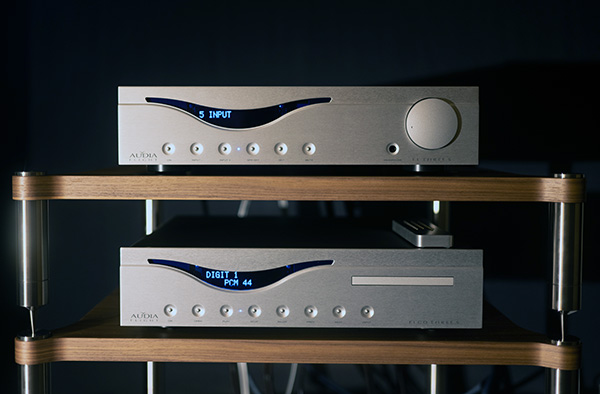
Remarkably, much of the Embassy Suites’ 10th floor was taken up by relative newcomer Fidelity Imports, an import and distribution company started four years ago by industry veteran Steve Jain, who’d held management positions at Klipsch and Pioneer. Jain, 46, likes to move fast. After first signing three British companies in short order—Cyrus Audio (amplification), Q Acoustics (speakers), and QED Cable (duh)—he looked to other parts of the globe for further expansion. These days, his stable includes 17 brands, including Slovakia’s Neo (high-end audio racks), Italy’s Audia Flight (amps, preamps, CD players), and Japan’s Soulnote (amplifiers and other stereo components).


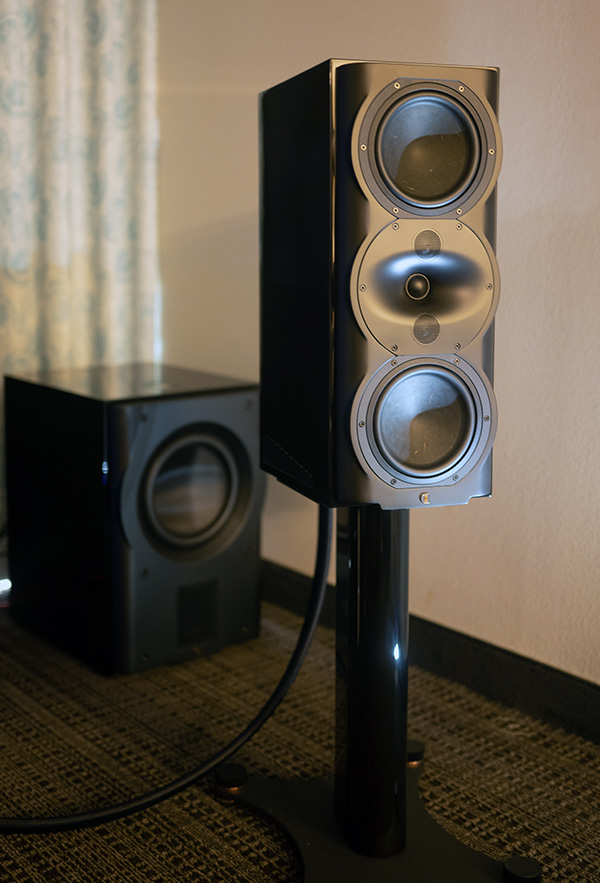
The cool thing about Jain is that, like many businesspeople in the high end, he’s clearly not just in it for the money. His fervor for superior sound and the concepts behind it came into focus repeatedly during the 75 minutes I spent with him in half a dozen Fidelity rooms, including two with very fine-sounding Perlisten speakers (S7ts at $17,990/pair and R5ms at $5990/pair, above).


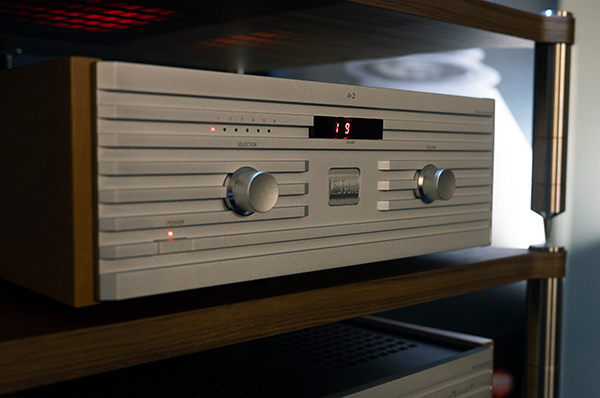
It was almost endearing to watch Jain wiggle the loose-seeming top panel of a Soulnote amp (above), explaining that the Japanese engineers build it like that on purpose because “they don’t like the sound to get trapped in the box.” Pure voodoo and myth-making? Perhaps, but the enthusiasm was genuine, and it’s hard to argue with the results: each Soulnote, such as the $7999 A2 integrated, is gorgeous both cosmetically and sonically.


I listened to two sets of Q Acoustics speakers, both cabled with AudioQuest products. The Concept 300s ($4999 with spindly-legged stands inspired by the design of suspension bridges) were driven by an Italian class-A Unison Research Unico Due hybrid amp that sported a pair of 12AX7 tubes. The 300s’ sound was balanced, accurate, and not unduly polite. I dug it, just like JA did in his full review.


Moving to the Concept 50 floorstanders ($2995/pair) powered by Audia Flight electronics (above), I heard roughly the same sound signature, with the positive caveat that I slightly preferred these less expensive speakers. (Go figure.) The 50s somehow showed an elevated ease, a kind of “flowiness” that made “Green Song” by Anne Sofie von Otter and Elvis Costello go down as smoothly as a single-malt Scotch. I’ll have another anytime.

Posted in Uncategorized

On A Higher Note: Graham Audio, Moonriver, Bergmann, Cardas

It’s a personal thing, perhaps a shortcoming: I don’t care for harps, having never heard a piece of harp music I found appealing. Truthfully, that didn’t suddenly change when I heard French Canadian harpist Isabeau Corriveau perform in the Embassy Suites room outfitted with hi-fi gear from On a Higher Note, distributor Philip O’Hanlon’s company. (O’Hanlon can be seen on the right in the photo.) But Corriveau is a fetching presence and a helluva musician, and it was impressive to listen to her play along to A Leap of Faith, a vinyl disc of her own music. With eyes closed, I had a hard time reliably delineating the sonic boundary between live instrument and recorded music.


That level of challenge indicated highly capable speakers—in this case, a pair of Graham Audio LS8/1 standmounts, their iconically British design and character much akin to Wharfedale Lintons and Harbeth SHL5s. The Grahams retail for $9700/pair including stands. (During her performance, Corriveau was seated right between them, leading O’Hanlon to quip that she was “the most fantastic center channel” we’d ever hear.)


Driving the speakers were a Moonriver 404 Reference integrated amplifier and 505 phono stage ($5995 each), fed by a Danish-made Bergmann Modi turntable ($17,000)—all of it connected by Cardas Clear cables. Unusually, the Grahams were positioned along the long wall of the standard hotel room, about 7.5′ apart, putting the listening position just 6′ away. While that wasn’t ideal on paper, it worked out pretty excellently. I enjoyed the delicateness of Joe Chambers’ brushwork on saxophonist Wayne Shorter’s “Penelope,” and the caramel-colored, mysterious quality of Melanie De Biasio’s voice on “Your Freedom is the End of Me.” The system generated a sweet midrange purity, erring on the side of mellow rather than incisive—correctly so, to my ears.

Posted in Uncategorized

AV Luxury Goods: Raidho and Margules

If you’re pressed for time at a busy audio show, it can be a mistake to walk into a room just to say hi to an industry contact. Should the music speak to you, and the sound is dead-on, you may succumb to the temptation to sit down for a longer-than-expected listen. That’s what occurred this morning. You know what? I regret nothing.


Mexican electronics company Margules and Denmark’s Raidho speakers, both brands represented by distributor Bruce Ball’s AV Luxury Goods, have a rare synergy. I first got to experience it at the 2022 AXPONA, where a duo of Margules U280-sc tube amps drove a pair or Raidho TD3.8 loudspeakers ($119,999/pair) to such heights that two things happened: seemingly helpless, I eventually had to buy one of those Margules amps; and I excitedly arranged to audition the TD3.8s in my home (review to come).


In Tampa, Ball had installed a pair of “lesser” Raidho’s, the TD2.2s ($46,500/pair)—but clearly lesser is a relative word here. The 2.2s had no problem bowling me over in seconds flat. “Tight and right,” was the phrase that came to mind. Also: “Seductive.” “Engaging.”


Low-end grunt was just about unbelievable considering that it was produced by just four 6″ drivers, two for each channel. Margules Group USA’s Carlos Smith brought out the tape measure to confirm the transducers’ diameter beyond a doubt, and reminded me that there were no subwoofers in the room. I’m told the 2.2s go down to 32Hz, but it sure seemed even lower than that.


Margules’ head honcho Julian Margules was on hand to explain why, from his perspective, the rig managed to sound as holographic as it did—something to do with feedback adjustments that benefit harmonics over fundamentals. It’s above my pay grade, but my ears knew how to appreciate Margules’ careful work and decades of experience.


Inevitably, it all comes at a price: the U280-sc amps now cost $12,000 each (up from 10 grand last year), while the SF220 preamp retails for $8000. The digital source was a prototype Margules music server, specs and price to be announced. Cable brands were RSX and Atlas.


From solo voices to lone percussion hits to full-force orchestras: everything sounded first-class . . . and often borderline exhilarating.

Posted in Uncategorized

Florida’s Audio Expo is Back, and it’s Gone (More) International

If you live in Maine, and it’s wintertime, and a kind magazine editor calls offering a getaway to the Florida International Audio Expo, what do you say? In my case, it was Yes please. And so, yesterday, I arrived at the Embassy Suites Westshore in sunny Tampa, suddenly without the need for scarves and double-insulated boots, but with my usual hankering for a serious hi-fi fix. I’ll be getting a three-day series of them, in fact. Lucky me.


The fourth edition of the sold-out Florida show, with almost 80 exhibit spaces, promises to be a more worldly affair than before, thanks to the prominent presence of brands like Latvia’s Aretai and Japan’s storied TAD. (That company’s R1TX Reference One loudspeakers are truly something else—more on that soon.)


International ambitions notwithstanding, the Expo in Tampa is known for its relaxed vibe, the younger-than-typical crowd, and an atmosphere that co-founder Bart Andeer describes as “family-friendly.” Students and spouses get free admittance.


Andeer’s take on audio is simple: “If everyone turned off the news and listened to music more, the world would be a better place.” Amen to that. Let’s go!


The show runs through Sunday February 19.