Author Archives: Stephen Scharf

Aurender N20 Music Server

Within the last decade, we’ve seen the emergence of a market for a new type of high-end audio component: the digital-music server/streamer. Integrating the functions of a computer, music server, network bridge, and Internet gateway, the server/streamer provides the flexibility of listening to music files from a disc drive (spinning or solid-state) as well as from high-quality music-streaming services such as Tidal and Qobuz. Aurender has a been one of the pioneers and innovators in this market for some time, and as we shall see, the N20 represents a fresh, formidable, and innovative offering. 

Description, Functions, Features

The Aurender N20 is an “all-in-one” digital-music server/streamer that integrates the functions of a music server, a content streamer, and a LAN port to connect to your router in a single component that can be placed in your main audio rack. Contrast the N20 to my streaming setup, where I have servers and fiber-media converters in one room, connected by a long run of optical fiber to an Uptone EtherREGEN and SOtM network bridge in my listening room. Each of these devices requires its own linear power supply, Shunyata NR power cords, and Ethernet cables. While the setup works, it’s, well, complicated. 

Unlike the Linn Klimax DSM/3 (which has virtually no support for on-board music-file storage), the N20 comes with two internal, hard-drive storage bays, which allow you to add the amount of on-board music storage that best meets your needs and budget. For example, if you listen exclusively to music from an online streaming service, there will be no need to add internal storage. If your requirements change, on-board music-file storage can be added by installing a 2.5″ hard drive in one or both of the N20’s hard-drive bays. At full capacity, the N20 can provide up to 16TB of storage (with SSD drives). 

Another key N20 feature is its all-digital, phase-locked-loop subsystem (ADPLL), utilizing a field-programmable gate array (FPGA) in conjunction with an oven-controlled crystal oscillator (OCXO) to reduce jitter. OCXOs are among the most accurate and stable clocks for audio components—orders of magnitude more accurate and stable than the ordinary crystal oscillators found in computers and “generic” consumer-grade networking devices. 

Due to the superior clock and oscillator, the N20’s AES/EBU, BNC, coaxial, and optical outputs provide a superior musical presentation. As opposed to asynchronous USB connections, where the DAC pulls packets of information from the player, N20’s SPDIF audio outputs push the signal to the outboard DAC, at intervals defined by the precision, on-board OCXO clock. The Aurender N20 also utilizes an Intel Quad-Core CPU to support streaming of digital file codecs, including native DSD512. All supported file types and formats are handled by this dedicated processor. 

Because many DACs only support DSD decoding via a USB interface, the N20 also supports DSD-to-PCM conversion on its SPDIF interface by use of an FPGA. This permits the sampling-frequency output to be selected between 88.2kHz and 176.4kHz. Moreover, the gain is adjustable in 1–6dB steps, and a low-pass filter accommodates 24Hz, 30Hz, 40Hz, and 50Hz settings. Additionally, the N20 supports the MQA first-unfold, allowing playback of MQA files at up to 88.2kHz or 96kHz with an optional in-app purchase. It is also compatible with DACs that perform MQA rendering, thus providing full MQA decoding with those MQA-compatible DACs. The first unfold expands the 48kHz sample rate of the MQA file to 88.2kHz or 96kHz for conversion by your DAC at that higher frequency. This works with any DAC. For the full MQA experience, you’ll need an MQA-compatible DAC that performs the second decoding step—MQA rendering.

The N20’s SPDIF digital output employs transformer-isolated grounding that reduces the noise floor; the USB 2.0 output also benefits from Aurender’s latest methodologies to reduce noise and jitter. A word-clock input allows for an external word clock to be connected, which could, depending on its quality, significantly increase SPDIF digital-output performance. The RJ45 Ethernet LAN port is also double-isolated with Ethernet isolation transformers, which reduce noise components from the network or router and lower the overall system noise floor for quieter and more accurate playback of audio signals. 

The N20 also has an internal uninterrupted power supply (UPS), which can perform a safe shutdown in the event of an abrupt power outage, thereby preventing system and/or disc corruption.

Setup and Use

Setting up the Aurender N20 is easy, fast, and effective: Take the unit out of its box, place it on your rack, connect power, networking, and signal cables, and power it up; flip to Page 2 of the short, printed, set-up guide that comes with the N20; use a bar-code app on your smartphone to take a screenshot of the 3-D bar code printed on that page, and the Aurender Conductor app will download to your phone; launch the Aurender Conductor app, and it will look for an Aurender on your network, and prompt you to connect to the specific model that it finds; hit the onscreen button, and…that’s it! You’re up and running! If you have Tidal or Qobuz, you can log into your account in the Conductor app, and, presto, you’re streaming content. It took me all of eight minutes from taking the N20 out of its box to streaming music to my DAC. To say I was impressed would be an understatement. 

The Aurender N20 also provides functions, features, and flexibilities that make using it and accessing your digital music simple and easy. If you have a lot of ripped or downloaded music files, simply add a hard drive to one (or both) of the bays previously mentioned, connect your music library to the N20’s USB port, and easily transfer your music. 

One of the other notable features about the Aurender N20 is its large, 8.8″-wide LCD display. The display shows the album cover artwork as well as the album name and artist in beautiful color. A nice touch is you can easily read it from across the room. 

Using the Aurender App

While many folks will use the Aurender Conductor app via a smartphone or tablet, because the new M1 Macs now support native iOS applications, I used my 2021 MacBook Pro laptop to run the iPad version of the Conductor app! This was cool as I invariably prefer using my laptop with its larger display to using a smartphone or a tablet. The larger screen on the iPad version of the Conductor app shows a set of panels that allow browsing of available ripped or streaming content on the right side of the screen. Icons at the top allow you to toggle between content on the Aurender itself or content from a streaming service. 

When the Aurender icon is selected (signifying that it will scan content on internal drives), there are two menu hierarchies: the top-row menu allows you to select Song, Artist, Album, Genre, Composer, Conductor, and Folder. Under this row is another list of choices which reflect the names of the folders on your internal storage (if applicable). There are filters to view recently added content, DSD, Hi-Res PCM, or “starred” favorite content. There is also a Search field at the top right.

When the streaming service icon (e.g., Qobuz, Tidal, Spotify, etc.) is selected, there are two menu hierarchies. At the top is Song, Artist, Album, Genre, Playlist, and Search. Underneath that row that is New Release, Streaming Charts, Download Charts, Most Featured, By the Media, Editor Picks, Qobuzinissim, The Qobuz Ideal Discography, and Purchased. 

You can easily hide the right-side content panel by swiping right, showing more of the actual content being played on the left side of the app. At top is the Song Detail metadata with its respective content and track info. Below the Song Detail pane, are the Queue and Playlist Editor panels. The features of these two panels overlap quite a bit. The Queue panel lets you play a previously saved Playlist; Save, Edit, and Shuffle the content in the playlist; and turn Consume Mode on. The Playlist Editor lets you select a previously saved Playlist, as well as Save, Edit, and Play the current playlist. 

As a long-time Roon user, I found it easiest to use the Conductor app by picking an album in the right side of the display, either from the internal drive or Qobuz, and after selecting the small oval icon with three dots at the top right, simply pressing Replace Queue with the new album of choice in the dialog box that pops-up. This will remove the tracks from the previously played album in the Queue and replace them with the tracks from the just-selected album. There are some other choices in this menu that let you decide how you may want to play a given album or the tracks you’ve selected, but I found just using Replace Queue to be the most “album-oriented” and, for me, the most effective method. 

While the Conductor app isn’t as intuitive as Roon’s interface, it does allow you to add and “mix ’n’ match” content from different sources, such as albums and/or streaming playlists, to the tracks in the playback Queue. You can also easily create and save custom playlists, either from files on the drive or from streaming services, within the Aurender app. A particularly nice feature is if you click on the album cover and then touch on the album artwork, an icon with three lines at the lower right pops up that lets you overlay the album track list onto the album artwork. This is a nice feature if, like me, you tend to prefer to listen to an album in its entirety. 

Listening Impressions

Right from the get-go, the Aurender N20 impressed me with its audio quality. Blessed with exceptional transparency, resolution, clarity, and focus, the music was presented with superb tonal accuracy, dynamic articulation, and instrumental and vocal body against a jet-black background devoid of digital hash, grit, or grain. The foundational work done by Aurender to mitigate all possible sources of grunge, phase noise, threshold jitter, etc. from servers, networks, and the component itself strips away those nuisance noise factors that can result in disengagement compared to a world-class analog source. Combine this very clean foundation with FPGA-controlled OCXO clocking, and you get an engaging, involving, natural, and organic presentation that pulls you fully into the musical experience and simply won’t let go. I spent many a late night enjoying the Aurender, unable to tear myself away from the music. 

Have a listen to Gene Harris’ beautiful piano playing on the Ray Brown Trio’s wonderful Soular Energy [Analogue Productions 268], for example. His piano sounds so relaxed, so natural, effusive, and harmonious, that you just can’t help getting sucked into “Cry Me a River.” The “vapor trail” from the piano has outstanding timbral and temporal articulation as it decays gently into the depth and space of the studio. Brown’s bass makes a beautifully textured, weighty, superbly defined counterpoint to Harris’ piano. The two artists play off each other, fully resolved in their own spaces. Sublime. 

A standout quality of the N20 is its ability to present and portray tonal density—the attribute that gives instruments and vocalists their gravitas. Whether it’s the shimmering, almost dulcimer-like quality of Chris Jones’ solo guitar on “Set ’Em Up, Joe” [Closer to the Music, Vol. 1, Stockfisch Records SFR357.2903.0] or the weight, body, and power of Oscar Peterson’s piano and the tonal color and richness of Ben Webster’s sax on Ben Webster Meets Oscar Peterson [Verve 5214482], the N20’s presentation is driven forward with powerful and refined sophistication in rhythm and timing. Staying seated in my listening chair was challenging because this wonderful recording just swings with the N20. 

I also spent some time listening to the N20 in Critical Listening Mode, where the main display and other ancillary functions are powered down to provide the best possible audio quality. In this mode, the N20’s sonic attributes do not change in character or degree. What is improved, however, is soundstage resolution and refinement, imaging definition and placement, and the resolution of spatial and ambient cues. This was most noticeable on recordings made in real spaces, e.g., churches or symphony halls, rather than in the “spaces” created by a recording engineer in a studio session. 

Using Critical Listening Mode for J. S. Bach’s Violin Concerto No.1 in A Minor [Bach: Violin Concertos, Philips 420 700-2], played by the incomparable Arthur Grumiaux and Les Soloistes Romands, was a veritable delight. Grumiaux’s impeccable tone, attack, and pacing, his exquisite phrasing and control of dynamic range (did you know that a violin has more dynamic range than a piano?) infused this wonderful recording with energy, joy, and exuberance. With Critical Listening Mode on, I heard spatial, imaging, and soundstage cues that I had never heard before. It is a tour de force performance, and it sounded gorgeous on the N20. 

Kenny Dorham’s legendary 1956 hard-bop album, ’Round Midnight at the Café Bohemia [Blue Note BLP 1524] was presented through the N20 with the wonderful intimacy and nuance that only come from live recordings made late at night in a jazz club, when the band is fully warmed up and really swinging. The stick and brushwork of Arthur Edgehill on cymbals was rendered with a fine, delicate, brassy sheen; Dorham’s trumpet was warm, sweet, and inviting, never biting. The Aurender N20’s fine rendering of space, atmosphere, and instrumental subtleties put me in the club with the audience. What a wonderful recording.

Summing up, I loved the musical experiences conjured up the by the Aurender N20. It presented the music with very high accuracy and precision, complete with the requisite muscle and horsepower to provide superb rendition of dynamic contrasts and shadings, but could temper and punctuate those dynamics with the delicate articulation of instruments and voices. The overall presentation was exceptionally uncolored and tonally accurate, yet rich with natural timbral warmth, three-dimensional weight and body, and fine gradations of instrumental or vocal textures. All this goodness was presented with clean, quiet, and very black backgrounds, refined, stable, and precise imaging, expansive soundstaging, and most importantly, nuanced, refined, and relaxed naturalness. 

Bringing it home, the Aurender N20 is one of a handful of the best-designed, best-integrated, best-engineered, and, most importantly, best-sounding audio components I have ever had the pleasure to use and experience. As such, it constitutes an innovative new benchmark in digital music server/streamers. Highest possible recommendation—the Aurender N20 is a veritable home run.

Specs & Pricing

Digital outputs: AES/EBU, coaxial, BNC (75Ω), TosLink, USB
Compatible formats: Native DSD, DSD (DSF, DFF), WAV, FLAC, AIFF, ALAC, M4A, APE
Bit and sample rates: SPDIF: Up to 24-bit, 192kHz; USB: 32bit/384kHz; DSD: Up to DSD256 (DoP), Native DSD: Up to DSD512
Control app: Aurender Conductor iPad and iPhone app, Android phone and tablet
SSD caching drive/DRAM: 1x 500GB, M.2 MVME/DDR3 8GB
DSD-to-PCM: Precision DSD-to-PCM conversion for SPDIF outputs
Digital I/O: 2x Isolated Gigabit Ethernet LAN, 2x USB 3.0 data ports
Internal UPS: Super Capacitor-based uninterrupted power supply for safe shutdown
Master clock input: Word clock or master clock input (BNC) 10MHz, 12.8MHz (44.1kHz and 48kHz multiples from 1 to 512)​, input impedance 75Ω
Integral storage: None (two trays for 2.5″ 15mm/7mm HDDs/SSDs, user installed)
Dimensions: 16.9″ x 4.4″ x 14.0″
Weight: 29.8 lbs.
Price: $12,000

Associated Equipment
Digital sources: Aurender N20 server streamer, Mac Mini Roon Core Server, Sonore OpticalModule fiber-media converter, Uptone Audio EtherREGEN Ethernet switch, Uptone Audio LPS-1.2 linear power supply.
D/A Converter: Lampizator Baltic 3 and Holo Audio May KTE R2R
Analog source: Michell Gyro SE, SME V, Bob’s Devices Cinemag step-up transformer
Phonostage: E.A.R. 324
Preamplifier: First Sound Presence Deluxe 4.0 SE MkIII-SI active preamp with Paramount Special Edition Upgrade
Power amplifier: Conrad-Johnson ART150S
Integrated Amplifier: Constellation Inspiration
Loudspeakers: Harbeth 40th Anniversary 30.2, Dynaudio Contour S3.4 with Esotar 2 tweeters, REL R-305 subwoofer
Cables: Shunyata Research Sigma XC and NR V2 (Everest & amplifiers), Alpha NR V2 (preamp and phonostage), Shunyata Omega QR-s (DAC), V14D Digital power cables (for 100% digital components), Shunyata Omega and Sigma interconnects, Omega Ethernet cable, Shunyata Alpha USB cable, and Shunyata V2 VTX-Ag speaker cables, Shunyata DF-SS cable elevators.
A/C power: Shunyata Research Everest 8000 and SR-Z1 wall outlet. 

The post Aurender N20 Music Server appeared first on The Absolute Sound.

Rega Planar 10 Turntable

My love for Rega turntables goes back a long way. In 1980, when I was looking to upgrade my Thorens TD160 turntable, a good friend and audio buddy provided me with a recommendation: “You should check out this new company, Rega. I hear it is doing really good things.” 

Shortly thereafter, I purchased the original Rega Planar 3, and, as low-tracking-force cartridges were then the rage, put the new SME Series III tonearm on it. If memory serves, I used a Frank Van Alstine-modified Sonus Gold cartridge. I took the rig over to another audio buddy, who was then using the Kenwood KD-500 granite turntable and Infinity Black Widow tonearm, which, at the time, comprised one of the “hot” turntable setups recommended by TAS’ founder, Harry Pearson. 

Much to our mutual surprise, the Rega Planar 3 blew the Kenwood into the weeds. We did multiple comparisons that evening, back and forth, with our best reference LPs played on both decks. Every single time, the Rega sounded better, hands down. My friend went out the next week and bought a Linn Sondek LP12, which he owns to this day. And I kept my Planar 3 for the next 30 years, using it exclusively as my music source during the years when my involvement with high-end audio waxed and waned. In 1987, I put a Grace Ruby on the SME, and then in 2009, Peter Ledermann of Soundsmith re-tipped the Grace with one of his ruby-cantilevered styli, which took the cartridge to another level. Eventually, I passed my Planar 3 on to my brother-in-law as a Christmas gift when his ’table died.

PL10 RB3000 bias housing detail 

When I got seriously back into high-end audio in 2010, and was looking for a newer turntable, my Linn-owning friend offered me his like-new SME V tonearm for a great price (the SME wasn’t a good match for his Linn), and I bought a Michell Gyro SE turntable for it. About a year later, I snagged a very lightly used Koetsu Urushi Vermilion moving-coil cartridge. This setup became my reference (the Vermilion has since been re-tipped and fully re-built by Koetsu), but I never forgot how much I enjoyed Rega turntables, and in 2012, bought a lightly used Rega P5 with external power supply from a friend. I put a Sumiko Pearwood Celebration II cartridge on it, and was surprised at how good it sounded, performing way above its price point. The P5 had excellent detail and resolution, and had a punchy, energetic quality with real drive. It really “kicked out the jams,” great for rock, 80s New Wave, and blues. For 20% of the cost, I estimate the P5 performed at 80% of the level of my reference setup. That’s an excellent value proposition and, in my opinion, the P5 is still a great ’table, even today. 

Cut to the present. The better part of a decade has passed, and time and turntable development have not stood still. While Rega still advocates using light, stiff, low-mass plinths coupled to tonearms of superior engineering, since the legendary P9 it has been extending the classic Rega ethos with new designs that utilize innovative materials and manufacturing technologies. 

The post Rega Planar 10 Turntable appeared first on The Absolute Sound.

UpTone Audio EtherREGEN Ethernet Switch

With the increasingly widespread streaming of digital music content to our audio systems, either from discs or streaming services (e.g., Tidal or Qobuz), many audiophiles are finding the need for an audio-grade Ethernet switch to connect their home computer network modems, routers, computers, drive arrays, etc. to an increasingly wide array of devices to mediate the transfer of digital content to digital-to-analog converters. As my digital streaming “front-end” has been in development for the last year and half or so, I’m finding there are now better audiophile-grade solutions that provide network access to my nearly 4TB of disc-based digital content, and to new content via streaming services.

UpTone Audio is a small audio-products firm based in Northern California. Company principal and founder, Alex Crespi, has been in the audio business for over 30 years, and was one of the co-founders of the well-regarded audio products company, Hovland, which was started in 1999 and closed in 2009. UpTone was founded in 2010, and all of its products are developed in close partnership with professional electronics engineer, John Swenson, who has had a long career designing the power-distribution networks deep inside large custom computer chips (the sort of devices that run high-speed network data centers). As UpTone Audio, Crespi and Swenson have developed a successful range of products for digital playback including the REGEN line of digital audio products and the UltraCap line of linear power supplies for digital components and music servers. John is also well-known as the hardware engineer for the popular Sonore Rendu series of products.

I purchased my $640 UpTone Audio EtherREGEN in October, 2019, and I can unequivocally say it has been instrumental in getting the audio performance of my digital streaming front end to a level where it is now as fully engaging, immersive, and enjoyable a musical experience as my turntable-based analog system.

Description and Features
The UpTone Audio EtherREGEN Ethernet switch utilizes the same oval-shaped aluminum case used for many UpTone Audio products, and measures 112mm x 110mm x 30mm. Of note, UpTone has specifically designed EtherREGEN so that it does not require an external linear power supply to provide nominal performance. Rather, it comes with an UpTone Audio switch-mode power supply specially designed to prevent the passage of high source-impedance leakage current to the EtherREGEN (more on this later).

The EtherREGEN is unique among Ethernet switches in that it uses a circuit topology called the Active Differential Isolation Moat or ADIM that completely isolates the side of the switch used for connecting network devices (typically the “A” side) from the side connected to the renderer, network bridge, or streamer (typically the “B” side). The ADIM provides electrical, galvanic, and noise isolation between the two sides. I’ll discuss the rationale and function of the “moat” in more detail in its own section in this review.

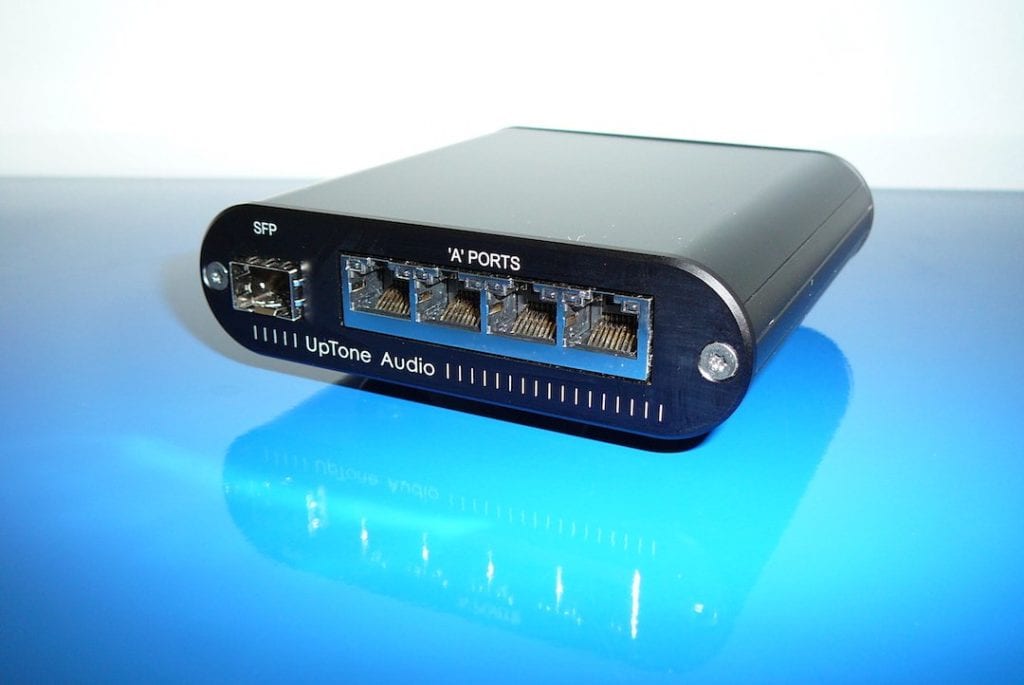
On the “A” side of EtherREGEN is a SFP (small form-factor, pluggable) cage for making fiber optic connections using an optical transceiver (Figure 1) and an RJ45 module composed of four specially manufactured copper Ethernet ports with status lights. There are 12 transformer cores in each port and the center-taps of these cores are grounded using capacitors to block port-to-port leakage current.

EtherREGEN B Side

The “B” side of EtherREGEN (Figure 2) has a DC-power barrel jack, ground post, a single 100-Megabit RJ45 port with status lights, a switch for selecting the internal or an external clock, and a BNC connector for connecting an external clock, if hot-rodding your EtherREGEN is desired. The standard impedance for the clock connector is 75-ohm, but a 50-ohm clock connection can be ordered from UpTone Audio at no additional charge. While EtherREGEN works identically in both directions, the “B” side is typically connected to the computer, streamer, network bridge, endpoint renderer, etc., with a copper Ethernet cable. DACs that have an Ethernet input can be directly connected to the “B” port.

Technical Considerations and Design Features
The Active Differential Isolation Moat (ADIM) design is unique to the EtherREGEN, as it provides data-transfer functionality and audio performance that significantly differentiates it from all other Ethernet switches, including those modified for audio applications. EtherREGEN has two data/power/clock domains which are isolated from each other by the ADIM. These two domains are referred to the as “A” side and “B” side, respectively. Each isolated domain is re-clocked, and the clocking system runs from an advanced, programmable, jitter-attenuating clock synthesizer with four differential outputs. It is referenced to an ultra-low-jitter/phase-noise Crystek CCHD-575 oscillator, and the clock distribution system is run differentially throughout. UpTone Audio colloquially refers to the separation provided by the ADIM between the sides of its circuit board as “the moat.”

The rationale for the moat is important because every signal “edge” coming out of any digital device carries the jitter and phase-noise of the clock used to “clock out” that edge. When dealing with Ethernet-based signals, specifically for audio applications, where timing is critical, there are two types or classes of sound-degrading noises that EtherREGEN was designed to mitigate: 1) low and high source-impedance leakage current, and 2) clock phase noise. Clock phase noise travels on the Ethernet signal and on power and ground planes. This phase noise affects the threshold jitter of chips’ clock inputs.

The differential circuitry was specifically designed to eliminate the signal-borne phase noise going from one side of the moat to the other. EtherREGEN is mostly symmetrical—technically, there is no “dirty side” or “clean side.” While ER works identically in both directions, it is best to have the streaming endpoint device (renderer/streamer/network bridge) that connects to the DAC be the only device that is connected to that particular side (typically the “B” side). While the circuitry between the individual RJ45 ports or SFP cage on the “A” side decreases phase-noise effects to some degree, it does not decrease it to the same degree obtained by crossing the moat. This is because crossing the moat makes use of differential isolators in conjunction with differential flip-flops. (Refer to the engineering white paper by John Swenson, Understanding how perturbations on digital signals can affect sound quality without changing bits, and how these issues are addressed by the UpTone EtherREGEN, https://cdn.shopify.com/s/files/1/0660/6121/files/UpTone-J.Swenson_EtherREGEN_white_paper.pdf?v=1583429386.) And this is the big advantage: The differential isolators prevent the data-borne clock signature from getting onto the ground plane of the circuit board, while the differential flip-flops prevent the clock phase-noise signature from getting into the flip-flop’s own internal ground network, as well as the ground plane of the rest of the board. It is the use of these two differential isolation methodologies together that provides the performance advantage of EtherREGEN compared to other Ethernet switches.

Physically, EtherREGEN circuitry is mounted on a single, premium, six-layer circuit board, but electronically it is actually two boards (Figure 3). Looking at the EtherREGEN circuit board, we see it is galvanically divided into two parts, the “A” side (lower half of Figure 3) that typically handles network connections, and the “B” side (upper portion of Figure 3) across the moat, which provides the fully isolated signal to the renderer/endpoint.

Transfer of data from one side to the other is mediated using high-speed Analog Devices differential isolators. When the network signal has passed to the other side of the moat via the differential isolators, it is sent to the “B” side electronics that re-clock the data with an ultra-low phase noise Crystek CCHD-575 Crystal oscillator and Silicon Labs jitter-attenuating clock synthesizer (unless the clock switch is set to external, in which case, the external clock signal is used).

This is a key point: Because all the clocking in EtherREGEN is run with differential lines, and the isolators and flip-flops are fully differential, there is no noise overlaid on EtherREGEN’s ground plane by any of the el-cheapo clocks from network devices (e.g. routers, music servers, NAS’s, generic switches, etc.) upstream. Furthermore, no leakage current from switch-mode power supplies from these upstream devices can pass across the moat, either. No other Ethernet switch design does this, and these features are key aspects of EtherREGEN’s unique design because they prevent the data-borne clock signature and leakage currents from getting onto the ground plane of the circuit board and into the DAC, where they will increase jitter in the circuitry. Reduction of phase noise, leakage current, and concomitantly, jitter, are the significant audible benefits that EtherREGEN offers when used in a digital music streaming setup.

Set-up and Configuration
The setup and configuration of EtherREGEN is simple and straightforward. Connect a single copper Ethernet cable from their main network router or switch to any of the RJ45 ports on the  “A” side (Figure 4) of EtherREGEN. The remaining three RJ45 ports can be used for other connections, e.g. a music server, NAS, or other network device. If an optical-fiber connection is used, it can be connected to an optical transceiver in the SFP cage on the “A” side. 

Depending on the user’s network or requirements, different connection configurations are possible. For example, one could leave the network router music server, NAS, etc. connected to another switch, and make a single Ethernet connection to EtherREGEN as shown in Figure 4. How the connections are configured are primarily a matter of convenience and/or the requirements of the specific network, and UpTone says the effects of different configurations on sonic performance are likely to be small, if any.

Networking Setup for Evaluation
I made my evaluations of the EtherREGEN compared to a consumer-grade TP-Link Ethernet switch, as I did not have access to any other “audiophile-grade” Ethernet switches. Since I am using a run of fiber from the bedroom study, where the music server, router, and switches are located, to the main audio rack, I also used a consumer-grade TP-link fiber-media converter (FMC) in conjunction with the TP-link Ethernet switch. It’s important to understand that the base configuration was composed of two networking devices used together to stream the data: the consumer Ethernet switch and a fiber-media converter. The run of fiber connected at the downstream end in the main audio rack to a Sonore Optical Module that was connected by a Shunyata Sigma copper Ethernet cable to my SOtM SMS-200 UltraNeo network bridge, which serves as my endpoint/renderer, as shown in the base networking configuration in Figure 5. 

For my configuration with EtherREGEN, I replaced the generic TP-link FMC with the Sonore OpticalModule at the upstream end; the Mac Mini music server and OpticalModule were connected to the RJ45 ports on my network router with Shunyata Sigma Ethernet cables. The OpticalModule was connected with a forty-foot run of optical fiber downstream to EtherREGEN’s “A” side via it’s SFP cage in my main audio rack. A Shunyata Sigma Ethernet cable from the “B” side of EtherREGEN was connected to my SOtM SMS-200 UltraNeo renderer/endpoint, which was connected to my Schiit Gungnir Multibit DAC with a Shunyata Alpha USB cable. The configuration using EtherREGEN is shown in Figure 6.

Power Connections for Network Devices
Because of the insidious and audible problems of leakage current, caused by the use of switch-mode power supplies in virtually almost all network devices, I paid special attention to the quality of power for the devices in the digital streaming chain. In my base configuration, when the TP-link Ethernet switch and FMC were used, they were powered by Jameco Reliapro linear power supplies; my Pace router used its standard switch-mode power supply with a home-made connector that shunts high source-impedance leakage current to ground. For the purposes of this review, the Mac Mini music server was powered with a Shunyata Venom V14D digital power cord, and the Sonore OpticalModule was powered with an UpTone Audio LPS-1 power supply. Both the UpTone LPS-1 and the Mac Mini were plugged into a Cryoparts power strip powered by a Shunyata V12 NR power cord. The Shunyata V12 NR power cord provides approximately 12dB of noise reduction for the power strip, and the Venom V14D digital power cord, specifically designed for devices that utilize switch-mode power supplies (e.g. the Mac Mini), provides another 12dB of noise reduction. In the main audio rack, the EtherREGEN was evaluated using the supplied UpTone Audio power supply, and the SOtM SMS-200 UltraNeo endpoint renderer was powered by a Keces P3 linear power supply. Both of these power supplies were powered by Shunyata Venom V14D digital power cords plugged into a Shunyata Everest power distributor. All listening evaluations were conducted using my two-channel loudspeaker system described in the addendum.

Listening Impressions
My journey with my digital streaming front end has been one of discovery, experimentation, and reflection. This journey has taught me new ways to listen to digital content that are much more convenient, flexible, and enlightening, specifically when I use the Radio mode of Roon and Qobuz to discover new music. While I was reasonably satisfied with my first digital front end, when I made the decision to run a direct optical fiber cable connection from the music server to the DAC (see my article on streaming via optical fiber in the May issue of TAS), I needed an Ethernet switch. I bought a generic, consumer-grade TP-link switch to connect the router, music server, and my fiber media converter to the network. After installing it, there were aspects of the presentation that I just didn’t like. Upon first listen, the TP-link switch brought improved detail, but upon extended listening it also brought other attributes were very decidedly un-musical.

What I found was, despite the increased detail, there were “components” to the music and presentation that became increasingly irritating, fatiguing, and over longer listening sessions, quite unpleasant to listen to. I found that I couldn’t listen to the system for more than an hour without wanting to leave the room. It turns out that my Pace network router had four RJ45 ports on it, and I found that by not using the TP-link Ethernet switch (and just using the RJ-45 ports in my router) the presentation was actually pretty good. I would have thought that installing a dedicated Ethernet switch should have sounded better than the ports in a generic Internet router, but every time I put the TP-link switch back into the network (regardless of recording) the system sounded…ghastly. Harsh, strident, bright, irritating, with shrinking of the soundstage and spatiality, a crushing down of dynamic range, and a loss of nuance and gesture in the artists’ singing or playing. By contrast, I found when just using the router’s RJ-45 ports to make connections the sound was acceptably good; I’ll circle back to this observation in the conclusion.

Installing the EtherREGEN Ethernet switch into the system (Fig. 6) brought a significant improvement to the system overall—so much so that it doesn’t even sound like the same system compared to the base configurations. I heard these improvements immediately upon installation, but also noted that, as with almost every other component I’ve owned, audio performance was a bit uneven for the first 200 hours. After that burn-in period, EtherREGEN really smoothed out tonally and opened up spatially with a very low noise floor, providing an exceptionally clean space for the music to emerge into. Most importantly, there was virtually no digital glare, hash, or other nasties that induce listener fatigue. Rather, the presentation was organic, relaxed, and natural to the degree that my digital streaming front end fully rivaled my analog setup.

With EtherREGEN in the system, the Spanish guitar solo fantasia “Malagueña,” composed by legendary guitarist Celedonio Romero, and performed by his son Pepe Romero, had incredibly energetic pacing, a fulsome woody timbre, and finely delineated harmonic structures, as Romero ripped his way through this classic with stunning virtuosity and impeccable technique. There was so much resolution and definition and sheer virtuosity on display that, the first time I heard it, I thought two guitarists, Celedonio and Pepe Romero, were playing…but no, it was just Pepe. As he is the only musician, the stereo image is precisely focused on Romero, but the trailing edges of notes can clearly be heard decaying into the space of the room. Romero moves from a forceful, fast, and dynamic passage to a very beautiful slow, refined, and delicate passage with exquisite phrasing, nuance, and control, and you can hear deeply into the recording, the subtle shadings of timbres and notes flying with perfect articulation off the sound box of his guitar. It was dazzling and incredibly beautiful.

“Falling out of Love” by Mary Gauthier (Mercy Now), is skillfully recorded and mastered with a rich tapestry of sounds, from Gauthier’s gruff voice to her clear, sonorous, and pitch-perfect acoustic guitar in counterpoint to a background harmonica, all fully grounded by a bass drum with a steel guitar layering a plaintive whine on top. Everything comes together as a darkly beautiful song, full of pathos and loss. One of the things that I heard for the first time with EtherREGEN was the gourd instrument, the shakere, driving the rhythm forward, fully resolved but played with just enough restraint not to overpower Gauthier’s voice.

The timeless standard “Cry Me a River” with bassist Ray Brown (Soular Energy) featuring Gene Harris on piano, was beautifully presented with a deep black background against which Brown’s finely articulated string bass provided counterpoint to Harris’ exquisite piano playing. This is one of the most natural and organic-sounding jazz recordings I’ve ever heard, and the clean and quiet background provided by EtherREGEN let the simple beauty of the mastering shine through with subtlety, texture, and naturally rendered tone colors from the piano and bass.

I’ll have to admit I haven’t followed Adele’s studio recordings all that closely—a bit too much commercial overexposure for my sensibilities—but the first time I heard her live recording of “Lovesong” (Adele: Live at the Royal Albert Hall) on my Harbeths, I was smitten. With an exquisitely beautiful vocal performance by Adele, “Lovesong” is exceptionally well-recorded and mastered for a live recording in a large venue. Its starts with the two guitarists, Ben Thomas and Tim Van Der Kull, left and right, and Miles Robertson’s organ laying out the melody and rhythm as her voice comes in over the top, followed by the crispness of Derek Wrights’ drumming and the swell from the string section. The song builds and develops slowly and beautifully as Adele’s incredible voice, finally set free, soars above the string section. It is an absolute knockout. The feel, ambience, and atmosphere of an outstanding live performance in front of a enraptured audience is captured on the recording, and listening to it with EtherREGEN in the system I felt as if I could dive into the experience along with the audience.

After 40 years as an audiophile, I’ve never tired of listening to J.S. Bach’s Concerto for Two Violins, strings, and continuo in D Minor, particularly when Belgian violinist Arthur Grumiaux is playing, as he is on the Decca recording with Les Solistes Romands. Here Grumiaux used his Guanerius violin, Rose, made by Giuseppi Guaneri in 1744. All the classic Guarnerius violin attributes—richness, sonority, timbral weight, and exquisite tone—are in full evidence, and in Grumiaux’s hands the virtuosity is fully resplendent, bright, and energetic, never harsh or strident. Each musician in the chamber orchestra is precisely positioned in the soundstage, and with the inner detail and spatial accuracy that EtherREGEN brought, you could focus in on each instrument in the orchestra and hear it fully resolved against the background of the orchestra as a whole. For example, during the Allegro on Concerto No. 2 for Violin, strings, and continuo in E Major on the same recording, as Grumiaux winds down a solo, I could clearly hear the first cello come in on the right, providing counterpoint to Grumiaux’s violin.

A recent find from Roon’s Radio mode and Qobuz is Yeol Eum Son and The Academy of St Martin in the Fields, playing Mozart piano concertos. In particular, Piano Concerto No. 21 in C Major (“Elvira Madigan”) is a standout. Son’s sweet, light touch and virtuosic technique remind me of Julian Katchen, and give full credit to Mozart’s genius as well as his musical “sense of humor” in this, his most popular piano concerto. The vibe that comes across is that the musicians are having an absolute blast playing this delightful concerto. This is most evident in Movement III: Allegro Vivace Assai; where both Son and the Academy engage in the classical music version of “call and response,” both pianist and orchestra playing with incredible speed, delicacy, and touch in this challenging movement, the woodwinds cleanly interlaced with the piano. The piano’s full dynamic range, power, weight, and timbre were evident, yet resolved and defined, as were the contributions of every musician and instrument in the orchestra. A fabulous recording by Onyx Records, Son and the Academy’s world-famous super-clean, super-light, and super-tight playing is sensational. Just a fantastic recording and performance.

Conclusions
As I mentioned in Listening Impressions, my journey with developing my digital streaming front end and the UpTone Audio EtherREGEN has been an interesting and informative one. I’ve learned that digital streaming, either via a music server or a streaming service (especially Roon), has clear advantages with respect to accessing and listening to digital content. But, as we add more networking devices to take advantage of the convenience, functions, and features, there is a price to paid. Every consumer-grade digital device with el-cheapo clocks (powered by those dastardly switch-mode power supplies) that we add to our streaming network is adding more clock phase noise, leakage current, and noise on the ground planes of our endpoints and DACs, thereby increasing threshold jitter and, concomitantly, timing errors. The reason for this is explained in John Swenson’s White Paper for EtherREGEN referenced above:

“What this clock phase-noise overlay looks like depends upon the clocks and circuits involved. Most ‘residential’ network devices have very cheap oscillators with very high phase noise, so effects from this in the combined clock can be very strong. Therefore, if your endpoint has a very good local clock, the overlay from upstream can be significantly greater than the local clock.”

When I understood this, it became clear why I couldn’t bear to listen to the system after I added the TP-Link Ethernet switch into the configuration: The digital nasties from it were overlaid onto those already present from the other upstream networking devices (router, FMC, and music server). This additional overlay pushed things over the top for me, creating too much of a bad thing. And this is where EtherREGEN rushed in like the cavalry and saved the day, changing the audio experience from one that previously drove me from the room to one that became completely engaging, compelling, and beguiling.

In summary, I consider the UpTone Audio EtherREGEN to be both a breakthrough and a landmark audio product. If you have, or are looking to put together, a music-server-based digital streaming front end, and you need an Ethernet switch in your network, the EtherREGEN deserves serious consideration. Mine has provided me with the convenience, access, and functionality of Roon with curation of content of Qobuz. And, in doing so, it provides a musical experience that’s every bit as engaging and compelling to listen to as my analog system. At only $640, it’s got to be of the biggest value propositions in all of high-end audio, and has my highest possible recommendation.

Specs & Pricing

Circuitry: Fully differential clock circuitry, isolators, and flip-flops
Clock system: Ultra-low jitter/phase noise Crystek CCHD-575 oscillator
Power regulation: Linear Technology LT3045 and LT3042 voltage regulators
Operating Temperature: 48-52° C (118-126° F
Dimensions: 112mm x 110mm x 30mm
Weight: 298 grams (10.5 oz)
Price: $640

Associated Equipment
Digital sources: Schiit Gungnir Gen 5 USB Multibit DAC, SOtM SMS-200 UltraNeo network bridge, Mac Mini Roon Core Server, Sonore OpticalModule fiber media convertor, UpTone Audio EtherREGEN Ethernet switch, UpTone Audio LPS-1.2 and Keces P3 linear power supplies.
Analog source: Michell Gyro SE turntable, SME V tonearm, Koetsu Urushi Vermilion cartridge, Bob’s Devices Cinemag step-up transformer, Uni-Pro protractor
Phonostage: E.A.R. 324
Preamplifier: First Sound Presence Deluxe 4.0Si Mk-III dual mono preamplifier with dual mono external power supplies.
Power Amplifier: Conrad-Johnson LP70S
Loudspeakers: Harbeth 40th Anniversary 30.2, Dynaudio Contour S3.4 with Esotar 2 tweeters, REL R-305 sub
Cables: Shunyata Research Sigma XC (Everest), Sigma NR V2 (power amp), Alpha NR V2 (preamp), Venom NR-V10 (DAC), Venom V14D Digital (digital components), Black Mamba CX (phonostage) power cables, Shunyata Research Delta and Venom interconnects, Shunyata Research Sigma Ethernet & Alpha USB digital cables and Shunyata Research Delta V2 VTX-Ag speaker cables
A/C Power: Shunyata Research Everest power distributor and SR-Z1 wall outlet

The post UpTone Audio EtherREGEN Ethernet Switch appeared first on The Absolute Sound.
Shunyata Research Sigma NR v2 Power Cord

The Sigma NR v2 power cord sits at the top of Shunyata Research’s new Reference Series of noise-reducing (NR) power cords, which also includes the new Alpha and Delta NRv2 models. These new offerings were developed using the same designs and technologies found in the top-of-the-line Shunyata Omega QR power cord.

Product Information and Design
The new Noise-Reduction Version 2 (designated here as “NR v2”) are distinguished from the original “v1” series of NR power cords introduced in April, 2017, by a new design and new features. Notably, the NR v2 series introduces a conductor geometry and construction designated “VTX-Ag.” This design comprises an inner conductor of pure silver with a concentric outer conductor of high-purity OFE copper. The materials and geometry are said to combine the transient speed and definition of silver with the warmth, power, and body of copper.

The Sigma NR v2 power cord also utilizes a refinement of Shunyata’s patented noise-reduction (NR) technology, which provides ~12dB of “in-line” noise reduction. This multi-element, wide-bandwidth noise-reduction technology was developed by Shunyata Research’s medical division, Clear Image Scientific, to improve the performance of medical imaging systems in cardiology and neurosurgery. The noise-reduction filter is built into the component-end plug.

The NR v2’s build has also been refined and improved to provide superior audio quality over first-generation NR power cords. For instance, each power cord is treated with Shunyata’s innovative and proprietary Kinetic Phase Inversion Process (KPIP) for a minimum of four days. The KPIP process significantly reduces burn-in time, as well as improving sonics. Most notably, I’ve found that KPIP-treated power cords provide a relaxed and lifelike presentation from the get-go, eliminating the hassles and uneven performance often associated with burning-in new power cords.

On the outside, the Sigma NR v2 is an all-new design, with a black TechFlex jacket terminated with plugs of genuine black carbon-fiber and metallic trim rings. The overall appearance is very attractive, crisp, and modern, and exudes quality. The new design also utilizes Shunyata’s proprietary CopperCONN connectors, which maximize current delivery. The CopperCONN plugs are flash-plated with nickel to ensure contact integrity and provide durability. Not only are the genuine carbon-fiber plugs very sexy looking, they are also functional, as they attenuate and damp micro-vibrations that can impact maximal sound quality. Even though the Sigma NR v2 is a 6AWG cord, it is very flexible and supple, which makes routing and connecting it easy.

sigma nrv2 plug

Setup and Configuration
For this review, I used Sigma NR v2s to power my Conrad-Johnson LP-70S amplifier, CT-5 preamp, and Schiit Gungnir Multibit DAC. All components were powered by connecting the Sigma NR v2s to my Shunyata Denali 6000/S v2 power distributor, which was connected to the AC wall receptacle with the new Shunyata Sigma XC power cord. The Sigma XC is the same-specification power cord as the NR v2, absent the noise-reduction filter, and specifically designed for delivering maximal current to power distributors. The Denali v2 is a key player when used in conjunction with the Sigma NR v2, as I’ll explain. My digital front-end networking components: Mac Mini music server, UpTone Audio EtherREGEN, and SOtM SMS-200 UltaNeo network bridge were powered using Shunyata Venom V14D digital power cords, specifically designed for this class of device.

Listening Impressions
Prior to installing the Sigma NR v2 power cords, I was using a mix of Shunyata Venom NR-V10, NR-V12, and Delta NR v1 power cords. After installing the Sigma NR v2 in the system and letting them settle for a day or so, I gave them a listen. It was a veritable revelation.

Let me provide some context: From the first Shunyata Diamondback and Venom 3 power cords I purchased in 2009 and 2010, respectively, my experiences with Shunyata power cords have been positive. Over the years, I’ve come to the conclusion that the power cords and power distributor are the most important parts in a high-end audio system. You don’t build a superb house on a weak foundation; you build it on the best foundation, for sound (no pun intended) engineering reasons. The power distribution of a high-end audio system is no different.

Successive generations of Shunyata’s power cords have resulted in an increased reduction in noise, hash, and grunge, and a concomitant increase in resolution, transparency, bass articulation, and definition. I’ve heard some really good power cords over the years, but the new Sigma NR v2 breaks fresh ground in audio reproduction, and most notably, does so in different ways than I’ve experienced to date.

Listening to the Sigma NR v2 cord it quickly became apparent that standard audio-review terminology didn’t apply. Rather, I came to the conclusion that using the Sigma NR v2 in conjunction with the Denali V2 power distributor required a new vocabulary as well as a new perspective, because the intrinsic quality of the musical presentation was different in a fundamental way. The most accurate way to convey this change is to adopt the language used to describe fine musical instruments, e.g. how a Stradivarius sounds compared to a Guarnerius violin, or how a Bösendorfer sounds compared to a Steinway grand.

This power cord brings an accuracy of timbre and harmony, a musical veracity, that I’ve simply not experienced before. Yes, it’s got all the audiophile virtues I’ve described in my previous experiences with Shunyata power cables. But those attributes really don’t speak to what the Sigma NR v2 is about.

While it sounds amazing on all types of music, the qualities of the Sigma NR v2, particularly when used in conjunction with the Denali V2 power distributor, are most fully evident on classical symphonic pieces. The power cords and the distributor work in harmony to provide a class of resolution, timbral definition, transparency, vocal and instrumental accuracy, hall spaciousness and ambience that I have not experienced before. All of this is heard against a background so quiet that the experience is like sitting with the musicians, rather than sitting with the audience. On Joaquín Rodrigo’s Fantasia para un gentilhombre with Pepe Romero and the Academy of St Martin in the Fields [Philips 438-016-2], Romero’s guitar is so fully and clearly articulated that you can hear his clear ringing tone, the spruce-and-cedar character of his guitar, and the nuances of his virtuosic technique perfectly articulated, even against the backdrop, complexity, and power of the full orchestra going flat-out behind him during very dynamic passages. Moreover, there is so much precision you can “zero-in” on every single instrument in the orchestra in the beautiful acoustics of Watford Town Hall in the UK. Normally, during these passages like these, the subtle, intricate musical details of a classical guitar can get lost against the background of an entire symphony playing en masse. With the Sigma NR v2, you can hear and pinpoint each individual musician or instrumental voice within the full orchestra.

In studio recordings, the gestalt is one of actually being in the studio during recording rather than listening to playback of the recording session. On recordings such as Kenny Burrell’s “Saturday Night Blues” on the seminal hard-bop album Midnight Blue, or Melody Gardot’s “Your Heart is Black as Night” from My One and Only Thrill, I can hear the secondary reflections and, most incredibly, the decay of these secondary reflections splay off the opposite wall in the recording studio. “Tibet” on I Ching’s Of the Marsh and Moon [Chesky Records] is a sophisticated mix of Chinese instruments with complex tonal structures. With lesser power cords, this tapestry of sounds can easily become somewhat congested, but with the Sigma NRv2 every instrument is reproduced with extremely finely resolved detail, timbral texture, and harmonic accuracy.

A friend recently asked me, because of the silver in the VTX-Ag conductor, whether its signature was on the analytical side of the equation or the “warmer and richer” side that some legacy Shunyata power cords, e.g. the “CX Series,” were known for. It occurred to me that I had never considered this question because the Sigma NR is so neutral. And by this I do not mean what “neutral” has come to mean to some audiophiles, which is slightly on the lean, spare, or cool side, rather than the warmer, more romantic side. I mean truly neutral: The Sigma NR v2 imposes virtually no coloration or shading of its own on the music.

Maximizing the Performance of Denali and QR/BB
The traditional experience of listening to live or reproduced music is one of the listener sitting back from the musicians performing in a hall or concert stage. Not so with the Sigma NR v2 and Denali v2. Rather, the soundstage and imaging is so three-dimensional and holographic it’s as if you being surrounded and enveloped within the music. Moreover, each musician and instrument is focused, palpable, and fully fleshed out. Upon reflection, it occurred to me that the Sigma NR v2 was letting me fully hear the impact and functionality of the QR/BB device in the Denali 6000/S v2 power distributor. A good analogy would be putting a larger throttle body in the fuel injector of a high-performance motor. Providing more instantaneous current (what Shunyata refers to as Dynamic Transient Current Delivery or DTCD) enables the full performances of the motor, or in this case, the QR/BB device in the Denali v2. This device, used in the Shunyata Tyhpon QR and Denali power distributors, fundamentally changes the presentation in a way that the audiophile terminology we’ve used for the last 40 years no longer adequately describes. Put quite simply, one has to experience it to get it.

Conclusion
I could go on, but the most important way I can sum up what the Sigma NRv2 power cord does (particularly when it is used with a Denali v2) is to say that it sounds as if you are in the room with the musicians as they create the music in the moment.

With the Sigma NR v2, my traditional perspectives on what a stereo system can reproduce has shifted away from a language that describes gear to a language and sensibility that describes music. Remarkable, truly remarkable.

Specs & Pricing

Conductors: 06 VTX-Ag
Connectors: CopperCONN
Headshell: Carbon-fiber
Noise reduction: >12dB @ 1MHz
IEC connector: C19 20A, C15 15A
Lengths: 1.25m or 1.75m (standard length is 1.75m)
Price: $3500

Associated Equipment
Digital sources: Schiit Gungnir Gen 5 USB Multibit DAC, SOtM SMS-200 UltraNeo network bridge, Mac Mini Roon Core Server, Sonore OpticalModule fiber media converter, UpTone Audio EtherREGEN Ethernet switch, UpTone Audio LPS-1.2 power supplies
Analog source: Michell Gyro SE turntable, SME V tonearm, Koetsu Urushi Vermilion cartridge, Bob’s Devices Cinemag step-up transformer, Uni-Pro protractor
Phonostage: E.A.R. 324
Preamplifier: Conrad-Johnson CT-5
Power amplifier: Conrad-Johnson LP70S
Loudspeakers: Harbeth 40th Anniversary 30.2, Dynaudio Contour S3.4 with Esotar 2 tweeters, REL R-305 sub
Cables: Shunyata Research Sigma NR V2 power cable (preamplifier, amplifier, and DAC) V14D Digital (digital networking components, Delta and Venom interconnects, Sigma Ethernet & Alpha USB digital cables, Delta V2 VTX-Ag speaker cables
A/C Power: Shunyata Research Denali 6000/S V2 and SR-Z1 wall outlet

The post Shunyata Research Sigma NR v2 Power Cord appeared first on The Absolute Sound.

How To Optimize Digital Streaming With Optical Fiber

How To Optimize Digital Streaming With Optical Fiber

With the advent and rise of steaming music services (e.g., Spotify, Tidal, and Qobuz) in recent years, along with the ever-increasing use of music servers in conjunction with ripped or downloaded music files in lieu of traditional physical media, more and more audiophiles have come to rely on LAN-type network connections for providing content to digital components. While Wi-Fi-based connections can work well for transmitting digital files or streaming music files from service providers, most listeners are finding fewer dropouts, more consistent connectivity, and higher audio quality is obtained by using physical LAN-based connections. Copper Ethernet cables have been the …

Gold Note PH-10 Phonostage

Gold Note PH-10 Phonostage

A trend I’ve noticed over the last few years is that a number of audio companies are producing a range of audio products intended for younger customers. Companies such as Dynaudio, Devialet, KEF, Elac, Innuous, etc., are developing innovative products for people who have always appreciated and loved fine music reproduction, but have busy lifestyles. These customers likely prefer a “set it and forget it” experience rather than the hassles associated with traditionally designed audio products. Gold Note, founded near Florence, Italy just over seven years ago, has been creating just such a range of very attractive audio products with …