
World News
Ayre Acoustics KX-8 preamplifier
Ayre Acoustics KX-8 preamplifier
For the previous decade or so, I have never been utilizing a preamplifier. The D/A processors I’ve been utilizing all have quantity controls, so I’ve been feeding their outputs on to the facility amplifiers. It would appear logical that having nothing within the sign path would have much less of a degrading impact than a preamp’s enter and output sockets, switches, quantity management, printed circuit-board traces, and energetic and passive elements, to not point out a further pair of interconnects. However, with a number of the preamplifiers I’ve auditioned in my system, there was little doubt that the sound high quality improved in contrast with the direct connection from the digital processor.
The most up-to-date of those preamps was the MBL N11 that Jason Victor Serinus reviewed in July 2021, which was preceded by the Pass Labs XP-32 I reviewed in March 2021, the Benchmark LA4 Kalman Rubinson reviewed in January 2020, and going again even additional, the Ayre Acoustics KX-R Twenty I reviewed in December 2014, which was one of many merchandise Ayre launched to rejoice its twentieth yr of operation.
The KX-R Twenty, which value $27,500 on the time of my evaluate, is at present priced at $40,000. Ayre’s extra reasonably priced 8-series merchandise have been getting constructive protection in Stereophile. Ken Micallef reviewed the EX-8 2.0 Integrated Hub D/A built-in amplifier ($8450) in November 2021 and the VX-8 energy amplifier ($6800) in October 2023. I’m now reviewing the KX-8 line preamplifier, which prices $6500 in fundamental kind. Three optionally available digital enter modules can be found: the X-8 DAC module ($1500) provides one AES3 enter, one coaxial S/PDIF enter, and two optical inputs; the X-8 USB2 module provides USB and prices $1000; the X-8 Net2 Ethernet module, which turns the X-8 right into a streaming DAC, prices $1500. The evaluate pattern had all three optionally available modules put in, bringing the as-equipped worth to $10,500.
What it’s
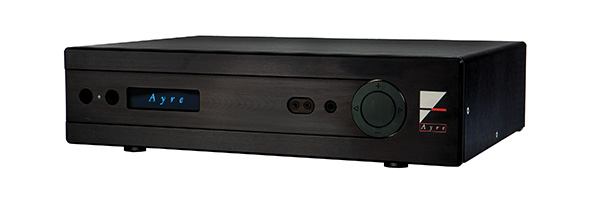
The KX-8 is housed in a slim, aluminum enclosure that resembles the enclosures of the opposite 8-series merchandise. The entrance panel has a rotary quantity management on its proper, with a single-ended headphone output on a �" jack and a balanced stereo headphone output on two 3.5mm jacks to the left of the management. On the left of the entrance panel are two buttons with a multicolored LED between them, and there’s a small rectangular, turquoise-on-black OLED show to their proper.
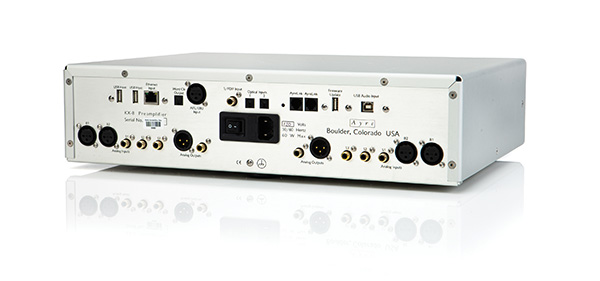
The again panel options two pairs of balanced analog inputs, three pairs of single-ended inputs, and one pair every of balanced and unbalanced outputs. Above these are the enter ports for the digital modules. In addition to the AES3 and optical/coaxial S/PDIF inputs talked about earlier, there are three USB-A ports, two labeled "Host" and one for updating the firmware, a USB-B port for connecting to a bunch pc, and an Ethernet port. There are additionally two AyreHyperlink ports for speaking with different Ayre merchandise and a Word Clock output.
The KX-8’s zero-feedback, totally balanced analog circuitry makes use of discrete gadgets relatively than op-amp chips and what Ayre describes as a "High-Speed" circuit-board materials. It options Ayre’s Equilock achieve stage, which makes use of transistors working primarily in present mode, and the corporate’s Diamond circuit, which is used for each the principle outputs and the headphone outputs.
For greater than a decade, Ayre has been utilizing variations on the Diamond topology, which the corporate’s founder, the late Charley Hansen, uncovered whereas studying a 1967 patent by Richard Baker of MIT. The Diamond topology makes use of a bridge community of 4 bipolar transistors. On the signal-input facet are a PNP transistor and an NPN transistor tied collectively at their bases; on the signal-output facet are one other NPN transistor and a PNP transistor in reverse polarity. The emitters of the left-hand transistors are tied to the bases of the adjoining right-hand transistors. The PNP’s collectors are biased negatively, the NPN’s positively.
Baker described the Diamond topology as having a number of strengths, together with the flexibility to function successfully in a floating- or above-ground situation, with appreciable energy achieve. More importantly, Hansen felt that the Diamond circuit merely sounded higher. Of all widespread strong state push-pull topologieswherein two phases of a sign are recombined to kind a full wavethe Diamond is the one one wherein the 2 half-signals are joined at a single level within the circuit, with no intervening circuitry. Thus, the Diamond circuit creates an output that must be extra trustworthy to the form of the enter.
A big characteristic of the KX-8 is its use of Ayre’s Continuously Variable Gain Transimpedance (CVGT) quantity management, a variation on the VGT quantity management launched within the KX-R preamplifier in 2008. Unlike a conventional quantity management, which makes use of a variable resistor related between the utmost output voltage and floor to attenuate the sign, the CVGT adjusts the enter circuit’s achieve, utilizing completely different resistors for every setting. The advantage of this method is that the noisefloor is decrease at decrease quantity management settings, maximizing decision.
The optionally available digital module makes use of an ESS ES9038Q2M DAC chip coupled with a Xilinx Spartan FPGA to function in 16× oversampling mode. The S/PDIF digital inputs are asynchronously coupled to the KX-8’s native oscillators to reduce jitter. The reconstruction filter is Ayre’s quick minimum-phase sort.
Control Options
With the preamp powered up by way of the back-panel change, a single press on the leftmost button on the entrance panel wakes up the KX-8 from Sleep mode. Pressing it once more mutes the output. The rightmost button switches between the inputs. The two buttons may also be used to entry a setup menu for every enter. Pressing and holding the left button for 3 seconds places the preamplifier into Sleep mode; subsequently urgent and holding the suitable button for 3 seconds prompts the setup menu’s major web page, which permits entry to the Input, Display, Network (together with Wi-Fi setup), and System settings.
Each enter will be activated, renamed, and set to unity-gain Pass-Through mode. There can be an possibility to make use of the AES3, S/PDIF, and optical inputs in Video Mode, which forces the KX-8 DAC to make use of incoming phrase clock knowledge relatively than the preamp’s asynchronous clock for the chosen enter. Each enter can be utilized with an AyreHyperlink connection to an Ayre supply part. The consumer can select show timeouts of 5s, 15s, 30s, 60s, or "Never"; turning off the show reduces RF noise and maximizes the lifetime of the module. (Ayre warns that choosing "Never" could cause faster-than-normal show fading.) The System possibility allows you to entry auto-sleep (on or off), view the firmware revisions and which choices had been put in, and carry out a manufacturing facility reset.
How it sounds
I began my important listening to the KX-8 with its balanced outputs related to a pair of Parasound JCA100 Tribute monoblocks, which in flip drove the MoFi Electronics SourcePoint 888 loudspeakers I reviewed within the March subject. The supply was the balanced outputs of the MBL N31 D/A processor, which transformed audio knowledge from my Roon Nucleus+ server. (The MBL’s quantity management was set to its most relatively than the 13dB I normally set it to for my preamp-less auditioning, and as ordinary I chosen its minimum-phase filter.) In addition to the KX-8, Ayre additionally despatched a VX-8 energy amplifier, which I substituted for the Parasounds. After the SourcePoint 888s had been returned to MoFi, I used the VX-8 first to drive GoldenEar BRX standmounts, then the Stenheim Alumine Two.Fives which might be in for evaluate.

With the KX-8 in between the MBL and the facility amplifiers, whereas the depth of the soundstage on the recordings I had made within the Nineteen Nineties of the Santa Fe Chamber Music Festival was well-developed, it was not fairly as deep because it was with out the preamp within the system. When I recorded works by Mendelssohn and Brahms in 1997 (Encore, Stereophile STPH011-2), I needed to place the microphones nearer to the musicians than in earlier years as a result of impact of an acoustic shell meant to throw the sound towards the viewers. I due to this fact used a even handed quantity of synthetic reverberation after I mastered the recordings, matching the character of that reverb to the sound of the empty corridor. With the KX-8, the photographs of the person devices had been palpably positioned within the soundstage, however I wanted I had used just a little extra synthetic reverb.
HI-FI News
by way of InnerFidelity https://ift.tt/JSZwu45
April 24, 2025 at 08:58PM
-
Product on sale
 Audiophile Vinyl Records Cleaning BundleOriginal price was: €69.90.€59.90Current price is: €59.90. incl. VAT
-
Product on saleEasy Start Vinyl Records Cleaning KitOriginal price was: €69.90.€59.90Current price is: €59.90. incl. VAT
-
Vinyl Records Cleaner Easy Groove Concentrate€34.95 incl. VAT
-
Easy Groove Super Set€199.00 incl. VAT
-
Easy Groove Enzycaster – vinyl records prewash cleaner€34.95 incl. VAT
-
Easy Groove Extreme MK. II- vinyl records prewash cleaner€45.00 incl. VAT
-
Vinyl Records Cleaner – Easy Groove Virgin Concentrate€35.00 incl. VAT
-
Easy Groove Spray&Wipe vinyl records cleaner€34.95 incl. VAT


