
World News
B&O Beomaster 2000
B&O Beomaster 2000
 With the Danish firm within the doldrums come the early ’70s may this reimagined receiver with phase-locked loop decoder ship on its promise of ‘excessive constancy’ sound?
Bang & Olufsen’s first transfer into the world of significant hi-fi got here in 1967 with the introduction of the Beolab 5000 amplifier and Beomaster 5000 tuner [HFN Dec ’12]. These outlined the European state-of-the-art on the time and have been as profitable as their excessive costs allowed. The firm then distilled these two models into the Beomaster 3000, which supplied comparable qualities at a extra accessible worth. It lacked the sheer energy and flexibility of the Beolab 5000 however offered strongly all through an extended manufacturing run.
These merchandise created a brand new sector within the firm’s vary – ‘excessive constancy’. The fashions have been aimed on the critical listener and supplied excessive energy output, superior amenities and what the designers thought of to be the very best sound.
Wide Ranging
This ‘excessive constancy’ line obtained off to begin however floundered in 1973 when the Beomaster 4000 was launched. This was supposed as a Beolab substitute and was primarily based on a modified 3000 chassis, uprated to provide 2x60W. Yet its sound was lifeless and unexciting. The 6000 4channel receiver [HFN Sep ’21] was not as dynamic because it may have been both, suggesting that one thing had gone severely amiss within the design of B&O’s range-topping fashions.
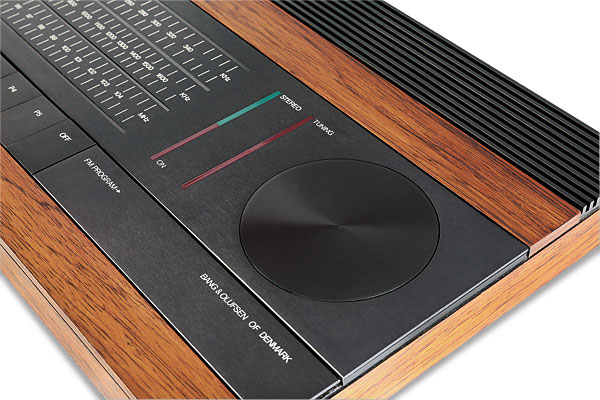
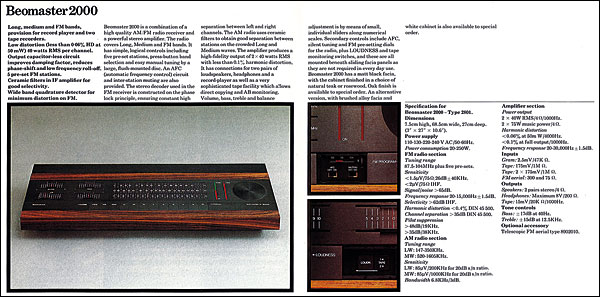
It was in opposition to this backdrop that the Beomaster 2000 reviewed right here appeared. Launched in late 1975 and new from the bottom up, it noticed designer Jacob Jensen’s beloved ‘low and large’ look launched to the intense finish of the vary. And there have been loads of novel technical concepts inside too. B&O’s circuitry usually advanced slowly throughout inter-related fashions however many of the 2000 had not been seen earlier than. For instance, the AM radio part was B&O’s first IC-based design and included a ceramic filter to present exact tuning. The FM part additionally made intensive use of ICs and included 5 pre-set stations and a classy energetic AFC system, which ensured completely correct tuning.
The key innovation, nevertheless, was the phase-locked loop stereo decoder – B&O’s first. Even the dearer fashions within the vary nonetheless used the older regenerative kind, so by way of radio efficiency the 2000 was an enormous step forward. Yet whereas spectacular, none of those options have been what made the Beomaster 2000 particular.
Low Rider
The actually vital change was that it was B&O’s first amplifier to make use of DC coupling between the output transistors and speaker load. Dispensing with the transformers or capacitors that beforehand sat between these two components meant the amplifier’s output impedance might be lowered [see PM‘s Lab Report, p125] and considerably fixed in respect to frequency. This, in flip, paid dividends by way of the damping issue that might be achieved on the speaker interface and the standard of bass that might be reproduced.
Capacitor Crusade
DC-coupled amplifiers had been made attainable by the introduction of matched pairs of complementary energy transistors within the early Nineteen Seventies. B&O was to not be rushed into producing a DC-coupled design however the 2000 proved to be thoughtfully engineered and rugged when it did finally seem. The output transistors chosen have been high-gain Darlington varieties, a category of element B&O had intensive expertise of given their widespread use in a earlier sequence of lower-powered, AC-coupled fashions.

This was not the top of the story, nevertheless. Having eradicated the big aluminium electrolytic capacitors in sequence with the loudspeaker outputs the designers then systematically eradicated them from in every single place else within the design the place it was sensible. In the top, solely six remained, which have been needed for energy provide filtering the place no different capacitor know-how may yield the values wanted. What’s extra, all of the capacitors within the sign path have been both tantalum or movie varieties. While a well-recognized sufficient efficiency amplifier approach immediately, it was a largely unexplored thought in home hi-fi within the mid Nineteen Seventies.
The styling had moved on because the days of the Beomaster 1200 whose tuning management seemed like a large slide rule. The 2000 used a bigger model of the flush-mounted flywheel first seen within the 6000 4channel. The temptation to make use of digital sign routing was resisted with operate choice being carried out by outsized push buttons. These too have been flush with the fascia when not in use.
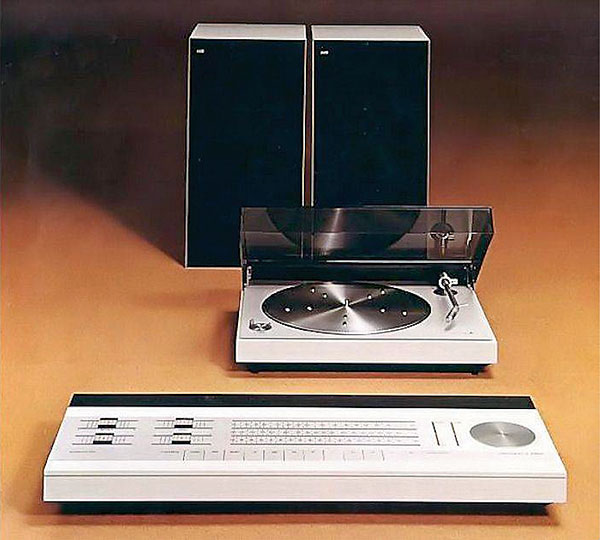
Most Beomaster 2000s have been completed in matt black anodised alloy with both teak or rosewood veneered cabinetwork, however restricted numbers have been produced with silver alloy over white. These are extremely prized by collectors immediately. All B&O gear from the Nineteen Seventies is fashionable, however the Beomaster 2000 takes this to the following degree. Despite its mechanical controls it hasn’t dated as a lot as another B&O fashions – home visitors who clapped eyes on it throughout my auditioning assumed it was lower than ten years outdated.
Flushed With Success
The Beomaster 2000 can be a delight to make use of – B&O described the push buttons as ‘tremendous clean’ and so they actually are. The flush tuning flywheel is properly weighted whereas the tuning steadiness and stereo indicator lamps related to it do not a lot flicker as stream, as if they’re operated by some ingenious association of viscous fluid. Five pre-set stations are supplied on FM, their setting made by a bunch of tiny scales beneath a sliding cowl on the precise of the unit. An analogous cowl on the left provides entry to a tape 1/2 change and a loudness button (which is greatest left switched off).
Compared to the opposite controls, the sliders for the amplifier are a bit stiff and jerky in use. Connections are supplied for a turntable and two tape recorders, a pair of headphones and two pairs of loudspeakers. The turntable enter is matched to B&O’s personal moving-iron pick-ups however these are comparable sufficient to trendy MM varieties for there to not be compatibility issues.
Having two tape sockets provides a helpful place to attach a CD participant, however that is greatest positioned in ‘Tape 1’ and the recorder in ‘Tape 2’ in any other case CD-to-tape transfers can’t be made. The loudspeaker sockets are organized in order that one pair is muted when the headphones are related and the opposite pair is just not. The direct (audio system 2) is the only option for crucial listening, however much less handy in a home setting.
HI-FI News
by way of Hi-Fi News https://ift.tt/h4xr60D
January 6, 2024 at 12:47AM
-
Product on sale
 Audiophile Vinyl Records Cleaning BundleOriginal price was: €83.88.€73.88Current price is: €73.88. incl. VAT
-
Product on saleEasy Start Vinyl Records Cleaning KitOriginal price was: €83.88.€73.88Current price is: €73.88. incl. VAT
-
Vinyl Records Cleaner Easy Groove Concentrate€41.94 incl. VAT
-
Easy Groove Super Set€238.80 incl. VAT
-
Easy Groove Enzycaster – vinyl records prewash cleaner€41.94 incl. VAT
-
Easy Groove Extreme MK. II- vinyl records prewash cleaner€54.00 incl. VAT
-
Vinyl Records Cleaner – Easy Groove Virgin Concentrate€42.00 incl. VAT
-
Easy Groove Spray&Wipe vinyl records cleaner€41.94 incl. VAT







