
World News
Compact Chips Advance Precision Timing
Compact Chips Advance Precision Timing
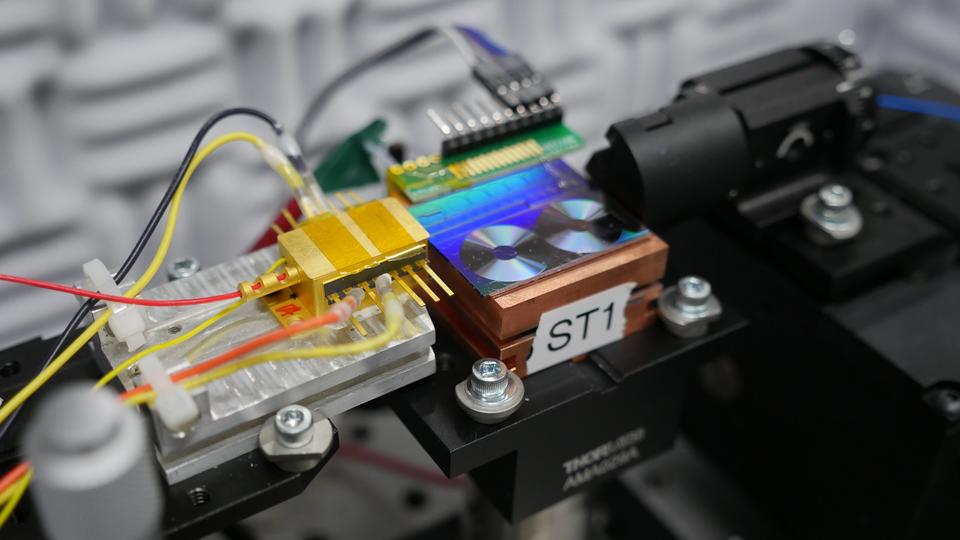
NIST researchers check a chip for changing gentle into microwave indicators. Pictured is the chip, which is the fluorescent panel that appears like two tiny vinyl records. The gold field to the left of the chip is the semiconductor laser that emits gentle to the chip.
Credit:
Ok. Palubicki/NIST
The National Institute of Standards and Technology (NIST) and its collaborators have delivered a small however mighty development in timing expertise: compact chips that seamlessly convert gentle into microwaves. This chip might enhance GPS, the standard of cellphone and web connections, the accuracy of radar and sensing methods, and different applied sciences that depend on high-precision timing and communication.
This expertise reduces one thing generally known as timing jitter, which is small, random modifications within the timing of microwave indicators. Similar to when a musician is attempting to maintain a gradual beat in music, the timing of those indicators can generally waver a bit. The researchers have lowered these timing wavers to a really small fraction of a second — 15 femtoseconds to be precise, an enormous enchancment over conventional microwave sources — making the indicators rather more secure and exact in ways in which might enhance radar sensitivity, the accuracy of analog-to-digital converters and the readability of astronomical photographs captured by teams of telescopes.
The workforce’s outcomes had been revealed in Nature.
Shining a Light on Microwaves
What units this demonstration aside is the compact design of the elements that produce these indicators. For the primary time, researchers have taken what was as soon as a tabletop-size system and shrunken a lot of it right into a compact chip, about the identical dimension as a digital digicam reminiscence card. Reducing timing jitter on a small scale reduces energy utilization and makes it extra usable in on a regular basis units.
Right now, a number of of the elements for this expertise are situated outdoors of the chip, as researchers check their effectiveness. The final objective of this mission is to combine all of the totally different elements, equivalent to lasers, modulators, detectors and optical amplifiers, onto a single chip.
By integrating all of the elements onto a single chip, the workforce might cut back each the scale and energy consumption of the system. This means it might be simply included into small units with out requiring a lot of power and specialised coaching.
“The present expertise takes a number of labs and plenty of Ph.D.s to make microwave indicators occur,” mentioned Frank Quinlan, NIST bodily scientist. “A variety of what this analysis is about is how we make the most of the benefits of optical indicators by shrinking the scale of elements and making every little thing extra accessible.”
To accomplish this, researchers use a semiconductor laser, which acts as a really regular flashlight. They direct the sunshine from the laser right into a tiny mirror field known as a reference cavity, which is sort of a miniature room the place gentle bounces round. Inside this cavity, some gentle frequencies are matched to the scale of the cavity in order that the peaks and valleys of the sunshine waves match completely between the partitions. This causes the sunshine to construct up energy in these frequencies, which is used to maintain the laser’s frequency secure. The secure gentle is then transformed into microwaves utilizing a tool known as a frequency comb, which modifications high-frequency gentle into lower-pitched microwave indicators. These exact microwaves are essential for applied sciences like navigation methods, communication networks and radar as a result of they supply correct timing and synchronization.
“The objective is to make all these elements work collectively successfully on a single platform, which might drastically cut back the lack of indicators and take away the necessity for further expertise,” mentioned Quinlan. “Phase one in every of this mission was to indicate that each one these particular person items work collectively. Phase two is placing them collectively on the chip.”
In navigation methods equivalent to GPS, the exact timing of indicators is important for figuring out location. In communication networks, equivalent to cell phone and web methods, correct timing and synchronization of a number of indicators be certain that information is transmitted and obtained accurately.
For instance, synchronizing indicators is vital for busy cell networks to deal with a number of cellphone calls. This exact alignment of indicators in time permits the cell community to arrange and handle the transmission and reception of knowledge from a number of units, like your cellphone. This ensures that a number of cellphone calls might be carried over the community concurrently with out experiencing important delays or drops.
In radar, which is used for detecting objects like airplanes and climate patterns, exact timing is essential for precisely measuring how lengthy it takes for indicators to bounce again.
“There are all kinds of functions for this expertise. For occasion, astronomers who’re imaging distant astronomical objects, like black holes, want actually low-noise indicators and clock synchronization,” mentioned Quinlan. “And this mission helps get these low noise indicators out of the lab, and into the fingers of radar technicians, of astronomers, of environmental scientists, of all these totally different fields, to extend their sensitivity and talent to measure new issues.”
Working Together Toward a Shared Goal
Creating the sort of technological development isn’t accomplished alone. Researchers from the University of Colorado Boulder, the NASA Jet Propulsion Laboratory, California Institute of Technology, the University of California Santa Barbara, the University of Virginia, and Yale University got here collectively to perform this shared objective: to revolutionize how we harness gentle and microwaves for sensible functions.
“I like to check our analysis to a building mission. There’s a whole lot of shifting elements, and you have to be certain everyone seems to be coordinated so the plumber and electrician are exhibiting up on the proper time within the mission,” mentioned Quinlan. “We all work collectively rather well to maintain issues shifting ahead.”
This collaborative effort underscores the significance of interdisciplinary analysis in driving technological progress, Quinlan mentioned.
Paper: Igor Kudelin et al. Photonic chip-based low noise microwave oscillator. Nature. Published on-line March 6, 2024. DOI: 10.1038/s41586-024-07058-z
Vinyl
by way of ACM TechNews https://ift.tt/PCW1gXz
March 11, 2024 at 04:07PM
-
Product on sale
 Audiophile Vinyl Records Cleaning BundleOriginal price was: €69.90.€59.90Current price is: €59.90. incl. VAT
-
Product on saleEasy Start Vinyl Records Cleaning KitOriginal price was: €69.90.€59.90Current price is: €59.90. incl. VAT
-
Vinyl Records Cleaner Easy Groove Concentrate€34.95 incl. VAT
-
Easy Groove Super Set€199.00 incl. VAT
-
Easy Groove Enzycaster – vinyl records prewash cleaner€34.95 incl. VAT
-
Easy Groove Extreme MK. II- vinyl records prewash cleaner€45.00 incl. VAT
-
Vinyl Records Cleaner – Easy Groove Virgin Concentrate€35.00 incl. VAT
-
Easy Groove Spray&Wipe vinyl records cleaner€34.95 incl. VAT







