
Audio-Nachrichten
Dezibel und Watt
Dezibel und Watt

Decibels and Watts
https://ift.tt/fOLhMQY
Decibels and Watts
Why does 120 decibels (dB) pose a risk of permanent hearing damage when an ordinary conversation already reaches 60 decibels? And why do some of us need amplifiers with several hundred watts when we usually listen at less than one watt per channel? The numbers behind it aren’t all that complicated—once you know how they work.
We’ve all seen charts that place sound events such as conversations, traffic noise, jackhammers, takeoff by airplanes, and shotguns on a decibel scale. An uninformed observer might conclude from such a chart that last night’s 120-decibel rock concert was about twice as loud as the housemate snoring away at 60 decibels. Of course, that’s not true: decibels are not a linear quantity, but a logarithmic one, much like the Richter scale for earthquakes. In fact, the concert was 1,000 times as loud, and its sound power was millions of times greater—but how do we arrive at those figures?
Logarithmic means that instead of a linear increase, the measured value represents a multiplication of the quantity being measured by a set factor. In our case, an increase of 10 decibels (1 bel*) means a tenfold increase in sound power—and this is true regardless of the starting value: 70 dB means ten times as much power as 60 dB; 80 dB is another tenfold increase, and therefore 100 times as much as 60 dB. The unit thus measures not absolute values, but ratios:
| dB | Sound level | Sound power |
| ±0 | × 1 | × 1 |
| +3 | × 1.413 (~× √2) | × 1.995 (~× 2) |
| +6 | × 1.995 (~× 2) | × 3.981 (~× 4) |
| +10 | × √10 (~× 3.16) | × 10 |
| +20 | × 10 | × 100 |
| +40 | × 100 | × 10,000 |
| +60 | × 1,000 | × 1,000,000 |
As we can see, logarithms do us two big favors: +3 dB corresponds very closely to a doubling (× 1.995), and +6 dB to a quadrupling (× 3.981) of power—both accurate enough that, in practice, there’s no need to worry about rounding errors.
Now, as the opening example and the table show, the increase in level corresponds to the square root of the increase in power. Physically, this can be explained as follows: sound is a periodic fluctuation in air pressure, caused by air molecules moving back and forth in time with the frequency. Doubling the sound level means that the air pressure varies by twice as much; in simple terms, the air molecules are pushed apart and compressed again over twice the distance in the same amount of time—for example, by a speaker cone oscillating back and forth at the desired frequency. To move an object (such as our speaker cone) twice as far in the same amount of time requires twice the force over twice the distance, and therefore four times the power.
Electrically, this is reflected in the relationship between voltage and current. To play 6 dB louder, a speaker must move its cones twice as far. The voice coil follows the voltage curve from the amplifier: the greater the voltage swing, the greater the excursion—so in the tangible world of physics, voltage swing corresponds to distance. Current (effectively, force, measured in amps) is voltage divided by impedance, according to Ohm’s law. A 4-ohm speaker driven by a 2-volt signal would draw half an amp (2 V/4 Ω) from the amplifier; with a 4-volt signal, it would draw twice as much, or one amp. The power drawn therefore rises from one to four watts, increasing with the square of the level.
So much for the theory …
But what does all this mean for our everyday listening? In all the examples so far, we’ve been sitting exactly one meter from the speaker, whereas a typical listening distance is more like two to three times that. In a free field, the sound power at the listening position falls to one quarter each time the distance doubles, because the pressure waves radiating from the source ideally spread out spherically, and the surface area of that sphere increases with the square of its radius. The fact that a change in level is only the square root of the change in power works in our favor here, because the sound pressure does not fall quadratically, but only linearly—by 6 dB for each doubling of distance.
On top of that, we don’t listen in a free field, but in a living room with a limited interior volume, where reflections from the walls partly make up for the lost sound pressure. How much we regain depends greatly on the room’s size and characteristics, but as a rule of thumb, we can assume that each doubling of listening distance costs us not 6, but only about 3 dB. What’s more, a second speaker, with its own stereo channel, gives us another ace up our sleeve. In an ideal electroacoustic setup, this would gain us a further 6 dB—if we combined both speakers into a single unit with twice the cone area, increasing its sensitivity by 3 dB. The second stereo watt would also have to send exactly the same signal to the speaker, in the same phase, which would make it a mono signal. Since the speakers are some distance apart, their sound waves don’t just add together but also partly cancel each other out, and the signals on the left and right stereo channels aren’t identical either. So with two speakers and one watt per channel, we assume a gain of only three additional decibels—which still means that, in a typical home setup with two channels and a listening distance of two meters, we get roughly as many decibels per watt at the listening position as the speaker’s specifications indicate. A realistic speaker rated at 84 dB/W (87 dB/2.83 V at 4 Ω) would therefore deliver around 84 dB at the listening position with one watt per channel—a very respectable listening level. Things get interesting when more is required: since every additional 6 dB requires four times the power, you need 4 watts for 90 dB, 16 watts for 96 dB, and a concert-level 108 dB takes a hefty 250 watts per channel. By contrast, someone listening at 80 dB with an efficient 90 dB transducer and wanting 20 dB in reserve for dynamic peaks will be perfectly fine with a 10-watt tube amp.
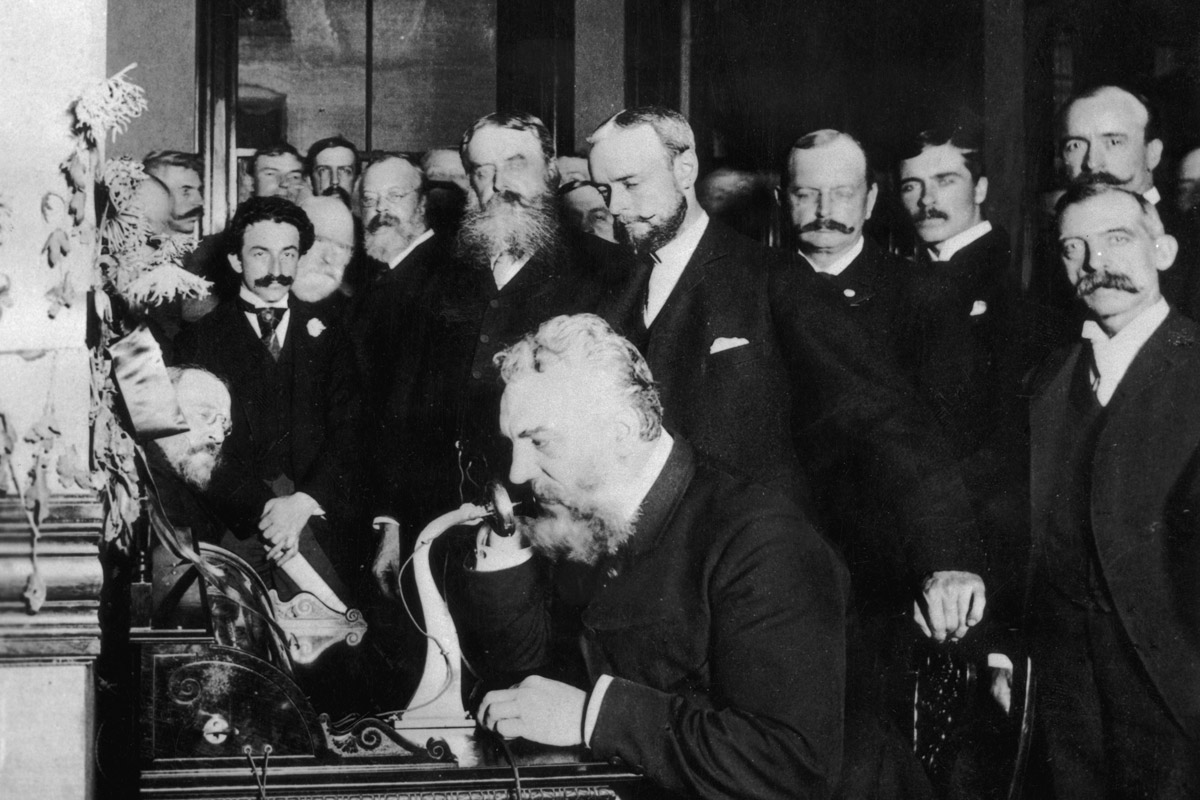
*Alexander Graham Bell (1847–1922) did not live to see the introduction of the unit named after him: in 1924, Bell Telephone Laboratories—whose indirect connection to Bell followed a rather convoluted path—introduced the Transmission Unit (TU) to indicate signal power loss in telephone cables. In 1928, the unit was renamed the bel in Bell’s honor, with its tenth, the decibel, intended from the outset as the practical unit for everyday use.
The article Decibels and Watts first appeared on FIDELITY online.
HI-FI News
via FIDELITY online https://ift.tt/a1HZ9fF
November 11, 2026 at 08:24AM
November 11, 2026 at 08:24AM
-
Product on sale
 Audiophile Vinyl Records Cleaning BundleOriginal price was: €69.90.€59.90Current price is: €59.90. incl. VAT
-
Product on saleEasy Start Vinyl Records Cleaning KitOriginal price was: €69.90.€59.90Current price is: €59.90. incl. VAT
-
Vinyl Records Cleaner Easy Groove Concentrate€34.95 incl. VAT
-
Easy Groove Super Set€199.00 incl. VAT
-
Easy Groove Enzycaster – vinyl records prewash cleaner€34.95 incl. VAT
-
Easy Groove Extreme MK. II- vinyl records prewash cleaner€45.00 incl. VAT
-
Vinyl Records Cleaner – Easy Groove Virgin Concentrate€35.00 incl. VAT
-
Easy Groove Spray&Wipe vinyl records cleaner€34.95 incl. VAT







