
World News
Grateful Dead: Terrapin Station
Grateful Dead: Terrapin Station
The Dead’s first album for Arista noticed them teamed with a producer and backed – with out their information – by an orchestra. Steve Sutherland preludes the 180g reissue
The Eno documentary just lately proven in cinemas induced a little bit of a fanfare as a result of, characteristically of our eggheaded pal Brian, it wasn’t simply any common-or-garden doc protecting his illustrious profession. Instead, it employed groundbreaking know-how to perform one thing that had by no means been carried out earlier than. Using generative software program designed to sequence scenes and create transitions out of interviews with Eno and an archive of never-before-seen footage, every exhibiting featured totally different scenes and music in a distinct order. Every time it performed, it was a brand new expertise.
Changing tunes
A cinematic first, little question, however it obtained me serious about The Grateful Dead, as a result of what Brian Eno had dropped at the flicks, The Grateful Dead dropped at the gig. The group, initially shaped as The Warlocks in 1965 within the Bay Area metropolis of Palo Alto, by no means repeated the identical set twice, and by no means performed the identical tune the identical method twice.
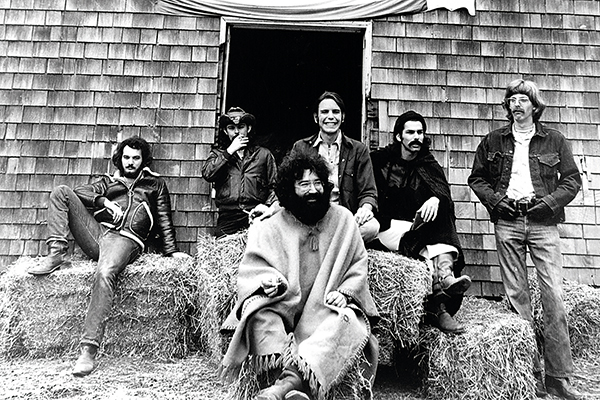
Above: The Grateful Dead in 1970 (l-r): Kreutzmann, McKernan, Garcia, Weir, Hart and Lesh
Partly this was right down to technical incapability – proficiency simply wasn’t that prime on their agenda, it was not the best way the band rolled – however principally it was right down to believing that music is alive within the second, vibing off the gang and no matter chemical, emotional or private state every band member was in on the time. They inspired tapers within the viewers to document their gigs for posterity. Personal favourites like ‘Friend Of The Devil’ had been remodeled over time from acoustic people to one thing approaching reggae.
Anyway, the exact same improvisational method which served them so properly on stage over three a long time proved an insurmountable obstacle when it got here to recording albums within the studio. The concept of making a definitive model of a tune was anathema to the Grateful Dead, simply as finessing, over-dubbing and perfecting was not a characteristic of their DNA.
Occasionally they’d rein it in and hit a candy spot, comparable to their 1970 albums American Beauty and Workingman’s Dead, which had been early swerves into what has grow to be often called Americana, and 1973’s Wake Of The Flood, which issued forth an hypnotic soporific groove. But typically their studio efforts had been workout routines in pissed off compromise. Not to fret, because the band and their followers accepted that the most effective Dead LPs had been the dwell recordings – Live/Dead, the triple Europe ’72 – whereas studio takes had been regarded upon as novelties that includes debuts for numbers that will likely be expanded and improved as soon as they had been taken out on the highway.
Arista-cats
Constant touring, although, is an costly and exhausting enterprise and in 1974 the band known as a hiatus. They additionally folded their very own label, Grateful Dead Records, which they’d launched in 1973 to take complete management of their careers, solely to find the day-to-day admin and maintenance too draining. Searching for a brand new residence, they signed to Arista records, whose president, the legendary Clive Davis, was decided to market them to a wider viewers. To that finish, he insisted the Dead make use of a producer outdoors of their familial circle – one thing the band had resisted up till this level. His nominee was Keith Olsen, who’d found Stevie Nicks and Lindsey Buckingham, eased them into Fleetwood Mac and polished them into multi-million-selling chart toppers. It should have made sense on paper, however what’s that saying about previous canines and new methods?
Hammer and nails
Rather than sort out them on their very own patch, Olsen had the Dead shifted lock, inventory and barrel to Los Angeles and onto his personal territory, Sound City Studios in Van Nuys. Things didn’t progress easily.
‘During the chopping of the essential tracks it was fairly arduous to get each member of the band within the studio on the identical time’, recalled Olsen. ‘So I despatched somebody out to the ironmongery store and obtained these big nails and a fantastic huge hammer and as quickly as everyone was in, we hammered the door shut from the within… We didn’t have drifters from the opposite studios coming in to hear. We began getting work carried out’.
Olsen tried to get the Dead to behave within the method any regular band may – doing take after take seeking one thing stable to brighten – however the gamers bridled, resisted, and obtained bored. They had been additionally wasted. Lead guitarist/ vocalist Jerry Garcia was hooked on a smokeable type of heroin and different band members had been no saints both, which led to a slothful perspective to the mission.
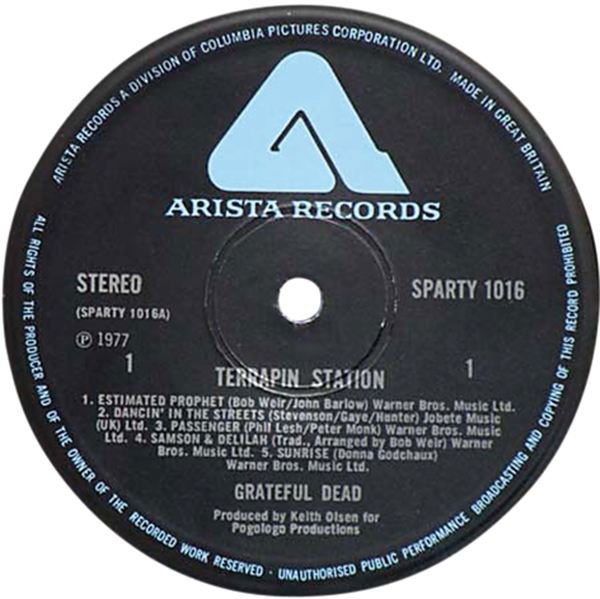
Above: Label of authentic UK LP on Arista Records
When the album was launched in July ’77, it was not the Dead at their finest. Side one comprised ‘Estimated Prophet’, the place rhythm guitarist Bob Weir suffers underneath the phantasm that he’s Bob Marley; a canopy model of Martha & The Vandellas’ ‘Dancin’ In The Streets’; one thing unmemorable by bassist Phil Lesh known as ‘The Passenger’; a soulless tackle a trad tune known as ‘Samson & Delilah’, and the worst quantity the band ever recorded, ‘Sunrise’, written and sung by Donna Godchaux as a result of her husband Keith performed keyboards. It’s horrible.
Mythical music
The eagle-eyed can have observed the absence of Garcia on facet one, however he makes his mark on facet two. Running for 16 or so minutes in seven actions, and taking on the entire facet, ‘Terrapin Part 1’ is a quasi-mythical factor from the pen of his common lyric-writing associate Robert Hunter. What it’s about is anybody’s guess, however primarily there’s this girl who seems in a fireplace to a sailor and a soldier. She chucks her fan right into a lion’s den and the lads are examined to show who loves her essentially the most. Nothing to do with terrapins, however hey-ho.
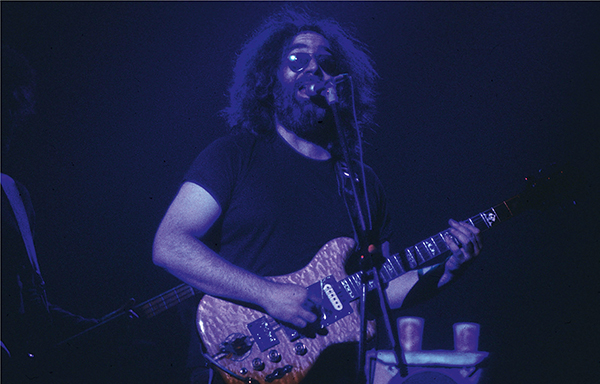
Above: Jerry Garcia on stage in May 1978 on the Veterans Memorial Coliseum
The piece as a complete is extra prog than the Dead ever obtained earlier than or since. Garcia’s voice is handled with this bizarre impact which makes him type of warble and his guitar sound – which had hitherto been dextrous and clear – is a type of synthesised sludge. To add insult to harm, Olsen took the tapes to London so as to add strings, horns and a choir with out the information of the band.
When the Dead heard the completed album they had been horrified however too befuddled and sure by the enterprise to do something about it. Out it got here, sounding extra like England’s The Moody Blues than good ol’ Grateful Dead. Unsurprisingly, Terrapin Part 2 was by no means recorded.
HI-FI News
through Hi-Fi News https://ift.tt/zkXqJUK
May 22, 2025 at 01:39PM
-
Product on sale
 Audiophile Vinyl Records Cleaning BundleOriginal price was: €69.90.€59.90Current price is: €59.90. incl. VAT
-
Product on saleEasy Start Vinyl Records Cleaning KitOriginal price was: €69.90.€59.90Current price is: €59.90. incl. VAT
-
Vinyl Records Cleaner Easy Groove Concentrate€34.95 incl. VAT
-
Easy Groove Super Set€199.00 incl. VAT
-
Easy Groove Enzycaster – vinyl records prewash cleaner€34.95 incl. VAT
-
Easy Groove Extreme MK. II- vinyl records prewash cleaner€45.00 incl. VAT
-
Vinyl Records Cleaner – Easy Groove Virgin Concentrate€35.00 incl. VAT
-
Easy Groove Spray&Wipe vinyl records cleaner€34.95 incl. VAT


