
Audio News
Hegel H150
Hegel H150
https://ift.tt/cHvh6Wm
Hegel offers an extensive range of well-regarded audio electronics, but it’s best known today for making excellent, accessible integrated amplifiers. The latest addition is the H150, whose development codename was among the audio world’s best-kept secrets: Hegel called it ‘The Prodigy’.
Give an amplifier a name like ‘The Prodigy’ and you might invite a few jokes. After all, it’s an amplifier, not Mozart. But the H150 is a seriously capable machine. Consider its specifications and performance alongside what comparable money could buy just a few years ago, and the name starts to seem rather less fanciful. Hegel has drawn on ideas from products higher up its range, including the H400 integrated amplifier and the brand’s The Viking CD player. The H150 is also very much a product for today, with ample digital and line-level connections, a turntable input for traditional sources, and a range of streaming options. It’s a compelling one-box solution for anyone who just wants to add speakers.
The Prodigy has one more notable role. Although Hegel’s website still lists the older H120, that model has effectively been discontinued as the range is streamlined to meet a changing market. The H150 is therefore one of the first steps into Hegel’s deceptively sophisticated amplifier lineup.
Why ‘deceptively’?
Hegel has long excelled at keeping its amplifiers straightforward on the outside while handling the complexity within. As the automotive world is learning to its cost, an overcomplicated user interface can frustrate people, however futuristic it may look. Switching from a streamer to a record player at home is hardly as dangerous as taking your eyes off the road at 70mph to adjust the air conditioning on a touchscreen. Still, Hegel has taken an almost Occam’s Razor approach to the controls: two knobs, a simple display, a headphone socket and a power button underneath.
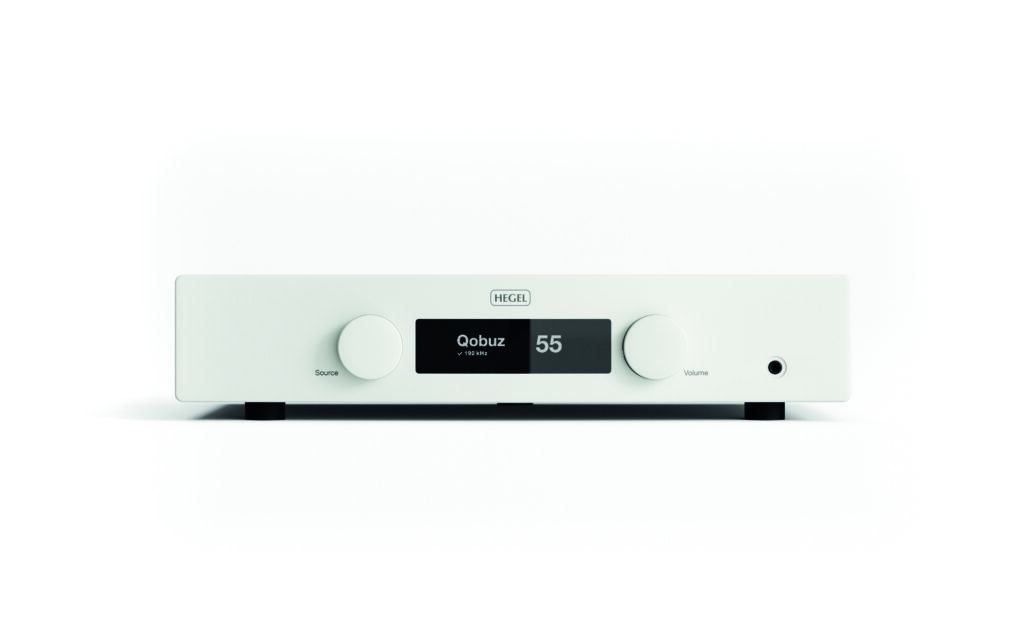
The remote and Hegel Control app provide extra features, assist with setup and let you browse internet radio. If you’re comfortable using a smartphone or tablet, the H150 is an effortless playback hub. For anyone who believes an amplifier should be as simple to operate as a toaster—and easy for anyone to use without a lengthy explanation—the H150 fits the bill.
It’s helpful to think of the Hegel H150 as a black (or occasionally white) box, rather than getting lost in technical specifications. Specs matter in audio, and the H150’s 2x 75W output and toroidal transformer in its linear power supply are relevant points when making a purchase. But how much should they really dominate the decision?
More ‘yes’ than filler
As someone who needs words to fill a page, I could say they matter a great deal. In practice, though, once you’ve checked that your sources are compatible—its MM phono stage won’t accommodate a moving-coil cartridge without a step-up transformer—you’re largely ready to go.
One reason I appreciate Hegel is its knack for giving each subsystem a memorable name. SoundEngine 2, for instance, describes a fairly sophisticated feed-forward sampling signal-correction system in just two words. The result is lower distortion, more dynamic Class AB biasing and a higher damping factor. In listening terms, that means a cleaner, less ‘hashy’ and ‘electronic’ presentation, along with a firm hold on the loudspeakers.
Hegel also avoids getting drawn into discussions about its DAC chip, beyond noting that it’s the same one used in The Viking. That’s another example of a practical, rather than specification-led, approach to digital audio. The optical S/PDIF input supports PCM up to 24-bit/96kHz, while the coaxial connections, USB ports and RJ45 Ethernet connection handle PCM up to 24-bit/192kHz. There’s no 32-bit processing, 786kHz sampling, DSD or MQA—just the formats that people shopping for an amplifier at this level are likely to use.
Keep it simple
The Hegel H150 has more to offer in the way of convenience. Input sensing lets it wake automatically and select the appropriate source. Auto-standby switches it off when playback ends, and support for common TV remote codes makes everyday control easy. It can also work with systems such as Apple Home and Google Home, so setting up voice commands doesn’t require much Internet Ninjutsu. The most noticeable omissions for everyday use are Bluetooth and HDMI ARC or eARC.
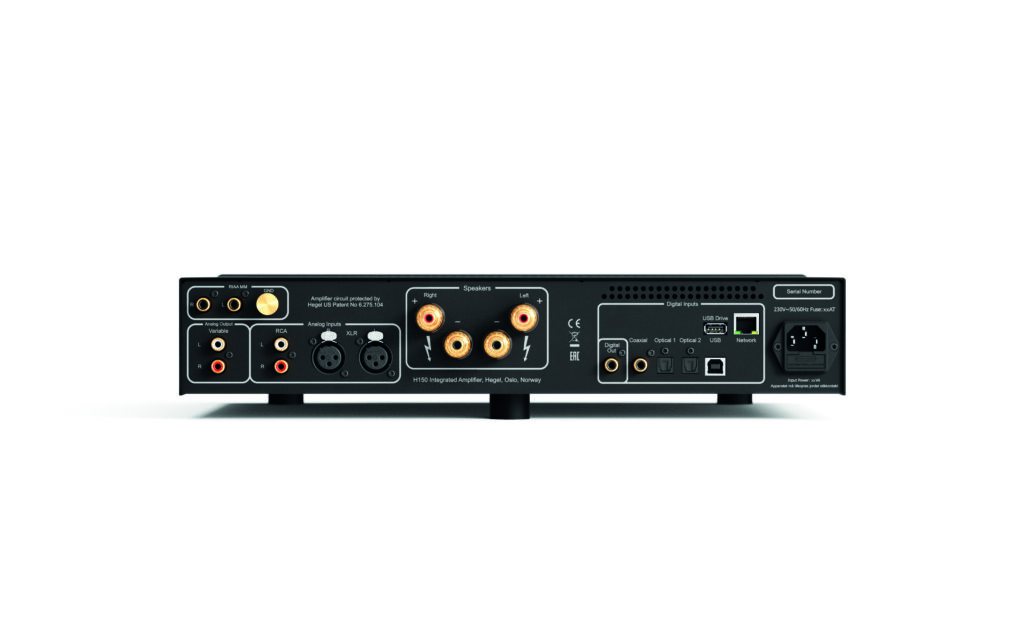
This isn’t a standard inventory of inputs and outputs, because ‘The Prodigy’ deserves to be considered on its own terms rather than as a conventional amplifier. Does it offer an abundance of digital and analogue connections? No. Does it include every cutting-edge interface and future format? Not at all. But does it cover what people actually want from an amplifier at this price? Absolutely. You get Spotify, Tidal and Qobuz Connect, plus Apple AirPlay and Google Cast, all available over Ethernet. The H150 is also Roon Ready, though Roon may be more than most H150 owners need. It’s a welcome extra, but hardly essential.
The best part
We’ve kept the highlight for last: the sound. The H150 is a hugely enjoyable listen, with bass that feels powerful, controlled and satisfyingly ‘meaty’. Its low end doesn’t make an immediate show of deep extension, but that first impression can mislead. Uncontrolled, ‘flubby’ bass is often mistaken for depth. There’s plenty of substance in the Hegel’s bass, and it’s tight and informative. Before long, you may find yourself reaching for the electronic and dub records in your collection—or adding them to your playlist.
That sent me to Augustus Pablo’s mighty ‘King Tubby Meets Rockers Uptown.’ I’ve known the track since my teenage years and have heard it on everything from a clock radio to the bowel-loosening Four Aces sound system in Dalston in the 1980s. You can’t reproduce that visceral sound-system experience at home—and you probably shouldn’t. By the end of the night, you’d have done lasting damage to your hearing and shuffled your internal organs around so thoroughly you’d be wearing your pancreas as a hat. Instead, choose a system that reveals what the pioneers of dub, reggae, electronica and related styles are doing. The Hegel H150 gives those bass lines an excellent sense of shape and definition.
Up the registers!
The same engaging character carries through the rest of the frequency range. The midrange sounds open, nimble and articulate, while detail and overall coherence range from good to excellent. Treble balance is well judged: lively and revealing, but never so forward that it turns harsh or bright. The soundstage is spacious, particularly in width, with a convincing measure of depth and height. Dynamics keep things lively, and the amplifier has a natural feel for rhythm.
Hegel has never made pace its main selling point, but its amplifiers are certainly no plodders. The H150 brings rhythm further to the fore, with a more energetic, emphatic character. It may not convert the most devoted rhythm obsessives, but its timing has an extra sense of ‘beat’ compared with some earlier Hegels. Martin Stephenson & The Daintees’ ‘Wholly Humble Heart’ from Gladsome, Humour and Blue [Kitchenware] doesn’t have quite such a tightly regimented pulse, yet the H150 still ranks among the most rhythmically expressive Hegel amplifiers so far.
An exceptional exception
I’ve always enjoyed Hegel amplifiers, and the Hegel H150 is no exception. Actually, that’s not quite right: it’s an exception—a remarkable amplifier that more than earns the ‘The Prodigy’ nickname. Reviewers can become blasé about expensive equipment, sometimes calling an amplifier priced like a Bentley ‘a bargain’. But this £2,750 integrated amplifier draws meaningfully on the strengths of Hegel’s popular top-of-the-range models, making it hard not to regard it as exceptional value. It isn’t merely good for the money. It’s simply damn good!
Technical specifications
- Power output: 2x75W into 8 Ohms @ 1kHz 1% THD, 100/120/230V AC
- Minimum load: 2 ohms
- Analog inputs: 1x Balanced (XLR), 1x Unbalanced (RCA)
- Phono input: 1 x Unbalanced (RCA) for Moving Magnet (MM)
- Digital outputs: 1x Coaxial S/PDIF – 24/192
- Digital inputs: 1x Coaxial (RCA) S/PDIF – 24/192, 2x Optical S/PDIF – 24/96, 1x USB B- 24/192, 1x USB A 2.0 – USB Drives, 1x Network – 24/192
- Line level outputs: 1x Unbalanced variable (RCA)
- Streaming: Spotify Connect (Lossless), Tidal Connect, Qobuz Connect, Apple AirPlay, Google Cast, airable Internet Radio and Podcast, UPnP, Roon Ready
- Streaming formats: MP3, WAV, FLAC, ALAC, AIFF, AAC, PCM, Ogg
- Frequency response: 5Hz-100kHz
- Signal-to-noise ratio: More than 100dB
- Crosstalk: Less than -100dB
- Distortion: Less than 0.01% @ 50W 8 Ohms 1kHz
- Intermodulation: Less than 0.01% (19kHz + 20kHz)
- Damping factor: More than 2000 (main power output stage)
- Dimensions (WxDxH): 43 x 35 x 10cm
- Weight: 9.7kg
- Price: £2,750, €2,995, $3,600
Manufacturer
Hegel Music Systems
UK distributor
Auden Distribution
+44(0)7917 685759
The post Hegel H150 appeared first on hi-fi+.
HI-FI News
via Articles Archive – hi-fi+ https://ift.tt/lLznKwq
November 17, 2026 at 01:14PM
-
Product on sale
 Audiophile Vinyl Records Cleaning BundleOriginal price was: €69.90.€59.90Current price is: €59.90. incl. VAT
-
Product on saleEasy Start Vinyl Records Cleaning KitOriginal price was: €69.90.€59.90Current price is: €59.90. incl. VAT
-
Vinyl Records Cleaner Easy Groove Concentrate€34.95 incl. VAT
-
Easy Groove Super Set€199.00 incl. VAT
-
Easy Groove Enzycaster – vinyl records prewash cleaner€34.95 incl. VAT
-
Easy Groove Extreme MK. II- vinyl records prewash cleaner€45.00 incl. VAT
-
Vinyl Records Cleaner – Easy Groove Virgin Concentrate€35.00 incl. VAT
-
Easy Groove Spray&Wipe vinyl records cleaner€34.95 incl. VAT







